4338.204 · July 23, 2018 AD
The Desert Beyond
Luke stands under an alien sun, tethered to reality by the smallest of proofs, only to find himself swallowed by a vast and silent desert. As awe turns to exhaustion, he realises survival in this world will demand more than curiosity.
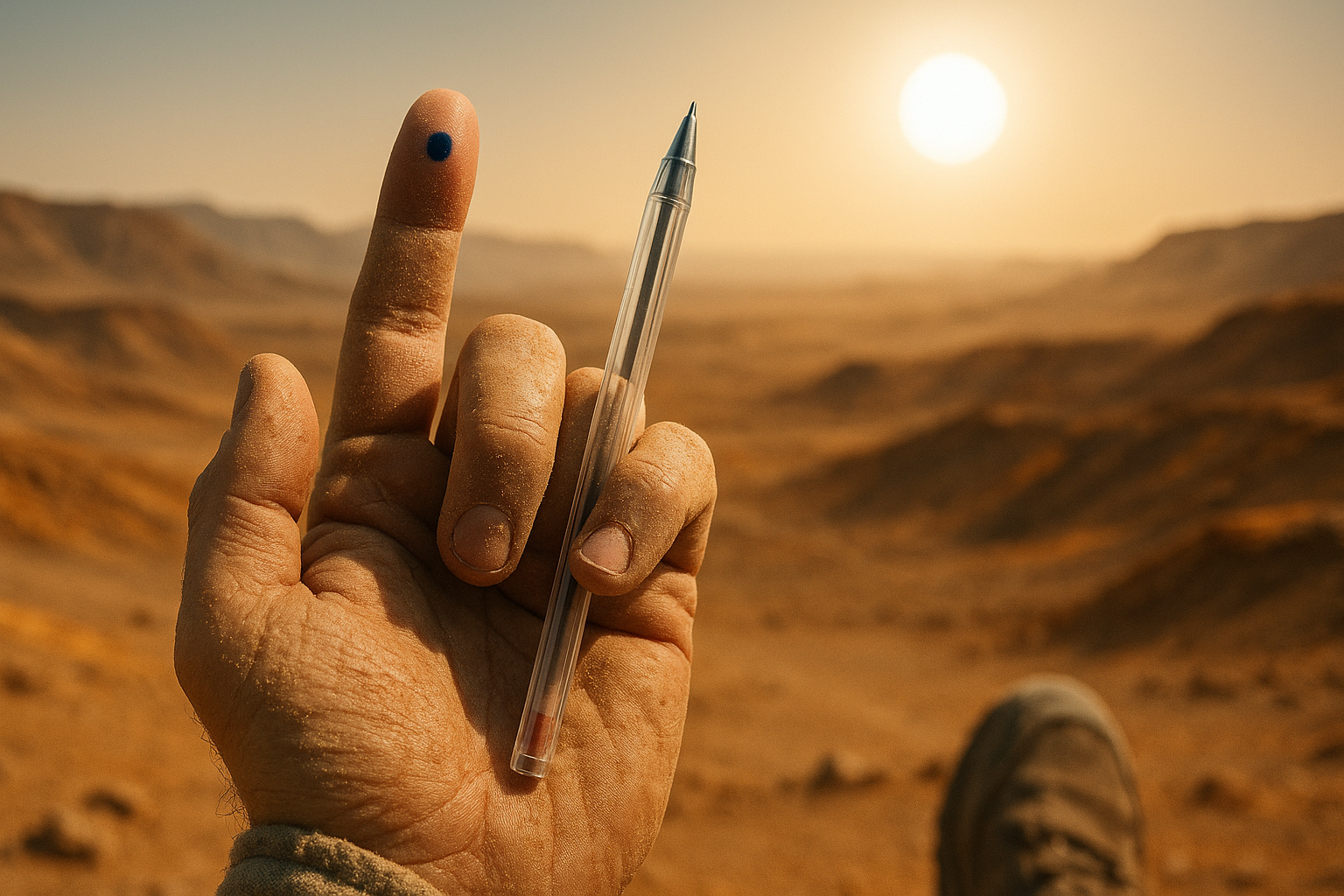
“Proof can be as small as a drop of ink… and as heavy as an entire world.”
In that moment—standing beneath a sun that burned with a colour I had no name for, hearing words that had bypassed air and ear to settle directly into the architecture of my thoughts—I felt the borders of everything I'd ever believed split apart like old seams finally surrendering to pressure they were never built to withstand.
Clivilius.
The name reverberated through me with a resonance that transcended mere sound. It was less a word than a key turning in a lock I hadn't known existed, opening doors inside my mind that had been waiting—patiently, silently, for thirty-four years—for exactly this moment. The voice I'd heard since childhood had finally named itself. Had finally shown me the world it had been describing all along in dreams I could never quite translate upon waking.
I stood there, blinking against brilliance that seemed to press down from everywhere at once, and felt the exhilaration that had flung me through the portal transform into something denser. Awe, certainly—awe so complete it seemed to hollow me out and fill the space with silence. But threaded through that wonder ran something rawer, more primal: the crystallising understanding that whatever came next—terror or transcendence or some alloy of both I couldn't yet imagine—I had crossed a threshold from which retreat would never be simple.
The voice had marked the beginning. I had no map for what followed.
As my vision began to adjust, shapes asserted themselves from the dazzle like photographs developing in chemical bath. Edges emerged. Distances sorted themselves into comprehensible layers. Shadows—actual shadows, cast by an actual sun in an actual sky—stretched across ground that existed, that was solid, that I was genuinely standing upon in some world that wasn't Earth.
My eyes ached from the assault of unfamiliar light, but curiosity proved stronger than discomfort. It always had been, ever since I was eight years old and the voice first spoke to me in a dream about ceramic gnomes and doorways that led somewhere beyond the walls of my childhood bedroom. That curiosity had gotten me into trouble more times than I could count. It had also, apparently, gotten me here.
I blinked again, harder this time, forcing my pupils to cooperate.
And there it was.
Lying on the ground perhaps three metres from where I stood—incongruous as a joke told at a funeral—was the pen. The same cheap plastic pen I'd snatched from my desk and hurled into the kaleidoscopic void to test whether what I was seeing was real. Its presence here, in this alien place, struck me as both absurd and oddly touching, as though the universe had sent me a souvenir to commemorate my own recklessness.
I moved toward it without thinking, my body operating on instinct whilst my mind continued its frantic attempt to process the impossible. The ground beneath my feet felt strange—not quite sand, not quite stone, but something intermediate that shifted slightly with each step whilst remaining fundamentally solid. The texture registered dimly through the soles of my shoes, another data point my brain filed away for later analysis.
I bent to retrieve the pen.
My hand trembled as I reached for it—not dramatically, not the theatrical shaking of someone performing distress, but the fine, involuntary quiver of a nervous system pushed past its designed parameters. My fingers closed around that familiar plastic form, and the simple act of touching something I recognised anchored me in a way I desperately needed. Here was something from my world. Here was something that had existed in my study, on my desk, surrounded by the comfortable detritus of the life I'd been living an hour ago—or a lifetime ago, or perhaps no time at all, because who knew how duration functioned between dimensions?
The pen was mundane. Unremarkable. The sort of object you'd find in any office supply drawer, purchased in bulk, used without thought, discarded without ceremony when the ink ran dry. I had probably owned a hundred identical pens across my lifetime, never once considering any of them significant.
But when I turned this one over, my breath caught.
The pen bore the same scarlet stain as before.
My blood. Vivid against the blue plastic casing, smeared across the barrel where my pricked finger had touched it during those frantic seconds in my study. The crimson looked almost defiant in this alien light—a streak of earthly life carried across the boundary between worlds.
That sight cut through the awe like a blade through tissue paper.
Here was evidence I couldn't dismiss. Here was proof that what had happened in my study was not delusion, not breakdown, not the elaborate hallucination of a mind finally cracking under the weight of dreams it had carried since childhood. I had been in my study. I had pricked my finger on that strange device. I had bled. I had thrown this pen into a hole in reality. And now I stood in another world entirely, holding the same pen, staring at my own blood dried to rust-brown against cheap plastic.
The question that had haunted me—Is this real?—suddenly seemed almost insultingly insufficient. Like asking whether water was wet whilst drowning in an ocean.
Here was the evidence in my hand: a banal object from my desk in Berriedale, Tasmania, Earth, now carried across dimensional boundaries I hadn't believed existed until approximately two minutes ago. Its ordinariness made the extraordinary undeniable, bridging what I had left behind with what I now faced.
The surreal was real.
And I was standing inside it.
Something shifted in my chest—some final barrier of disbelief crumbling into rubble. I felt it go, felt the reconstruction of my understanding begin. I had stepped through a portal into another world. The voice that had spoken to me since I was eight years old had been real all along. Every dream, every vision, every whispered hint of something beyond the ordinary—all of it validated in a single, irreversible instant.
I didn't know whether to laugh or weep or scream. So I did none of those things. I simply stood there, bloodied pen clutched in trembling fingers, trying to remember how to breathe.
Compelled by an instinct I couldn't name—something between scientific curiosity and magical thinking—I lifted the pen toward my wounded finger. The gesture felt ritualistic, almost sacred, as though the smallest act might carry outsized significance in a world where reality had proven itself malleable. My hand shook faintly as I positioned the nib against the pad of my fingertip, the bloodied surface poised above the narrow point where ink waited to prove something I desperately needed confirmed.
For an instant, everything seemed to pause.
The air held its breath. The alien sun hung motionless in its strange sky. Even my own heartbeat seemed to suspend itself between beats, waiting alongside me for whatever came next.
I pressed the pen gently against my skin.
The contact was brief—a soft pressure of plastic against flesh, the familiar sensation of writing instrument meeting surface it was designed to mark. My breath caught in my throat, half-prepared for reality to ripple again, for colour to fracture, for the ground beneath my feet to reveal itself as illusion and drop me into some deeper void.
But instead, there it was.
A dot.
A tiny, inconsequential blot of blue ink blooming on my fingertip where I'd pressed the nib. So small I might have missed it in any other context. So ordinary that under normal circumstances, I would have wiped it away without a second thought.
And yet it was everything.
Proof.
A mark of my existence in this place, a confirmation that the laws I had known—or at least some of them, at least the laws governing ink and skin and simple mechanical action—still held some authority here. I stared at that minuscule blue dot as though it contained the secrets of the universe, because in that moment, for me, it did.
The sight sent my heart lurching into a rhythm that felt simultaneously too fast and too slow, each beat carrying its own freight of emotion. Disbelief still lingered at the edges, reflexive and stubborn, but it was being overwhelmed now—washed away by awe that rose like tide water, by a dangerous thrill that curled through my veins like something illicit and addictive.
The sting of pain from my pricked finger. The smear of blood on the pen's barrel. The inked dot on my skin. Each sensation as solid and undeniable as the alien ground beneath my feet, as the strange air filling my lungs, as the light of an impossible sun falling across my upturned face.
I was somewhere else.
The thought tolled through me like a bell struck in an empty church, its resonance spreading outward through every part of my being. I stood far beyond the safety and predictability of the world I had always known—the world of Tasmania and aged care shifts and missed phone calls from partners I couldn't explain myself to. My feet were planted in a place where imagination had been forced into flesh, where the dreams I'd carried since childhood had materialised into landscape and sky and the weight of existence pressing down from every direction.
The realisation carried edges both exhilarating and terrifying. Boundless promise on one side—the vindication of everything I'd secretly believed, the opening of possibilities I'd never dared articulate even to myself. Absolute otherness on the other—the knowledge that I stood utterly alone in a world whose rules I didn't know, whose dangers I couldn't assess, whose very nature remained fundamentally alien to everything I'd been raised to understand.
Pen still clutched in one hand, ink-marked finger still raised like a silent oath or a gesture of surrender, I understood with startling clarity that I was not merely passing through.
I was here.
Not a visitor testing the waters before retreating to safety. Not a tourist snapping photographs to prove they'd been somewhere exotic. A participant. A resident of this impossible place, at least for whatever span of time fate or luck or my own reckless curiosity had allotted me.
And this extraordinary reality—with all its wonder and danger, its beauty and its stark indifference to human need—was now mine to navigate.
I lifted my gaze from the pen and the proof inked upon my skin.
My breath caught in my chest, shallow and tight, as the landscape unfurled before me in all its immensity. I had been so focused on the pen, on confirmation, on the desperate need to anchor myself in something comprehensible, that I hadn't truly looked at where I'd arrived.
Now I looked. And what I saw drained the remaining air from my lungs.
It was a world painted in the vocabulary of thirst.
Browns dominated—every shade conceivable, from the golden whisper of wheat fields at harvest to the dark promise of creek beds that hadn't seen water in generations. Ochre and umber sprawled across my vision like arguments about the nature of earth itself. Sienna bled into rust bled into the colour of old blood bled into shades I had no names for, colours that existed outside the spectrum I'd learned to recognise in thirty-four years of Earthly existence.
The ground beneath my feet was coarse and brittle, fine powder clinging to my shoes with the stubbornness of something that hadn't encountered moisture in epochs. When I shifted my weight, the dust rose in small plumes that caught the light and shimmered briefly before settling again, as though even the earth here was too weary to stay disturbed for long.
Before me stretched an endless mosaic of these earth tones, each subtle shift in colour weaving together into a tapestry that was simultaneously desolate and magnificent. My eyes swept across it, trying to find edges, trying to find boundaries, trying to find anything that might suggest this wasteland had limits—and finding nothing. The browns continued. The emptiness extended. The desert refused to end.
Yellow streaks ran through the distant hills like veins of precious metal exposed by some ancient upheaval, their brightness dulled beneath the sun's unrelenting attention. Here and there, flashes of orange broke the monotony—brief interruptions of warmer colour that did nothing to soften the oppressive barrenness. If anything, they made it worse. They reminded me of sparks from a dying fire, the last flickers of something that had once burned with vitality but was now reduced to ash and silence and the long, slow patience of entropy.
The dunes rose and fell in gentle undulations, their curves shaped by forces I could neither see nor hear. Wind, perhaps—though I felt only the faintest whisper of movement against my skin, barely enough to stir the fine hairs on my arms. The hills seemed to breathe with their own slow rhythm, rising and falling across distances too vast to comprehend, leading always to more hills, more valleys, more of the same relentless sameness stretching toward horizons that bled into each other without boundary.
I turned in a slow circle, searching for any point of reference. Any landmark. Any sign that this world contained something other than sand and stone and the pitiless glare of an alien sun.
There was nothing.
No trees broke the monotony of brown and orange. No rivers carved paths through the dust. No structures rose against the shimmering horizon—no houses, no towers, no roads, no evidence that anything with hands had ever shaped anything here. Not even a cloud marred the blank expanse of sky above me, which was not quite blue and not quite any other colour I could name, just a vast, washed-out canvas holding that brutal sun in its centre like an eye that never blinked.
The silence was perhaps the most overwhelming thing of all.
It was not merely the absence of sound. It was something more substantial—a positive force, a pressure that seemed to lean against my eardrums and fill the spaces between my thoughts. I strained to hear anything: the scuffle of an animal, the whisper of wind through grass, the distant call of a bird. Even the hum of insects would have been welcome, some sign that life existed here in any form beyond my own terrified, exhilarated consciousness.
But the world offered nothing.
Only my own breath disturbing the silence. Only my own heartbeat, suddenly loud as thunder in the absolute quiet. Only the soft scrape of my shoes against the powder-dry earth when I shifted my weight.
These sounds felt invasive. Out of place. As though I was trespassing in a cathedral whose congregation had departed millennia ago, leaving only dust and memories and the echoing absence of voices that would never speak again.
I stood on the edge of something that felt less like a landscape and more like a statement—a declaration of emptiness so complete it seemed almost intentional. As though this world had looked at the concept of life and comfort and green growing things and deliberately chosen otherwise.
A desert without end. A silence without mercy. A beauty that unsettled as much as it amazed.
I had wanted answers. I had wanted to understand what the voice had been showing me all these years, what world lay beyond the dreams that had haunted my nights since childhood.
Now I stood in that world, swallowed by vastness, and wondered whether some questions were better left unasked.
Driven by something that felt equal parts desperation and denial, I forced my legs into motion.
Standing still felt like surrender. Standing still felt like accepting that this emptiness was all there was—that I had traded my entire known existence for nothing but sand and silence and the slow cooking of an alien sun. I couldn't accept that. Not yet. Not without at least trying to find something more.
The nearest rise in the land offered the promise of perspective. Higher ground. A chance to see farther, to survey more of this world, to discover whether the desolation extended forever or whether something—anything—waited beyond the immediate horizon.
I headed toward it.
Each step sank slightly into the loose grit beneath me, the ground yielding just enough to make walking feel like wading through something that resented my presence. Dust rose with every footfall, small bursts of particulate matter that caught the fierce sunlight and shimmered briefly before drifting back into the vast, undisturbed sea of brown and orange I was trying to cross. The particles hung suspended for a moment like tiny dancers, catching light, spinning in currents of air too subtle to feel, before gravity reclaimed them.
The climb was not steep—the rise was gentle, almost inviting in its gradual incline—but the weight of the place pressed on me with every pace. Not physical weight, exactly. Something more insidious. As though the desert itself resented intrusion, as though it was slowly leaching away my will with each step I took through its territory.
I thought of Jamie as I climbed. Thought of the missed call I hadn't returned, his name flashing on my phone screen in the moments before everything changed. What was he doing now? Was he still at work, going about his shift at Vaucluse, wondering why I hadn't picked up? Or had enough time passed—however time worked between worlds—that he'd returned home to find my study transformed, to find me gone, to find explanations that would never satisfy?
The guilt was sharp and unexpected. I pushed it aside. There would be time for guilt later. Right now, survival demanded my full attention.
I pushed upward. One foot after another. The rise that had looked modest from below seemed to stretch itself as I climbed, as though the desert was playing tricks with distance and perspective, as though this world didn't quite obey the same geometries I'd grown up trusting.
At last I reached the crest.
My breath came quick and uneven now, my chest heaving with something that felt like more than mere exertion. The heat was extraordinary—not the comfortable warmth of a Tasmanian summer but something more aggressive, a heat that seemed to reach into my lungs and steal moisture with every breath. Sweat had begun to trickle down my back, and my mouth felt strange—dry in ways I wasn't accustomed to, thirsty in ways that hinted at danger.
I turned in a full circle, my eyes straining against the glare as they swept across the horizon in every direction. Around and around I went, searching, desperate, willing something to appear—a movement, a line of green, a shadow cast by something other than hills and stones. Any sign that life existed here. Any evidence that I hadn't traded everything for a world that held nothing.
But there was nothing.
The desert stretched unbroken in every direction, rolling in waves of sand and stone that seemed to mock my small human hope for meaning. Each hill led only to another. Each hollow revealed no secret, offered no shelter, contained no salvation. The horizon shimmered with heat mirages—cruel illusions that promised water, vegetation, something—but delivered only more of the same endless, indifferent expanse.
I completed my circle. I completed it again, as though repetition might change the outcome, as though looking harder might conjure something from the void.
Only desolation answered.
Only the relentless sprawl of emptiness, stretching toward infinities in every direction, swallowing the world, swallowing hope, swallowing me.
The climb and the heat and the spinning search exacted their price without warning.
It came on suddenly—not gradually building but arriving all at once, as though my body had been holding itself together through sheer denial and had simply reached the limit of what willpower could sustain. A heaviness settled over me, draping itself across my shoulders and pressing down from above. Not just fatigue. Something deeper. Something that felt less like tiredness and more like a fundamental failing of the systems that kept me functional.
The air itself seemed to thicken into something hostile, pressing against me from every angle, fighting its way into my lungs with each laboured breath. My body no longer felt like my own. It had become cargo—something I was forced to carry, something that dragged at me with every step, every heartbeat, every moment I remained standing in this place that seemed designed to destroy fragile Earth-born things.
I became startlingly aware of my own internal workings in ways I had never experienced before.
The rush of blood surging through my veins was no longer an invisible rhythm happening somewhere beneath consciousness. I could feel it—a tangible force, a river coursing through channels too narrow for its volume, pressing against the walls of vessels that were struggling to cope with demands they'd never been designed to meet. Each pulse carried warmth, at first faintly comforting in a primal way—I am alive, I am alive—but quickly growing insistent, demanding, alarming.
The warmth thickened. Intensified. It spread outward from my core like something searching for escape, filling my extremities with heat that felt less like blood temperature and more like fever. My fingers tingled. My face flushed. My skull felt like it was being slow-cooked from the inside out.
Something was wrong. Something was very, very wrong.
The world began to sway around me.
The horizon bent and twisted, as though the desert had grown restless, as though the landscape itself was trying to shake me loose like an unwanted parasite. My vision blurred—not gradually but in lurches, clarity giving way to smears of brown and orange before snapping back into focus and then dissolving again. The hills seemed to pulse. The sky seemed to throb. Everything solid and reliable had become liquid and treacherous.
A low hum filled my ears—not external but internal, the blood in my body roaring through channels suddenly too loud, too present, too inescapable. I could hear my own heartbeat thundering against my eardrums. I could hear the rush of circulation that should have been silent and invisible. I could hear my body beginning to fail.
This is bad, some distant part of me observed, clinical and detached. This is very bad. You're about to collapse.
The clarity arrived at the last possible moment—sharp and undeniable, cutting through the fog that had been closing in from all sides. I knew what was happening. Heatstroke, maybe. Dehydration accelerated by an alien sun that my Earth-evolved biology had no defences against. The basic mathematics of survival failing catastrophically because I had stepped through a portal into another world without water, without shade, without any of the resources a fragile human body required to continue functioning.
"Oh, crap," I whispered.
The words came out rasped and barely audible, snatched away by the vast silence before they had time to settle into the air. It was such an inadequate thing to say—such a small, foolish human utterance in the face of such enormous catastrophe. But it was all I had left. All the eloquence I could manage as my legs buckled beneath me.
Then the ground surged up to meet me.
The dust gave way beneath my weight, yielding with deceptive softness as I crumpled into its embrace. It was almost gentle, almost kind—the way the earth received my falling body, cushioning the impact, welcoming me into horizontal stillness after so much futile vertical striving.
The palette of brown and orange that had surrounded me moments before bled together, colours mixing and dissolving into a deepening haze that swallowed definition and detail. The distant hills lost their edges. The horizon lost its meaning. Everything became smear and blur and the slow dimming of a lamp running out of oil.
Darkness seeped in at the edges of my vision.
It crept inward with patient inevitability—not rushing, not aggressive, simply advancing the way night advances across a landscape, one degree of dimness at a time. I watched it come. I had no strength to resist, no capacity to fight what my body had clearly decided was necessary.
And so I surrendered.
Pulled under by exhaustion, by heat, by the sheer enormity of a world I had no right to survive, I slipped into unconsciousness with the taste of dust on my lips and the weight of an alien sun pressing down upon my back.
Alone.
Cradled by a silent desert that stretched endlessly in every direction, indifferent to my dreams and my questions and my desperate human need for answers.
I became a single figure swallowed by a canvas vast enough to forget me—one more grain of sand in an ocean of brown and orange, one more small thing lost to the infinite patience of a world that had existed for aeons before I arrived and would continue existing for aeons after I was gone.
The darkness wrapped itself around me like a shroud.
And I was gone.
