4338.210 · July 29, 2018 AD
The City That Forgot My Name
Staggering through a rain-slick Hobart night, Karl wrestles with guilt, delusion, and the echo of a voice that shouldn’t exist. As the city twists into something unfamiliar, he begins to wonder if he’s walking home—or deeper into a version of reality only he can see.
“Sometimes a city stops recognising you. Same streets, same lights—but it looks at you like a stranger who’s stayed too long.”
The walk back to my place felt endless, each footfall heavy with everything I’d done—and everything I still didn’t understand. Hobart’s streets unravelled before me like a puzzle I no longer had the pieces to solve. Familiar, yes, but blurred now, skewed by my state of mind. The city I knew had grown foreign, as if I’d slipped sideways into some slightly altered version of it where nothing quite fit.
The architecture remained unchanged—the same Victorian terraces with their wrought-iron lacework, the same weatherboard cottages huddled against the winter wind, the same corner shops with their glowing windows casting amber pools across wet footpaths. Yet everything felt distorted, as though I were viewing it through warped glass. The shadows fell at wrong angles. The streetlamps seemed to flicker in patterns that spoke of malfunction—or judgement.
I’d walked these streets a thousand times before. Knew them by heart: the uneven paving stone outside the fish-and-chip shop on Elizabeth Street, the dog-leg turn at the bottom of Melville where the bluestone guttering always pooled with rainwater, the weathered sandstone steps leading up to St David’s Cathedral, worn smooth by a century and a half of footsteps. But tonight, that intimate knowledge offered no comfort. It only made the alienation more profound. I was a stranger in my own city, expelled from the familiar by the magnitude of what I’d done.
The rain had started as a fine mist, barely noticeable, but by the time I was halfway home it had turned into a steady drizzle. Cold. Relentless. It soaked through my jacket and clung to my skin, the chill seeping deep into my bones. I barely felt it. The discomfort was there, but distant—another muted signal in a body overloaded with noise.
Water ran down my face in rivulets, tracing the contours of my cheeks, dripping from my chin. I didn’t wipe it away. Couldn’t summon the energy or the interest. The rain mingled with something else—tears, perhaps, though I couldn’t be certain. My face felt numb, frozen not just from temperature but from the sheer emotional overload that had short-circuited my nervous system.
My hands—still raw, still aching—swung at my sides as I walked, fingers curling and uncurling reflexively. The skin was abraded, reddened from the frantic tearing at those rubbish bags, the desperate search that had yielded nothing but humiliation. Beneath the physical pain lay something worse: the phantom sensation of Sarah’s blood on my palms, hot and accusatory, though I’d scrubbed them clean hours ago. The sense-memory persisted, a ghost imprinted on nerve endings that refused to forget.
My mind had narrowed to a loop: the whispered voice, the glint of malice behind that simple word—“Bye.” Sarah’s face, as she slid down the wall, eyes wide with hurt and disbelief. The blood. My hands. The sickening crack as her head met solid surface, a sound that would echo in my nightmares for years to come, assuming I ever found the peace to sleep again.
Each repetition of the mental film added new details I hadn’t consciously registered in the moment. The way Sarah’s hand had reached out—not to break her fall, but towards me, as if even in that instant of betrayal she’d been seeking connection rather than protection. The scatter of glass shards catching the light like fractured stars. The smear of red against cream-coloured paint, stark and damning. The expression on Gladys’s face in the doorway—not shock, but something closer to vindication, as though I’d confirmed every terrible thing she’d suspected about me.
And underneath it all, threading through every iteration: Luke’s voice. That whisper. That taunt.
“Bye, Karl.”
Two words. Two syllables. An entire world of mockery compressed into seven letters.
I replayed it obsessively, dissecting the tone, the timbre, the placement. Had there been a hint of laughter in it? A breath of satisfaction? The voice had been quiet, yes, but not uncertain. It had possessed the confidence of someone utterly secure in their position, someone who knew they held all the cards while I scrabbled in the ruins of my credibility.
The physical reality of the voice was unquestionable in my mind. I could recall the direction it had come from—just behind me, slightly to the left, at approximately head height. Could remember the way it had cut through the ambient sounds of the house: the creak of floorboards under Gladys’s tread, Sarah’s breathing, the faint hum of a refrigerator from the kitchen. The whisper had possessed substance, dimension, acoustic properties that my detective’s brain had catalogued even in that moment of crisis.
But the room had been empty.
That was the sticking point. The undeniable, damning fact that had transformed my certainty into doubt in everyone else’s eyes. The room, when we’d burst through that door, had contained nothing but rubbish bags and silence. No Luke. No hiding place that could have concealed a grown man. Just absence where I’d sworn there was presence.
Had I imagined it? The possibility gnawed at me like acid. Was I losing my grip on reality? Had the stress, the obsession, the accumulation of sleepless nights and mounting professional pressure finally fractured something fundamental in my psyche?
No. I rejected that possibility with every fibre of my being. The voice had been real. Had to be real. Because if it wasn’t—if I’d hallucinated that whisper, reacted with violence to a phantom—then everything I’d built my life upon was suspect. My instincts. My judgement. My very identity as a detective.
By the time I reached home, Hobart had disappeared beneath a veil of darkness. The sky hung low and black, Mount Wellington rising like a monolith behind the city—a deeper shadow in the night, a presence rather than a shape. Even the mountain offered no grounding. Its usual comfort felt hollow now, a silhouette that watched rather than reassured.
I’d always found solace in the mountain. It was a constant—a massive geological fact dominating the southern horizon, unchanging and implacable. In moments of stress or confusion, I’d found myself gazing towards it, drawing strength from its permanence. The mountain didn’t care about human drama, human failings, human violence. It simply was, had been for millions of years, would continue long after I was dust.
But tonight, even that ancient comfort rang false. The mountain’s indifference, usually soothing, now felt like condemnation. It watched with the same dispassion it brought to everything—storms and sunshine, life and death, guilt and innocence all equally inconsequential against the timescale of geology. My crisis was nothing. My anguish, my certainty, my crumbling career—all of it was less than a breath of wind against that stone face.
The thought should have been freeing. Instead, it felt like abandonment.
The streetlamps spilled weak circles of sulphur-coloured light across the footpath, but they failed to lift the gloom. If anything they accentuated it—sodium-vapour glow draining the colour from everything, leaving a monochrome of shadow and jaundice. The pools of light read less like illumination than like stage spots, each lamp isolated, unable to reach its neighbours, so that crossing from one circle to the next meant passing through bands of shadow thicker than mere absence of light. Every flickering bulb a reminder of things left unsaid. Things broken.
I counted the lights as I walked, a meaningless exercise that gave my mind something to focus on besides the loop of memory. Seven between the house and the corner. Eleven more along Melville Street. The fourth one was out completely, leaving a gap of darkness that I had to traverse blind, trusting muscle memory and the faint glow from windows to guide me. For those dozen steps, I was truly in the void, disconnected from even the meagre comfort of artificial light.
When I emerged back into the light, I found I’d been holding my breath.
My phone began to buzz the moment I stepped inside.
The first vibration came before I’d even closed the door behind me, the device jolting to life in my pocket with an urgency that made me flinch. I stood in the narrow hallway of my flat, one hand still on the doorknob, and felt the phone drum against my thigh like an accusation made physical.
Sarah. Claiborne. Sarah again. Claiborne again.
Each vibration set off a new stab of anxiety—sharp and jarring. I didn’t have it in me to answer. Couldn’t face their voices. Not yet. The guilt was too fresh, too raw. I was still standing in that room, hearing that voice, feeling Sarah slump against the wall. The missed calls stacked up like charges laid out for sentencing.
I pulled the phone from my pocket and stared at the screen. The backlight glowed cold, illuminating Sarah’s name in stark white letters. The photo I’d assigned to her contact—a candid shot from a department barbecue, her head thrown back in laughter—seemed to mock me now. That Sarah, carefree and trusting, felt like someone from another lifetime. Someone I’d murdered through my actions, if not in body then in spirit.
The phone buzzed again. Sarah. I watched her name flash, counted the rings—one, two, three, four—before it clicked to voicemail. Thirty seconds later, it started again. Claiborne this time.
Seven from Sarah. Four from Claiborne.
I stared at the screen as it lit up again, then fell dark once more. The silence that followed felt louder than any reprimand Claiborne could hurl my way. Accusation by absence.
What would they say if I answered? What words could possibly bridge the chasm that had opened? Sarah would be hurt, confused, possibly concussed. She’d want explanations I couldn’t give, apologies that would sound hollow even to my own ears. And Claiborne—Christ, Claiborne would be volcanic. I could hear his voice in my imagination, that particular pitch of fury he reserved for officers who’d crossed unforgivable lines. The disappointment would be worse than the anger. I’d been his protégé once, the detective he’d held up as an example. Now I was the cautionary tale.
Eventually, I silenced it completely.
The finality of that gesture—pressing the button, watching the screen go dark and stay dark—felt like sealing my own tomb. I’d cut myself off from the department, from my partner, from any possibility of explaining or defending my actions. The silence I created wasn’t peace. It was exile.
I moved through the flat like a shadow, my own rooms offering little comfort. Jargus was waiting—my one constant, my quiet, loyal sentinel. He greeted me not with the usual exuberance but with something more measured: a soft whine, his tail wagging slow and tentative, as though he understood that enthusiasm would be unwelcome. His brown eyes tracked my face, reading my state with the uncanny perception dogs possess—that ability to sense emotional weather humans hide from one another.
I filled his bowl, crouched beside him and ran my fingers through his wiry fur. That simple act—the rhythm of it, the warmth—offered something like peace. His needs were simple. Immediate. Honest. I envied that. The purity of animal logic.
He ate cautiously, glancing back at me between mouthfuls, still worried. I remained crouched beside him, my hand resting on his flank, feeling the slight movement of his ribs as he breathed and ate. The steady rhythm of animal life: breathe, eat, exist. No complications. No moral calculations. Just the simple fact of being.
How long had it been since I’d felt that uncomplicated? Years, probably. Perhaps decades. The job had trained me to see complexity everywhere, to question motives, to never accept surface appearance. That suspicious lens had served me well professionally. But it had eroded something essential, some capacity for straightforward experience. I’d become so accustomed to reading between lines that I’d forgotten how to simply read the line itself.
When Jargus finished eating, he turned and licked my hand—the damaged one, the one still tender from tearing through rubbish in a stranger’s home. The slight sting of his rough tongue against abraded skin brought tears to my eyes. Not from pain, but from the simple kindness of it. Unconditional. Unquestioning. He didn’t know what I’d done. Didn’t care. I was his person, and that was enough.
Eventually, I rose and changed clothes—fitted black track pants, a tight t-shirt. My movements were stiff, automatic, more routine than intent. The cotton clung to skin still damp from the rain, the fabric scratchy, jarring in its contact. It made me wince.
In the bathroom mirror, I caught sight of myself.
A stranger stared back.
I stood there for a long moment, hands gripping the edges of the sink, and studied the man in the glass as though he were a suspect. What did this face tell me? What story did it narrate?
Skin pallid. Jaw clenched tight with anger that hadn’t found its release. My face was drawn, the angles too sharp, like something carved from fatigue and self-loathing. I looked like a man on the edge of something. Perhaps I already was.
But it was the eyes that disturbed me most. They were my eyes—I recognised the colour, the shape, the small scar through my left eyebrow from a childhood fall. Yet something in them had changed. They held a wildness I’d never seen before, a quality of desperation that reminded me of suspects I’d interviewed, people pushed beyond their limits by circumstance or choice. They were hunter’s eyes. Hunted eyes. Both at once.
I tried to arrange my expression into something more normal, more like the Karl Jenkins I’d been a week ago. The attempt felt grotesque, like a poor actor donning a mask. The face in the mirror refused to cooperate, the muscles responding stiffly, producing a rictus grin that looked more unhinged than reassuring.
For a moment, I thought of the whisky bottle in the cupboard.
It would be easy. A shortcut to silence.
The bottle was Laphroaig, a Christmas gift from Claiborne three years ago. Quarter full now, the remaining liquid amber and promising. I knew exactly where it sat in the cupboard—third shelf, behind the paracetamol and the old boxes of plasters I kept meaning to throw out. Knew the heft of it, the way the glass felt smooth and cool in my hands, the sharp bite of peat and iodine that hit the nose before the first sip ever touched your lips.
I could taste it in my imagination. That first swallow burning down, harsh and purifying. The warmth spreading through my chest, radiating outward like a sun breaking through cloud. The softening of edges, the blurring of that too-sharp mental focus that was currently tearing me apart. Two drinks would calm me. Three would numb me. Four would let me sleep.
But I didn’t reach for it.
The decision wasn’t noble. It wasn’t strength. It was something darker, more obsessive. I needed to stay sharp. Needed to think. The whisky would dull me, and dull wasn’t acceptable. Not when Luke was out there, laughing. Not when the truth remained just beyond my grasp, taunting me with its proximity.
I’d earned this pain. Deserved to feel it, fully and completely. The alcohol would be escape, and I’d forfeited my right to escape when I’d put my hands on Sarah.
Instead, without quite knowing why, I found myself back at the door, keys in hand. My fingers closed around the metal instinctively. Cold. Familiar. Comforting in the way only old routines can be.
The keys hung on their usual hook by the door—car key, house key, the small brass key to my desk drawer at the station that I probably shouldn’t have taken home. They jangled softly as I lifted them, a sound that was somehow both mundane and momentous. This action, this choice, felt significant in a way I couldn’t quite articulate. I was making a decision, taking control, refusing to simply buckle under the day.
Each key had its own texture against my damaged skin. The car key, plastic-topped, with its panic button and central locking controls. The house key, brass and worn smooth from years of use. The small key that meant nothing now, a token of a professional life that might already be over. I squeezed them tighter, feeling the bite of metal against torn skin, the bright pinpoint of pain that confirmed I was still present, still real, still capable of action.
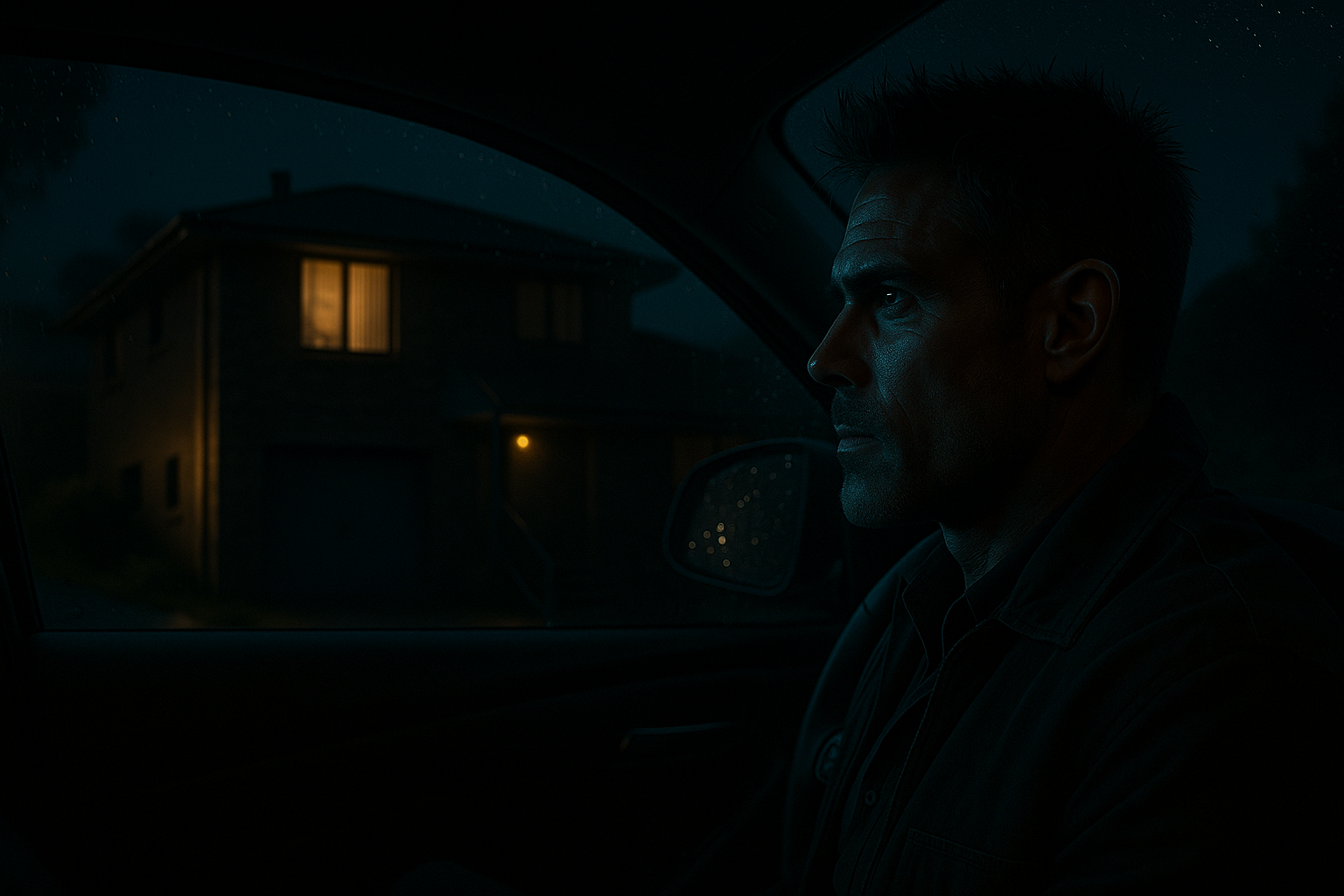
I slid into the car. Turned the ignition.
The engine grumbled into life with a low, reluctant growl. Even the car seemed to question my judgement.
I sat there for a moment, breathing in the stillness.
The car smelled of old coffee and the faint ghost of Jargus from the times I’d taken him to the beach. The steering wheel was cold under my hands, the vinyl cracked at ten and two o’clock from years of gripping. The rear-view mirror needed adjusting but I didn’t bother. I wasn’t interested in what was behind me.
Then I put it into gear.
