4338.209 · July 28, 2018 AD
Ten Years in a Single Breath
A door opens on Interview Room Three and a decade collapses. Karl Jenkins recognises the woman waiting inside — Louise Jeffries, whose history with him predates the badge he wears and the partner standing beside him. Two men are missing. A name has been spoken that Karl has not heard aloud in fifteen years. And in the corridor outside, Sarah Lahey is already assembling questions that no one in the room seems willing to answer.
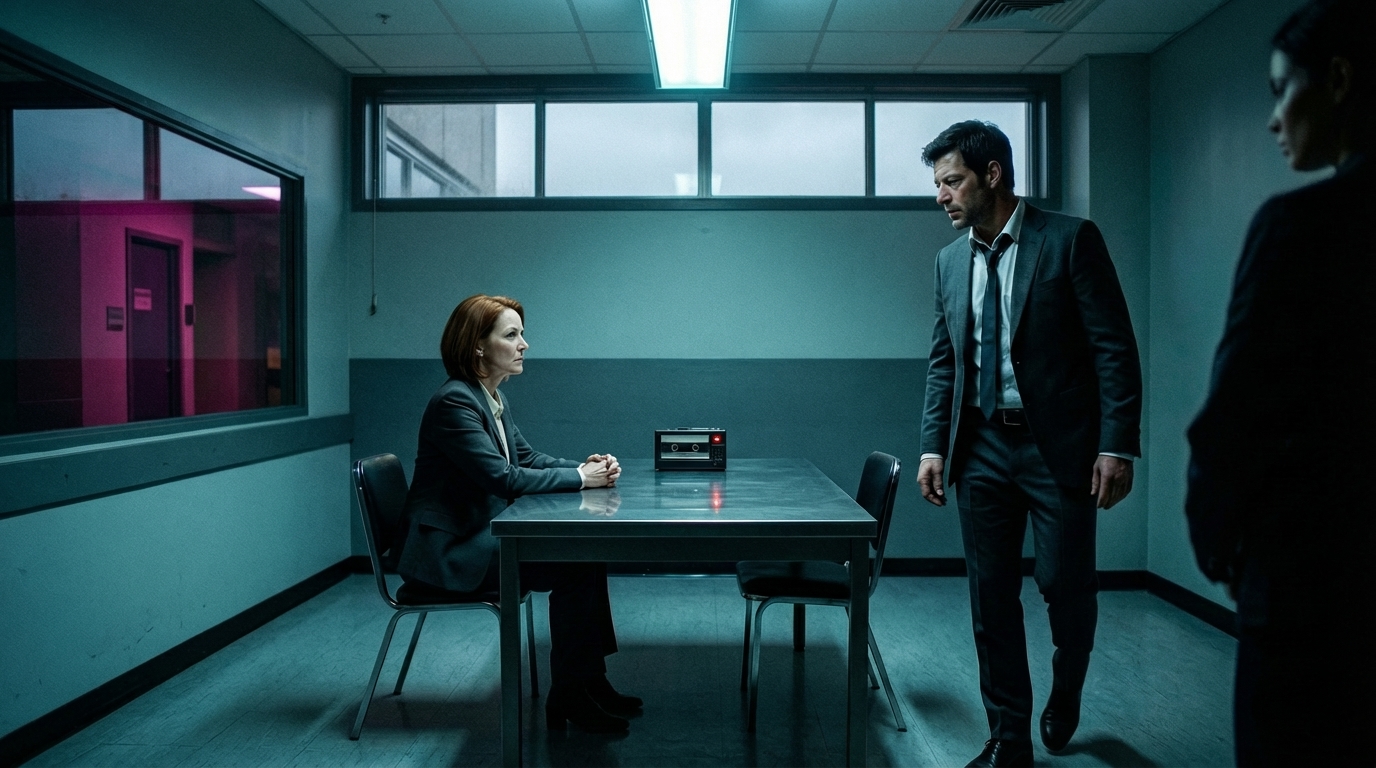
Interview Room Three had been holding its breath all morning.
The fluorescent tube overhead hummed its flat, indifferent note above the steel table bolted to linoleum, the four rigid chairs arranged in their permanent geometry of confrontation, and the recording equipment blinking its red witness-light in the corner. The room had hosted a thousand conversations that no one had wanted to have — confessions extracted, alibis dismantled, truths dragged into the open by officers trained to recognise the particular silence that preceded surrender. It was a room designed to strip away pretence, and it performed this function with the same institutional efficiency as the disinfectant that failed to mask the anxiety accumulating in its walls.
Louise Jeffries had been sitting in this room long enough for the chair to have stopped feeling cold. She had already given Sarah Lahey the bones of it — her son Kain, missing for two days; her brother Jamie Greyson, unreachable for four; a partner named Luke Smith whose explanation for Jamie's absence had the particular neatness of a story rehearsed before it was needed. She had delivered these facts with the controlled precision of a woman who understood that composure was the only currency she could not afford to spend, and then she had asked for Karl Jenkins by name, and the asking had carried a weight that transformed a request into a condition.
What passed between Louise and Sergeant Charlie Claiborne while Sarah was gone — the whispered exchange through the door left fractionally ajar, the urgency in Louise's voice as she spoke of years of watching, the slip of paper that Claiborne's fist closed around with the practised speed of a man who understood that evidence existed in the hand as well as in the file — remained in the room's atmosphere like residual heat from a fire extinguished moments before witnesses arrived. Sarah caught fragments on her return. She caught the movement. She filed both without reaction, adding them to the growing inventory of things she had observed and could not yet explain.
Karl arrived in the corridor wearing the charcoal suit like armour over damage, his composure reconstructed but visibly provisional — the kind of surface that would hold under professional scrutiny but might not survive anything that reached beneath it. Claiborne stopped him at the threshold with a palm to the chest that was not gentle and words pitched low enough to exclude the corridor: the woman inside had asked for him, specifically, and the story she carried was not routine. The warning that followed — four words, delivered flat, carrying the full gravitational weight of institutional authority — was less instruction than prophecy. Do not fail at this.
The door opened, and ten years collapsed into a single breath.
Recognition struck Karl whole. Not gradually, not in stages, but as a complete event — the woman in the chair connecting to every version of herself he had archived across a decade of deliberate distance. Louise Jeffries, whose voice had once navigated the worst parts of him with a steadiness he had never quite found in anyone since. Louise, whose son he had quietly saved from a public drinking charge six years earlier in a room not unlike this one. Louise, whose brother Jamie had once occupied a place in Karl's life significant enough that fifteen years of silence had not diminished the weight of his name when it finally surfaced in this room, spoken by the sister who needed Karl to understand that Jamie's absence was not voluntary and never had been.
Sarah watched the recognition happen. She watched Karl's professional surface fracture along a fault line she had not known existed, watched him speak Louise's name with a familiarity that bypassed rank and procedure and landed somewhere personal enough to make the interview room feel suddenly too small for the number of histories it was being asked to contain. She asked the question that the moment demanded — whether they knew each other — and received an answer that confirmed everything while specifying nothing, three words that opened a door and immediately closed it again.
The interview that followed was conducted across a distance far narrower than the steel table that separated them. Louise delivered the architecture of the disappearance with the precision of someone who had spent days constructing a case she hoped would be dismantled by better evidence than she possessed. Four days of silence from Jamie — unprecedented, she stressed, for a brother whose connection to her had survived every other disruption life had delivered. Kain dispatched to investigate and consumed by the same void. Luke Smith's account of Melbourne and marital strain, offered with the rehearsed distress of a man who had prepared his grief in advance. The car still parked in the driveway. The calls that rang and rang and found nothing on the other end.
Karl learned that Jamie had a partner. The information arrived as an absence made visible — an entire chapter of Jamie's life lived beyond Karl's knowledge, a relationship he had not witnessed, a dimension of the man he had once known that existed only in the gap between who Jamie had been and who he had become during the fifteen years Karl had spent not asking. The discovery landed quietly, carried not as shock but as the specific ache of understanding how much distance could accumulate between two people who had once known the shape of each other's silences.
His hands found Louise's across the table. The gesture was not planned and not professional and not something Karl would have been able to justify if asked to account for it in writing. It was simply what happened when the accumulated weight of a woman's composure began to fracture and the man sitting opposite her possessed a history that predated the badge and the procedure and the partner watching from the adjacent chair with an expression that had shifted from professional alertness into something colder and more personal — the dawning comprehension that the man she had partnered with for years contained entire territories she had never been granted access to, and that those territories were now asserting themselves across an interview table in full view of witnesses.
Luke Smith's story did not hold. The contradictions were structural — Kain sent to check on Jamie, Luke claiming Kain never arrived, two absences folding into each other with the neatness of something arranged rather than accidental. Sarah said it aloud: none of this made sense. Karl agreed. The agreement was the last thing that passed between the three of them before Karl stood, reassembled the professional outline that the interview had softened, and delivered the standard assurances with words that were procedurally correct and personally inadequate for what had just occurred in this room.
Sarah led Louise into the corridor. Karl remained behind, alone with the bolted table and the humming light and the chair Louise had occupied, still angled toward the space where he had been sitting as though her presence had left an impression in the room's geometry that would take time to dissipate. He stood in the silence that followed — not the silence of an empty room, but the loaded quiet of a space that had just been asked to hold more than it was designed for, the accumulated weight of two missing men and fifteen years of unspoken history and a name he had not said aloud since Brisbane pressing down on his shoulders with a specificity that no amount of professional training had prepared him to carry.

