4338.212 · July 31, 2018 AD
Stalking Shadows in Berriedale
Reeling from Jane's revelation, Detective Sarah Lahey drives towards Luke Smith's Berriedale address seeking answers—only to spot Karl jogging up the steep hill in full black kit, heading in the same direction. What follows is an increasingly absurd surveillance operation as Sarah tracks Karl tracking Luke's house, leaving Sarah injured, concealed in bushes, and desperately trying to understand what Karl has gotten them both into.
"There's something deeply wrong when you find yourself trespassing in a stranger's garden, apologising to crushed flowers, whilst watching your partner commit what might be a crime."
The light was dying.
Not quickly — not with the dramatic finality of sunset dropping below the horizon in sudden darkness — but slowly, reluctantly, the way daylight always gave ground to evening in Tasmania during winter. The sky bled through shades of amber and rose, streaking clouds with colours that would have been beautiful if I'd been capable of noticing beauty, if anything beyond the churning chaos in my head could have penetrated the fog of shock and betrayal.
Jane's words echoed with relentless repetition, each syllable carved into my brain like a brand: Luke Smith is my grandson.
My hands gripped the steering wheel with force that made my knuckles ache, the bandage on my right hand pulling against the wound beneath. I'd left Vaucluse in something approaching flight — not quite running but moving with desperate urgency, putting distance between myself and that revelation before I completely fell apart in front of Virginia and Bob and Jane herself.
The receptionist had given me the contact details I'd demanded with nervous efficiency, probably relieved to see me leave. I must have looked properly unhinged — tear-stained face, barely controlled panic, the kind of person you didn't want lingering in your nursing home frightening the residents.
Now I was driving. Moving. The familiar streets of Hobart passing in a blur as I headed towards... towards what? Luke's house.
Luke has to know something about Killerton Enterprises and the missing persons. The conviction settled in my chest with certainty born from too many coincidences, too many connections that couldn't be random. I'm certain of it.
Jamie worked at Vaucluse. Visited Jane regularly. With Luke. His partner. Who was apparently my cousin. Who Jane had kept secret for years. Who knew about me whilst I'd remained ignorant.
The pieces were there. The pattern existed. I just needed Luke to confirm it, to fill in the gaps that would make this nightmare make sense.
Pulling off the highway, I began the steady climb up Berriedale Road. The road was steep — one of those Hobart hills that made cyclists suffer and cars strain, gradient punishing legs and engines alike. My own vehicle handled it easily enough, though I barely noticed the mechanical response, my mind too occupied with rehearsing conversations that would probably never happen the way I imagined them.
Luke, I'm your cousin. Did you know that? Of course you did. Jane told me you knew. So why didn't you tell me? Why let me investigate you without—
Movement caught my attention, pulling me from my internal monologue before it could spiral further. A figure jogging along the side of the road, battling the incline with visible effort. The last remnants of twilight silhouetted him against the fading sky — tall, broad-shouldered, moving with the kind of determination that suggested fitness rather than desperation.
I couldn't help the slight chuckle that escaped — dark amusement at watching someone voluntarily torture themselves on this gradient, choosing to run up a hill this steep and winding. There was something absurdly human about it, something normal in a day that had been anything but.
As my car drew closer, details became clearer. Running gear all in black. Athletic build that suggested regular training rather than casual exercise.
And then I was close enough to see his arse.
That particular shape. That familiar silhouette that I'd seen countless times in countless contexts — professional and decidedly unprofessional, clothed and otherwise, moving with purpose or tensed with pleasure or simply existing in the mundane moments between everything else.
"Shit!" The profanity burst out as recognition hit with force that made my hands jerk the wheel.
Karl.
I swerved sharply, taking an abrupt left turn down a side street, tyres squealing slightly with the sudden manoeuvre. My heart hammered against my ribs, adrenaline flooding my system with a fight-or-flight response that had nowhere productive to go.
What the hell is Karl doing out here?
The question screamed through my head even as I slowed the car, pulling further away from the main road, putting distance between myself and the man I'd just narrowly avoided passing directly.
This was nowhere near his house. Karl lived in South Hobart, a deliberate choice that minimised commute and maximised availability for callouts. Berriedale was kilometres away, up in the hills, well outside his usual territory.
Where's his car? And why is he dressed all in black?
The observations accumulated with a detective's instinct that couldn't be suppressed even by personal chaos. Karl never ran in full black kit, never this far from home without his car visible somewhere nearby.
And then the thought I didn't want to think, the connection I desperately didn't want to make:
He can't be on his way to Luke's.
The words formed silently, rejected even as they crystallised. No. That was coincidence. Had to be coincidence. Karl didn't know I was coming here. Hell, I hadn't known I was coming here until twenty minutes ago when I'd walked out of Vaucluse with contact details clutched in my shaking hand.
But Karl had been obsessed with this case. With Luke Smith specifically. With finding connections and pursuing leads and pushing boundaries in ways that had made even me uncomfortable. And now here he was, jogging up Berriedale Road in the direction of Luke's address, dressed like someone who didn't want to be noticed.
"No," I whispered to myself, reaffirming the denial. "He can't be on his way to Luke's."
But even as I said it, even as I tried to convince myself of a benign explanation, my hands were already manoeuvring the car further up the side street, finding a place to park where I wouldn't be immediately visible from the main road.
The process took longer than it should have — my hands were trembling, reaction to too much stress layered on too little sleep layered on revelations that kept rewriting my understanding of reality.
Finally satisfied — or as close to satisfied as I could manage — I killed the engine and sat for a moment in the sudden quiet. My breath came too fast, shallow gasps that weren't quite panic but weren't exactly calm either.
I had to go back. Had to make sure I didn't lose Karl. Had to understand what he was doing here, whether it was innocuous coincidence or something darker, something that would complicate an already impossible situation.
The rational part of my brain pointed out that I was making assumptions, that Karl could have perfectly legitimate reasons for being here that had nothing to do with Luke or the case or anything remotely concerning. Maybe he'd parked somewhere and decided to run the hills for training. Maybe he had friends in the area. Maybe I was so exhausted and emotionally wrecked that I was seeing patterns where none existed.
But the detective in me — the part that had kept me alive through years of this work, the instinct that had been honed through thousands of hours reading crime scenes and interviewing suspects and noticing the details that didn't quite fit — that part knew something was wrong.
I climbed out of the car and started jogging back the way I'd driven. My knee protested immediately — the injury from the forest pursuit still not fully healed, aggravated by today's additional abuse. The bandage on my hand felt too tight.
But I ran anyway, because the alternative was sitting in the car whilst Karl potentially did something I couldn't predict or prevent or even understand.
My eyes strained against the gathering darkness, squinting up the road ahead, searching for any sign of Karl's distinctive silhouette. But there was nothing — he'd vanished completely, swallowed by shadows and distance and the particular way dusk erased details whilst leaving shapes ambiguous.
My pulse kicked up, that familiar surge of anxiety that came from losing sight of a subject. There was only one direction to go from where I'd turned off — upward, following the road's relentless climb towards whatever destination Karl was pursuing.
So where the hell is he? Did he see me?
The questions spun through my head as I slowed my pace, trying to make sense of his sudden disappearance. My eyes darted around frantically, scanning every shadow cast by the gum trees lining the road, twitching at every rustle of leaves in the evening breeze, my nervous system primed to interpret every stimulus as potential threat or revelation.
The rational explanation was simple — Karl had just moved beyond my line of sight, hidden by the road's curve or the increasing darkness or simply the distance between us. But rationality felt like a luxury I couldn't afford right now, not when everything else about this day had been irrational, impossible, reality-defying in ways that made simple explanations feel naive.
I didn't know where Karl had parked his car. Didn't have any clear idea of where he might be heading beyond the general vicinity of Luke's address. The lack of information made me feel exposed, vulnerable, operating blind in a situation that demanded clarity.
Headlights suddenly appeared from the direction of the hilltop, cutting through the dusk, beams sweeping across trees and pavement in rhythm with the driver's steering.
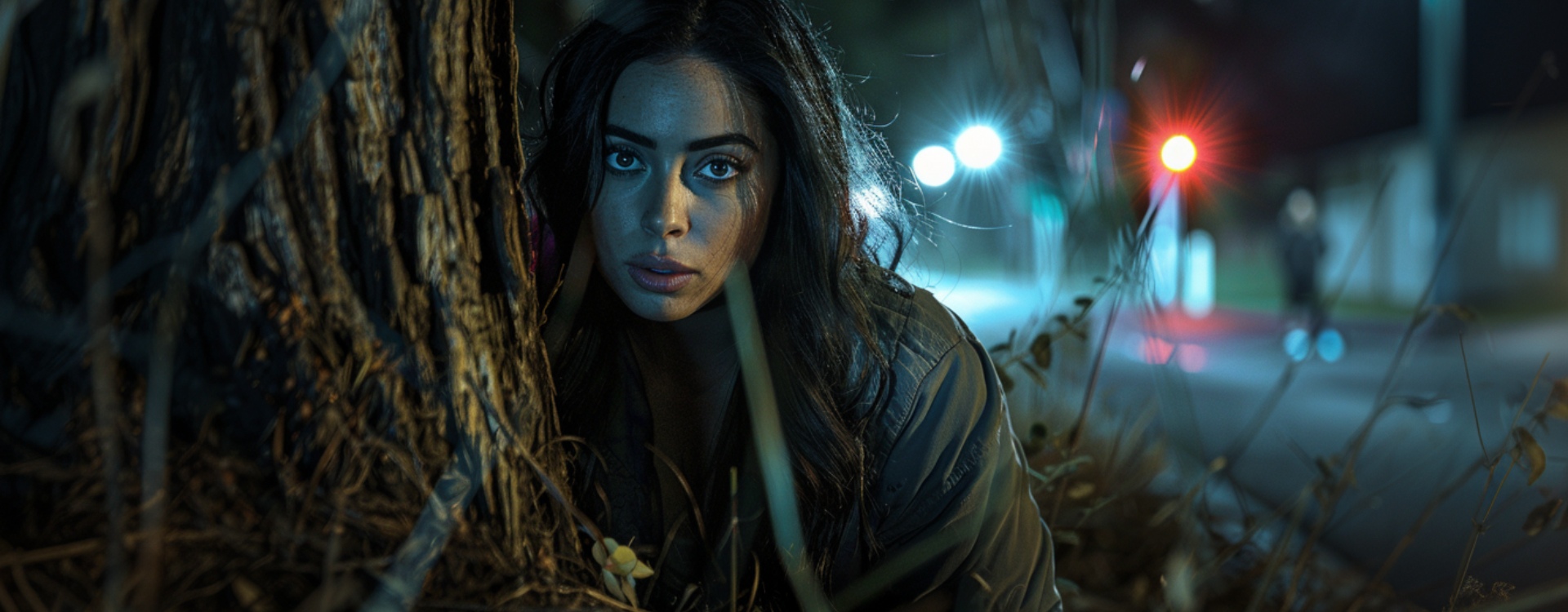
Without thinking, I dove for cover behind a large gum tree near the roadside. My back pressed against rough bark, my breathing harsh in my ears, heart hammering as the car approached.
I had no idea if this vehicle had anything to do with Karl's disappearance or if it was just a local resident passing by, completely innocent and utterly unconnected to the drama unfolding in these hills. But I couldn't take the chance of being spotted, couldn't risk whoever was driving seeing a woman lurking beside the road and either stopping to offer help or calling police to report suspicious behaviour.
The irony of hiding from potential police intervention whilst being police wasn't lost on me, but I shoved that thought aside as the vehicle drew closer.
I forced myself to take a deep breath — one of those deliberate, measured inhalations meant to calm racing thoughts and allow my eyes to adjust properly to the dimming light. The physiological response was automatic, trained through years of high-stress situations: slow the breathing, lower the heart rate, let the body's panic response settle enough for the brain to function properly.
As the car's headlights approached I carefully stole a peek from behind the tree trunk. The beams sliced through the darkness with temporary brilliance, and for a brief moment, they illuminated a tall figure still jogging steadily towards the peak of the hill.
There he is.
Relief washed over me, tension releasing from my shoulders and chest. He hadn't seen me. Hadn't disappeared into some unknown location. Was just further ahead than I'd realised, still moving with that determined pace that suggested a specific destination rather than aimless exercise.
The car passed without slowing, its driver either not noticing or not caring about the jogger or the woman hiding behind a tree like some kind of amateur stalker. Its taillights disappeared around the next curve, leaving the road darker than before as my eyes struggled to re-adjust after the temporary brilliance.
My relief gave way to renewed urgency. I couldn't afford to lose him again. Whatever Karl was doing, wherever he was going, I needed to stay close enough to understand his actions without being so close that he'd notice my presence.
As the darkness enveloped the road again, I prepared to move out from my hiding spot. My knee complained as I shifted weight, reminding me with sharp insistence that I'd already pushed this injury too far today. The bandage on my hand felt damp — probably from sweat rather than blood, though I couldn't be certain without checking.
I waited until the car's engine sound faded completely before stepping back onto the road, resuming my pursuit. Eyes locked on Karl's distant form. Breathing controlled despite the exertion.
After some time — minutes that felt like hours, distance that felt like kilometres though it probably wasn't — Karl stopped abruptly. Just froze mid-stride, standing motionless in the middle of the road, his head turning slowly as he surveyed the area around him.
Panic jolted through my system with electric intensity. In a split second that felt somehow both rushed and suspended, I made a decision that bypassed all conscious thought.
I leapt over the small white fence bordering the nearest property, my body moving on pure instinct and adrenaline. The landing was less than graceful — my boots hit a carefully mulched flowerbed with impact that sent pain shooting through my already protesting knee, and I felt the sickening crunch of something beneath my right foot.
Looking down with immediate guilt, I saw the carnage: a perfectly maintained bed of kangaroo paws, their distinctive red and green flowers now bearing casualties of my intrusion. One unfortunate plant lay completely flattened under my boot, crushed like a small animal under a tyre.
"Sorry," I whispered apologetically to the broken plant, feeling genuine remorse for the minor destruction in my wake even whilst simultaneously recognising the absurdity of apologising to flora whilst stalking my partner through suburban Hobart during what might be criminal activity.
But the apology felt necessary anyway — acknowledgment that I was trespassing, damaging property, operating so far outside normal professional conduct that future-me would probably spend considerable time questioning present-me's choices.
Turning my attention back to Karl whilst trying to remain hidden behind the fence line, I strained to see him in the growing evening darkness. The distance and rows of houses between us made clear observation difficult, but I could still make out his distinctive frame through gaps in the vegetation.
He was crouched in the bushes along the native scrubland that sprawled across the road from Luke Smith's property. The house itself was partially visible through the trees.
What is he doing?
I watched as Karl shifted his weight around in the bushes, clearly trying to find a comfortable position for... whatever he was doing. Surveillance, presumably. Watching the house. Waiting for Luke to appear or for something to happen or for some signal I couldn't begin to guess at.
My mind raced with possibilities, each one more concerning than the last. Was Karl conducting his own investigation into Luke, pursuing leads without official authorisation? That would be problematic but not catastrophic — overzealous rather than criminal, the kind of boundary-pushing that came from obsession with a case rather than malicious intent.
Or was there something more? Some connection between Karl and Luke that I hadn't suspected? Some reason he'd need to be here, watching, waiting, dressed in black like someone who didn't want to be identified?
The ambiguity of the situation was frustrating. There I was, crouched in someone's garden like a burglar or a voyeur, spying on my colleague whilst he spied on a house that belonged to someone who'd turned out to be my cousin, and I still had no idea what any of it meant.
I knew I had to be patient — to wait and watch despite the discomfort and the risk of being spotted by either Karl or the homeowners whose property I was currently violating. The answers I sought were tantalisingly close, yet shrouded in the complexities of the case and the fading light.
As Karl continued to adjust his position in the bushes — settling in for what looked like extended surveillance — I remained hidden, vigilant, ready to act on whatever unfolded.
The evening breeze picked up slightly, rustling leaves and bringing with it the distinctive scent of eucalyptus that always reminded me why I both loved and hated Tasmania in equal measure.
I shifted my weight carefully, trying to find a position that didn't make my knee scream quite so loudly. The mulch beneath my boots was soft and giving, probably expensive landscaping material chosen specifically for its aesthetic qualities and moisture retention.
Sorry, I thought again to the homeowners whose garden I was ruining, to the plants I'd crushed, to the normal Tuesday evening I'd disrupted by involving their property in whatever this was becoming.
Karl remained motionless in his hiding spot, a dark shape amongst darker shapes, distinguishable only because I knew where to look and what to look for. To anyone else — to the occupants of Luke's house, if anyone was home — he would have been invisible, just another shadow in a landscape full of them.
Which raised an uncomfortable question: how long had he been doing this? Was tonight the first time he'd come here alone? Or had he been conducting surveillance without me?
The thought made me feel sick — not just because it suggested Karl had been keeping significant secrets from me, but because it meant I'd been so wrapped up in my own emotional chaos that I'd completely missed signs I should have noticed.
Some detective I was turning out to be. Couldn't even properly surveil my own partner's activities.
The irony would have been funny if literally anything about this situation was funny, which it definitely wasn't.
I settled in to wait, knowing that patience was the only tool I had left, watching Karl watch the house whilst the darkness deepened around us all.
"Crap!" The word escaped under my breath, barely audible even to myself, as a blue Holden suddenly pulled into the driveway directly beside me.
The timing was catastrophically bad — as though the universe had decided I hadn't experienced enough humiliation and stress for one day and needed the additional thrill of being caught trespassing in someone's garden.
The car's headlights swept across the property as it turned, momentarily illuminating my hiding spot with brightness that made me instinctively duck lower, pressing myself closer to the ground despite knowing the movement probably made me more rather than less conspicuous.
The engine cut off with that particular mechanical sigh of a day's driving completed. The front passenger door opened with a dull metallic click, followed by the sounds of someone climbing out — the rustle of clothing, the thud of feet hitting driveway, the muffled voices of people who'd just arrived home and were discussing dinner or television or whatever normal people discussed when they weren't dealing with disappeared bodies and family revelations and partners who might be criminals.
The last thing I needed was to be caught by people who would be entirely justified in calling the police. The absurdity of it perfectly encapsulated how thoroughly my life had derailed from anything resembling professional conduct.
Reacting with speed born of pure survival instinct, I rolled along the fence line, my body moving before my brain could properly evaluate the decision. The movement flattened several more kangaroo paws in my hasty retreat — casualties of panic, their cultivated beauty destroyed by my graceless scramble for cover.
I'm so sorry, I thought desperately at the ruined plants, at the homeowners, at the universe in general for the destruction I was causing. I'll buy them new ones. I'll replace the whole garden. Just please don't let them see me.
Finally, after what felt like an eternity of rolling and crushing and desperately seeking concealment, I found myself pushing my way behind a short wall of pittosporums. The dense foliage offered a makeshift hiding spot — not perfect, far from ideal, but better than being completely exposed in the middle of their flowerbed.
I waited there, pressed against rough branches and glossy leaves, holding my breath whilst my heart tried to hammer its way out of my chest. The pittosporums smelled strongly of their distinctive scent — that particular aroma that was somehow both pleasant and slightly acrid, the smell of established hedging that had been there long enough to claim ownership of its space.
Through the gaps in the foliage, I could see the young family making their way towards the house. There were three of them — parents probably in their early thirties, and a small child of perhaps four or five, all moving with the tiredness of people whose day had been long and who were ready for the evening portion of their routine.
The father carried a backpack slung over one shoulder. The mother held the child's hand whilst juggling what looked like reusable shopping bags. The child was saying something animated and enthusiastic, their high voice carrying across the garden though I couldn't make out specific words.
They were utterly, blissfully unaware of the terrified detective concealed in their shrubbery, too focused on their own concerns to notice anything amiss in their front garden.
I watched as lights flicked on in various rooms of the house — first the hallway, then what looked like the kitchen, then the living room. Each illuminated window became a stream of light pouring through the as-yet-unclosed curtains, creating pools of brightness that made the surrounding darkness seem even more impenetrable by contrast.
My position was rapidly becoming untenable. I was hidden from some angles — from the road, from Karl's position down the street, from anyone approaching from the driveway. But I was alarmingly, terrifyingly exposed to anyone who might look out of the master bedroom window that faced directly towards my hiding spot.
If someone looked out — if the mother went to close curtains or the father glanced outside whilst passing through the room — I would be unmistakably visible. A dark shape pressed against their hedge, obviously human, obviously not supposed to be there.
But how do I get out?
The question echoed through my mind with increasing desperation. If I stayed put, someone in the house was bound to see me eventually. People closed curtains. Looked out windows. Noticed things in their own gardens that shouldn't be there.
Yet if I attempted to jump back over the fence — returning the way I'd come, extracting myself from this increasingly absurd situation — there was a significant chance Karl would spot me. Someone vaulting a fence would almost certainly draw his attention.
Either way risked exposure. Either option carried consequences I couldn't fully predict.
The darkness of the evening was my only ally, offering some concealment as I considered my next move. The temperature had dropped noticeably as night fell — that particular winter cold that Tasmania specialised in, the kind that seeped through clothing and settled into bones, making everything feel more difficult and urgent and uncomfortable.
You need to make a decision, I told myself firmly. You can't stay here indefinitely. Eventually someone will notice. Eventually you'll have to move.
Taking a careful breath, I turned slightly — slowly, incrementally, trying not to rustle the branches more than necessary — and peered out over the small fence towards Karl's position.
Karl's gone again!
The realisation sent a fresh wave of frustration through my already frayed nerves. How did he keep disappearing? Was he deliberately moving positions, conducting counter-surveillance to ensure he wasn't being watched? Or was I just terrible at this, losing him through sheer incompetence and exhaustion?
My eyes searched frantically in the ever-deepening darkness. The streetlights — few and far between in this part of the suburb — offered little assistance, casting long shadows that played tricks on vision, turning every bush and tree into potential human shapes that dissolved into vegetation upon closer inspection.
Maybe he's moved himself further into the bushes, I reasoned, trying to think like Karl would think, trying to anticipate his tactical decisions. If he was conducting serious surveillance, he'd want better cover than the roadside vegetation initially offered. He'd work his way deeper, find a position that provided a clearer view whilst offering better concealment.
Then, just as I was beginning to panic that I'd lost him completely, a sudden movement in the fringes of a streetlight's glare caught my attention.
There he is!
Relief mixed with renewed focus as I made out his figure. Karl was no longer in the bushes across the road — instead, he was sneaking along the property's side fence, quickly making his way towards the front of Luke's house with movements that were confidently stealthy.
Every muscle in my body tensed, ready to follow his lead whilst still maintaining safe distance. But confusion warred with the impulse to pursue, because this behaviour made no sense in the context of surveillance.
If Karl was simply watching the house, waiting to see if Luke appeared or to observe activities inside, he wouldn't need to approach the property directly. Surveillance meant observation from distance, not active intrusion. So why was he moving closer? What had he seen that prompted this shift from passive watching to active investigation?
"What the hell are you doing, Karl?" I whispered into the cool night air, the question directed more to myself than anyone else, seeking answers from a universe that had stopped making sense hours ago. "Did you see someone?"
My whispered questions hung unanswered in the stillness of the night. The inky blackness around me gave no reply, no hint of what Karl's intentions might be or who he could be pursuing.
I continued to watch, utterly gobsmacked — there really wasn't another word for it — as Karl approached the front door of Luke's house. The sight was surreal, reality taking on a dreamlike quality that made me question whether I was actually witnessing this or whether exhaustion and stress had finally pushed me into hallucination.
This was my colleague. My partner. Someone I'd worked alongside for years, whose professional judgment I'd trusted, whose instincts I'd relied upon in situations where lives depended on making the right call. And now he was approaching a suspect's residence at night, alone, without backup or warrant or any of the official procedures that governed how police were supposed to conduct investigations.
Moments later, he disappeared from view as he headed further behind the house, moving into the shadows that concealed the rear of the property.
My heart pounded in my chest, each beat echoing the urgency and gravity of the situation. I have to get out of the front garden and find out what on earth is going on.
The thought was less decision and more inevitability — I couldn't stay hidden in these bushes whilst Karl potentially did something that would have consequences neither of us could control. Whatever he was doing, whatever had prompted this night-time intrusion, I needed to understand it. Needed to be present, even if I couldn't stop it, couldn't prevent whatever was unfolding.
Glancing behind me towards the house, I could see the young homeowners moving about in their bedroom through the un-curtained window. They were engaged in evening routine — the father removing his work shirt, the mother sorting through what looked like laundry, completely absorbed in their own domestic concerns.
This is your chance, I realised. They're distracted. They're not looking outside. You can move without being seen.
But even as the thought formed, I hesitated. Because leaving this hiding spot meant committing fully to whatever came next. Meant acknowledging that I was no longer conducting professional surveillance but had instead become an active participant in something that felt increasingly like it would end badly regardless of my intentions.
Then, as if the universe was providing permission, a distraction from another room drew the homeowners' attention completely away from the window. A child's voice — probably the small one I'd seen earlier — called out something that made both parents turn away from their bedroom, heading towards what I assumed was the child's room to address whatever minor crisis of bedtime had arisen.
This was my moment.
Seizing the opportunity with movements driven by adrenaline and desperation in equal measure, I quickly launched myself back over the fence. My hands grabbed the top rail, and I vaulted the fence with as much grace as exhaustion allowed, which turned out to be very little grace indeed.
The landing was catastrophic. My boots hit the concrete footpath with jarring impact that sent pain shooting through my already protesting knee, the joint screaming in protest as it absorbed force it wasn't prepared to handle. I almost twisted my ankle — felt the sickening roll that preceded serious injury — but somehow managed to catch myself, overcompensating in ways that sent me stumbling forward.
My knee slammed hard into the concrete.
Fuck fuck fuck, I chanted internally, biting down on my lip to keep from crying out, tasting blood as teeth broke skin, pain layering on pain until it felt almost abstract, like something happening to someone else's body whilst I observed from a safe distance.
Ignoring the surge of agony — because what choice did I have? Because Karl was somewhere behind that house doing God knew what and I'd come this far and couldn't stop now — I quickly gave my injuries a once-over with the kind of rapid assessment that came from years of picking yourself up after physical trauma.
My knee throbbed with the kind of deep, insistent pain that suggested significant bruising if not worse. But when I carefully flexed it, testing range of motion, nothing felt broken. The joint moved, however painfully, which meant I could still walk, could still run if necessary.
My trousers hadn't torn — a small mercy in a night devoid of them. The fabric was scuffed and dirty, would probably never look properly clean again, but at least I wasn't dealing with exposed, bleeding knees on top of everything else.
The hand was worse. Blood was seeping through the bandage now, fresh red mixing with the brown stains of earlier movements. But it was my non-dominant hand, and unless I needed to grip something with significant force, I could work around the pain.
Confident that I hadn't done myself any damage severe enough to prevent movement — which was the only criterion that mattered right now — I made a dash for the bushes that Karl had used for cover earlier.
The distance felt longer than it actually was, each step a small negotiation with my protesting body, adrenaline providing temporary reprieve from pain that I knew would hit with full force once I stopped moving. But I reached the scrubland without incident, throwing myself into the dense native vegetation with relief that bordered on gratitude.
The bushes closed around me, branches catching at my clothing, leaves rustling with my passage, creating more noise than I would have liked but providing the cover I desperately needed. I crouched down low, ignoring the brief spike of pain that shot through my damaged knee, and tried to control my breathing which had become harsh and ragged from exertion and stress.
From this position, I had a clearer view of Luke's house. The windows were dark. There was no sign of movement, no indication that anyone was home or aware of Karl's presence on the property.
My eyes scanned the area where Karl had disappeared, trying to catch a glimpse of him or to understand his intentions. The pain in my knee was a constant, insistent presence, but my focus remained sharp despite the physical distress.
What are you doing, Karl? The question repeated like a mantra, unanswered and increasingly desperate. What have you gotten us into?
The darkness held no answers, only the rustle of leaves and the distant sound of someone's television playing through an open window and the pounding of my own heart.
