4338.209 · July 28, 2018 AD
Soap, Towel, Gavel
Four officers converge in the basement changing room of Hobart Police Station — a newly promoted detective standing naked and wrecked beneath institutional fluorescence, the partner who has crossed a line of protocol to retrieve him, a colleague whose territorial display masks something smaller than bravado, and a sergeant watching from the shadows with the patience of a man who has learned that silence reveals more than questions ever could.
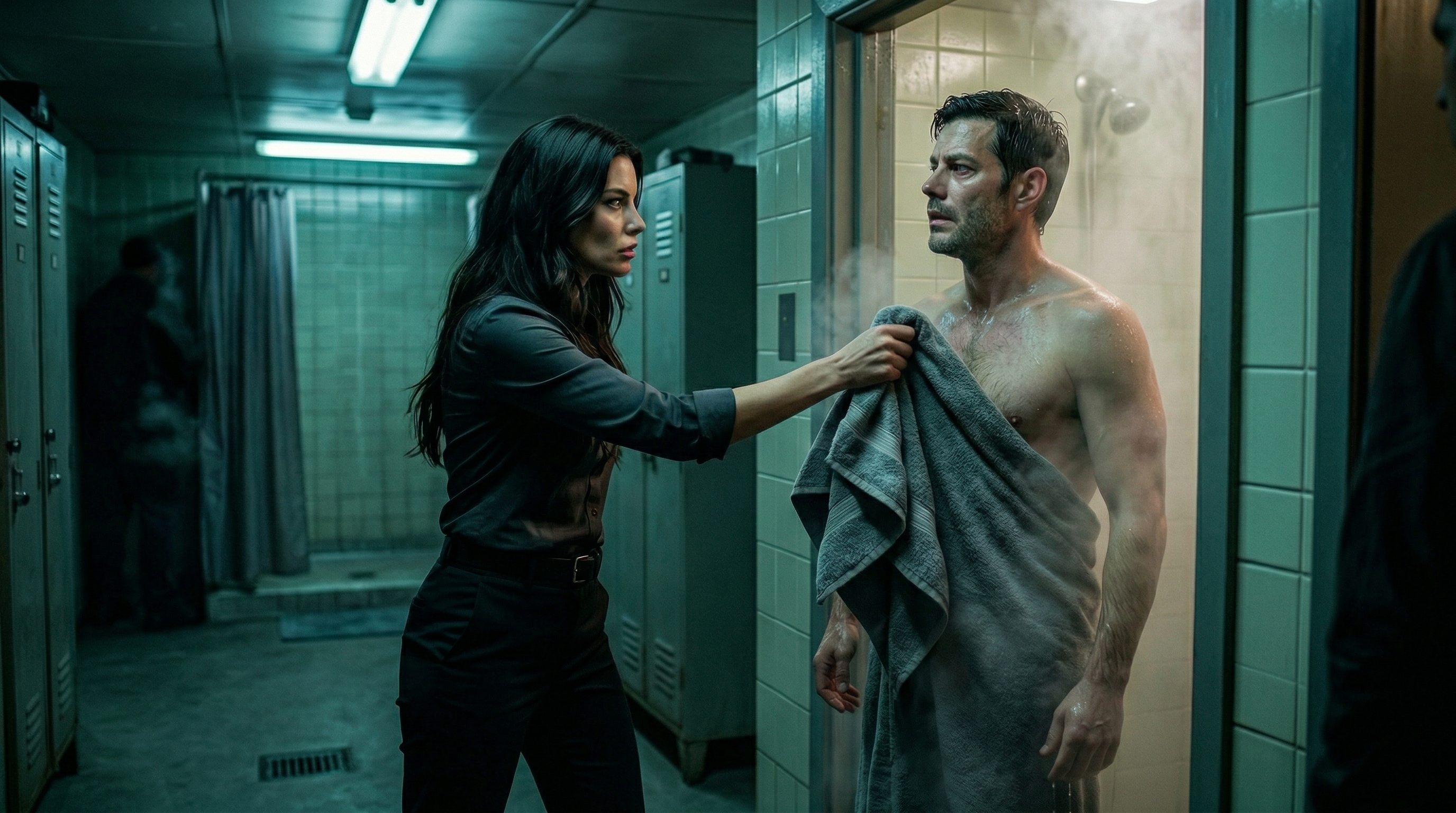
The men's changing room at Hobart Police Station occupied a space the building itself seemed to have forgotten — tucked between the vehicle bay and K9 holding, tiled in a shade of institutional green that had passed through unfashionable and into archaeological, the grout lines darkened to black by decades of accumulated grime that no amount of cleaning had ever troubled to address. The air carried the permanent residue of cheap soap and chlorinated water and something beneath both that was purely biological, the accumulated musk of a thousand showers laid down in strata like geological record. On any given morning, the room served its purpose without ceremony — men entered, men washed, men dressed, men left. The changing room asked nothing of them except that they keep the drains clear.
This morning, it was asked to hold considerably more.
Sarah Lahey had located Glen Crosswell at his desk with an enquiry about Karl Jenkins that she kept deliberately neutral and that Crosswell received with the predatory delight of a man who had been waiting for precisely this kind of opening. His response carried the familiar register of insinuation that he deployed like a calling card — the implication about her and Karl wrapped in the tissue-thin disguise of humour, the knowing smirk that communicated not merely awareness of their relationship but ownership of the knowledge, leverage held in reserve. Sarah absorbed it with the practised stillness of someone who had already paid the price for Crosswell's silence once and understood that the transaction would never truly be settled. She extracted Karl's location — the showers — and left Crosswell to his satisfaction, filing the exchange in the part of her mind that tracked debts and dangers with equal precision.
She did not hesitate at the door marked MEN. Whatever protocol governed the boundary between that door and the space beyond it, whatever unwritten codes separated the territories of male and female officers within the station's institutional geography, Sarah Lahey had decided that none of them outweighed the woman sitting in Interview Room Three with two missing people and a name she had offered like a lit fuse. She pushed through and moved into the steam with the focus of someone who had weighed the consequences and found them lighter than the alternative.
Karl stood dripping by an open shower cubicle, the water recently killed, steam still rising from his skin in slow coils that clung to the fluorescent light above him. The state of him registered immediately — grey beneath his usual colour, the toxins of the previous night sweating through pores that the shower had opened rather than cleansed, stubble darkening a jaw that was normally kept with compulsive precision. His eyes, when they found Sarah standing outside his cubicle, widened with the particular alarm of a man caught at the intersection of vulnerability and vanity, every professional pretence stripped away along with everything else.
She did not give him time to recalibrate. A towel was thrust into his chest with force enough to communicate that whatever discomfort he felt about the arrangement was his to manage, not hers. The urgency in her voice carried the specific weight of a case that had already begun to move without him, and the message was delivered without ornament: get dressed, come upstairs, this could not wait.
Crosswell had followed her down.
He materialised from the steam with the territorial ease of a man who considered this space his by right of decades' occupancy, a towel hanging around his middle with the precarious commitment of a flag at half-mast. His commentary arrived before his body did — a remark about Sarah's presence that carried the specific texture of a man marking boundaries by violating someone else's. He moved past her with calculated proximity, close enough that she would have felt the displacement of air against her skin, then shed the towel with theatrical indifference and stood exposed for a beat longer than function required before disappearing behind the curtain of the adjacent cubicle.
The performance was precisely what it appeared to be — territory claimed through the currency of discomfort, a reminder delivered in flesh that she had entered a space where the usual hierarchies did not apply in the usual ways. Karl's retort from behind his own curtain carried contempt but not surprise. Sarah's response carried revulsion that she did not attempt to disguise, the words landing with the particular sharpness of someone who had exhausted her capacity for tolerating what the institution continued to shelter. She thrust the towel, issued her instruction, turned, and walked out with a stride that carried its own authority — heels striking wet tile in a rhythm that dared the room to comment.
Three officers near the benches watched her leave. The room watched her leave. The room had always watched Sarah Lahey, and she had long since decided that being watched was a form of power she would claim rather than resist.
The door closed behind her. The steam resettled. And from the shadows near the entrance where he had positioned himself minutes earlier, having followed Sarah down from the upper floor with the unhurried patience of a man who preferred to observe before he intervened, Sergeant Charlie Claiborne stepped forward.
He had seen everything. The shower. The towel. Crosswell's display and the crude geometry of his provocation. Sarah's composure and the cost of maintaining it. Karl's wreckage, standing pale and dripping and shivering in the fluorescent light, looking less like a newly promoted senior detective and more like something that had washed up after a storm and hadn't yet worked out which direction was shore. Claiborne had catalogued it all with the quiet thoroughness of a man who had spent decades learning that the most useful intelligence was gathered by those who arrived unannounced and left unremarked upon.
A bar of soap slid from beneath Crosswell's curtain and came to rest near Karl's bare feet — a final schoolboy provocation, the kind of gesture that had stopped being funny sometime in the previous century but persisted in spaces where maturity remained optional. Karl dismissed it with a weariness that suggested the insult barely registered against the morning's larger catalogue of indignities.
Claiborne addressed Karl first. Two sentences, delivered without inflection, carrying the weight of rank deployed at its most economical. He confirmed what Sarah had already communicated — there was a woman waiting, and what she had to say warranted immediate attention. He offered no details. He offered no sympathy for Karl's condition. He offered only the clear understanding that the interview room required a detective, and that the man standing before him had precisely as long as it took to dress before that requirement became non-negotiable.
Then he turned to Crosswell's cubicle.
The knuckles struck the partition with the precision of a gavel — three sharp raps that carried the acoustic authority of a sound designed to end conversations rather than begin them. Claiborne's voice dropped a register into the tone that experienced officers recognised the way animals recognised the shift in air pressure before a storm. The instruction was simple: two minutes, desk, or graveyard shifts for the remainder of the week. The response from behind the curtain arrived strangled and stammering, the earlier bravado steamed out of it entirely, replaced by the unmistakable panic of a man who had just remembered that the chain of command had weight and that the weight could fall on him.
Claiborne permitted himself the ghost of a smile — brief, private, shared only with Karl in the fraction of a second before it vanished — and left with the same measured tread that had carried him in. His footsteps receded down the corridor, each one precisely placed, the sound of authority returning to its proper altitude.
What followed was collapse dressed as urgency. Crosswell erupted from his cubicle in a frenzy of damp limbs and wheezing breath, assembling himself into a detective with the coordination of a man building furniture without instructions. Underwear went on backwards and was corrected through an undignified shuffle. Shirt buttons misaligned across a torso still slick with shower water. The tie — yellow, patterned with cartoon ducks, chosen years ago by a wife whose patience deserved better than the man wearing it — hung unknotted like a surrender flag. Socks pulled over wet ankles, shoes jammed on and removed and jammed on again, jacket worn inside-out without correction. He left the changing room trailing shampoo flecks and the particular silence of a man whose performance of confidence had been punctured by three knocks on a partition wall.
Karl dressed alone in the quiet that followed. The suit he had selected hours earlier at his flat — charcoal, chosen for concealment, tailored just enough to project what he could no longer feel — went on over skin that was still damp, each garment a layer of armour assembled against the morning's demands. The tie cinched at his throat. The collar straightened. He stood before the mirror above the sinks and met the reflection that waited there — bloodshot, hollowed, stubbled, carrying the unmistakable evidence of a man who had spent the night destroying himself and the morning attempting reconstruction.
He pressed his forehead against the cool metal of his locker and held it there, feeling the surface bite against tender skin. One breath. Two.

