Sharon Louise Pafistis (née Reynolds)
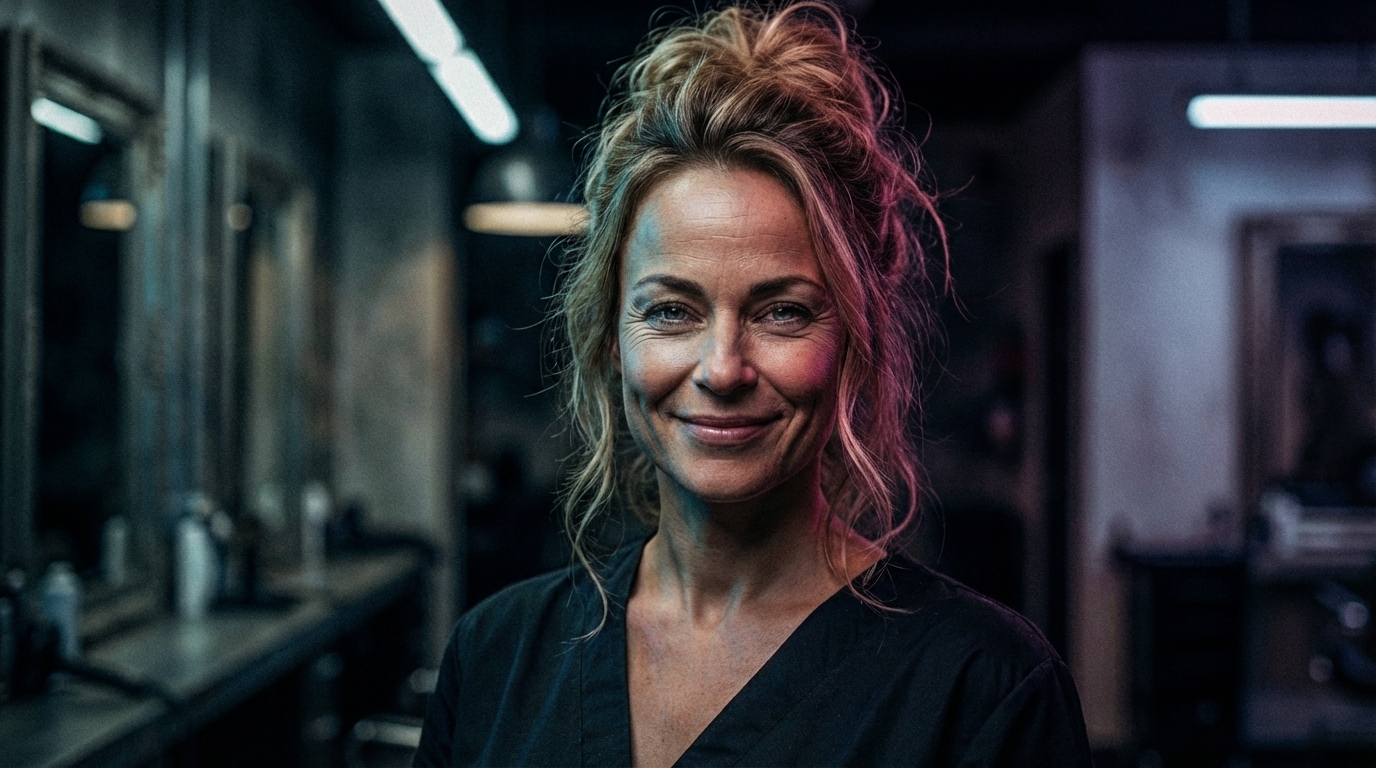
Sharon Louise Pafistis (née Reynolds), born 12 October 1975 in St Ives, Cornwall, is a talented British hairdresser and salon owner whose creative vision and entrepreneurial spirit took her from Cornwall's windswept coasts to Tasmania's shores. Founder of Serenity Hair and Beauty Salon in Hobart, she built a thriving business before her husband Adrian's mysterious disappearance in July 2018. Weeks later, Sharon and her daughters were brought through a Portal to Clivilius, where she faced the challenge of rebuilding family life in an unfamiliar world.
Cornish Roots and Coastal Beginnings
Sharon Louise Reynolds entered the world on 12 October 1975 in the seaside town of St Ives, located on the north coast of Cornwall, England. She was the third and youngest child of Margaret Ellen Reynolds (née Penrose, born 1942, Penzance) and Edward James Reynolds (born 1940, Newlyn). The Reynolds family resided in a modest but charming terraced cottage on Back Road West, just a short walk from Porthmeor Beach—a location that would become deeply woven into Sharon's earliest memories and fundamental identity.
St Ives in the 1970s was a town of striking contrasts—an ancient fishing port meeting modern artistic renaissance, where generations of families who had drawn their living from the sea existed alongside painters and sculptors drawn by Cornwall's singular quality of light. The town that had weathered Atlantic storms since medieval times, that had survived pilchard booms and devastating busts, provided Sharon with a childhood steeped in both hardship's pragmatism and beauty's possibility.
Margaret Reynolds owned and operated The Rose Harbour Tearooms, a popular establishment nestled on Fore Street, known for its homemade scones, loose-leaf teas, and stunning sea views. The tearoom was more than mere livelihood—it was Margaret's creative expression, her contribution to the community's social fabric, and her daily practice of the particularly Cornish art of making something beautiful from simple ingredients. Sharon would spend countless hours in The Rose Harbour's kitchen, absorbing lessons about presentation, hospitality, and the entrepreneurial spirit that would later define her own professional trajectory.
Edward, Margaret's husband, came from a long line of fishermen based in Newlyn, and captained the FV Cornelia, a 32-foot fishing vessel registered out of Hayle Harbour. Edward's days often began before sunrise, the rhythm of his life determined by tides, weather, and the mysterious movements of fish beneath Cornwall's cold waters. He was widely respected in the local fishing community for both his seamanship and his quiet wisdom about the sea's rhythms—a man of few words but profound competence, whose presence provided stability even as the Atlantic's moods shifted.
Sharon grew up alongside two siblings who would each chart distinctive paths. Thomas Edward Reynolds, born in 1967, would eventually follow their father into maritime life, though via a different route—becoming a marine engineer with the Royal Fleet Auxiliary, ultimately based in Portsmouth. Emily Grace Reynolds, born in 1970, pursued a career in early childhood education, becoming a nursery school teacher in Falmouth, maintaining closer geographical proximity to their childhood home.
The Reynolds household was known throughout St Ives for its hospitality and boisterous Sunday lunches, often attended by extended family and neighbours. These gatherings represented the best of Cornish community life—generous portions, lively conversation, the blending of generations, and the unspoken understanding that material modesty need never constrain warmth or welcome. Margaret's tearoom meant that Sharon grew up watching her mother work both creatively and tirelessly, establishing patterns Sharon would later replicate in her own business ventures—the understanding that customer service was fundamentally about making people feel valued, that attention to detail distinguished good work from excellent work, that building a business meant building relationships.
From an early age, Sharon displayed a strong creative streak. By the time she was seven, she was already making accessories from scrap fabric and experimenting with her mother's collection of Avon cosmetics. During summer fetes at St Ives Primary School, she would offer mini hair braiding sessions to classmates, using ribbons and clips she had collected from markets in Penzance. These weren't merely childish games but early expressions of what would become Sharon's professional identity—an intuitive understanding of how personal adornment could enhance confidence, how small aesthetic interventions could transform someone's self-perception.
She was particularly close to her maternal grandmother, Iris Penrose (1919-1993), who lived in nearby Carbis Bay. Iris was a retired seamstress who once worked for a tailoring house in Plymouth, and she nurtured Sharon's appreciation for fabric, design, and feminine expression. Together, they would watch classic films from the 1940s and 1950s on VHS—an experience that sparked Sharon's early interest in vintage hairstyles and old-Hollywood glamour. These viewing sessions weren't passive entertainment but active study, Sharon absorbing the visual vocabulary of different eras, understanding how hairstyles communicated status, personality, and cultural moment.
By age twelve, Sharon had begun keeping sketchbooks filled with outfit designs, hair ideas, and notes on products she had seen in magazines like Jackie and later Elle UK. Her room, decorated with clippings from Smash Hits and posters of Whitney Houston and Princess Diana, was a vibrant collage of the trends and dreams of a young girl beginning to shape her identity. The juxtaposition of American pop glamour and British royal elegance reflected Sharon's emerging aesthetic—a blend of accessibility and sophistication, warmth and polish.
Though their means were modest, Margaret and Edward were firm believers in education and encouraged each child to pursue their strengths. Sharon's natural affinity for aesthetics, her meticulous attention to detail, and her genuine love for people made her stand out even during formative years. Her upbringing in the vibrant yet tightly-knit St Ives community provided a foundation of resilience, creativity, and compassion that would continue to define her throughout her life—qualities that would prove essential when circumstances demanded adaptation beyond anything she could have imagined.
Education and the Formation of a Stylist
Sharon's formal education began at St Ives Primary School in 1980, situated near Talland Road overlooking the sea. The school—a progressive institution by the standards of Cornwall in that era—provided an environment where creativity was encouraged alongside academic fundamentals. Sharon quickly became recognised for her expressive creativity, especially in art and storytelling, and participated actively in school events including Harvest Festival Plays and the annual May Day Parade.
She was encouraged by teachers such as Mrs Angela Marsh, who recognised Sharon's particular talent for visual composition and personal styling. Sharon began experimenting with textile crafts from an early age, often creating costumes for school productions that demonstrated unusual sophistication for a child her age. In 1987, when Sharon was twelve, she won a local youth design competition sponsored by the Cornwall Women's Cooperative, with a paper dress design inspired by sea birds and local folklore. The piece was displayed for a week in the window of Harbour Gallery, giving Sharon her first taste of public recognition and validation that her creative instincts had value beyond family encouragement.
At age fourteen, Sharon earned a bursary to attend Truro High School for Girls, an independent school known for its strong academic performance and emphasis on arts and communication. The bursary—competitive and prestigious—represented significant achievement for a fisherman's daughter from St Ives, and Sharon's parents viewed her acceptance with a mixture of pride and trepidation about the social worlds it might open.
Sharon boarded during the week at Kea House, an experience that represented her first extended separation from family and coastal home. The adjustment was initially challenging—the formality of the institution, the subtle class distinctions amongst students, the expectation of excellence across multiple subjects rather than focused creative pursuits. Yet Sharon's artistic talent flourished under the guidance of Mr Jonathan Mallory, Head of the Art Department, who introduced her to artists such as Sonia Delaunay and Zandra Rhodes—figures who demonstrated that commercial creativity and artistic integrity need not be mutually exclusive.
Sharon's coursework in Art and Design, English Literature, and Textile Technology reflected her passion for visual storytelling and form. Her GCSEs, awarded in 1994, included A grades in Art, Design, and English, and she was given the Creative Achievement Commendation by Headmistress Miss Hilary Coates. Beyond academic achievements, Sharon contributed illustrations to the school magazine "The Kea Chronicle" and modelled in the annual St Agnes Charity Fashion Show—an event that would later inspire her involvement in community style events in Hobart.
Remaining in Truro for further education, Sharon enrolled at Truro and Penwith College in 1994, studying A-Levels in Art, Business Studies, and English Literature. The combination was unusual—most students focusing either on creative or commercial subjects—but Sharon's business tutor, Mr Paul Wickham, noted her unusual combination of creative vision and strategic thinking, a blend that would later underpin her success as a salon owner. During her time at the college, Sharon worked part-time at Tremayne & Co. Hair Studio in Penzance as a Saturday assistant, sweeping floors, booking appointments, and observing stylists at work. This early exposure strengthened her conviction to pursue a career in hair design and beauty services. She completed her A-Levels in June 1996, receiving grades of A (Art), B (Business Studies), and B (English Literature).
In 1996, Sharon was accepted into a full-time hairdressing apprenticeship with the prestigious Elite Hair Salon, located on Kenwyn Street, Truro. Under the mentorship of Jacqueline "Jackie" Berriman, a former stylist for the BBC's Pebble Mill, Sharon undertook rigorous training in modern and classical hairdressing techniques. Over two years, she earned both her NVQ Level 2 and Level 3 in Hairdressing, completing modules in Colour Theory and Application, Blow-drying and Finishing, Creative and Precision Cutting, Hair and Scalp Analysis, and Client Communication and Aftercare.
Her final assessment piece—a high-fashion editorial look inspired by 1960s Parisian mod culture—received distinction from the City & Guilds Examination Board in 1998. The piece demonstrated Sharon's signature ability to reference historical styles whilst creating something distinctly contemporary, to honour tradition whilst innovating, to understand both technical precision and artistic vision. These qualities would become hallmarks of her professional identity.
Love Across Oceans
In the summer of 1996, whilst working as an apprentice stylist at Elite Hair Salon, Sharon Reynolds met Adrian Louis Pafistis, a visiting builder from Melbourne, Australia, who was travelling through the UK on a six-month working holiday. Adrian, then aged twenty, had just completed his Advanced Diploma in Building and Construction at RMIT University and was undertaking short-term work placements across Europe and the UK to gain international experience before beginning his career back home.
They met through a mutual friend, Rachel Penman, a client of the salon and cousin to Adrian's temporary employer in Penzance. Sharon and Adrian were introduced during a local art exhibition at the Newlyn Art Gallery in August 1996, where they bonded over a shared interest in design—Sharon through fashion and textiles, Adrian through architecture and sustainable building. Their connection developed quickly, fuelled by long conversations about creativity and craft, day trips to Porthcurno and along the South West Coast Path, and weekends spent exploring Cornish villages and cafés.
There was an ease between them that belied their different backgrounds—Sharon's Cornish roots and artistic sensibility, Adrian's Greek-Australian heritage and analytical precision. Yet both shared fundamental values: commitment to quality work, appreciation for beauty in everyday things, understanding that true craftsmanship required patience and attention to detail. Adrian extended his stay in the UK by an additional month, unable to leave despite professional obligations pulling him back to Australia.
Despite the long-distance nature of their early relationship, they remained in close contact after Adrian's return to Melbourne in January 1997. The era before ubiquitous internet connectivity meant their connection was maintained through international phone calls—expensive and therefore carefully timed—and letters, the old-fashioned correspondence that required thought and commitment. Sharon visited Melbourne for the first time in April 1997, staying for three weeks and meeting Adrian's parents, Kostas and Helen Pafistis, at their family home in Brunswick East, Victoria. The visit confirmed what both had suspected—this was not merely holiday romance but something with potential for permanence.
Adrian proposed during a weekend trip to the Dandenong Ranges in September 1997, presenting Sharon with a ring he'd designed himself, incorporating elements that referenced both Greek and Cornish heritage. They were married the following year on 15 August 1998 in a romantic outdoor ceremony held at St Michael's Mount, Marazion, Cornwall. The ceremony—attended by over eighty guests including Sharon's extended family from Cornwall and Adrian's family who travelled from Australia—represented not just the union of two individuals but the bridging of two cultures, two continents, two families.
The wedding was quintessentially Cornish in many respects—the dramatic coastal setting, the local seafood, the involvement of extended community networks—yet it also incorporated Greek traditions through Adrian's family, creating a hybrid celebration that prefigured the bicultural household Sharon and Adrian would build together.
Building a Life in Tasmania
Following their wedding, Sharon and Adrian moved to Australia, initially living in Melbourne for several months whilst Sharon navigated visa requirements and began establishing professional credentials recognised by Australian industry bodies. The transition was significant—leaving behind family, familiar landscapes, the cultural context that had shaped her for twenty-three years. Yet Sharon approached the move with characteristic determination, viewing it as opportunity rather than loss.
In early 1999, Adrian accepted a project manager role at Horizon Builders in Hobart, Tasmania, and Sharon saw the move as chance to establish herself professionally in a growing, vibrant community. They relocated to Tasmania in mid-1999, initially renting before purchasing and extensively renovating a property in Battery Point by mid-2000. The renovation—a collaborative project that blended Adrian's architectural vision with Sharon's interior design flair—resulted in a spacious modern mansion that became simultaneously family home, creative expression, and social hub.
The Battery Point residence featured a grand entrance with Renaissance-inspired columns, a spacious foyer, and an expansive living area with soaring ceilings and floor-to-ceiling windows providing breathtaking views. The property included a luxurious heated pool, built-in BBQ for entertaining, and meticulously landscaped gardens with a vegetable garden reflecting Sharon's passion for fresh produce—a direct connection to her Cornish childhood where her grandmother Iris had maintained kitchen gardens. The home was featured in several Tasmanian lifestyle magazines, becoming known as an example of how European aesthetic sensibility could be successfully adapted to Australian coastal environments.
Determined to further her training and adapt to a new cultural and professional environment, Sharon enrolled in an Advanced Certificate Programme in Creative Hair Design at the Hobart School of Beauty, located on Collins Street. From February 2000 to October 2001, she specialised in Creative Cutting Techniques, Advanced Colour Correction, Up-styling for Events and Bridal Work, and Salon Management and Client Experience. Under the instruction of Marika Henderson, an acclaimed Melbourne stylist and guest instructor, Sharon developed signature styles that fused her British precision with emerging Australian trends.
Her coursework was complemented by practical experience at Belleza Hair Studio, where she was later employed full-time. She graduated with a Certificate of Excellence in Colour and Style Innovation, awarded by the Tasmanian Association of Hair Professionals, solidifying her reputation as a rising star in Hobart's beauty industry.
Professional Ascent and Entrepreneurial Success
Sharon's professional journey in Tasmania reflected steady progression built on exceptional skill, genuine client care, and strategic business development. From 1998 to 2000, she worked as Junior Stylist at Elite Hair Salon in Truro (prior to emigration), developing foundational skills and attracting a local client base. From 2001 to 2005, as Senior Stylist at Belleza Hair Studio in Hobart, she gained a strong following, praised for her artistic flair and empathy with clients—the ability to understand not just what clients asked for but what they truly needed.
Her reputation grew through word-of-mouth endorsements, the most valuable currency in the beauty industry. Clients appreciated Sharon's genuine interest in their lives, her ability to create both professional polish and approachable warmth, her technical precision combined with creative vision. From 2005 to 2010, as Lead Stylist and Assistant Manager at Belleza, Sharon took on managerial responsibilities and began mentoring junior stylists, demonstrating leadership capabilities that extended beyond personal technical excellence.
In 2010, Sharon took the significant step of founding Serenity Hair and Beauty Salon in Hobart. The boutique salon—located in a heritage building she and Adrian renovated specifically for this purpose—quickly gained reputation for excellence in personalised hair and beauty services. The name "Serenity" reflected Sharon's philosophy: that beauty services should be calming experiences rather than stressful ones, that clients should leave feeling renewed rather than merely altered.
The salon's interior design reflected Sharon's Cornish-Australian aesthetic—coastal colours, natural materials, vintage touches balanced with contemporary equipment. She created an environment where clients felt valued rather than processed, where appointments felt like conversations with friends rather than transactions with service providers. From 2012 onwards, Sharon served as Guest Lecturer at the Hobart School of Beauty, sharing her expertise with aspiring professionals. From 2014, she formally established mentorship programmes for apprentices, known for nurturing talent with patience and precision.
Between 2017 and 2018, Sharon also worked as Freelance Hair and Makeup Artist for local fashion events, often requested for editorial shoots and bridal styling due to her cutting-edge techniques and trend insight. Her professional network extended throughout Hobart's creative communities, making her a connector between different cultural spheres—from the practical working-class suburbs to the city's artistic elite.
Family Life and Motherhood
The couple welcomed their first child, Sarah Louise Pafistis, on 17 March 2002 at Royal Hobart Hospital. Sharon chose her own middle name for her eldest daughter—a quiet gesture of continuity and hope, passing forward something of herself whilst allowing Sarah to develop her own distinct identity. Sarah inherited artistic sensibilities from both parents, developing early interests in visual arts and physical wellness that would later manifest in her own creative practice.
Their second daughter, Brooke Isabella Pafistis, was born on 9 November 2006, a spirited child known for her musical talents—particularly piano—and adventurous nature. Sharon embraced motherhood whilst continuing to develop her career, often styling clients from home during the early years of her children's lives. She became known in the local community as a warm, grounded, and deeply engaged parent, often attending Albuera Street Primary School functions and organising fundraisers for local women's shelters through her salon networks.
Adrian, whilst managing his growing construction business, remained a committed and active father. Weekends were often spent hiking on Mount Wellington, attending Salamanca Market, or enjoying backyard barbecues. Their daughters recall evenings filled with storytelling, Adrian's laughter, and Sharon's calming presence—a household characterised by creative expression, intellectual curiosity, and genuine affection.
The Battery Point home became a hub for both family life and hospitality. Sharon maintained the Cornish tradition of hospitality she'd learned from her mother's tearoom, whilst Adrian's Greek heritage emphasised filoxenia—the sacred obligation to welcome others. They hosted regular gatherings that blended Sharon's Cornish warmth with Adrian's Greek traditions, creating a uniquely bicultural household where both daughters learned to embrace their complex ancestry. Sarah and Brooke grew up with stories of Cornish fishing villages and Greek card games, of their grandmother Margaret's Rose Harbour Tearooms and their grandfather Kostas's poker tournaments, developing identities that honoured multiple heritages whilst remaining distinctly Australian.
Sharon maintained close ties with her family in Cornwall through regular video calls and parcels of local Tasmanian goods exchanged for Cornish treats. When her mother Margaret died in April 2015, Sharon was devastated by the geographic distance that prevented her from being present during the final illness. The loss deepened her appreciation for the time she had with her own daughters, and she became even more intentional about passing forward the lessons Margaret had taught—about hospitality, quality work, genuine care for others, and the understanding that beauty services should be calming experiences of renewal rather than stressful transformations.
Her daughters developed dual heritage—Cornish and Greek-Australian—and Sharon actively encouraged them to embrace both aspects through food, music, and storytelling. Yet she also ensured they understood Tasmania as home, that their identity wasn't merely inherited but actively created through the lives they built together. After Margaret's death, Sharon began sharing more stories about her Cornish childhood, about The Rose Harbour, about the grandmother her daughters had known primarily through video calls and summer visits but who had profoundly shaped the woman and businesswoman Sharon had become.
Beyond family and work, Sharon maintained active community involvement. She was an avid reader with fondness for literary fiction and memoirs, often recommending books to salon clients and maintaining informal book discussion groups. She hiked the picturesque trails around Hobart and practised yoga, using nature and mindfulness to maintain balance amid life's demands. Her circle of female friends—many of whom had also faced various adversities—served as a support network rooted in mutual strength and authentic connection.
Family Tree Chart
The Disappearance and Its Aftermath
On the morning of 30 July 2018, Adrian left their Battery Point home to attend what he believed was a routine consultation with a new client, Luke Smith, regarding a renovation project in South Hobart. He never returned. Sharon reported him missing later that day after growing increasingly anxious when Adrian failed to respond to calls and texts—unprecedented behaviour for a man who maintained meticulous communication about his whereabouts.
The investigation was led by Detectives Karl Jenkins and Sarah Lahey, who uncovered unsettling parallels with another disappearance—Nial Triffett, who had also been in contact with Luke Smith shortly before vanishing. The detectives' visit to the Battery Point home marked the beginning of Sharon's transformation from successful entrepreneur and devoted wife into something else—a woman navigating the impossible space between grief and uncertainty, between hope and growing dread.
Detective Lahey would later note Sharon's composure during that initial interview, the way she maintained control whilst providing detailed information, her slight corrections about their marriage being "happy" (present tense shifting to past) revealing unconscious awareness that something fundamental had already changed. Sharon sent Sarah and Brooke to stay with friends whilst police investigated, protecting her daughters from the immediate machinery of official inquiry whilst privately confronting the growing possibility that Adrian might never return.
During this period, Sharon connected with Jenny Triffett, another woman whose husband had vanished in circumstances eerily similar to Adrian's. Their alliance—initially born from shared desperation for answers—would take both women into dangerous territory, breaking into properties and pursuing leads that official investigations had dismissed. Sharon revealed unexpected competencies during this period—an ability to pick locks, a willingness to cross legal boundaries in pursuit of truth, a capacity for calculated risk that surprised even her. Whether these skills had always existed or emerged from necessity remained unclear, but they suggested depths to Sharon's character that her professional poise had previously concealed.
Threshold and Transformation
The truth about Adrian's disappearance was far stranger than any investigation could have uncovered. He had not been lost but taken—pulled through a Portal into another dimension called Clivilius. On 17 August 2018, weeks after Adrian's forced transition, Sharon and daughters Sarah and Brooke were themselves brought through the Portal in a carefully orchestrated secondary transition event.
The reunion with Adrian in the settlement of Bixbus was complex—joy tempered by trauma, relief complicated by anger at the circumstances of their forced migration, love tested by months of separation and the impossibility of their new reality. For Sharon, the crossing represented the ultimate disruption—everything she had built across two continents, the business she had established through years of dedicated work, the community networks she had carefully nurtured, the life she had constructed for her daughters—all abandoned or transformed beyond recognition.
Yet Sharon approached Bixbus with characteristic determination. If her family was here, if return to Earth was not immediately possible, then this place needed to become more than mere survival camp—it needed to become liveable, perhaps even beautiful. She brought her aesthetic sensibility and organisational skills to Bixbus, helping establish community structures that transcended basic survival needs. Her experience in client care, in creating spaces where people felt valued and welcomed, proved unexpectedly relevant in a settlement of traumatised refugees navigating impossible circumstances.
Sharon's professional skills found new application in Bixbus. She established informal beauty services for settlement residents, understanding that maintaining personal appearance—often dismissed as vanity—was actually essential to psychological wellbeing, particularly in contexts where so much else had been stripped away. Her work became about more than hairstyling—it was about preserving dignity, maintaining human connection, creating moments of normalcy and care within an alien landscape.
The adjustment was not without profound challenges. Sharon watched Sarah struggle with resentment and artistic frustration, witnessed Brooke's musical talent seeking expression without proper instruments, navigated her own complex feelings about Adrian and the weeks of separation that had changed them both. The Battery Point mansion—that perfect expression of their shared vision—remained behind on Earth, frozen in time, a monument to dreams interrupted.
Yet Sharon persisted, drawing on the resilience inherited from Cornish fishing stock, from generations who had survived storms and privation, from her grandmother Iris who had stitched beauty during wartime, from her mother Margaret who had built community through tearooms and scones. She understood what her ancestors had always known—that home was not merely a place but a practice, not simply geography but the ongoing work of creating spaces where human life, in all its complexity and vulnerability, could continue.


