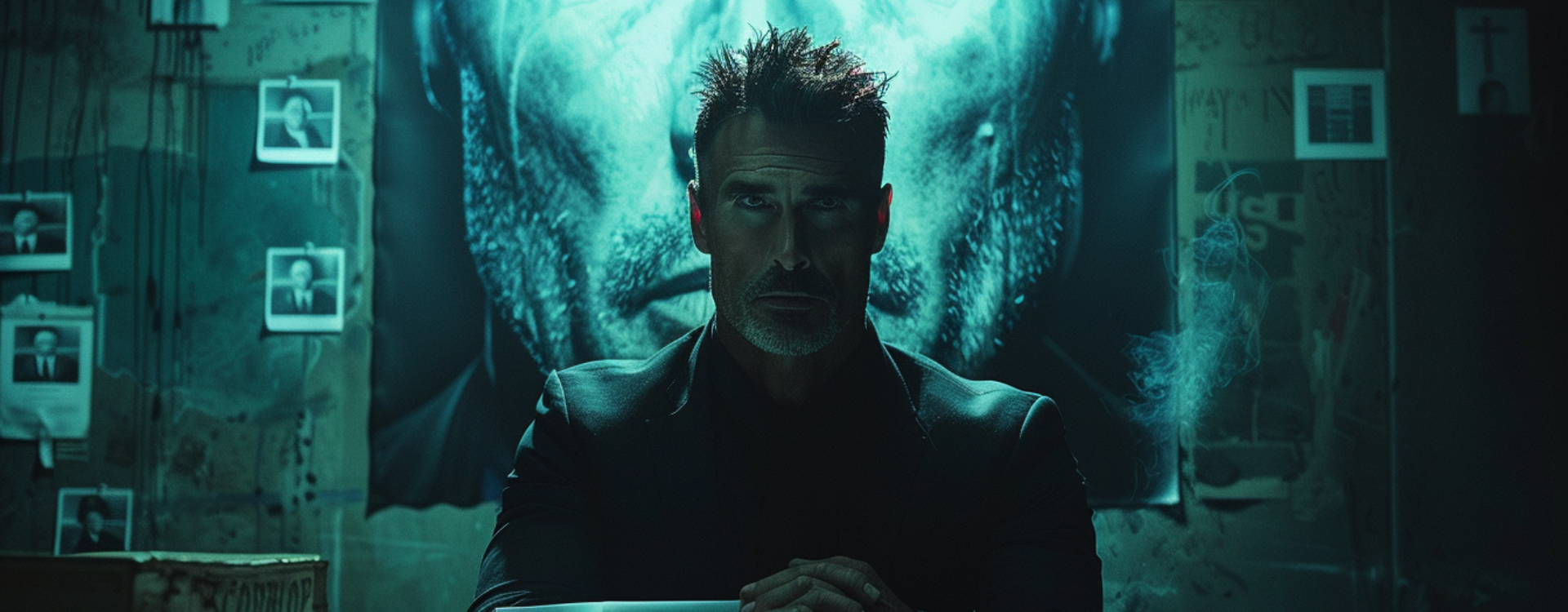
4338.213 · August 1, 2018 AD
Scapegoat
With a body buried hidden in the cupboard and no badge to hide behind, Karl faces the full weight of suspicion as someone reports him fleeing Luke Smith’s home. Benched, unravelled, and out of options, Karl begins to rewrite the story—shifting blame with quiet precision, even as the line between survival and betrayal begins to vanish beneath his feet.
“It’s not the lie that gets you—it’s how easy it is to tell yourself it’s the truth.”
"Detective Jenkins," Sergeant Claiborne called out as I walked by his office door. "A word in my office, please."
The summons froze me mid-step, muscles locking involuntarily. I turned, pulse quickening despite attempts to control it. The tone of his voice—cool, clipped, formal—wasn’t casual or collegial. It was official. Immediate. Ominous. As I approached Sergeant Claiborne’s office with reluctant steps, my pace slowed, a mix of reluctance and apprehension knotting in my stomach that was still tender from last night’s impacts.
"Detective Jenkins," he repeated, this time louder.
My heart, steady until now, kicked into overdrive, thudding a nervous rhythm against ribs that were still bruised from tumbling down Luke’s stairs. I paused just outside the office door, forcing a breath into lungs that had suddenly forgotten how to function properly. My mind scrambled for answers—had someone reported what happened last night? Had they found the body already? No. I had checked the internal logs myself before anyone else arrived this morning, scrolling through every entry with paranoid attention. Nothing. Not a whisper about a body or a break-in.
Still, anxiety coiled inside me like a living thing, tightening with each heartbeat. That body under the stairs wasn’t going to stay hidden forever. Bodies never did. The longer it remained undiscovered, the worse it would be for me when the truth emerged—and it always emerged. But some part of me—hopeful, delusional, desperate—clung to the idea that this meeting might be about something else entirely. Something routine. Maybe Claiborne wanted a case update on the Pafistis investigation. Maybe he’d found something new on Luke. Or maybe—
My thoughts snagged on an old, half-forgotten detail that surfaced unbidden: the note from Jamie Greyson, the one I’d lost years ago after the river incident. At the time, I hadn’t thought much of it—hadn’t even reported it missing. The message was seared into memory anyway, and without context, it was just a few odd scribbles on paper. Harmless. Wasn’t it?
Steeling myself with a breath that did nothing to calm my racing heart, I stepped inside the office.
The space was oppressively quiet, the air thick with a tension that made my skin crawl and my collar feel too tight. Files and case folders blanketed Claiborne’s desk, but his eyes were already on me, unreadable behind that damn poker face of his that gave away nothing.
"Yes, Sergeant. What would you like to see me about?" I asked, my voice steady—just barely. My palms, however, were clammy inside my pockets, and the back of my neck itched with sweat that had nothing to do with the station’s temperature.
He leaned forward slightly, hands clasped together on the desk in a gesture that was almost prayer-like. "It appears there has been a break-in at Luke Smith’s house," he said evenly, each word measured.
My stomach dropped like a stone thrown down a well.
"A break-in?" I echoed, managing to feign surprise despite the cold dread flooding through me. The words struck like a cold slap to the face. "When did that happen?" I added, forcing my voice not to crack or waver, channelling years of interrogation training.
Claiborne’s gaze held mine, steady and assessing, looking for cracks. "Not sure yet. It was reported very early this morning."
That made no sense. I’d checked the logs meticulously—every report filed between midnight and now, every call logged, every incident recorded. There’d been nothing. Unless… someone had buried the report. Kept it off the official books. But why? Why report a break-in and then want it hidden from standard channels?
I resisted the urge to shift on my feet, to give any physical tell. Claiborne’s gaze felt like it could see through layers of skin—through bone and sinew and lies—down to the secret I was straining to hide. My throat was dry as dust, tongue stuck to the roof of my mouth, but I nodded with what I hoped passed for professional concern.
"I’ll grab Detective Lahey and we’ll go and check it out immediately," I said, already turning, eager to escape that office, that scrutiny. I needed time. Space. I needed to think, to plan, to control the narrative before it controlled me.
"No, Karl," he said, flatly, the use of my first name stopping me more effectively than a hand on my shoulder.
I stopped, turning back slowly, dread clawing at my insides with sharp talons. "What do you mean, no?" My voice was quiet now, low and tight, a thread stretched too far, ready to snap.
"The caller wanted to remain anonymous."
The way he said it. Calm. Measured. Deadly.
Something inside me turned to ice.
"And what exactly did they report?" I asked, already knowing full well that I didn’t want to hear the answer.
"They said they saw you running from the property late last night," Claiborne said, watching my face carefully. "They gave your name, Karl."
There it was. A sucker punch to the gut delivered with bureaucratic precision, and I staggered under the weight of it, though I didn’t move an inch physically. My ears rang. My mind reeled. Someone had seen me fleeing. Someone had named me specifically. Not “a suspect” or “an individual”—me.
"What made them think it was me?" I asked, voice sharp with disbelief that was both real and carefully rehearsed. I was buying time, trying to process the rapidly narrowing options ahead, calculating probabilities and outcomes.
Claiborne exhaled slowly, like this was hurting him too, like he wished it were different. "They gave your name," he repeated with emphasis. "I have to put you on desk duty until further notice."
"What!" I barked, the word erupting before I could stop it, before training could reassert control. "That’s ridiculous!"
My head spun, trying to calculate the odds, running through possibilities. Who had seen me? Who could have recognised me in the dark, from any distance? My mind flicked through faces like flashcards—neighbours, fellow officers, informants, witnesses from past cases—anyone who could have connected the dots between a fleeing figure and Detective Karl Jenkins. And then… Sarah?
The thought lodged like a splinter.
"Do you know whether it was a male or female that called it in?" I asked, urgent now, voice taut with the panic I was struggling to contain beneath professional veneer.
His face hardened into granite. "You know I can’t tell you that."
"This is bullshit!" I hissed, each word laced with frustration, fear, and something dangerously close to despair that threatened to crack my composure entirely.
He didn’t flinch. Didn’t react. Just watched me with that steady, assessing gaze.
I pulled my gun from its holster slowly, deliberately, my fingers reluctant, stiff with resentment and the muscle memory of years carrying it. The heft of it was familiar, comforting, an extension of myself, and giving it up felt like surrendering a limb. With a hollow clunk that echoed in the quiet office, I laid it in his outstretched hand.
Then my badge. That stung more than the weapon.
The small, unremarkable bit of metal was suddenly the heaviest thing I had ever held in my hand. I stared at it for half a second too long before placing it on the desk beside the firearm, the gesture quiet and devastating, final.
The silence that followed was absolute, pressing down on me like a held breath.
I turned on my heel and left without another word, the sound of the door clicking shut behind me echoing like a closing cell door, like the sound of a life ending.
Whatever game Luke Smith had been playing, I was no longer just a player. I was a piece being moved by unseen hands.
And the board had just turned against me.
The moment I threw my jacket onto the empty seat in the corner of the squad room, I could feel every eye in the room on me, a physical pressure. The fabric landed with a soft thud, a stark contrast to the turmoil raging inside me that threatened to spill out. Conversations halted mid-sentence. Even the usual clatter of keyboards slowed to sporadic taps. I didn’t need to look up to know they were watching—some with curiosity, others with thinly veiled judgement, a few perhaps with sympathy. Rumours travelled fast around here, especially when a senior detective was abruptly benched. Whispers would already be starting.
I slumped down at my desk, a fortress of paperwork and cold coffee mugs that had accumulated over days of obsessive work, feeling a huff of frustration escape my lips. The sound felt loud in the sudden quiet that had descended. I ran a hand through my hair, then pressed my fingers against my temples, trying to ease the throb that had settled behind my eyes and never quite left since the nightmare.
I’ve royally screwed myself over this time, I chastised silently, the internal voice harsh and unforgiving. The thought repeated in my mind, relentless, like a drip of water on concrete—one drop at a time, slowly wearing me down, eroding whatever foundation remained. I could still feel the phantom weight of my badge in my pocket, the sudden hollowness on my hip where my sidearm had sat like a second limb for years.
I knew coming into work today had been a mistake the moment I’d walked through the doors, but I couldn’t have predicted it would turn out like this. Couldn’t have imagined I’d leave this building stripped of authority.
The air felt thick, like the pressure before a storm breaks. I shifted in my chair, suddenly acutely aware of how stiff and bruised my body was from the fall down the stairs, from the headlong run through streets, from the sheer physical and emotional toll of the past twenty-four hours. The desk—normally a place of focus and resolve—now felt like a prison cell, the walls made of old case files and cooling resentment, the ceiling closing in.
My attempts to reach Sarah since last night had been futile and increasingly desperate. Each call went straight to voicemail. Each text unanswered, marked as “delivered” but never “read.” It has to be her that called it in. The thought circled like a vulture, black-winged and merciless, refusing to land but never leaving. The only person who knew I was at the Smith property... was Sarah. She’d been the one to call Jamie’s phone while I was inside. She’d known, somehow, exactly where I was and what I was doing. That timing wasn’t coincidence. It couldn’t be.
But the why eluded me, scratching at my brain like a puzzle piece that didn’t fit. That was the thing I couldn’t make sense of, the equation that wouldn’t balance. Why warn me to get out—genuine panic in her voice—and then report me to Claiborne? It was like catching someone in the act of pulling the trigger and then watching them try to patch the wound. The contradiction made my head ache worse, made my thoughts spiral.
The possibility that Sarah might be involved in the disappearances sent a shiver down my spine. My fingers tightened around the edge of the desk until the tendons stood out beneath my skin like wires. It was a thought so chilling, so fundamentally wrong, that it felt like it might split my brain in two. We argued—God, did we argue—but that was part of the strange gravitational pull between us. The friction that, in some twisted way, kept us in orbit around each other, kept the partnership functioning.
But this... this was betrayal on a scale I couldn’t comprehend. The kind that cleaved bone from soul, that severed connections I’d thought were permanent.
The trust I thought was there, no matter how fractured or volatile, now seemed like an illusion I’d maintained through wilful blindness. A fragile construct built on assumptions and half-truths. A house of cards teetering in the wind, and now I was watching it collapse in slow motion, powerless to stop it.
I stared blankly at the clutter on my desk. An uncapped pen. A half-eaten protein bar from yesterday. A stack of witness statements yellowing at the edges. Each object was a relic of a life that, only days ago, had felt ordered, purposeful—even when chaotic. Now, they felt absurd. Foreign. As if they belonged to someone else, someone who hadn’t killed a man and hidden his body.
The squad room, usually humming with low conversation and the sharp cadence of investigative momentum, felt distant. Muffled. Like I was underwater. I heard laughter from the far side, the rustle of someone wheeling a chair back, the muted buzz of a phone. But none of it reached me properly. I was in the eye of my own personal storm, the world moving around me while I sat paralysed in its centre.
The pieces of this puzzle had turned sharp. Dangerous. And I was bleeding before I’d even begun to put them together.
The bitterness that lingered in my mouth, a physical reminder of my current predicament, was still potent as I answered the desk phone. "Detective Jenkins," I said, trying to sound as composed as possible under the circumstances, though my voice came out rough.
"Detective," a man’s voice came through, clear and professional. "This is Detective Jeremy Harding from the Broken Hill Police Station," he introduced himself.
"Broken Hill?" I echoed, my surprise evident in my tone. My eyebrows arched involuntarily. Broken Hill—the name alone conjured images of blistering sun, desolate highways and red-dirt plains stretching into nothing. "Isn’t that the tiny mining town in the middle of nowhere?" I asked, the mental picture solidifying: corrugated iron rooftops, pubs with faded signage, and heatwaves rising off the bitumen.
"It’s called the outback," Detective Harding replied with a chuckle, a touch of humour that softened his professional cadence.
Despite the gravity of my situation, I felt the corner of my mouth twitch. A thin smile surfaced and faded just as quickly. In a job filled with corpses and chaos, gallows humour was a universal language. "You’ve got my curiosity piqued. What can I do for you, Detective?" I asked, leaning back in my chair. For a moment, the pressures of Claiborne, desk duty, and the body hidden beneath the stairs faded behind the curtain of duty. I needed this—something familiar to grip.
"I’m investigating the disappearance of a young man who is believed to have travelled from Broken Hill over a week ago after getting into an argument with his wife, and he has not been heard from since," Harding began. "According to our investigation, we understand his brother bought him a plane ticket to fly from Adelaide to Hobart. Security footage has confirmed that Paul boarded the flight, but we’ve been unable to contact the brother," he explained.
I sighed silently, my eyes drifting to the tower of case files on my desk. Another disappearance. Another file to add to the growing pile. What’s the deal with all these missing men lately? The question drifted through my head like a spectre, and with it came a bitter taste in my throat. Each new case felt like a stone being added to an already overloaded rucksack slung across my back.
"And what is the brother’s name?" I asked into the phone, my hand moving automatically to the notepad, pen poised like muscle memory.
"Luke," the voice on the other end replied, casually at first. Then, slowly: "Luke Smith."
"Luke Smith?" I repeated, my hand freezing mid-scrawl, the pen hovering above the page. The name rang out inside me like a fire bell, reverberating with all the subtlety of an explosion.
"Yes. That’s correct," the detective confirmed.
"Shit!" The word escaped me before I could throttle it back. It hung there in the air like smoke from a gun.
"You know him then?" Harding’s voice crackled through the line, his tone shifting from formal to curious.
I rubbed the centre of my forehead, willing the pressure in my skull to abate. How many bodies would we find at the end of all this? That was the question now—no longer if, but how many. This wasn’t an isolated disappearance. It was a bloody pattern. A ripple becoming a wave.
"Yeah," I finally replied, the word thick with fatigue and buried anger. "We’ve been investigating him for the last week. We suspect he is responsible for the disappearance of at least five other people. I wasn’t aware that his brother was in the state."
There was a brief pause on Harding’s end, perhaps a breath of shared dread passing down the line. "We were hoping you might be able to check and confirm for us where Paul went after leaving the Hobart airport. Assuming he actually left the airport," he said, his voice tight with the uncertainty of someone trying to plug holes in a leaking dam.
"Sure," I agreed, the tone of my voice hardening slightly as the old detective in me stirred fully awake. The job always had a way of pulling me back in, even when I was drowning. "Email me through the flight details and I’ll look into it straight away." I scribbled a note on the pad, a jagged scrawl, the pen moving faster than my mind could process. The act of writing—of recording something clear and real—offered a lifeline. Something I could do.
"The rest of Luke’s family live in Adelaide. Do you think they might be in danger?" Harding’s question carried a gravity to it, the kind that suggested he already feared the answer.
"Hmm," I mused aloud, buying a few seconds to recalibrate. Luke had always been at the centre, but the perimeter was expanding. Now family, too? I leaned forward, pressing the heel of my hand against my chest, trying to steady the rising tide of unease. "We’re monitoring all airports and ports out of Tasmania. I think it’s unlikely he’d slip past and make it to the mainland. But I’ll let you know the moment I find anything."
"Thank you, Detective Jenkins," Harding said. There was a mutual respect in his tone—two detectives navigating the same minefield from opposite ends. Then he hung up.
The phone clicked softly as I returned the receiver to its cradle. I sat motionless for several seconds, the silence around me roaring with new implications. Paul Smith. A new name, a new thread. How many others are tangled in Luke’s web?
I picked up the notepad, scanning my own frantic scribble: PAUL SMITH – flight from Adelaide. The name stared back at me, an accusation and a plea. Another missing man. Another potential corpse.
And now, perhaps… a trail.
In a moment of frustration, I threw a pen at the wall in front of me, watching as it clattered against the surface and fell to the floor. The sound echoed through the office, a stark reminder of my growing agitation. It wasn’t just the noise—it was the finality of it, the empty little gesture of someone coming apart at the seams. I’d been so laser-focused on Jamie and the intricacies of his disappearance that I hadn’t even considered reaching out to Luke’s family. The thought struck me like a slap, raw and unfiltered. It was an oversight, a rookie error that gnawed at me. I should have known better. I did know better.
Maybe the Sergeant was right. Maybe I was too close to this case—too caught up in its knotted threads, too blinded by my own proximity to see the broader picture. The truth was hard to swallow, bitter and sharp, and it scraped the inside of my throat as I sat there, feeling every one of my failures hang like weights from my limbs.
I leaned back in my chair, its old joints creaking beneath me, and stared up at the ceiling like it might provide answers. The fluorescent lights buzzed faintly overhead, matching the low hum of static that had taken residence in my brain. The sum of every decision, every misstep, every moral compromise pressed down on me, unrelenting. I had always believed I could keep the line between professional and personal firmly drawn, but now the chalk had blurred and bled. The edges were gone, and I was adrift in the grey.
Then, like a flare in the fog, the dark screen of my phone lit up, slicing through the gloom. A message. I lunged for it with a desperation I didn’t care to hide. My eyes snapped to the screen, already hungry for something to anchor me—some sliver of progress or certainty in this haze of confusion. A surge of adrenaline pushed through me as I read the message.
Officer: Detective Jenkins - Luke caught first flight from Hobart this morning, bound for Adelaide. Flight would have landed by now.
This is perfect, I thought, the logic forming with clinical speed. A plan began to take shape—strategic, ruthless, necessary. If I play my cards right, I may just be able to pin last night’s… accident… on Luke. The cold calculation in my own thoughts startled me, but I didn’t stop. I couldn’t. The move made sense—simple, effective. If the information was accurate, Luke’s hasty exit from the state, under cover of dawn, would only deepen suspicion. To anyone else, it would reek of guilt.
And I wanted it to reek of guilt.
I knew what I was doing. It wasn’t justice—not in the purest sense—but it was survival, and in this moment, survival felt like the only thing left within reach. I pressed the phone to my ear and dialled Adelaide CIB, my voice level and precise as I relayed the details.
I told them we had just received intel about Luke Smith, a primary suspect in the disappearance of at least six individuals, including his partner and his own brother. I didn’t need to exaggerate—his name already reeked of shadows. I reported that he had landed in Adelaide this morning. I added, carefully, that he might be experiencing a psychotic break, and that his family, still residing in the area, could be in danger.
I heard the subtle shift in tone on the other end of the line—the alertness, the quickened pace of typing, the understanding that this was not a drill. I suggested they send a patrol to Luke’s parents’ address immediately. Urgency wrapped every word, and when the officer on the other end confirmed the dispatch, I thanked them and hung up.
And then I just sat there.
Slumped back into my chair, the tension that had held my body upright now melted into a puddle of aching muscle and empty fatigue. I stared blankly at the muted screen of my computer. A thick silence hung in the room, broken only by the distant ringing of someone else’s desk phone and the low murmur of conversations I could no longer follow. I should have felt vindicated. I should have felt smart, even triumphant. I’d taken a step to protect myself, shifted the spotlight, bought time.
But instead, a hollow nausea bloomed in my gut, creeping up through my chest, thick and insidious.
It didn’t feel like strategy—it felt like betrayal. Not just of the badge lying on Claiborne’s desk, but of something inside myself, something I’d once believed was incorruptible.
The screen stared back at me, black and unblinking, mirroring the darkness I’d just stepped further into. I’d set something in motion. I couldn’t take it back. And as the silence pressed in, I realised with sick certainty that this wasn’t over.
It was only just beginning.
