Sandra Elizabeth Langley
Sandra Elizabeth Langley, born in Launceston on 15 August 1972, joined Tasmania Police in 1995 after an honours degree in criminology, and spent her whole career at the Hobart station — general duties, community policing, and finally family violence response. Married to James Chugg, with two children, she was the officer who assessed Nial Triffett's disappearance as a domestic walkout on the night of 28 July 2018, and never entirely put the finding down.
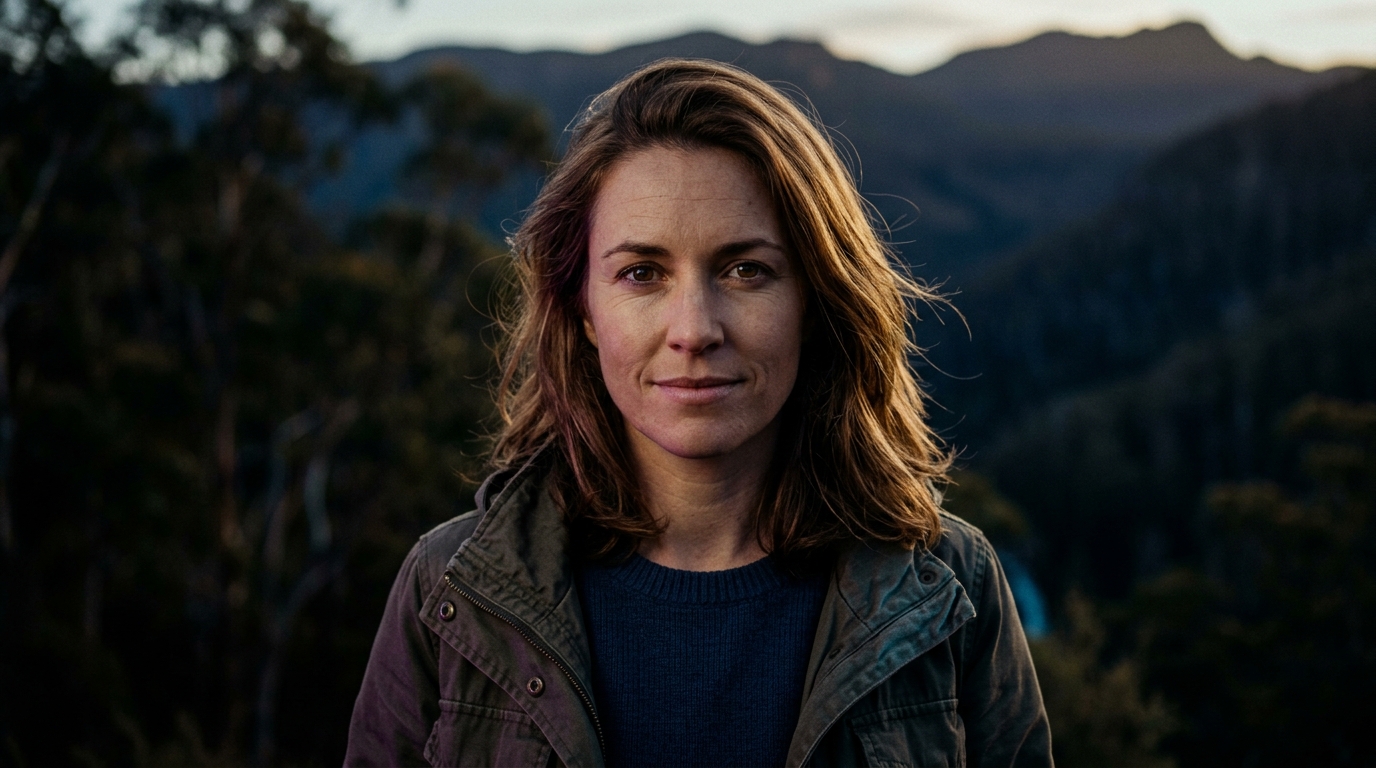
A Hydro Man's Daughter
Sandra Elizabeth Langley was born on 15 August 1972 at the Queen Victoria Hospital in Launceston, the third of the four children of John Edward Langley and Catherine Anne Langley, née Fitzallen. John, born at Deloraine on 8 March 1944, was a fitter with the Hydro-Electric Commission and spent the better part of Sandra's childhood in the highlands, at Poatina and later on the Gordon scheme, home for four days in every fourteen and asleep for most of the first of them. Catherine, born in Launceston on 22 June 1947, worked the dispensary counter at the Launceston General Hospital until the children came and afterwards in the canteen at Mowbray Heights Primary.
The family lived in a cream brick-veneer house off Vermont Road in Mowbray, four bedrooms after John built the sleepout, with a Hills hoist and a lemon tree that never did much. Peter John had been born on 12 March 1967 and Raymond Douglas on 30 September 1969. Kerry Anne arrived on 4 July 1979, seven years after Sandra, and was treated by the whole household as a small visiting dignitary.
It was not a poor house but it was a carefully managed one. Catherine kept the shift roster on the fridge door under a magnet shaped like a strawberry, and the household ran off it. Sandra learnt early that a woman could hold an entire domestic structure together on a calendar and a tone of voice, and that nobody would ever remark on it.
She was tall by twelve and taller by fourteen, which decided a good deal for her. She played basketball three nights a week at the Elphin Sports Centre, badly at first and then very usefully, and coaches called her unselfish, meaning that she could see the whole floor and was not much interested in scoring. She was not the cleverest of the four children — that was Raymond, who wasted it — but she was the one who finished things.
In the winter of 1988 somebody came in through the laundry window of the Vermont Road house while the family were at Peter's engagement party and took the television, a camera and Catherine's rings. A constable came the following morning, a young one, and sat in the kitchen and drank a cup of tea and wrote in a notebook, and nothing whatever came of it. What lodged in Sandra was not the burglary and not the failure. It was that her mother had apologised to him for the state of the kitchen.
Eighteen Thousand Words on Discretion
She finished at Launceston College at the end of 1989, having intended for most of two years to become a physical education teacher. She changed her mind in the last term for reasons she was never able to make sound principled, and enrolled instead at the University of Tasmania in Hobart, in a Bachelor of Arts majoring in criminology and police studies.
She was the first of the Langleys to go to a university and the family treated it as slightly comic, which was their way of being proud. She moved to Hobart in February 1990, into a cold weatherboard share house in Lenah Valley with three other students and a wood heater that had to be coaxed, and worked Thursday nights and Saturdays at a bakery in Salamanca Place to cover the rent.
She was a steady rather than a brilliant student for three years. The honours year was the one that mattered. Her thesis, submitted in October 1994, examined the exercise of discretion by frontline officers in northern Tasmania — specifically, how the decision was made at the front door as to whether a complaint became a recorded offence or a line in a running sheet. She read three years of station records at Launceston, Deloraine and George Town, and interviewed nineteen officers.
Her finding was blunt and slightly unwelcome. The decision was substantially made in the first four minutes, and it was made less on the facts disclosed than on the officer's reading of the household — its tidiness, its noise, the way the complainant held herself, whether the story arrived in the right order. She graduated with first-class honours in December 1994. Her supervisor spent an afternoon trying to talk her into a scholarship and a doctorate.
She had already sat the police entrance examination. When people asked her, over the following thirty years, why she had joined, she generally said it was for the superannuation. This was a deflection, and it was also true, and she was never entirely sure which of those was doing more of the work.
The Van
She began recruit training at the Tasmania Police Academy at Rokeby in February 1995, twenty-two years old, in a squad of thirty-one that contained six women. She was competent on the practical assessments, indifferent on the range and in the top third academically, and the phrase in her final report was a safe pair of hands. She was pleased with it at the time. She heard it as a ceiling later on, and she was not wrong.
Sworn in November 1995, she was posted to the Hobart Police Station as a probationary constable and took a flat above a shop in North Hobart. She stayed at that station, in one form or another, for the whole of her career.
The first eight years were general duties, which in Hobart in the late nineties meant Liverpool Street at closing time, the cells, the Brooker Highway, and a great many kitchens in Bridgewater, Gagebrook and Claremont at two o'clock in the morning. She was good at it in an unshowy way. She had a low, level voice that did not rise, and she discovered that she could walk into a room where two people had been screaming at each other for an hour and have them both sitting down within ninety seconds, and that this was a genuine and rare skill and that nobody was ever going to promote her for it.
Between 1999 and 2001 she attended a house in Claremont eleven times. The woman who lived there was Robyn Wells, who was thirty-four and worked at a chemist and who would not make a statement, ever, about anything. Sandra went to that door in every possible mood — patient, brisk, exhausted, and once, in the small hours of a Sunday in the winter of 2000, close to sharp with her. The last attendance was in February 2001 and the entry Sandra wrote at the end of it read no offences disclosed, parties separated for the night.
Robyn Wells was killed by her partner in June 2001. Sandra gave evidence at the Supreme Court the following year, for eleven minutes, and was not criticised by anybody.
What she took away from it was a working rule, and she carried it for the next seventeen years and taught it to every probationer she was given: when a person has gone, or been hurt, or will not talk, the answer is almost always inside the marriage, and you have to go in and get it, and you do not get to be squeamish about how you ask. It was a lesson learnt from the worst thing that had happened to her, and it was substantially correct, and it was the reason she got the single most consequential assessment of her career exactly wrong.
Daylight Hours
In 2003 she transferred to the Community Policing Unit. Some of her colleagues regarded this as a soft landing and one or two of them said so, which she did not much mind and did not forget either. Her actual reason was that she was thirty years old and had not had a complete weekend since 1995.
The work was school visits, bicycle rodeos, neighbourhood watch meetings in cold church halls, and, increasingly, seminars for older people about the men who rang up claiming to be from the bank. She was very good in front of a room of teenagers, largely because she declined to perform for them, and hopeless at the committee end of it, having no patience whatever for the sort of meeting that existed in order to have been held.
She met James Andrew Chugg in the winter of 2006 across a youth drop-in project at Claremont, where he was the community development officer for the Glenorchy City Council. He was two years younger than her, unhurried to the point of exasperation, and spent eleven years restoring a clinker dinghy that never went in the water. She had been engaged once before, in 1999, to another officer, and had broken it off in 2002 for reasons she never discussed with anybody, including him.
She and James married on 6 November 2010, in the garden of the Mowbray house, with sixty people and rain from three o'clock. She kept her own name at work and used his everywhere else, and thirty years of school newsletters and rosters and appointment cards were addressed to a woman she was only intermittently sure she was.
In the same year she completed a graduate certificate in police management through the Australian Institute of Police Management at Manly, three residential blocks and a great deal of reading on aeroplanes. She was promoted to senior constable in 2012, which was less an event than an arithmetic outcome of years served. She applied for sergeant in 2013 and again in 2014 and was unsuccessful both times. She told James that the second panel had been stitched up before it sat, which was probably true and was not the whole of it. She did not apply again.
Charlotte Anne was born on 3 May 2012, when Sandra was thirty-nine. Paul James followed on 19 November 2014, after two years, one round of IVF and a good deal of expenditure that they did not tell either family about. They had bought a low brick house at Old Beach in 2011, on a street where the back fence looked across at the Derwent, and Sandra drove the Bowen Bridge twice a day for the rest of her working life.
She was not an easy woman to live with in those years. She used the level voice all day at work and came home with none of it left, and she was short with James over things that did not deserve it and then apologised in the form of cooking something. Her father died on 2 September 2015, at seventy-one, of a heart attack in his shed at Mowbray with a carburettor in pieces on the bench. Sandra took four days and went back.
A Fortnight in Winter
In the winter of 2018 she was forty-five, in her twenty-third year of service, and she had been given a probationary constable named Graeme Cribthorpe to run. He had been born in 1993, which is to say he was younger than her honours thesis, and he was earnest, over-scented and better than she gave him credit for.
On 26 July the two of them drove out to New Norfolk to follow up a complaint about a delivery. A package had been left at the door of a house belonging to Lance and Amy Cradock, smeared with what the householders had at first taken for blood and which turned out to be vomit; the manager of the delivery company, a man named Garry Finch, had somehow neglected to mention that detail when Sandra spoke to him. The packaging had been binned. A garden gnome had gone missing from the front of the property in the same week.
A neighbour, Mrs Evelyn Turner, came across the road to volunteer that she had seen the delivery made by a dishevelled middle-aged woman with dark-reddish hair, who had dropped the parcel and then fallen over beside it. Sandra wrote it all up and took it back to the station as a nuisance job with an odd shape to it, which is exactly what it looked like.
On the evening of Saturday 28 July, in rain, she and Cribthorpe drove up the mountain to a pale blue weatherboard house at Fern Tree, where a woman named Jenny Triffett had telephoned to say that her husband had left that morning to look at a job and had not come home.
Sandra took the statement in the living room. The husband had been gone under twelve hours. There was no sign of violence and no indication of coercion, and the man had left voluntarily to attend a meeting. She asked the questions she had learnt to ask in eleven visits to a house in Claremont, including the one about the couple's intimacy, and she asked it without embarrassment and without dropping her eyes, because that was the only way she had ever found to ask it. The answer came back fluent, unhesitating and warm. She wrote it down.
The text message arrived while she was still sitting in the room. She read it aloud, and she watched the wife insist that the wording was wrong, and she made a judgement — that a man who was in a position to send his wife a message was a man who was not in the boot of a car. On the doorstep she advised Mrs Triffett to contact her family lawyer, and when the woman went, she put a hand on her shoulder and left it there, and meant it. Cribthorpe, on the threshold, went outside his instructions and told her to come to the station if her husband was not home by the following afternoon. Sandra said his name once in the hallway, hard. He did not take a word of it back. He was right and she was not, and she never told him so.
On 1 August she knocked on the door of an interview room at the Hobart station and asked Sergeant Claiborne for a private word, having come down with the fingerprint result that tied the woman inside — a Gladys Cramer — to the disappearance of a man named Joel Gibbons. She glanced past him at the suspect while she said it, and formed no particular view. Within the hour Cramer was out of the building. Sandra was asked about that morning twice in the months that followed, once formally, and both times she had nothing to give beyond the fact that she had delivered a fingerprint result to a sergeant in a corridor.
On 4 August, Jenny Triffett and her three-year-old son were reported missing from the same house at Fern Tree. The report was made at the front counter by the woman's mother, Rowena Hodgman, who had been in the dining room drinking tea on the night Sandra came up the mountain.
Within the Bounds of Standard Procedure
The internal review found that the assessment made at Fern Tree on 28 July had been within the bounds of standard procedure and that the attending officers had not been negligent, which was true. It also established that the delay had cost the investigation twelve hours. Sandra read the finding twice and accepted the first half of it in the way it was intended and never once managed to accept it in any other way.
The Triffett file went into what became Operation Vanished, along with the Greyson and Jeffries matters, and she had no further part in it beyond doorknocks, statements and the endless clerical work of a linked investigation. Detective Karl Jenkins, who had taken the wife seriously when she came to the counter on the Sunday, disappeared himself on 2 August. Two nights after that a house at Berriedale went very badly wrong, and Sandra spent three days on a cordon in the rain listening to detectives talk about an exotic cat.
She wrote to Rowena Hodgman in the December of that year. It was four paragraphs long and took her a fortnight, and she did not apologise, because she had been advised not to and was not certain the apology would have been for the right thing. Mrs Hodgman replied in January, courteously, in a beautiful hand, thanking her for the letter and asking her not to write again. Sandra kept it.
She was not visibly changed by any of it. She went to work, and ran the seniors' seminars, and took Charlotte to Saturday basketball, and drank about a third more than she had the year before, and slept badly for the better part of eighteen months in a way she attributed to perimenopause and her back.
The Back Half of a Career
In 2019, at forty-six, she asked to go back on general duties. She got eighteen months out of it before her body declined to keep doing night shift, and she came off the road in the middle of 2020 with a herniated disc and a settled understanding that she had been trying to serve a sentence rather than do a job.
Most of the following year went on the pandemic. She spent months on border compliance — the airport, a fortnight of relief at the Devonport wharf, quarantine checks in motels along the Brooker — and found the work strange in a way she could not shake, because it consisted almost entirely of standing over decent people while they cried and explained themselves. She did not enjoy the discovery that she was quite good at that too.
In the spring of 2021 she moved into family violence response and referral work in the Southern Division, and stayed there. It was the best of her, and everyone who worked alongside her knew it, and a fair number of them found her hard going: she was blunt in case conferences, contemptuous of paperwork that existed to protect the organisation rather than the woman, and she had an unnerving habit of walking out of a first attendance and naming, in the car, exactly what would happen in that house over the following six months. She was usually right. She was aware of how she had come by the skill and did not think it made her admirable.
Catherine Langley went into a nursing home at Newnham in the autumn of 2022, having spent three years insisting to all four of her children that there was nothing whatever the matter with her memory. Sandra drove north every second month. By 2025 her mother called her Kerry, and Sandra had stopped correcting her, and had begun to find that the visits were easier that way, which was its own small shame.
The marriage went through a bad stretch in 2022 and part of 2023, most of it conducted in a courteous silence that neither of them was any good at. They slept in separate rooms for eleven weeks. What ended it was nothing dramatic — James cut back to four days at the council, took over the school run and most of the cooking, and the temperature came down. What they had afterwards was plainer than what they had married with, and closer.
Peter stayed in Launceston and took over his father's tools and half his opinions. Raymond went to Queensland in 1996 and came back twice in thirty years. Kerry nursed at the North West Regional in Burnie and rang Sandra most Sundays, and was the only member of the family who ever asked her directly about 2018, once, in 2020, in a car park.
Charlotte turned fourteen in 2026, played representative basketball out of the Kingborough club and had her mother's floor vision and none of her patience. Paul, at eleven, was the anxious one; he built enormous fragile things out of Lego and could not be got out of the house on a Saturday without negotiation. Sandra was better with him than she had expected to be and worse with Charlotte than she wanted to be, and had worked out that this was because Charlotte argued the way she did.
She marked thirty years of service in November 2025. There was a morning tea and somebody had ordered a cake, and she was asked to say a few words and said about thirty seconds' worth and sat down, and was privately mortified for a week by how much it had meant to her.
She held two medals by then. The Tasmania Police Service Medal had come in 2008 and the National Police Service Medal in 2015, and she knew precisely what both of them were — awards for turning up for long enough, given to everybody who managed it. They lived in the second drawer of the dresser in the spare room at Old Beach, still in their boxes, in the same drawer as a folded and slightly foxed missing-person flyer with a photograph of a man in a work shirt laughing up at nothing. She could no longer have said whether she kept the flyer as a reproach or as a receipt, and she had long since stopped taking it out to look at it, and she had never once considered throwing it away.

