Samuel Phillip Triffett
Born on 24 October 2014 in Hobart, Tasmania, to Nial and Jenny Triffett, Sammy's early childhood in Fern Tree was marked by creative nurture and growing mysteries before his family's July-August 2018 transition to Clivilius. At barely four years old, he became one of Bixbus's youngest settlers, adapting with remarkable resilience to an alien world whilst forming deep bonds with his adopted brother Alexander Martinez, demonstrating childhood's extraordinary capacity to rebuild normality from impossibility.
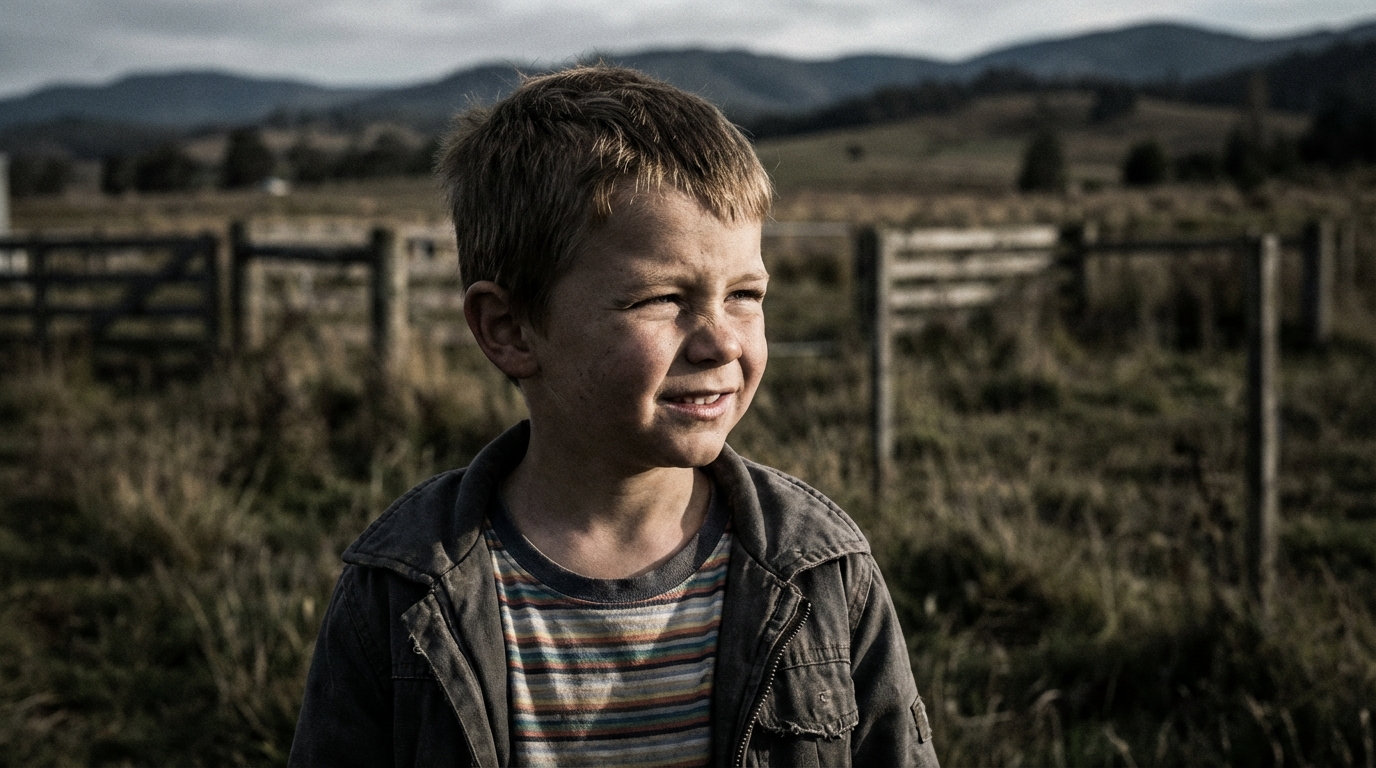
The Arrival: Fern Tree, October 2014
Born on 24 October 2014 at Royal Hobart Hospital, Samuel Phillip Triffett—"Sammy" to everyone who would come to know him—arrived eight months before his parents formalised their decade-long relationship through marriage. His birth represented not convention's fulfilment but love's natural progression, a child conceived by two people who had been building toward this moment since their university days, when Nial Triffett's warm brown eyes first met Jenny Hodgman's intelligent blue gaze across a theatre department rehearsal room.
The pale blue weatherboard house in Fern Tree, perched on kunanyi/Mount Wellington's eastern slopes where urban Hobart dissolved into wild Tasmanian bush, became Sammy's first home. The dwelling, built in 1974, had been purchased by Nial and Jenny shortly after university, a space they'd gradually transformed into a creative sanctuary before Sammy's arrival necessitated additional transformations—the spare room converted to a nursery, dangerous corners baby-proofed, the house itself reshaped around the small life now at its centre.
From his earliest moments, Sammy inherited distinctive features from both parents. Nial's warm brown eyes found perfect replication in his son's gaze—an undeniable genetic signature establishing immediate connection between father and son. Yet Sammy's other features drew from Jenny's side: fair hair that would gradually darken from infant blonde toward something closer to honey-brown, delicate bone structure suggesting Jenny's theatrical elegance rather than Nial's sturdier build, a smile that could transform his face with the same warmth his mother brought to classrooms and stages.
His arrival transformed the Triffett household in ways both predictable and profound. Nial, who'd spent years building Triffett Fencing Solutions with determination, discovered that fatherhood awakened protective instincts and tender emotions existing beneath his capable exterior but rarely finding expression. Those shared brown eyes represented visible connection, but deeper bonds formed through guitar lessons that would come later, weekend adventures exploring Tasmania's remarkable landscapes, quiet moments when Sammy's small hand grasped Nial's calloused fingers with complete trust.
Jenny approached motherhood with the same intentionality she brought to teaching drama, determined that Sammy would grow up immersed in artistic and cultural experiences without feeling pressured toward any particular path. Family activities included theatre visits, gallery tours, local performances—exposing Sammy to creativity in its many forms whilst allowing him to discover his own interests. The household that had been a couple's sanctuary became a family's proving ground, routines accommodating Jenny's school schedule and Nial's sometimes irregular construction hours, creating stability within inherent unpredictability.
Early Childhood: A World of Wonder and Warmth
Sammy's first years unfolded in an environment deliberately designed to nurture curiosity whilst providing security. The Fern Tree house, with its mist-veiled corridors and proximity to Tasmania's wild beauty, offered a liminal childhood space—neither wholly urban nor completely rural, a threshold existence between civilisation and the ancient forests clothing Mount Wellington's slopes.
His parents' contrasting but complementary approaches shaped his earliest development. From Nial came an appreciation for how things worked—mechanical understanding translated through play, weekend projects where Sammy's small hands helped Daddy measure fence posts or sort tools, lessons about patience and precision disguised as quality time. From Jenny came theatrical imagination, the understanding that the world could be transformed through creativity, that stories possessed power to reshape reality, that ordinary moments could become extraordinary through the lens of artistic vision.
The late 2017 arrival of Buffy, a spirited Dalmatian whose distinctive black-spotted white coat became as familiar as family, added another dimension to Sammy's expanding world. Born 14 May 2016, Buffy was rehomed to the Triffetts when her original owners could no longer care for her. For Sammy, then approaching three years old, Buffy became both companion and co-conspirator in adventures real and imagined. Buffy's protective instincts perfectly matched to Sammy's boundless curiosity, the dog somehow sensing the subtle changes in the Triffett household whilst her playful energy kept Sammy's world bright despite gathering shadows.
Play took forms both conventional and distinctly Triffett. Sammy absorbed Jenny's theatrical bent, creating elaborate scenarios with toy figures that weren't merely playthings but characters in unfolding dramas. He'd arrange them with surprising care for someone so young, narrating their adventures with vocabulary and emotional complexity beyond his years—inheritance from a mother who understood that stories weren't escapes from reality but frameworks for comprehending it.
Yet alongside this creative play ran more troubling undercurrents. By 2018, when Sammy approached his fourth birthday, patterns emerged that transformed parental concern into something approaching dread. Unexplained bruises appeared on his small body—marks that couldn't be attributed to ordinary childhood tumbles, that seemed to multiply despite Jenny and Nial's increasing vigilance. Sleep disruptions became routine rather than exception, Sammy's nights fractured by terrors he couldn't articulate, his small voice crying out for parents who rushed to comfort distress they couldn't fully understand.
The paediatric appointments that followed provided medical expertise but frustratingly few answers. Dr Richard Carmichael, a respected practitioner whose professional demeanour masked growing unease, conducted examinations that revealed nothing physiologically wrong whilst the evidence of something profoundly amiss accumulated before his eyes. The bruises defied explanation. The exhaustion etched beneath Sammy's innocent gaze suggested experiences no four-year-old should endure. The night terrors Dr Carmichael described as "unprecedented" in his decades of practice pointed toward trauma whose source remained maddeningly obscure.
July 2018: The World Fractures
The events of late July 2018 would forever divide Sammy's childhood into before and after—though he was too young to fully comprehend the magnitude of changes cascading through his family's existence. At three years and nine months old, Sammy inhabited that peculiar developmental stage where the world remained primarily magical, where adults' anxieties registered as atmospheric shifts rather than concrete threats, where tomorrow existed as abstract concept rather than pressing concern.
The morning of 28 July began with familiar routines twisted by undercurrents Sammy sensed without understanding. His mother's preparation for Dr Carmichael's appointment carried unusual weight, her movements through their Fern Tree home more deliberate, her smile requiring more effort than usual. In the bathroom, Sammy's playful vandalism with toothpaste—smearing mint across the fogged mirror whilst giggling at his own mischief—masked deeper vulnerability that surfaced when he asked if the doctor could banish his bad dreams. The cleared reflection revealed more than two faces; it exposed the fragile boundary between childhood innocence and encroaching darkness.
The appointment itself unfolded in Dr Carmichael's waiting room, where cheerful primary-colour murals attempted to disguise the clinical reality beneath. Sammy played with toys whilst Jenny watched with heightened vigilance, noting every movement, every expression, searching for clues to mysteries that medical science seemed unable to solve. His casual comment about shadows being "quiet here" carried weight that transformed Jenny's concern into something approaching terror—what shadows had been speaking to him elsewhere?
Between doctor visits and family tensions, an incident occurred that would later prove pivotal. When Jenny returned home from the appointment to discover Nial absent and his usually locked office standing inexplicably open, Sammy had wandered outside to his sandpit. Finding him there should have brought relief, but his testimony about an open back door and a mysterious man with rainbow lights shattered what remained of Jenny's rational understanding. The man had taken Buffy, Sammy explained with four-year-old matter-of-factness, leading her through a circle of coloured light that danced and shimmered in ways physics shouldn't permit.
The In-Between Days: August 2018
The week following Nial's disappearance stretched into nightmare territory for Jenny, but for Sammy, it became a confusing interlude where ordinary routines dissolved without clear replacement. His father's absence registered as wrongness rather than catastrophe—Daddy was simply not there, a fact that troubled him without destroying his world's fundamental architecture. His mother's mounting panic he experienced as atmospheric pressure, Jenny's brittle composure cracking in ways that frightened him more than Nial's absence.
Rowena Hodgman's arrival brought complicated stability. Sammy's maternal grandmother, with her exacting standards and forceful personality, provided practical care whilst Jenny navigated police stations and her own deteriorating emotional state. For Sammy, this meant being shuttled between his familiar home and Grandma's house, between Jenny's anxious attention and Rowena's more structured approach to childcare. The contrast was stark: Jenny desperate to maintain normalcy whilst secretly unravelling, Rowena determined to impose order on chaos through sheer force of will.
Play-dough sessions and toy trains continued, ordinary childhood activities proceeding as scheduled whilst adult worlds fractured around them. Sammy moulded green shapes with innocent focus during police interviews, pushed his beloved red rescue train across floor tracks whilst conversations about missing persons and family crises unfolded above his head. His acceptance of these juxtapositions demonstrated childhood's remarkable adaptability—or perhaps its terrible necessity to continue being a child even when circumstances demanded otherwise.
Threshold Crossing: The Portal to Clivilius
The exact circumstances of Sammy and Jenny's transition to Clivilius on 4 August 2018 remain partially obscured—both by the event's impossibility and by Sammy's limited capacity at three years and ten months to process or later articulate what occurred. What is known suggests that Luke Smith, who had lured Nial through an inter-dimensional portal weeks earlier, orchestrated their passage as well, completing the family's forced relocation to the settlement he'd established in this alien world.
For Sammy, the transition itself registered as sensory chaos—colours, sounds, physical sensations that defied Earth-based experience. Did he scream? Did he cling to Jenny? Did some protective mechanism in his young mind simply accept the impossible as children often do, processing dimensional travel as just another inexplicable adult activity to be endured? The specific memories, assuming they formed at all, would fragment into impressions rather than narrative: Jenny's arms tight around him, strange light cascading past, the sensation of falling whilst simultaneously remaining still, emergence into landscape bearing no resemblance to Tasmania's familiar contours.
Reunion with Nial in Bixbus should have been joyous, but for Sammy it became a complicated collision of relief, confusion, and adjustment to circumstances he couldn't begin to comprehend. Daddy was here—that registered clearly. But where was here? Why did everyone seem so serious?
The settlement Sammy arrived to bore no resemblance to Fern Tree's misty beauty. Bixbus in August 2018 was a desperate frontier outpost struggling toward basic stability. Fewer than a dozen people occupied temporary shelters, minimal infrastructure, predatory fauna that made Tasmania's extinct thylacine seem benign by comparison. The Shadow Panther's severed head at the camp's perimeter served as grotesque welcome—physical proof that this world's dangers transcended Earth experience.
For a child who'd known only comfortable suburbia, this represented a complete environmental rupture. Yet Sammy adapted with resilience that would characterise his Clivilius childhood, his young mind somehow accepting that life now involved different parameters, different rules, different threats requiring different responses. Where adult settlers struggled with psychological adjustment to involuntary exile, Sammy simply began learning how this new world worked—characteristic of childhood's pragmatic approach to changed circumstances.
Family Reconstituted: The Bixbus Years
The Triffett family's reconstruction in Bixbus required deliberate effort from all members, including Sammy. Jenny and Nial had to re-learn each other after traumatic separations that had changed them both. Trust needed rebuilding not because of betrayal but because trauma had created emotional distances requiring deliberate bridging. For Sammy, this meant adjusting to parents who seemed simultaneously familiar and transformed—Mummy more guarded, Daddy more serious, both carrying weights they tried unsuccessfully to completely hide from their perceptive son.
The family's expansion when they took in Alexander Javier Martinez represented another major adjustment. Alexander, born 5 March 2012, arrived in Bixbus during the September 2018 Brisbane School Bus tragedy that brought multiple children to the settlement through catastrophic accident. Brilliant, traumatised, carrying his star projector and dreams of distant galaxies, Alexander needed a stable family environment whilst processing separation from his biological parents.
For Sammy, then approaching four years old, Alexander's arrival meant suddenly acquiring an older brother. The two-year age gap placed Alexander in simultaneously protective and vulnerable position—old enough to understand more about their shared circumstances, young enough to still need parenting himself, positioned as both fellow child and occasional guide through challenges Sammy couldn't fully grasp. Their relationship bloomed in quiet moments: Alexander sharing constellation stories whilst Sammy listened with wide-eyed wonder, the older brother's gentle nature nurturing the younger's curiosity, creating bonds through shared displacement rather than shared genetics.
Education and Development: The Learning Grove
As Bixbus evolved from desperate camp to functioning settlement, childhood education became both practical necessity and psychological imperative. The Learning Grove, established in September 2018, emerged from Bixbus's desperate need for childhood normality in abnormal circumstances. Fashioned from shipping containers and determination, it provided Sammy and other displaced children with structured learning environments when everything else about their lives had dissolved into chaos.
Jenny's involvement in The Learning Grove allowed her to simultaneously mother Sammy and practice her educational vocation, though the dual role created complications. Sammy needed his mother as mother, yet she was also Mrs Triffett, the teacher helping establish this makeshift educational space. The boundary between maternal care and professional responsibility sometimes blurred, leaving Sammy uncertain whether he was receiving special treatment or whether Mummy simply couldn't separate her roles.
The Learning Grove's curriculum balanced Earth educational standards with Clivilius's unique requirements. Sammy learnt reading and mathematics alongside other fundamentals, but also absorbed lessons about this world's ecology, dangers, and opportunities.
His classmates included children from multiple Earth locations, different socioeconomic backgrounds, varying educational preparation—all processing trauma of involuntary world transition whilst trying to continue normal childhood development. Some had arrived with parents, like Sammy. Others, like Alexander, had been orphaned by the catastrophe of portal passage, their biological families lost to a world they'd never see again. These shared circumstances created bonds transcending typical childhood friendships—they were fellow survivors, witnesses to impossibility, children whose ordinary childhoods had been transformed into something simultaneously magical and tragic.
Childhood in an Alien World: 2019-2020
As Bixbus stabilised and expanded, Sammy's childhood gradually acquired routines approximating normality. The transition from The Learning Grove to the permanent Bixbus School in late 2019 marked both personal and communal milestone. The new facility represented Bixbus's commitment to children's futures and recognition that education formed foundation for any society hoping to endure.
Sammy's days developed rhythm: morning routines in the Triffett household, school attendance where Jenny taught drama amongst other subjects, afternoons exploring Bixbus with Alexander or other children under increasingly relaxed but still vigilant adult supervision, evenings with family where they maintained Earth traditions whilst adapting to Clivilius realities. Weekend adventures with Nial continued, though now they explored Bixbus landscapes rather than Tasmanian wilderness, learning about Clivilius's ecology rather than Earth's natural history.
His relationship with Alexander deepened beyond initial guardedness into genuine brotherhood. The age gap that initially seemed significant gradually mattered less as Sammy matured and Alexander adjusted to his role as older sibling.
Character Formation: The Boy Taking Shape
The Sammy emerging through these early Bixbus years demonstrated resilience remarkable even by child standards. Where many adult settlers struggled with depression, anxiety, or outright psychological breakdown from involuntary exile, Sammy adapted with pragmatic acceptance characteristic of childhood's flexibility. This wasn't stoicism—he experienced fear, sadness, confusion—but his young mind possessed capacity to rebuild normalcy frameworks that adult consciousnesses found difficult.
His personality synthesised inheritances from both parents whilst developing distinctive qualities shaped by unique circumstances. From Nial came practical competence and genuine warmth, capacity to connect with others through authentic presence rather than performance. From Jenny came creative imagination and theatrical sensibility, understanding that reality could be interpreted through multiple lenses, that storytelling possessed power to transform experience. But layered atop these inheritances was something uniquely Sammy's: adaptability forged through impossibility, wisdom about world's fundamental uncertainty that most children never acquire.
His relationship with adults demonstrated this synthesis. With Jenny, he remained primarily son—seeking comfort, expressing needs, occasionally testing boundaries in ways that reassured her his spirit hadn't been crushed by trauma. With Nial, he became apprentice learner, absorbing practical knowledge through helping with projects, understanding that competence meant safety in world less forgiving than Earth. With other Bixbus adults, he exhibited combination of childhood openness and earned wariness, recognising that grown-ups weren't infallible protectors but fellow survivors managing their own challenges.
His peer relationships reflected similar complexity. With Alexander, he balanced brotherly affection with occasional sibling rivalry, shared displacement creating bonds whilst age differences created natural tensions. With other Bixbus children, he formed friendships based on mutual understanding that their childhoods differed fundamentally from what Earth children experienced. They played with genuine joy whilst carrying knowledge that safety remained conditional, that the world could rupture without warning, that nothing was truly permanent.
