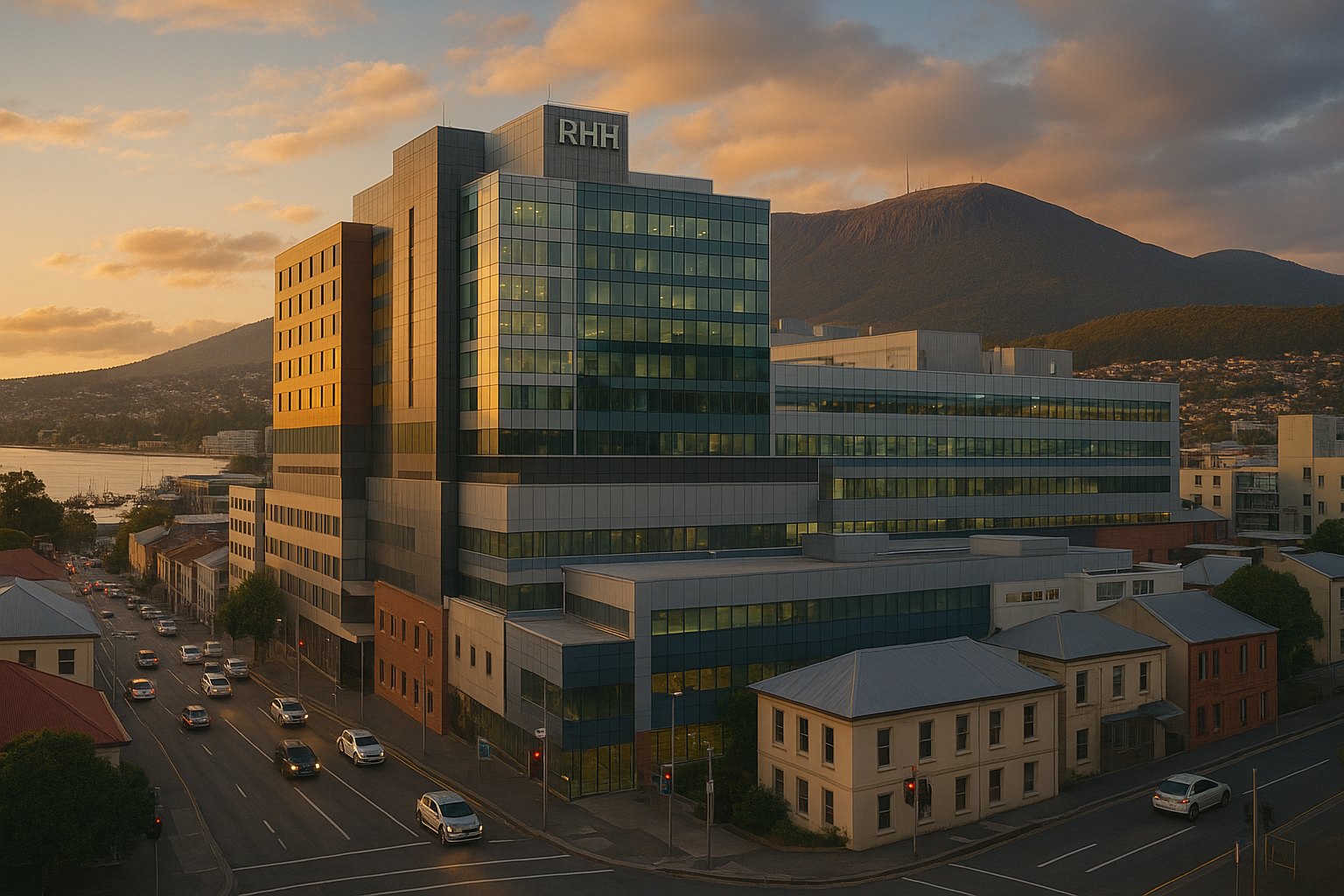
Royal Hobart Hospital (RHH), Tasmania
Established in 1804, the Royal Hobart Hospital (RHH) is Tasmania's oldest and most significant public healthcare institution. From its origins as a colonial infirmary, RHH has grown into a nationally respected tertiary teaching hospital and research centre. Its long history reflects both Tasmania's medical evolution and the broader trajectory of Australian public health. Through war, pandemic, reform, and innovation, the Royal Hobart Hospital has remained a pillar of care, education, and resilience—even extending its healing mission beyond dimensional boundaries.

Colonial Genesis: The Infirmary Years
The Royal Hobart Hospital was born alongside Tasmania's penal settlement in 1804, emerging from necessity rather than planning. When Lieutenant Governor David Collins established the Hobart settlement at Sullivan's Cove, medical facilities were afterthoughts to the urgent demands of housing convicts, building shelters, and securing supplies. The first hospital, if it could be called such, occupied a crude timber structure on Hunter Street near the Derwent River, where mortality rates reflected both the primitive conditions and the limited medical knowledge of the era.
Supplies arrived sporadically from Sydney, often spoiled by the voyage. Surgical instruments were few and frequently shared between procedures with minimal cleaning. The concept of antisepsis lay decades in the future. Convicts suffering from scurvy, dysentery, typhoid, and the physical consequences of flogging filled makeshift wards where the smell of gangrenous wounds mingled with the stench of inadequate sanitation. For those sentenced to Van Diemen's Land, the hospital represented either salvation or merely a different manner of death.
Mary O'Connell, an Irish-born widow appointed as the colony's first matron in 1808, brought an unexpected force of character to these barely civilised conditions. Widowed young and possessing no formal medical training, O'Connell nonetheless commanded the respect of convict orderlies and colonial surgeons through sheer determination and what contemporaries described as an "alarming competence with the discipline of routine." She established basic protocols for patient care, insisted on minimal standards of cleanliness, and maintained meticulous records—an innovation that would prove foundational for the hospital's later development.
By the 1820s, the colony's growing population and increasing complexity demanded better facilities. A purpose-built stone hospital rose on Liverpool Street, its Georgian architecture reflecting both colonial confidence and practical necessity. The building's solid sandstone walls provided insulation against Hobart's cold winters whilst its elevated position offered better drainage and air circulation than the cramped Hunter Street location. The new hospital could accommodate approximately fifty patients, a significant increase that nonetheless proved inadequate within years.
The appointment of Dr Alastair Merivale in 1831 marked a turning point in the hospital's institutional culture. A Royal Navy surgeon who had served in the Mediterranean and Caribbean, Merivale brought military discipline and emerging medical knowledge to an institution that had functioned primarily as a holding facility for the dying. He introduced systematic patient records, basic surgical protocols, and the radical notion that hospitals might actually cure patients rather than merely warehousing them until death.
Merivale's tenure also established the hospital's educational function. Young surgeons arriving in the colony learned their craft under his supervision, developing skills through observation and practice on patients who often had little choice in the matter. This early teaching role, though informal and at times brutal by modern standards, established patterns that would eventually flourish into formal medical education programmes.
The convict era left indelible marks on the hospital's character and operations. The institution learned to function with limited resources, to improvise solutions, and to maintain dignity in circumstances designed to strip it away. These lessons—resourcefulness, adaptation, and resilience—became embedded in the hospital's institutional DNA, serving it well through subsequent challenges that tested very different forms of endurance.
Victorian Transformation: Science Meets Service (1850–1900)
Tasmania's transition from penal settlement to free colony fundamentally altered the Royal Hobart Hospital's purpose and patient population. No longer primarily serving convicts and military personnel, the hospital became a public institution serving a growing civilian population with increasingly diverse medical needs. This transformation coincided fortuitously with revolutionary developments in medical science that would reshape healthcare across the Western world.
Dr Edward Farquharson's appointment as Chief Surgeon in 1853 brought Scottish medical training and public health philosophy to an institution still emerging from its penal origins. Farquharson, a contemporary of Joseph Lister and familiar with emerging theories about disease transmission, became an early advocate for antiseptic protocols when Lister's carbolic acid techniques reached Australian shores in the late 1860s. The scepticism Farquharson initially faced—surgeons who considered hand-washing effeminate, colleagues who mocked the idea that invisible organisms caused infection—gradually gave way as mortality rates from post-surgical infection began their dramatic decline.
The transformation was not instantaneous. Senior surgeons, trained in an era when pus in surgical wounds was considered evidence of healthy healing, resisted protocols that challenged decades of practice. Farquharson persisted, demonstrating results through carefully maintained statistics and gradually converting the sceptical through the undeniable evidence of patients who survived operations that previously guaranteed death. By the 1880s, antiseptic surgery had become standard practice at RHH, placing the hospital at the forefront of Australian medical innovation.
The Victorian era also saw the hospital's physical expansion and architectural refinement. New wings accommodated surgical wards separate from medical wards, recognising the need for specialisation and contamination control. In 1887, a modest maternity wing opened, providing women with an alternative to home births attended by midwives of varying competence. The establishment of dedicated women's care represented both medical progress and social evolution, acknowledging that childbirth, whilst natural, benefited from medical supervision and emergency intervention capacity.
Dr Cecil Wigram, Farquharson's successor from 1889, built upon these foundations by establishing formal training programmes for nurses and medical orderlies. Previously, nursing staff learned through observation and trial-and-error, with standards varying dramatically between individuals. Wigram introduced structured education, basic examinations, and certificates of competence, transforming nursing from a poorly regarded occupation into an emerging profession. The ripple effects of this innovation extended well beyond RHH, as trained nurses carried their education to other institutions across Tasmania and beyond.
The hospital also began developing specialised services that reflected both medical advancement and changing population needs. Mental health care, previously the province of asylums with minimal medical involvement, gained tentative foothold within the hospital through consultations and temporary placements. Infectious disease wards isolated patients with typhoid, scarlet fever, and other contagions, protecting both the public and other hospital patients whilst providing specialised treatment impossible in home settings.
By the century's end, the Royal Hobart Hospital had transformed from a colonial infirmary into a modern medical institution. The changes were visible not just in buildings and equipment, but in the confident professionalism of staff who understood themselves as practitioners of science rather than mere attendants to the sick. The hospital's reputation attracted talented physicians and surgeons, creating a virtuous cycle where skilled professionals drew patients, generating experience that further improved outcomes and attracted more skilled practitioners.
The Anzac Era: Service and Sacrifice (1900–1945)
The twentieth century's opening decades brought both prosperity and tragedy to Tasmania, and the Royal Hobart Hospital stood at the intersection of both. Philanthropic support, partly driven by civic pride and partly by emerging ideas about public health as collective responsibility, funded significant expansions. Sir Robert Dobson, a Hobart businessman whose fortune derived from timber and shipping, gifted funds in 1903 for a new operating theatre and surgical ward equipped with the latest medical technology. The Dobson Wing, as it became known, featured electric lighting, improved ventilation systems, and surgical equipment that positioned RHH amongst Australia's better-equipped provincial hospitals.
The establishment of the Royal Hobart School of Nursing in 1906 formalised training programmes and established professional standards that elevated nursing from occupation to vocation. Florence Macleod, one of the school's earliest graduates, exemplified the new professional nurse: educated, competent, and capable of sophisticated patient care independently of physician supervision. Macleod's later appointment as Chief Matron brought innovation including rotating ward assignments that broadened nurses' experience and standardised patient charting that improved continuity of care.
Then came the Great War, and with it, transformations that would reshape Australian society and the hospitals that served it. When young Tasmanian men enlisted and departed for training camps in 1914, few anticipated the scale of carnage awaiting them on distant battlefields. The Royal Hobart Hospital prepared for casualties, but preparation proved inadequate for the reality of modern industrial warfare's devastating efficiency at destroying human bodies.
The wounded began returning in 1915, and the hospital established a temporary military ward—the Anzac Annex—to accommodate soldiers whose injuries defied civilian medical experience. Shrapnel wounds, gas damage to lungs, "shell shock" that manifested as tremors and nightmares, amputations requiring prosthetic fitting and rehabilitation—these became the hospital's new specialities, learned through necessity and refined through tragic experience. Nurses who had trained to care for surgical patients and manage fevers now confronted psychological trauma and disfigurements that challenged both their professional skills and emotional resilience.
The Anzac Annex operated until 1920, though its legacy extended far beyond its closure. The hospital's staff had gained expertise in trauma care, psychological treatment, and rehabilitation that would serve future generations. The war also accelerated medical innovation—blood transfusion techniques, reconstructive surgery, treatment of infection in contaminated wounds—that found peacetime applications. The Royal Hobart Hospital emerged from the Great War as an institution hardened by experience and enriched by hard-won knowledge.
The inter-war years brought new challenges demanding different responses. The 1918 influenza pandemic tested the hospital's capacity as wards overflowed with patients whose deaths came with terrifying swiftness. The economic devastation of the 1930s Depression strained resources whilst simultaneously increasing demand for free care from destitute families. The hospital's commitment to providing treatment regardless of ability to pay became both point of pride and source of constant financial pressure.
World War II brought renewed military service demands, though the Royal Hobart Hospital's role differed from the previous conflict. Rather than receiving casualties directly from battlefields, RHH served as a base hospital for servicemen stationed in Tasmania and a recovery facility for personnel evacuated from Pacific theatre operations. The hospital's staff gained experience with tropical diseases, injuries from naval operations, and the psychological toll of modern warfare that differed from but echoed the shell shock of the previous generation.
Through both wars and the turbulent decades between them, the Royal Hobart Hospital maintained its dual commitment to military service and civilian care. This balance, often difficult and sometimes impossible, defined an era when institutions bore responsibilities that strained their capacities whilst revealing reserves of dedication and resilience that peacetime could never test.
Modern Medicine: Innovation and Integration (1945–1990)
The post-war decades witnessed transformations in medical science, healthcare delivery, and public expectations that revolutionised the Royal Hobart Hospital. The institution that had begun as a colonial infirmary now embarked on becoming a tertiary teaching hospital and research centre, a journey requiring not just new facilities but fundamental reimagining of the hospital's role and relationships.
The establishment of Tasmania's first radiology department in 1952 represented more than new technology—it symbolised the hospital's commitment to remaining at the forefront of diagnostic medicine. Dr Muriel Trask, a rare female consultant in an era when medicine remained overwhelmingly male-dominated, led the department with a combination of technical excellence and quiet determination to prove that gender posed no barrier to medical achievement. Her presence also inspired younger women considering medical careers, demonstrating possibilities that previous generations could only imagine.
New specialised wards proliferated throughout the 1950s and 1960s: cardiology for heart disease management, paediatrics for children's specific needs, infectious disease units for isolation and treatment of contagions. Each specialisation required dedicated staff, specialised equipment, and physical spaces designed for particular medical purposes. The hospital expanded physically and organisationally, developing the departmental structures and administrative complexity characteristic of modern tertiary institutions.
Dr Margaret Penrose's appointment as Director of Cardiology in 1963 marked another milestone in both medical specialisation and female leadership in Australian medicine. A graduate of the University of Melbourne with advanced training in Edinburgh, Penrose brought international expertise to Tasmania whilst demonstrating commitment to developing local capacity rather than merely imported authority. Her advocacy for capital investment in cardiac care led to the construction of the Penrose Cardiac Centre, which opened in 1971 with state-of-the-art facilities for cardiac surgery, catheterisation, and intensive monitoring.
The Centre's opening coincided with dramatic advances in cardiac surgery and interventional cardiology that transformed previously fatal conditions into treatable diseases. Coronary bypass surgery, valve replacements, pacemaker implantation—procedures that once existed only in experimental settings became routine operations saving lives across Tasmania. The Penrose Centre established RHH's reputation for cardiac excellence that persists to the present day, attracting specialists and drawing patients from across the state and beyond.
The formal affiliation with the University of Tasmania Medical School in 1965 transformed the hospital's teaching role from informal apprenticeship to structured clinical education. Medical students rotated through RHH's departments, learning from experienced clinicians whilst providing additional workforce under supervision. The relationship proved mutually beneficial: the Medical School gained essential clinical training facilities, whilst the hospital accessed academic expertise, research opportunities, and the intellectual stimulation that accompanies teaching institutions.
This era also witnessed nursing profession's continued evolution. The traditional hierarchy that positioned doctors as unquestioned authorities whilst nurses followed orders gave way to collaborative models recognising nurses' expertise and autonomous decision-making capacities. Senior nurses like Virginia Collins, who led the mental health unit for elderly patients from 1994 to 1997, demonstrated that nursing innovation extended beyond following physician protocols to developing holistic care approaches addressing patients' complex needs.
By the 1980s, the Royal Hobart Hospital had become Tasmania's premier medical institution, the largest hospital in the state and the principal trauma centre. Its emergency department handled cases ranging from simple injuries to life-threatening emergencies requiring immediate surgical intervention. Its intensive care units provided mechanical ventilation, continuous monitoring, and sophisticated interventions that kept alive patients who would have died in previous eras. Its specialised departments offered expertise that once required travelling to Melbourne or Sydney.
The hospital's staff, numbering in the thousands, represented every level of healthcare expertise from internationally trained specialists to porters ensuring clean linens reached every ward. This vast enterprise required sophisticated administrative structures, quality assurance systems, and financial management that matched corporate complexity whilst maintaining public service mission. The tension between medical excellence and fiscal responsibility became a defining characteristic of modern healthcare institutions, testing leadership in ways colonial surgeons never imagined.
Contemporary Challenges: Redevelopment and Crisis Response (1990–Present)
The late twentieth and early twenty-first centuries presented the Royal Hobart Hospital with challenges demanding both significant capital investment and institutional adaptation. The hospital's aging infrastructure, some dating to Victorian construction, struggled to accommodate modern medical equipment and meet contemporary standards for infection control, patient privacy, and staff safety. Emergency department overcrowding became chronic, with patients waiting hours or sometimes days for admission to wards operating perpetually at or beyond capacity.
The Tasmanian Government's initiation of a major redevelopment project in 2010 represented both recognition of critical need and substantial financial commitment. The centrepiece, K Block—a new emergency and critical care tower—required a decade of planning and construction, navigating political changes, budget pressures, and the complexity of building within an operating hospital where disruption could literally prove fatal. When K Block finally opened in 2020, it provided desperately needed expansion of emergency capacity, modern intensive care facilities, and additional operating theatres designed for contemporary surgical requirements.
The timing proved providential. Within months of K Block's completion, the COVID-19 pandemic tested healthcare systems globally with demands unprecedented in modern medicine. The Royal Hobart Hospital, like institutions worldwide, rapidly adapted protocols, established isolation wards, implemented testing facilities, and prepared for potential overwhelming patient numbers. Dr Pierre De Bruyn, appointed Chief Medical Officer in 2018, led the hospital's pandemic response with a combination of clinical expertise, administrative capability, and crisis management skills honed through years of emergency preparedness planning.
Tasmania's island geography and relatively small population provided some protection against COVID-19's worst impacts, but the Royal Hobart Hospital nonetheless faced significant challenges. Staff required training in appropriate personal protective equipment use, infection control protocols demanded rigorous enforcement, and resource allocation decisions forced uncomfortable choices about competing priorities. The hospital established vaccination facilities handling thousands of Tasmanians, contributing significantly to the state's public health response whilst maintaining essential services for patients requiring care unrelated to the pandemic.
The COVID-19 crisis revealed both the hospital's strengths and its persistent vulnerabilities. Staff demonstrated remarkable dedication and adaptability, working extended hours under stressful conditions with limited certainty about disease transmission risks. Leadership coordinated effectively with state health authorities and other institutions, demonstrating that decades of emergency planning translated into functional crisis response. Yet the pandemic also exposed workforce shortages, infrastructure limitations, and the fragility of systems operating perpetually at capacity with minimal slack for extraordinary demands.
Throughout this contemporary period, individual staff members continued the hospital's tradition of medical excellence and compassionate care. Dr Finn Montgomery, Head of Emergency Medicine since 2016, developed advanced trauma life support training programmes that improved outcomes across multiple mass casualty incidents. His calm leadership during crises, from motor vehicle accidents involving multiple casualties to complex medical emergencies requiring coordinated specialist responses, exemplified the professional competence that transforms good hospitals into excellent ones.
The hospital also maintained its commitment to education and research, recognising that tomorrow's medical advances require today's investigation. Research programmes spanning cardiac disease, cancer treatment, infectious disease management, and health services delivery attracted funding and produced publications in peer-reviewed journals. Medical students, nursing students, and allied health trainees continued learning from experienced clinicians whilst contributing to patient care under supervision. The cycle of knowledge generation, dissemination, and application that characterises teaching hospitals remained central to RHH's institutional identity.
Administration by the Tasmanian Health Service (Southern Region) since 2015 positioned the Royal Hobart Hospital within a coordinated regional health network whilst preserving its status as the tertiary referral centre for southern Tasmania. This administrative structure aimed to balance hospital autonomy with system-wide coordination, ensuring that specialist resources concentrated at RHH remained accessible to patients across the region whilst maintaining sustainable operations.
By 2025, the Royal Hobart Hospital employed over 3,000 staff across clinical, administrative, and support roles. Its annual budget exceeded several hundred million dollars, reflecting both the hospital's scale and the cost of modern medical care. Approximately 45,000 inpatient admissions annually, 70,000 emergency department presentations, and countless outpatient consultations established RHH as Tasmania's busiest hospital and a critical component of the state's healthcare infrastructure.
Dimensions Beyond: The Clivilius Connection (2018)
On 5 August 2018, the Royal Hobart Hospital became an unlikely participant in events that challenged fundamental assumptions about reality itself. When crisis erupted in the world of Clivilius following a catastrophic school bus accident that injured dozens of children, Dr Pierre De Bruyn received an urgent message from his wife Glenda—herself trapped in that otherworldly dimension—requesting medical assistance for overwhelming casualties that local resources couldn't manage.
De Bruyn's response demonstrated both personal courage and institutional capacity. Within hours, he had assembled a multidisciplinary medical team: trauma surgeon Dr Emily Nguyen, who had honed her skills in RHH's operating theatres from 2015 to 2018; emergency nurse Jackson Roberts, whose calm competence had served the hospital for sixteen years; anaesthetist Dr Lisa Chen, whose meticulous attention to detail ensured safe sedation in the most challenging cases; and paediatric nurse Melissa Grant, whose gentle manner brought comfort to countless frightened children and their families.
The team systematically gathered critical medical supplies from RHH's extensive stockrooms. Surgical kits containing instruments for emergency procedures, medications ranging from antibiotics to anaesthetics, blood products for transfusions, diagnostic equipment enabling basic assessment and monitoring—all were requisitioned with the efficiency of staff familiar with emergency protocols. Each carefully selected item represented not just medical technology but the accumulated knowledge of two centuries of institutional experience in treating trauma.
On 5 August, the team departed Royal Hobart Hospital carrying equipment and expertise developed through generations of medical practice. They stepped through a Portal in a Berriedale house, leaving behind the familiar world of antiseptic corridors and evidence-based protocols for a frozen landscape governed by different physical laws. For RHH, this represented an extraordinary extension of its mission beyond any conceivable jurisdiction or conventional understanding of healthcare delivery.
In the days following, the hospital faced a different manifestation of inter-dimensional phenomena. On 9 August, Guardians led by Luke Smith and Beatrix Cramer conducted raids targeting RHH's ambulance fleet and medical supplies. The raids, whilst technically criminal, served a desperate purpose: establishing the Bixbus Medical Centre in Clivilius required equipment and supplies unavailable in that world, and RHH possessed what survivors needed. The hospital that had spent two centuries accumulating medical resources suddenly became a target for appropriation by forces operating outside law and conventional ethics.
The medical team's departure through the Portal proved one-way, a fact unknown to those who remained behind. Dr Nguyen, Jackson Roberts, Dr Chen, and Melissa Grant—professionals whose expertise had served countless Tasmanian patients—never returned to Royal Hobart Hospital. Their contributions to Bixbus Medical Centre's establishment saved lives and provided healthcare capabilities in a world that had lacked modern medicine. Yet for RHH, their departure represented permanent losses: experienced staff whose institutional knowledge and patient relationships could never be fully replaced.
The hospital's official records could never acknowledge the true circumstances of their disappearance. Personnel files noted resignations or unexplained absences. Colleagues speculated about sudden departures, family emergencies, or personal crises. The truth—that they had crossed dimensional boundaries to provide humanitarian medical assistance in another world—remained known only to those few who understood the Portal's existence and its implications.
These events connected Royal Hobart Hospital to narratives far stranger than anything in its recorded history. The institution that had served convicts and settlers, wounded soldiers and pandemic patients, had unexpectedly extended its healing mission across dimensional boundaries. The raids and medical team departure occurred quietly, leaving behind subtle traces that official records couldn't capture and conventional histories would never mention.
