Rowena Margaret Hodgman (née Turner)
Rowena Margaret Hodgman (née Turner), born 5 December 1955 in Hobart, is Tasmania's celebrated pianist, educator, and cultural guardian. Her life harmonises artistic excellence with maternal devotion, from acclaimed concert performances to nurturing three accomplished children. Following her husband Wayne's death in 2013, she continues enriching Hobart's musical landscape through teaching and mentorship, her legacy resonating through generations of students and family alike.
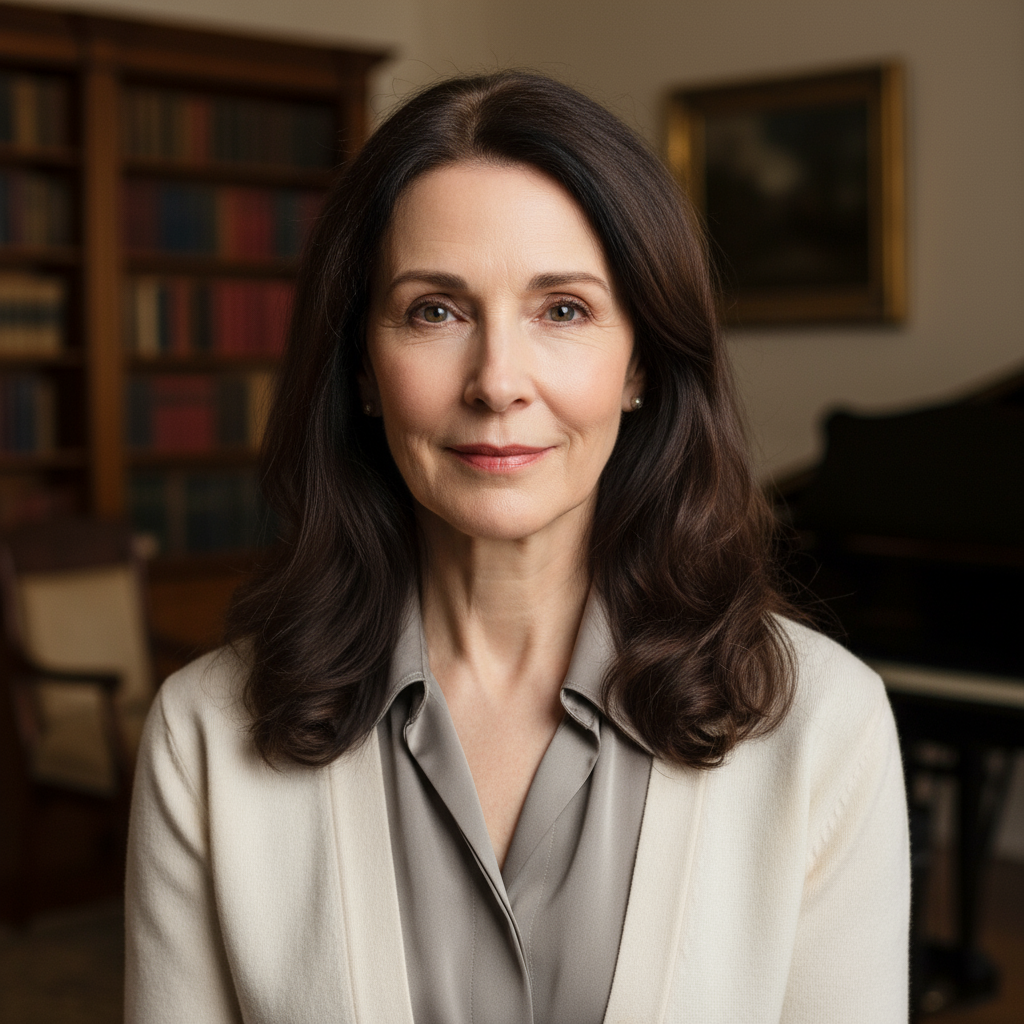
Early Life and Musical Foundations
Rowena Margaret Turner entered the world on 5 December 1955 in Hobart, Tasmania, beneath the watchful presence of Mount Wellington. Born into a household where creativity flourished as naturally as breath, she was the eldest child of James Turner, a respected composer whose melodies captured Tasmania's rugged beauty, and Eliza Turner, a dedicated music teacher who transformed countless young minds through the discipline of scales and theory. The Turner home resonated with constant music—from her father's compositional experiments echoing from his study to her mother's patient instruction of neighbourhood children in the front parlour.
As the eldest of three children, Rowena bore the gentle weight of setting an example for her younger siblings. Her brother Edward, who would eventually establish himself as a professional violinist, and sister Clara, who followed their mother's path into music education, grew up witnessing Rowena's early dedication to the piano. From the age of five, her small fingers found their way across the keys with an intuitive understanding that suggested destiny rather than mere childhood interest. The instrument became her voice before she fully understood the language it spoke.
Her childhood unfolded against the backdrop of 1960s Hobart, a city still finding its cultural identity whilst harbouring pockets of remarkable artistic ambition. The Turner children attended local concerts at the Town Hall, where visiting orchestras introduced them to the broader world of classical music beyond Tasmania's shores. These experiences, carefully curated by their parents, instilled in Rowena an understanding that music was not merely entertainment but a vital force that connected communities and transcended geographical isolation.
Education and Artistic Development
Rowena's formal education at St. Michael's Collegiate School provided the structure her musical gifts required to flourish. The school, with its emphasis on academic excellence and cultural refinement, proved the perfect environment for a young woman whose talents extended beyond the piano bench. She excelled in literature and languages, developing an appreciation for poetry that would later complement her musical interpretations. Her teachers recognised in her not just technical proficiency but an emotional maturity that allowed her to inhabit the pieces she performed.
During her teenage years, Rowena's reputation as a pianist began to extend beyond school walls. She participated in eisteddfods throughout Tasmania, consistently earning accolades for her performances of Romantic repertoire. Her interpretation of Chopin's Nocturnes, in particular, drew praise for their delicate balance of technical precision and emotional depth. These competitions, whilst challenging, taught her the discipline of performance—the ability to channel nervous energy into focused artistry, a skill that would serve her throughout her career.
Upon completing her secondary education in 1973, Rowena's path led naturally to the Tasmanian Conservatorium of Music. Here, under the exacting tutelage of Professor Charles Lindemann—a German émigré who had studied with pupils of Liszt—she underwent a transformation from talented student to serious artist. Lindemann's approach was rigorous, demanding not just technical excellence but a deep understanding of musical history and theory. He insisted his students comprehend the cultural context of each piece, the composer's life circumstances, and the philosophical underpinnings of different musical periods.
Love, Partnership, and Early Career
It was during her third year at the Conservatorium, in 1976, that Rowena's life took an unexpected turn. At a faculty recital featuring works by Australian composers, she found herself seated next to Wayne Hodgman, a literature student who had wandered into the concert hall seeking respite from his thesis on colonial Australian poetry. Their conversation during the interval revealed a shared sensibility—both understood art as a means of exploring human experience rather than mere aesthetic exercise. Wayne's insights into the relationship between musical structure and narrative form intrigued Rowena, whilst her ability to articulate the emotional architecture of a symphony captivated him.
Their courtship unfolded through long walks along the Derwent River, discussions in coffee shops near the university, and evenings spent attending concerts and poetry readings. Wayne would read to her from Keats and Wordsworth whilst she played Schumann's intimate piano pieces, creating a private dialogue between words and music. This interplay of artistic forms became the foundation of their relationship, each bringing their distinct perspective whilst finding harmony in their shared values.
Rowena graduated with honours from the Conservatorium in 1977, her final recital featuring an ambitious programme that spanned from Bach's Well-Tempered Clavier to contemporary Australian compositions. The performance established her as one of Tasmania's most promising young pianists, earning invitations to perform with the Tasmanian Symphony Orchestra and at venues throughout the state. Yet even as her career began to flourish, she understood that her artistic ambitions would need to coexist with other aspirations.
On 20 April 1980, Rowena and Wayne married in a ceremony that reflected their artistic sensibilities—held in a historic church in Battery Point, with music provided by her Conservatorium colleagues and readings selected from their favourite poets. Their wedding marked not an ending of individual pursuits but the beginning of a partnership that would nurture both their careers and, eventually, their family.
Motherhood and Musical Maturity
The 1980s brought new dimensions to Rowena's life as she navigated the demands of professional performance whilst building a family. Robert arrived in 1982, transforming the Hodgman household into a careful orchestration of rehearsal schedules and feeding times. Rowena discovered that motherhood, rather than diminishing her artistry, added new emotional colours to her playing. Pieces she had performed for years suddenly revealed different meanings—Brahms's Intermezzos now carried the weight of lullabies sung in darkened nurseries.
Jenny's birth in April 1986 coincided with one of Rowena's most productive periods as a performer. She had developed a reputation for her interpretations of Debussy and Ravel, bringing an Australian sensibility to French impressionism that critics found both fresh and authentic. Balancing touring with family life required careful choreography, with Wayne adjusting his academic schedule to ensure one parent was always present. Their home became a hub of controlled chaos—manuscript paper scattered amongst children's drawings, piano exercises interrupted by requests for stories.
Kevin's arrival in August 1990 completed their family constellation. By this time, Rowena had established herself not just as a performer but as an educator, teaching private students and conducting masterclasses at the Conservatorium. She approached teaching with the same intensity she brought to performance, believing that every student, regardless of ultimate ambition, deserved access to music's transformative power. Her students ranged from young children taking their first tentative steps on the keyboard to advanced players preparing for professional careers.
Teaching Philosophy and Community Impact
Rowena's teaching philosophy evolved from her own experiences as both student and mother. She understood that technical proficiency alone did not make a musician; rather, it was the ability to connect emotionally with both the music and the audience that transformed notes into art. Her lessons often began not at the piano but in conversation, exploring what the student hoped to express through their playing. She taught them to find their own voice within the established framework of classical tradition.
Her involvement with local schools extended beyond private instruction. She established programmes that brought classical music into primary schools, believing that early exposure to the arts was crucial for developing well-rounded individuals. These initiatives, often delivered without compensation, reflected her conviction that music education should not be the exclusive province of the privileged. She worked with school administrators to integrate musical literacy into broader curricula, demonstrating how rhythm could enhance mathematical understanding and how melodic patterns could improve memory and cognitive function.
The annual student recitals she organised became significant events in Hobart's cultural calendar. Held at various venues throughout the city—from intimate church halls to the grand stage of the Theatre Royal—these performances gave young musicians the opportunity to experience the full arc of performance, from preparation through execution to the grace of accepting applause. Rowena insisted that every student, regardless of skill level, participate in these recitals, believing that the courage to perform publicly was as important as technical achievement.
Professional Heights and Personal Trials
Throughout the 1990s and 2000s, Rowena's career reached new heights whilst her family evolved and matured. Her performances, both solo and with orchestra, demonstrated a mature artistry that balanced technical brilliance with emotional depth. Critics noted her ability to find fresh perspectives in familiar repertoire—her recording of Beethoven's late sonatas, released in 2003, was praised for revealing the composer's humanity within his formal structures. International tours took her to Europe and Asia, where audiences responded warmly to her distinctive interpretative style.
The balance between professional and personal life remained delicate. As her children developed their own interests and talents, Rowena observed with mixed feelings Jenny's gravitation toward drama rather than music, though she recognised in her daughter's theatrical instincts the same emotional intelligence that informed her own musical performances. Kevin's fascination with history pleased her, understanding that his scholarly pursuits shared with music a desire to preserve and interpret human experience. Robert, the eldest, carved his own path, and whilst his choices sometimes puzzled her, she maintained her support.
The year 2012 brought joy as Kevin married Linda Patterson, a fellow historian whose intellectual curiosity matched his own. Rowena found in Linda a kindred spirit who understood the demands of creative and scholarly work. The wedding, a tasteful affair that balanced tradition with personal touches, reminded Rowena of her own marriage decades earlier—two minds meeting in mutual respect and affection.
Loss and Resilience
The trajectory of Rowena's carefully orchestrated life changed irrevocably in 2013 when Wayne succumbed to cancer after a brief but devastating illness. The loss of her intellectual companion and emotional anchor left a silence that no amount of music could fill. For months afterward, she found herself unable to approach the piano, the instrument that had been her voice now feeling foreign beneath her fingers. The house they had shared for over thirty years seemed to echo with his absence—books half-read on his nightstand, his reading glasses still perched on his favourite chair.
Grief reshaped Rowena's relationship with her art. When she finally returned to the piano, she discovered that sorrow had deepened her understanding of certain pieces—Schubert's late sonatas, written as the composer faced his own mortality, now spoke to her with devastating clarity. Her first public performance after Wayne's death, a recital devoted to music of loss and remembrance, became a cathartic experience not just for herself but for the audience, many of whom had followed her career for decades.
The support of her children during this period proved crucial. Jenny, despite the occasional tensions that had characterised their relationship, stepped forward with unexpected tenderness. Kevin's steady presence and practical assistance helped navigate the administrative complexities of death. The grandchildren—particularly Jenny's young son Sammy—provided moments of light that penetrated the grief, their innocent joy reminding her that life insisted on continuing.
Later Years and Continuing Legacy
As Rowena entered her sixties, her role in Tasmania's cultural life evolved from performer to guardian of tradition and mentor to the next generation. She increased her teaching load, finding purpose in nurturing young talent. Her masterclasses at the Conservatorium drew students from across Australia, eager to learn from someone who had successfully balanced artistry with life's practical demands. She spoke candidly about the challenges facing professional musicians—the physical demands of practice, the psychological pressure of performance, the difficulty of maintaining relevance in a changing cultural landscape.
Her home, always a sanctuary of music and literature, became even more so after Wayne's passing. The garden she had cultivated over decades provided solace and metaphor—the patience required to nurture growth, the acceptance of seasonal cycles, the beauty that emerged from careful tending. She often held informal salons, inviting students and colleagues to perform and discuss music in the intimate setting where she felt most herself.
The events of July 2018, when Jenny's husband Nial mysteriously disappeared, tested Rowena's resilience once again. The crisis that engulfed her daughter's family demanded that she set aside her role as refined artist and embrace her most fundamental identity as mother and grandmother. Taking care of Sammy whilst Jenny navigated police investigations and mounting desperation, Rowena found herself confronting a chaos that defied her orderly world. The child's strange behaviours and cryptic utterances about shadows and star-dances disturbed her profound belief in rational explanation.
During those terrible days, Rowena's Victorian home became a refuge where she attempted to maintain normalcy for her grandson—Earl Grey tea and fresh scones providing fragile comfort against incomprehensible horror. Yet even her legendary composure, honed through decades of public performance, began to crack as the situation spiralled beyond conventional understanding. When Jenny and Sammy vanished on 4 August 2018, Rowena was left to grapple with a loss that defied every framework she had built her life upon.
