Raglan’s Takeaway, Broken Hill
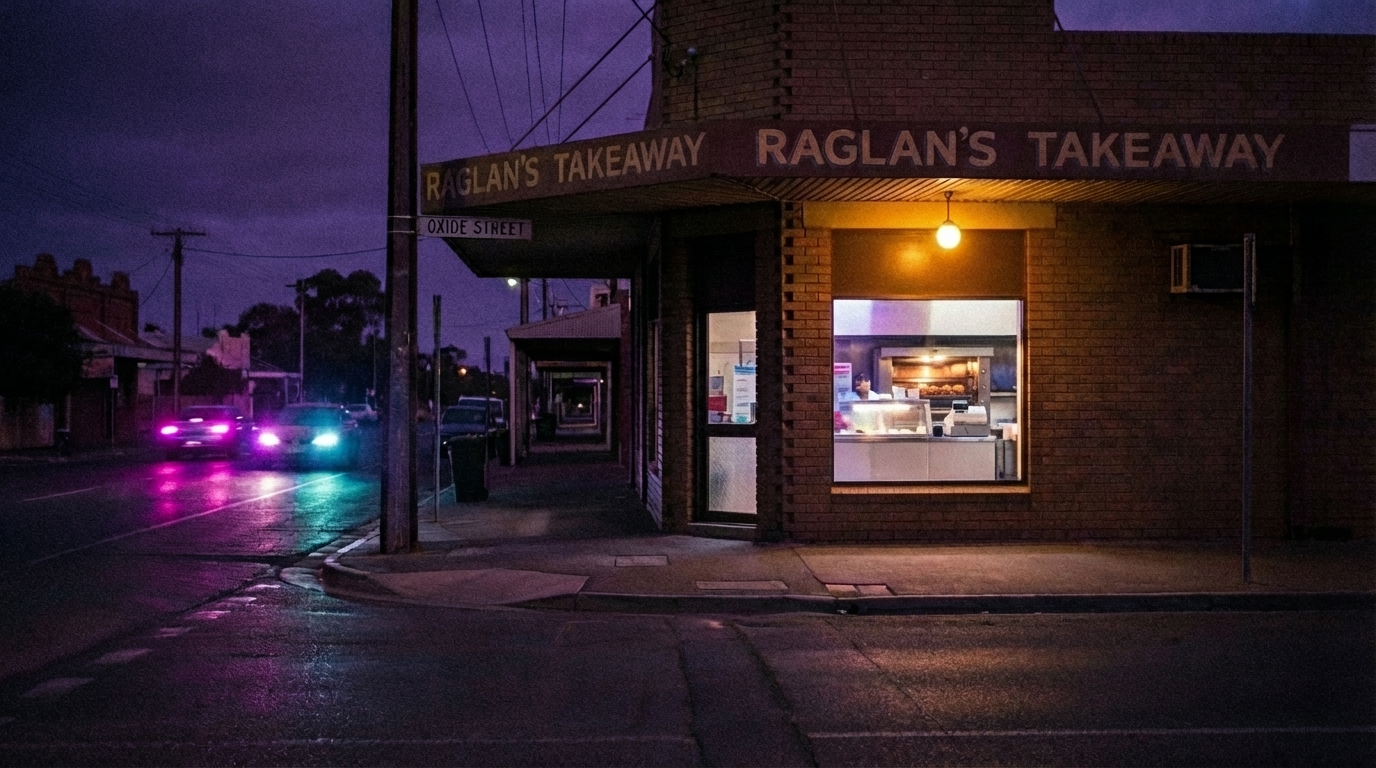
Raglan's Takeaway, known locally as "Rags," is a beloved establishment on Oxide Street in Broken Hill, New South Wales, serving the outback community since the late 1980s. Under David "Cheesy" Moreland's stewardship since 2007, the takeaway has become renowned for its crinkle-cut chips and legendary cheeseslaw. More than a food outlet, Rags functions as a community hub where locals gather, travellers pause, and outback resilience finds tangible expression.
Origins and Early History
Raglan's Takeaway first opened its doors in the late 1980s, establishing itself as a modest roadside stop serving the needs of Broken Hill's residents and the travellers passing through this remote mining town in far western New South Wales. The establishment took its name from an old-world British pub, the choice reflecting the heritage sensibilities common among Australian businesses of that era, when echoes of the mother country still resonated in commercial nomenclature.
The original premises occupied a site on Oxide Street, one of Broken Hill's main thoroughfares, positioning the takeaway to capture both local trade and passing traffic. In those early years, the business operated as a straightforward roadside venture, selling chips, burgers, and basic groceries to whoever needed them. The menu was unpretentious, the service functional, and the ambitions modest. Yet even in this humble beginning, the foundations were being laid for something that would grow to mean considerably more to its community than the sum of its fried offerings.
Broken Hill itself provided the context that would eventually elevate Raglan's beyond ordinary takeaway status. The town, established following Charles Rasp's discovery of silver, lead, and zinc deposits in 1883, had developed a character forged through mining prosperity, labour struggle, and the particular resilience that survival in the outback demands. Communities in such places develop tight bonds born of shared hardship and mutual dependence. Commercial establishments that serve such communities well become woven into their social fabric in ways that suburban businesses rarely achieve.
Through the 1990s, as Broken Hill weathered economic fluctuations tied to global mineral prices and evolving mining practices, Raglan's endured as a constant presence. The takeaway changed hands at least once during this period, each proprietor maintaining the essential character whilst adding their own touches. The establishment's survival through lean times demonstrated its integration into local routines—the shop that stayed open when others closed, the familiar stop that outlasted economic uncertainty.
David Moreland's Arrival
The transformation of Raglan's Takeaway from ordinary roadside stop into genuine community institution began in 2007, when David James Moreland took over the business. Born on 3 April 1959 in Broken Hill, David represented the town's working-class heritage in almost archetypal form. His father William had worked as a mechanic for one of the smaller mining operations, whilst his mother Margaret supplemented household income through cleaning work at mining company offices. The values instilled through this upbringing—hard work, loyalty, practical capability—would prove well suited to running a takeaway that served people much like himself.
David's path to Raglan's had wound through the mining industry that defined Broken Hill's economy and identity. At seventeen, fresh from school where his interests in history and storytelling had never quite translated into academic achievement, he followed his father's footsteps into the mines. For the next twenty-five years, he held various positions—machinery repair, pit labour, and eventually safety monitoring as his body began feeling the accumulated wear of physically demanding work. His transition to safety operations in his mid-thirties reflected both growing expertise and the practical recognition that younger bodies handled the heaviest labour more sustainably.
The pivotal change came in his late thirties when a workplace injury kept David off his feet for months. The enforced rest prompted reflection on a career that had served him well but whose physical demands he could no longer indefinitely sustain. During this period of uncertainty, he learned that Raglan's Takeaway was available for purchase. The prospect of working with people in a social setting, of trading underground darkness for counter service, of building something that served his community through different means—all this appealed to a man seeking change without abandonment of the values his working life had embodied.
The Cheesy Era Begins
David's takeover of Raglan's in 2007 initiated changes that would define the establishment's modern character. His approach combined the practical competence of a former miner with an instinct for hospitality that his previous career had never required but that proved natural when circumstances demanded it. Within months, he had introduced the signature items that would become synonymous with Rags: crinkle-cut chips dusted generously with chicken salt, prepared with attention that elevated humble ingredients into something worth travelling for.
The more distinctive innovation, however, was the cheeseslaw. This creation—a mixture of shredded cheese, grated carrot, and mayonnaise—represented David's personal contribution to the menu, a side dish that sounded improbable but proved surprisingly delicious. The combination had no particular culinary pedigree; it emerged from David's own preferences, developed during his mining years when substantial food that travelled well held practical appeal. Its introduction to the menu sparked initial scepticism among customers accustomed to conventional coleslaw, but the curious soon became converts, and the converted became evangelists.
The cheeseslaw earned David the nickname that would become inseparable from his identity. "Cheesy" Moreland embraced the moniker with good humour, eventually adding it to the menu with evident pride. The nickname captured something essential about its bearer—the lack of pretension, the willingness to be defined by something as humble as a side dish, the comfort with a identity rooted in service rather than status. In a town where mining had long determined hierarchies, a man who cheerfully answered to "Cheesy" represented democratic values that resonated with working-class sensibilities.
Physical Character and Atmosphere
Raglan's Takeaway presents a physical appearance that perfectly matches its function and clientele. The establishment occupies a modest building typical of outback commercial architecture—practical rather than aesthetic, designed to shelter operations rather than impress visitors. The signage, somewhat sun-faded from years of exposure to Broken Hill's intense sunlight, announces the business without unnecessary elaboration. Bright awnings provide shade for customers waiting to collect orders, their colours standing out against the stark blue skies and vibrant red dust that characterise the surrounding landscape.
Inside, the space prioritises function over comfort. A counter separates customers from the kitchen area, where fryers bubble and chickens rotate on spits, their aromas permeating everything. The décor accumulated gradually rather than being designed—photographs of Broken Hill's mining heritage, notices about community events, the occasional piece of local art. Nothing matches particularly well; everything feels authentic to its place and purpose. The overall effect suggests a establishment that has grown organically over decades, each element added when needed rather than planned in advance.
The kitchen visible behind the counter reveals the straightforward operations that produce Raglan's offerings. Commercial fryers maintain the oil temperature essential for proper chip preparation. The chicken rotisserie turns its cargo through endless cycles, producing the roast chickens that supplement the fried menu. Storage areas hold the supplies that keep operations running—potatoes by the sack, cooking oil by the drum, the ingredients for sauces and sides that complete each order.
The atmosphere Cheesy cultivates reflects his own temperament. Service proceeds at an unhurried pace that might frustrate customers accustomed to urban efficiency but suits the rhythms of outback life. Conversations extend beyond the transactional minimum, transforming orders into social exchanges. The radio plays softly—local news, classic rock, the background sound of Australian commerce. Regular customers receive recognition that acknowledges their place in the establishment's ongoing story, whilst newcomers encounter welcome that makes first visits feel like returns.
Community Hub Function
Under David's stewardship, Raglan's evolved from food vendor into genuine community institution. The transformation occurred gradually, emerging from countless small interactions rather than deliberate strategy. People began lingering after collecting orders, conversations extending into the casual fellowship that sustains remote communities. The establishment became a meeting place where plans were made, news exchanged, and relationships maintained through the simple ritual of sharing food.
The social function gained particular significance during the 1990s economic downturn that had affected Broken Hill before David's arrival, and which his tenure helped the community recover from psychologically if not economically. As mining industry restructuring forced friends and families to relocate, those who remained found in places like Raglan's the continuity that departure had disrupted. The takeaway became refuge for locals seeking familiar faces and warm meals during uncertain times, its continued operation representing stability when much else seemed precarious.
David's personality proved essential to this community role. His willingness to listen, his unhurried manner that suggested unlimited time for whoever stood before him, his repertoire of stories drawn from decades of mining and community observation—all contributed to an atmosphere where customers felt valued beyond their commercial significance. His characteristic fumbles with the cash register and slight confusion over change calculations became endearing quirks rather than service failures, adding to rather than detracting from the establishment's appeal.
The storytelling deserves particular mention. David accumulated tales across his lifetime—anecdotes from mining days, local legends passed through generations, observations on characters and events that had shaped Broken Hill's distinctive culture. These stories emerged naturally during service, offered without demand for attention but rewarding those who paused to listen. Younger customers heard history they might otherwise never encounter; older patrons found their memories validated and preserved. The counter at Raglan's became, in effect, a site of informal oral tradition.
Artistic Recognition
The artistic dimension of Raglan's story emerged through Marcus James Lowe, a painter from nearby Silverton whose work would eventually bring the takeaway to broader cultural attention. Marcus, born in 1987, had spent years struggling to establish himself as an artist, his avant-garde sensibilities finding little market in a region that preferred conventional landscape photography and historical memorabilia. His return to Silverton after unsuccessful attempts to build a career in Sydney had seemed like defeat.
The creative breakthrough came in January 2018, when Marcus's van broke down near Raglan's Takeaway. Stranded whilst awaiting roadside assistance, he observed David's interactions with customers—the ritual exchanges, the democratic equality of counter service, the intimacy of food prepared by familiar hands. Something in the scene's quotidian beauty triggered artistic epiphany. Marcus began sketching Cheesy behind the counter, attempting to capture not photographic likeness but emotional truth—the dignity of service, the poetry of routine.
The resulting painting, "Cheesy at the Pass," marked a turning point in Marcus's practice. The work depicted David in his natural environment, warm grin evident, trademark jar of chicken salt in hand, apron dusted with the evidence of honest labour. The style Marcus developed for this piece—which he termed "emotional realism"—balanced representational clarity with expressive intensity, capturing something essential about both subject and setting.
This initial painting spawned the "Everyday Icons of Broken Hill" series, through which Marcus documented the overlooked individuals whose consistency created community fabric. Yet Raglan's remained the series' centrepiece and recurring subject. Marcus painted the establishment from multiple angles, in various lights, across different seasons. Cheesy's crinkle-cut chips received still-life treatment rivalling Dutch masters' fruit bowls. The cheeseslaw earned representation usually reserved for sacred objects.
The artwork's exhibition at local venues drew positive response, validating both Marcus's evolved vision and the significance of his subjects. Visitors from beyond Broken Hill began arriving specifically to see Rags and meet the man behind its legend. David accepted this modest fame with characteristic humility, bemused by attention that his simple service had attracted but grateful that the establishment's story resonated with others.
Notable Visitors and Events
Raglan's Takeaway has witnessed its share of significant moments amidst the ordinary flow of daily commerce. The establishment serves as waypoint for travellers crossing Australia's vast interior, many of whom pause in Broken Hill en route between eastern cities and western destinations. These transient visitors experience Rags briefly but intensely, the takeaway representing their primary encounter with outback hospitality.
On 30 July 2018, the establishment received a visitor whose presence would connect Raglan's to events far stranger than typical takeaway commerce. Beatrix Cramer, a woman from Tasmania entangled in circumstances involving inter-dimensional phenomena and the mysterious Smith family, arrived at Rags seeking hot chips for her companion Paul. The visit seemed ordinary enough—a customer entering the warm glow of the shop, ordering chips, discovering the regional treasure of cheeseslaw that no one had warned her about.
Yet Beatrix's visit carried undertones of the extraordinary that had increasingly characterised her life. Outside, in the shadows of Oxide Street, a hooded figure watched her with unsettling attention, his presence noticed only as she prepared to leave. The watcher vanished into a side street before she could investigate further, leaving questions that the warmth of fresh chips could not answer. The incident demonstrated how Raglan's, for all its ordinary character, existed within a world where strange currents flowed beneath familiar surfaces.
