4338.211 · July 30, 2018 AD
Pursuit Protocol
Dragged from the Owens’ property and straight into a high-speed pursuit through the storm, Karl Jenkins finds clarity in chaos. As rain blurs the world into streaks of motion and colour, he and Sarah fall back into their old rhythm — two detectives chasing the unknown, and themselves. But as the tyres bite into wet bitumen and the siren drowns the thunder, Karl begins to suspect that what they’re really pursuing might already be behind them.
“The chase has a way of stripping things down — until all that’s left is who you really are when the road runs out.”
I trudged towards the patrol, each step a minor battle against the sucking mud beneath my boots. The rain showed no sign of easing—if anything, it had intensified in the minutes since the goose incident, drumming against my shoulders with a steady violence that made each stride heavier than the last, as though the storm itself were trying to pin me to the earth.
Water trickled down the back of my neck in cold rivulets, finding the gap between collar and skin, chilling my spine in a way that made my teeth want to chatter. The pounding in my temples kept time with the thunder that rolled across the hills in waves. Lightning forked across the sky with increasing frequency, briefly illuminating the treetops in stark flashes of electric-blue light that turned the world into a monochrome negative for half a second at a time—white branches against black sky, shadows cast in impossible directions.
"Karl, we have to go!" Sarah’s voice sliced through the cacophony with unexpected force, commanding. She stood by the driver’s door, rain cascading off her forehead in sheets as she shielded her eyes with one hand. The other arm waved me on with near-desperate urgency.
"What is it?" I shouted back, squinting through the curtain of water as I slowed my pace slightly.
I was exhausted—physically from the lack of sleep and the sprint to the dam, mentally from the constant pressure and the mounting mysteries. But the sight of Sarah, soaked and mud-splattered, hair plastered to her face in dark streaks, yet utterly unbowed and vibrantly alive with purpose, sparked something in me. Some reserve of energy I didn’t know I still possessed.
That was Sarah Lahey to the core: indomitable, sharp-edged, undeterred even by storm or sentiment or dead livestock. She channelled her fury into momentum with admirable efficiency, and sometimes—in moments like this—I envied her for it. That ability to transform frustration into forward motion, to refuse to be paralysed by setback or embarrassment.
"A priority call has just come over the radio, two cars are driving at high speed just off the highway near Collinsvale. We’re the closest unit. Quick, let’s go!" she shouted, her arm slicing the air in emphasis, water flying from her sleeve in an arc that caught briefly in the grey light.
The urgency in her tone was unmistakable, brooking no argument or delay. But it clashed violently with the part of me that refused to walk away from the blood trail inside the Owens’ cottage, from the mysteries we’d only begun to unravel. The unease still gnawed at me—the unspoken suggestion of violence in that blood pattern, the wet droplet that didn’t fit the timeline, the sanitised cleanliness that spoke of covering tracks.
My instincts warned me with insistent whispers that leaving now might cost us something crucial. That we were standing on the edge of a breakthrough, that answers lay just beyond reach if we could only stay focused. But there was no time to explain all that, to articulate the pattern I felt forming, to justify my reluctance. Sarah was already halfway into the car, a blur of motion and wet fabric and single-minded resolve.
"We can’t just leave the scene here," I called back, more to myself than to her, the words emerging half-formed, trailing off even as I spoke them. Procedurally, leaving an active scene was questionable at best. Personally, it felt like abandonment of something important.
But she didn’t pause or acknowledge the concern.
"It’ll be fine. I’ve already notified dispatch and forensics are on their way. We can swing by afterwards to check up on things. This call is urgent," she cut me off, her voice flat and unwavering, carrying the weight of a decision already made. The slam of the door behind her was lost in the thunder that rolled overhead, but I felt it all the same—a full stop on the conversation, punctuation that allowed no rebuttal.
"Fine," I muttered under my breath, picking up the pace despite my reservations, boots splashing through puddles with increased urgency.
The patrol car’s wipers were already thrashing across the windscreen in a frantic rhythm as I reached the door, beating back and forth with desperate speed, droplets running in rivulets down the glass faster than the blades could clear them. The visual effect was hypnotic and disorienting—moments of clarity between sweeps followed by immediate obscuration as more rain replaced what had been cleared.
Sarah had already turned the key in the ignition by the time I grabbed the door handle, and the car gave a guttural rumble as it came alive. I yanked the door open against the wind’s resistance and leaned in, water streaming from my clothes, barking over the engine’s noise: "Shift over, I’ll drive."
There was no room for negotiation in my tone—it was instinct asserting itself, the familiar balance of control between us briefly restored by this small but established ritual. It wasn’t about dominance or superiority or any kind of power play. It was about rhythm, about the practised efficiency of partnership. When I drove, I could focus the restless energy that currently churned inside me. When I focused, I could think through the chaos towards something approaching clarity.
With a frustrated exhale that fogged slightly in the car’s interior and an eye-roll that spoke louder than any verbal protest, Sarah climbed awkwardly over the centre console. Her wet clothes clung to the vinyl with audible resistance, fabric sticking and peeling. Her elbow knocked the gear stick, sending it rattling. One foot kicked the glove box hard enough to make the door pop open slightly. "Christ," she hissed under her breath, finally settling into the passenger seat and slamming her seatbelt into place with more force than necessary.
Water dripped from her sodden sleeves and puddled on the seat beneath her, creating dark stains on the fabric. She didn’t even bother wiping the fog from the side window that her breathing and body heat were creating—her eyes were locked straight ahead, pupils dilated despite the dim light, body tense with anticipation and residual anger. The adrenaline of impending pursuit was already overtaking other emotions, focusing her with the intensity I’d seen dozens of times before.
"Come on then!" she snapped, the edge in her voice barely masking the excitement of the chase already replacing the anger and embarrassment.
Sliding into the driver’s seat, I didn’t hesitate or second-guess the decision. The leather was cold and wet beneath me, slick with condensation and the water I’d brought in, clinging to my back with an uncomfortable squelch as my rain-soaked clothing formed a seal against it.
I slammed my foot down on the accelerator without preamble, the patrol car’s V8 engine answering with a feral growl that shook the entire vehicle. We launched forward, the rear tyres spinning momentarily on the slick combination of mud and gravel, searching for traction. The car fishtailed, the tail-end snapping to the left with sudden lateral force—then overcorrecting to the right as the tyres found purchase.
But I caught it with practised ease, hands making minute adjustments to the wheel, correcting without drama, feeling the car’s balance through my palms and the seat of my pants.
The windscreen wipers beat furiously against their maximum setting, motors whining with effort, struggling valiantly against the unrelenting downpour but achieving only partial success. Between swipes, the outside world blurred into an abstract smear—a dripping ink-wash of gum trees rendered in greys and blacks, bark textures lost in liquid distortion, shadows bleeding into each other. The tyres churned the mud into rooster tails behind us, spattering the undercarriage with wet earth in a sound like gravel being thrown against metal, mixing with the engine’s roar.
Adrenaline swept through me, carrying off the dregs of frustration and guilt left behind at the dam. It sharpened my thoughts like a whetstone to a blade’s edge, my awareness narrowing to the essential elements: the road, the engine’s note and what it told me about power delivery, the way the chassis leaned into each rut and turn. The chase was on.
The distraction of Sarah’s goose incident, the lingering sting of our strained partnership, the mysteries of the cottage, the blood trail leading nowhere—all of it faded into background noise, irrelevant to immediate necessity. There was only the pursuit now, the singular focus that made everything else disappear.
Beside me, Sarah’s posture shifted into its operational default—alert, focused, collected, professional. Her spine straightened, shoulders squared, breathing regulated into the controlled rhythm of someone managing adrenaline rather than being controlled by it. And for the first time in what felt like days, I saw her smile. Not the small, guarded smile I’d come to know in quiet moments, not the professional mask she wore in the station. But a bright, unfiltered flash of exhilaration that transformed her face completely.
The chase had always been our common ground. A space where the messy parts of our dynamic didn’t matter, where personal complications dissolved in the face of professional purpose. We were good at this. Together. The synchronicity that came from months of partnership, from learned patterns and mutual trust that functioned independently of personal tension.
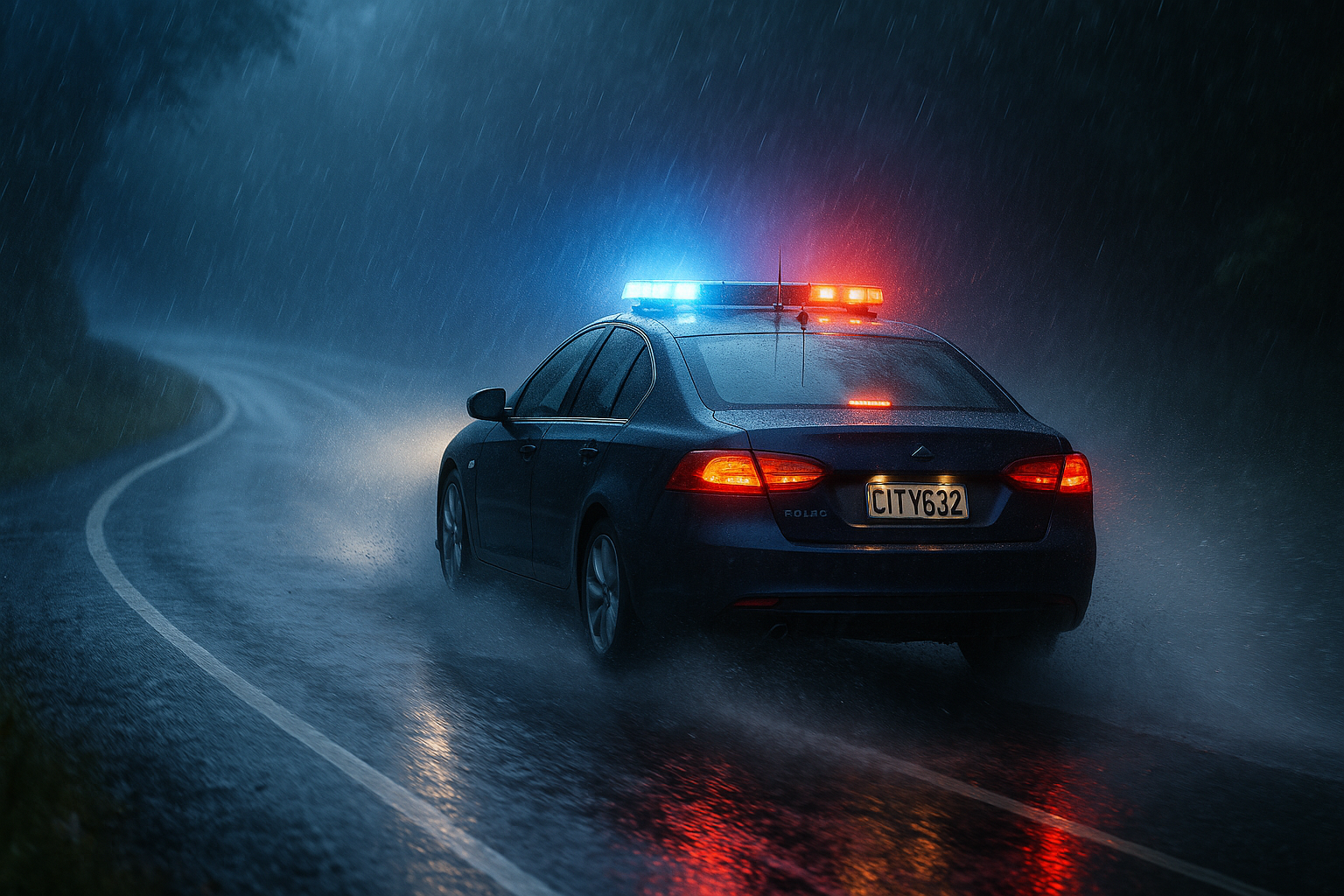
She snatched the radio handset from its mount, her voice crisp and clear despite the engine’s growl and the car’s jarring over every pothole and irregularity in the flooded driveway. "CITY632 requesting an update on the two speeding cars sighted near Collinsvale."
The radio crackled in response, static weaving through the dispatcher’s words like white noise threaded through signal. "Copy that CITY632. We already had a chopper in the air. They’re looking for the vehicles now. What is your location?"
The mention of the police helicopter was reassuring—aerial surveillance gave us enormous tactical advantage, eyes that could see beyond sight lines and track vehicles through terrain that would otherwise hide them. But it also meant the situation was being taken seriously at command level, that resources were being committed.
I brought the car to a sudden, controlled stop at the end of the Owens’ long driveway, gravel crunching and spraying beneath us as the tyres struggled to anchor the vehicle’s momentum in the loose surface. The stillness that followed our violent motion was momentary but sharp—unnatural after the cacophony of acceleration and engine noise. Rain battered the car roof in a steady roar that filled the vacuum left by the engine’s quieting. My breath fogged the inside of the windscreen almost immediately, mingling with the low mist clinging to the Collinsvale road visible through the cleared semicircle the wipers maintained.
For a moment, everything outside the vehicle was shapeless, a scene rendered in water and wind, details lost in the atmospheric chaos.
"CITY632. We’re at the edge of the Owens’ property in Collinsvale," Sarah reported, her gaze darting from road to mirror, scanning every shifting shadow for movement that might resolve into approaching vehicles. Her fingers drummed lightly against the side of her holster in a steady rhythm.
The radio crackled again, the dispatcher’s voice barely audible over the interference created by the weather and terrain. "Copy that, CITY632. The chopper has sight of the vehicles. They should be coming—"
The words were cut off abruptly as two vehicles screamed past our position like missiles, nothing more than dark smears across our field of vision, shapes distorted by speed and rain into mere suggestions of automobiles. I flinched instinctively as they tore through the intersection ahead, engines shrieking like wounded animals in mechanical agony, transmissions pushed beyond recommended limits. A geyser of road water exploded in their wake, engulfing our stationary patrol car in a blinding spray of mud, mist, and grit that completely obscured the windscreen for several critical seconds.
My foot slammed down on the accelerator before conscious thought could fully engage, instincts taking over before higher reasoning could catch up with sensory input. The patrol car jolted forward with neck-snapping acceleration, wheels spinning briefly before biting into wet bitumen with a sound like tearing fabric. I yanked the wheel hard to the right, swinging the car into the road in a tight arc. The rear end slid wide in immediate response, the car yawing into a full power slide across the rain-slicked road, weight transferring, tyres at the absolute edge of traction.
I corrected with surgical precision, muscles taut, reflexes honed to the millisecond through countless hours of pursuit driving training and real-world application. Every micro-adjustment was instinctive, bypassing conscious thought to flow directly from perception to action. The motion felt like controlled flight—dangerous, barely restrained, glorious in its execution.
The siren blared as Sarah hit the switch, the sudden wail slicing through the storm. Red and blue lights ignited across the bonnet in strobing pulses, casting chaotic reflections on the wet road that danced and flickered, creating pools of colour that moved with us. The sound and light shattered the monotony of grey, signalling to the world that we were in pursuit—that justice, or something close to it, was tearing down this highway.
I grinned despite everything—just a little, just enough to acknowledge the primal satisfaction of the chase. The road ahead bent to the left in a sweeping curve, the tail lights of our quarry barely visible through the haze of spray and rain, red pinpricks in the grey that beckoned like distant stars.
They had a head start—several hundred metres at least, maybe more.
But we had the chase. We had training and determination and equipment purpose-built for exactly this scenario.
And I wasn’t letting them go.
