New South Wales, Australia
New South Wales is the oldest European settlement in Australia, founded in 1788 when the First Fleet landed at Sydney Cove on Gadigal country. From penal colony to industrial powerhouse, the state has shaped Australia's political, commercial, and cultural identity across two centuries. Its history extends from the colonial processing of transported convicts to the darker twentieth-century mysteries of Broken Hill's outback, where Project Ironsand and the Silverton Strangler cast long shadows across generations.
Ancient Land and First Peoples
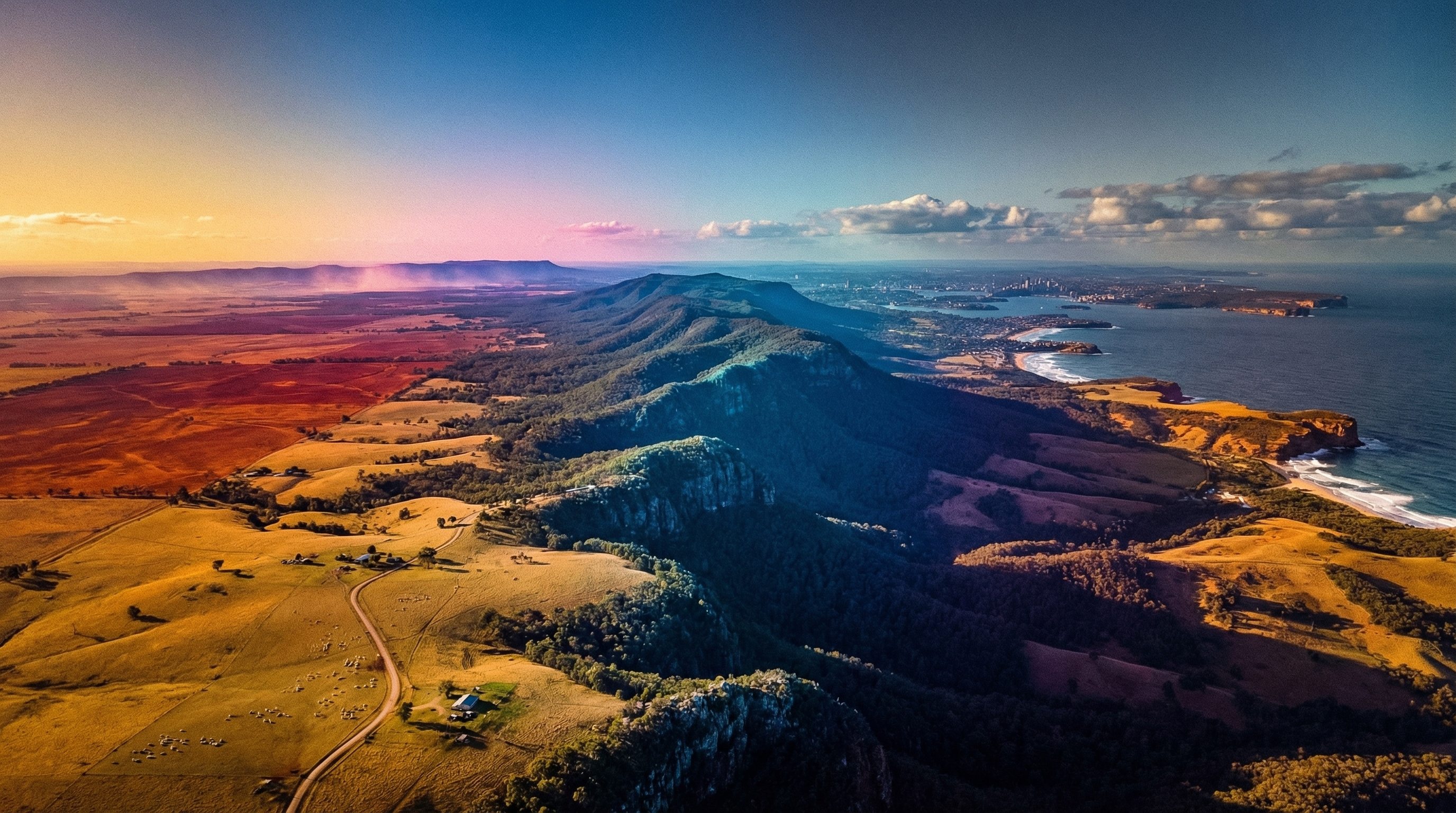
New South Wales occupies the south-eastern corner of the Australian continent, its borders encompassing a vast territory stretching from the subtropical coast to the arid interior. For at least sixty-five thousand years before European vessels breached the horizon, Aboriginal peoples inhabited this land, developing hundreds of distinct nations with their own languages, laws, and spiritual traditions. The Gadigal of the Eora nation maintained the harbour country that would become Sydney, whilst the Wiradjuri held the central western plains, the Barkindji followed the Darling River through the far west, and the Gamilaroi managed the fertile black-soil country of the north-west. Each nation sustained sophisticated relationships with its country, shaping landscapes through fire management, ceremony, and seasonal movement in ways that European observers would fail to recognise as deliberate stewardship.
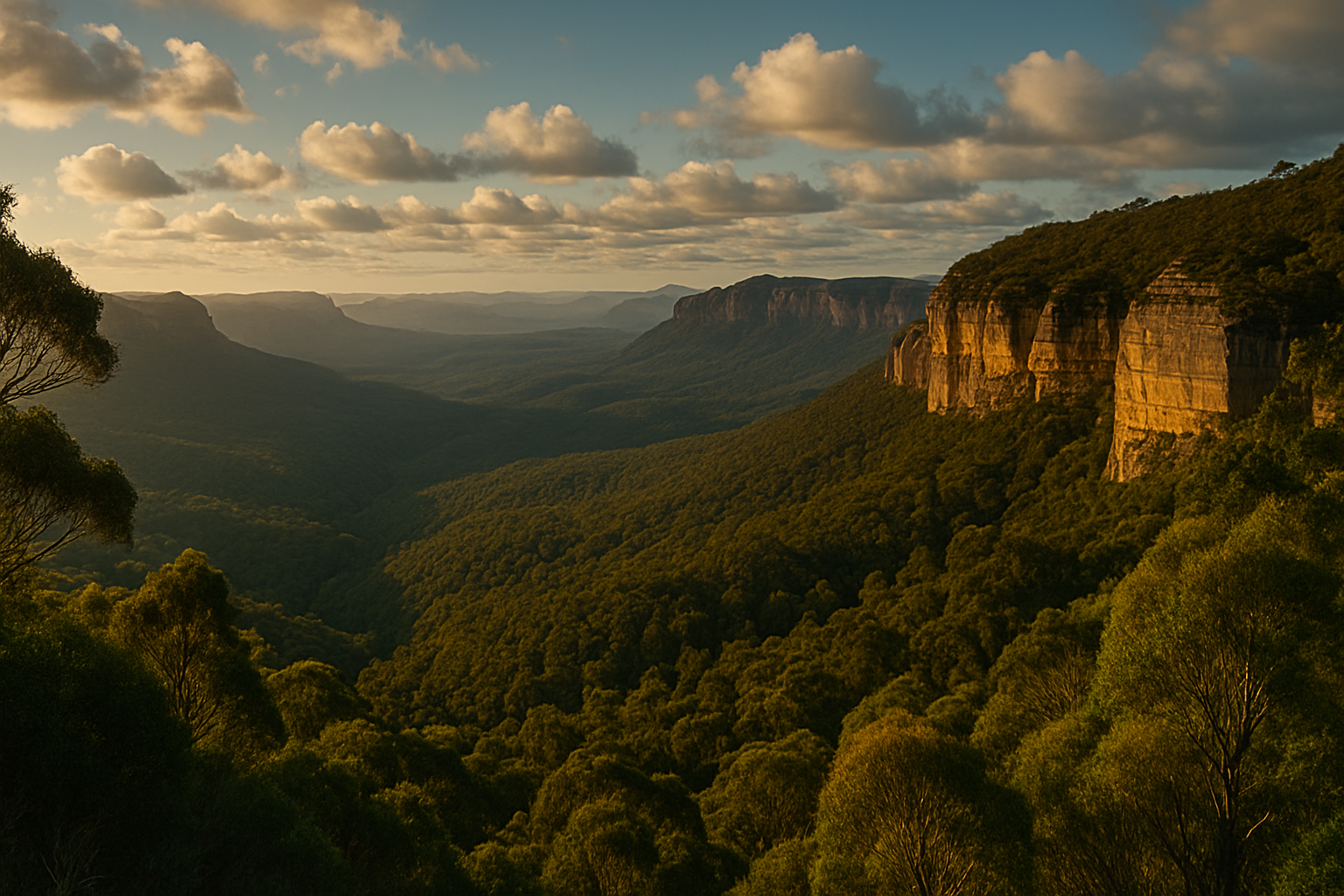
The geography of New South Wales contains extraordinary diversity within its eight hundred thousand square kilometres. The Great Dividing Range runs like a spine down the eastern third, separating the narrow and fertile coastal strip from the vast western plains that stretch toward the South Australian border. Rainforests cling to the northern ranges, alpine meadows crown the Snowy Mountains in the south, and the sandstone escarpments of the Blue Mountains create a natural barrier that would confine European settlement to the coastal fringe for a quarter-century after colonisation. West of the ranges, eucalypt woodlands give way to grasslands and eventually to the semi-arid red earth country that defines the outback — a landscape of immense silence, punishing heat, and a beauty that demands patience from those who seek to understand it.
The waterways that thread through this territory sustained both Aboriginal nations and the colonial settlements that would displace them. The Murray and its tributaries drained the southern interior, the Darling carried snowmelt from the ranges through country so flat that the river seemed barely to move, and the Hunter Valley's river system nourished what would become the colony's first significant agricultural region beyond the Cumberland Plain. Along the coast, harbours and estuaries provided anchorage, marine resources, and the sites upon which European towns would rise — none more consequential than the vast natural harbour at Port Jackson, whose deep waters and sheltered coves would determine the location of Australia's first and largest city.
European Contact and the Founding Colony
Lieutenant James Cook charted the eastern coast of the continent in 1770 aboard HMS Endeavour, claiming the entire eastern seaboard for the British Crown under the name New South Wales — a designation that originally encompassed far more territory than the modern state. Cook's reports of the land's potential, combined with Britain's urgent need for a new destination for transported convicts following the loss of the American colonies, led to the decision that would transform the continent irrevocably.
On 26 January 1788, Captain Arthur Phillip led the eleven ships of the First Fleet into the harbour he would name Port Jackson, having found the previously scouted Botany Bay unsuitable for settlement. The company that came ashore at Sydney Cove — approximately fifteen hundred souls comprising convicts, marines, and officials — stepped onto Gadigal country with little understanding of the civilisations they were displacing. Phillip reportedly declared Port Jackson the finest natural harbour in the world, a judgement that subsequent centuries would vindicate as the settlement grew from desperate encampment to thriving metropolis.
The early years tested every capacity the colony possessed. The convicts, predominantly urban poor whose experience extended no further than London's streets or the manufactories of English industrial towns, struggled to adapt their skills to an alien landscape. The soil around Sydney Cove proved rocky and reluctant, ill-suited to the crops whose seeds had been carried across fifteen thousand miles of ocean. Governor Phillip implemented strict rationing that applied equally to convict and free, marine and officer, a decision that earned grudging respect from men who might otherwise have mutinied. The discovery of fertile land at Rose Hill — soon renamed Parramatta, formally established on 2 November 1788 upon land the Burramattagal people had inhabited for millennia — alleviated the immediate threat of starvation and allowed Sydney to develop as the colony's administrative and commercial centre rather than its agricultural foundation.
The Convict System and Colonial Governance
New South Wales developed as the primary destination for Britain's transported criminals, receiving tens of thousands of convicts between 1788 and 1840. The system fundamentally shaped the colony's character, providing the labour that built roads, bridges, and public buildings whilst creating social hierarchies and tensions that would persist long after transportation ceased. Convicts were assigned to government works or private employers upon arrival, their skills — or lack thereof — determining whether they faced the road gangs, the quarries at Castle Hill, or the agricultural stations that fed the growing population.
The government farm at Parramatta, situated fifteen miles west of Sydney Cove, became one of the colony's most significant convict establishments. There, transported men broke ground under the scorching Australian sun, their labour transforming the fertile river flats into the granary that sustained the struggling settlement. Overseer Garrett and his successors maintained discipline through a combination of punishment and the incremental privileges that the ticket-of-leave system offered to those who demonstrated reliability and skill.
Political upheaval accompanied the colony's growth. The New South Wales Corps — nicknamed the Rum Corps for their involvement in the lucrative alcohol trade — had assumed a dominant role in colonial affairs since their arrival in 1790, leveraging control over supplies to amass significant wealth. Governor William Bligh's attempts to curtail these activities brought him into direct conflict with officers who had no intention of surrendering their advantages. On 26 January 1808, Major George Johnston led members of the Corps to Government House and placed Bligh under arrest. The Rum Rebellion, as it came to be known, represented the most dramatic assertion of military power in the colony's short history, sending ripples of uncertainty through a settlement accustomed to turbulence but unprepared for outright coup. The aftermath transformed lives — families like the Hawkins, who had arrived aboard the HMS Caledonia on 2 January 1805 with Dr Samuel Hawkins appointed as a colonial physician, accepted reassignment to Van Diemen's Land, departing aboard the HMS Integrity on 14 March 1808 to escape the political chaos.
Gateway and Departure Point
Sydney Cove's most enduring function in the colony's formative decades was as the gateway through which Britain's transported criminals entered their new existence. Convict ships arrived with grinding regularity, each vessel carrying its cargo of men and women whose crimes — or misfortunes — had earned them exile. The processing that accompanied these arrivals followed patterns established through repetition until they achieved bureaucratic efficiency: ships anchored in the harbour, officials prepared paperwork, convicts were brought ashore, their particulars recorded, and assignments determined according to colonial needs.
The arrival of the HMS Resolution on 28 February 1808 illustrated the routine that had become integral to the colony's growth. Captain Josiah Haverford oversaw the disembarkation of one hundred and fifty convicts after a ten-month voyage from Portsmouth, directing men toward assignments at the government farm at Parramatta, the quarries at Castle Hill, and various private employers throughout the settlement. Among them was twenty-two-year-old William Jeffries, a dockworker whose conviction for stealing a pocket watch had earned him seven years' transportation. The cove that received him had transformed remarkably since the First Fleet's arrival — brick and stone buildings lined the waterfront, streets climbed the rise in something approaching order, and vessels of every description lay at anchor throughout the harbour.
Yet New South Wales served not only as a destination but as a departure point. By the early nineteenth century, the colony was dispatching settlers, officials, and former convicts to the satellite settlements that Britain was establishing along the coast and across Bass Strait. Van Diemen's Land, established in 1803, drew many who sought fresh opportunities or calmer political waters. The merchant vessel Doris departed Sydney harbour at noon on 3 March 1815, carrying approximately thirty passengers bound for Hobart Town — among them William Jeffries, newly freed and bearing letters of introduction from the Sydney merchant Reginald Donnelly, whose daughter Eliza had championed Jeffries' prospects during a clandestine courtship that colonial society's rigid hierarchies could never have sanctioned.
Expansion and the Gold Rush
The crossing of the Blue Mountains by Gregory Blaxland, William Lawson, and William Charles Wentworth in 1813 opened the western plains to European settlement and pastoral expansion. Bathurst, established in 1815 as the first inland settlement west of the ranges, became the gateway to the interior, followed by towns that would dot the western landscape as squatters and selectors pushed ever further from the coast. The discovery of gold near Bathurst and at other locations from 1851 onwards triggered a rush that transformed the colony's economy and demographics virtually overnight. Tens of thousands of immigrants poured into New South Wales, many arriving through Sydney before dispersing to the goldfields. Towns like Orange and Lithgow grew from modest settlements into regional centres servicing the mining industry, whilst the pastoral stations that had dominated the economy found themselves competing for labour with the allure of easy wealth.
The mineral frontier extended far beyond gold. In 1883, boundary rider Charles Rasp discovered the broken ridge of rocks in the far west that would give Broken Hill its name and its fortune. The outcrop contained silver, lead, and zinc in quantities that seemed almost impossible — a geological accident that would create fortunes, build Australia's largest mining corporation, and forge a community defined by the harsh realities of extracting wealth from unforgiving earth. The formation of the Broken Hill Proprietary Company in 1885 marked the beginning of industrial-scale operations that would shape not just the town but Australia's economic identity. Grand buildings rose from red dust, the Umberumberka Reservoir sustained both town and mines, and labour strikes forged a culture of working-class solidarity that distinguished the far west from the more genteel establishments of the coast.
Industrial Growth and Federation
The nineteenth century's closing decades saw New South Wales emerge as Australia's pre-eminent colony in both population and economic output. Sydney's harbour facilitated international trade, Newcastle's coal deposits powered industrial expansion, and the agricultural regions of the Hunter Valley, the Riverina, and the western plains fed both domestic markets and a growing export trade. The railway network that extended from Sydney into the interior transformed regional towns like Parkes, Gunnedah, and Singleton into vital junctions connecting agricultural production to coastal markets and ports.
Newcastle, perched at the mouth of the Hunter River, developed into one of Australia's most significant industrial cities. Originally established as a secondary penal settlement, the city's fortunes became inextricably linked to coal — and later to steel. BHP's steelworks, which commenced operations in the early twentieth century, created an industrial workforce whose union traditions and working-class culture shaped the city's character for generations. Families like the Harlows built their lives around the rhythms of maritime and industrial toil, their stories woven into a community that balanced its working-class backbone with surfside charm and a deep sense of local identity.
New South Wales entered the Australian Federation on 1 January 1901, its capital Sydney becoming the nation's largest city whilst Canberra — carved from New South Wales territory — would eventually serve as the federal capital. The state retained its own parliament, courts, and administrative apparatus, managing affairs within the constitutional framework that Federation established. Sydney's economic dominance ensured that New South Wales remained central to national affairs, its financial institutions, media organisations, and cultural establishments wielding influence that smaller states could rarely match.
Wartime Shadows and Hidden Operations
The Second World War brought both sacrifice and secrecy to New South Wales. Industrial centres mobilised for war production, with Newcastle's steelworks operating round the clock to supply the Allied forces. Yet beneath the patriotic exertion, irregularities emerged that would remain unexplained for decades. Steelworkers at the Newcastle plant reported that five hundred tonnes of production vanished monthly between furnace and delivery — steel plates disappearing before dawn, unmarked wagons loaded during shift changes by unknown crews, management citing wartime security whilst workers threatened industrial action over the unexplained losses.
In December 1943, Major Wallace Trenholm of the Directorate of Military Intelligence led an audit that identified systematic discrepancies in strategic resource allocation across multiple BHP facilities. The investigation, designated by the code name Ironsand in a single mention that appeared in the Harbour City Herald, encompassed the entire vertical integration of BHP's operations — from ore extraction at Broken Hill to steel production in Newcastle. The audit revealed tonnage discrepancies representing thousands of tonnes of strategic materials unaccounted for since expanded war production commenced in 1941. Within twenty-four hours of coordinated newspaper coverage appearing across four publications, every edition was recalled, editors were replaced, journalists were reassigned, and Major Trenholm was dishonourably discharged for mishandling classified materials. By Christmas, he had left the country.
The wartime anomalies represented one strand of a far larger entanglement. Project Ironsand, as it came to be known to the very few who encountered the designation, had begun as commercial opportunism in BHP's early years, gradually transforming into a century-long arrangement where corporate expansion inadvertently enabled covert Guardian operations. The remote operations and complex supply chains of Australia's largest mining corporation provided cover for activities that spanned dimensions — activities that would continue, evolving and metastasising, long after the war's end.
The Outback Darkness: 1988
September 1988 brought horror to the far west of New South Wales that exposed connections between Broken Hill's mining heritage, institutional corruption, and forces operating outside normal understanding. Sixteen-year-old Violet Dallow, a Broken Hill High School student with a restless intellect and a fascination with the outback's mysteries, had been investigating the disappearance of Sally Harlow — a Newcastle researcher who had uncovered a disturbing pattern of women vanishing near Silverton stretching back to the 1890s. Sally's body was found strangled and carefully positioned outdoors in Silverton, one of the young women killed in 1988 in a pattern that would haunt western New South Wales for decades.
Violet's own investigations led her into the empty corridors of Broken Hill High during the school holidays, where she confronted her history teacher, Ryan Clarke, in his classroom. When she spoke the word Ironsand, his composure fractured — his warning carrying the particular weight of a man protecting more than his reputation. Clarke was linked to networks that had metastasised across education, law enforcement, and community institutions throughout western New South Wales, using the region's isolation and culture of discretion to conduct business that could not bear scrutiny. Shortly after those September events, Violet herself became a victim — murdered by a killer who would come to be known as the Silverton Strangler.
Detective Barry Glasson led the investigation into the Silverton killings, driven by personal connection — his daughter Mandy had been Violet's close friend. Despite extensive work, the killer remained elusive. More troubling still was the decision made at levels above Glasson's authority to treat the murders as separate incidents rather than the work of a serial killer, a choice ostensibly justified by concerns about tourist income but which served other, less explicable interests. Even in retirement, Glasson maintained his own files — newspaper clippings, copied reports, a timeline of potential connections mapped across the vast distances that made pattern recognition nearly impossible. Murders in Menindee in 2001, White Cliffs in 2009, Tibooburra in 2015: each investigated separately, the connections visible only to those who looked for them.
Cities and Communities
Sydney dominates the state's urban hierarchy with an authority that few Australian cities can match. Sprawling across the harbour and its hinterland, the city serves as the nation's financial capital, its busiest port, and its most cosmopolitan cultural centre. The harbour itself — its sandstone headlands glowing amber and ochre in the morning light, its waters busy with ferries and pleasure craft — remains the defining image of both the city and the nation. Sydney Airport connects New South Wales to the world, whilst the suburban railway network threads through communities stretching from the Blue Mountains in the west to the northern beaches and the southern suburbs that reach toward the Royal National Park.
Beyond Sydney, the state's regional centres each possess distinctive character shaped by geography, industry, and particular histories. Newcastle balances its industrial heritage with cultural transformation and surfside amenity. The Central West towns of Bathurst, Orange, and Lithgow retain the architectural evidence of gold-era prosperity. Parkes, at the junction of major rail lines, found unexpected fame as the home of the radio telescope that helped relay the Apollo 11 moon landing. Cobar, perched at the crossroads of western New South Wales, serves as a transient stop along the Barrier Highway — a town built on copper, grit, and the quiet perseverance of isolation.
The far west belongs to a different New South Wales entirely. Broken Hill, closer to Adelaide than to Sydney and operating on South Australian time, maintains its identity as the Silver City despite the slow decline of the mines that created it. The Living Desert sculptures stand against red earth and endless sky, galleries showcase works inspired by stark beauty, and tourism has partially replaced the mining revenue that once sustained the town. Silverton, the ghost town that once rivalled Broken Hill before the discovery of richer deposits, attracts visitors drawn by heritage buildings and film locations — most arriving unaware of the darker history that the dust and distance conceal. Bourke, at the edge of the outback, gave rise to the expression "back of Bourke" to describe the remotest reaches of the Australian interior.
Institutions and Infrastructure
New South Wales Police, established in 1862, serves a state whose geographical extremes pose unique challenges for law enforcement. Officers in the Broken Hill command policed communities separated by hundreds of kilometres of empty country, where a single road accident or domestic incident might require hours of driving to reach. The intimate knowledge that rural officers developed of their communities — the family tensions, the drinking patterns, the quiet feuds that simmered beneath outback courtesy — represented both an asset and a vulnerability. Detective Inspector Jeremy Marcus Harding, who served twenty-four years before being posted to Broken Hill, exemplified the methodical, patient approach that outback policing demanded — and the particular frustration of confronting crimes that defied conventional explanation.
Educational institutions developed to serve both the coastal population centres and the scattered communities of the interior. Charles Sturt University, established in 1989 with campuses across regional New South Wales, addressed the particular needs of rural and remote students. The University of Sydney, founded in 1850, and the University of New South Wales, established in 1949, provided the state's premier research and teaching facilities. In Broken Hill, the high school where Ryan Clarke taught history served as both educational institution and, for those few who knew its darker connections, evidence that the networks linking Project Ironsand to community institutions had penetrated the most ordinary of settings.
Media organisations documented — and occasionally were silenced for documenting — the state's affairs. The Harbour City Herald served as Sydney's newspaper of record, its journalists filing stories that ranged from political coverage to investigative reporting. The Silver City Sentinel covered Broken Hill and the far west, whilst the Newcastle Herald chronicled that city's industrial and cultural life. The coordinated suppression of all four newspapers' coverage of wartime production irregularities in December 1943 demonstrated how completely institutional power could silence inconvenient truths, and how thoroughly distance and bureaucracy could prevent pattern recognition across a state the size of many European nations.
Contemporary Character
Modern New South Wales exists as Australia's most populous state, its eight million residents concentrated overwhelmingly in the greater Sydney metropolitan area whilst vast tracts of the interior continue to depopulate as drought, economic restructuring, and the gravitational pull of the coast draw younger generations away from the towns their grandparents built. The tension between coastal prosperity and rural decline defines much of the state's contemporary politics, with regional communities arguing that Sydney-centric governance neglects the inland communities whose agricultural and mining output underpins the state's wealth.
Environmental pressures have intensified throughout the early twenty-first century. Drought and catastrophic bushfires — most devastatingly during the Black Summer of 2019–2020 — have scorched millions of hectares, destroyed communities, and challenged assumptions about the sustainability of settlement patterns that European Australians have maintained for two centuries. The Murray-Darling Basin, which drains much of western New South Wales, remains the subject of bitter disputes between irrigators, environmentalists, and downstream communities whose survival depends upon water allocations determined hundreds of kilometres away.
