Mark Anthony Dunham
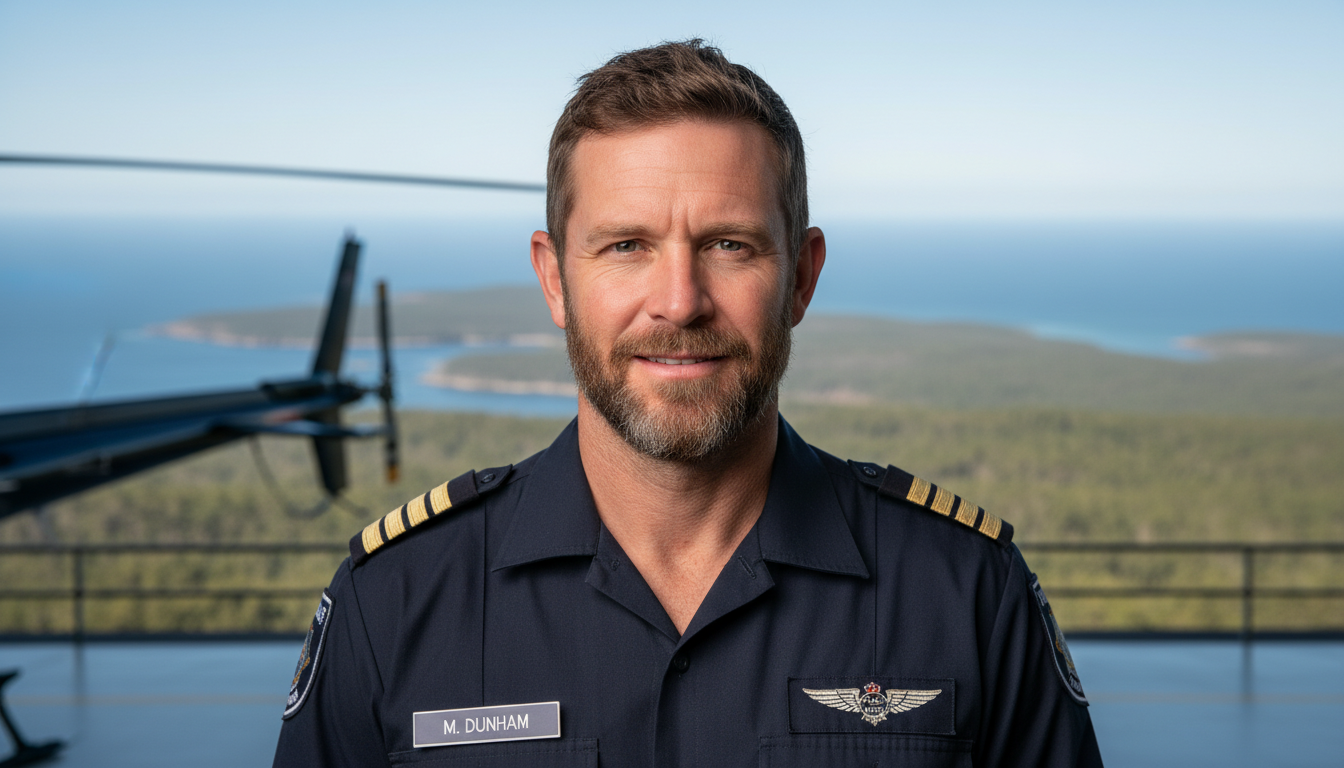
Born in Launceston in 1980, Mark Anthony Dunham transformed his inherited passion for aviation into a distinguished career with the Tasmania Police Air Wing. Following his father's air force footsteps through university engineering studies and military service, Mark transitioned to civilian policing in 2008, where his piloting expertise and strategic thinking earned recognition during complex operations. His work balancing professional demands with family life reflects the disciplined commitment that defines both his aerial service and his devotion to wife Rachel, children James and Naomi, and the broader Tasmanian community he protects from above.
Early Life and the Dunham Aviation Legacy
Mark Anthony Dunham was born on 6 June 1980 at Launceston General Hospital, arriving as the eldest child of Richard and Helen Dunham into a household where aviation wasn't merely a profession—it was a defining inheritance. Richard, a retired Royal Australian Air Force pilot, had spent decades commanding aircraft through both routine operations and crisis situations that demanded split-second judgement and unwavering nerve. Helen, a registered nurse who'd worked extensively in emergency and trauma care at the hospital where Mark was born, brought her own brand of calm competence to medical situations that required similar qualities. Together they created a home where duty, discipline, and devotion to service were foundational values rather than abstract concepts.
The Dunham residence in Launceston became a space where Richard's captivating stories of aerial missions mingled with Helen's more pragmatic accounts of medical emergencies successfully navigated. Mark absorbed both narrative traditions—the romantic appeal of flight combined with sober recognition that professional aviation demanded technical mastery and constant vigilance. His childhood bedroom featured model aeroplanes suspended from the ceiling, meticulously assembled following his father's exacting standards. Richard insisted that if something was worth doing, it was worth doing properly, a philosophy that extended from model construction to Mark's eventual approach to actual piloting.
The arrival of Mark's younger sisters Emily in 1983 and Sarah in 1986 shifted family dynamics whilst reinforcing certain patterns. As the eldest child and only son, Mark occupied a particular position within the family structure—not precisely favoured, but certainly bearing different expectations. Richard, whether consciously or not, projected onto Mark the continuation of the Dunham aviation tradition. This wasn't oppressive expectation but subtle invitation, communicated through father-son projects building model aircraft, visits to air shows, and gradually more technical discussions about aerodynamics and flight principles as Mark's understanding developed.
Family life operated on routines that reflected both parents' professional backgrounds. Meals occurred at regular times. Bedtimes were non-negotiable during school terms. Academic performance mattered, particularly in mathematics and sciences—subjects Richard correctly identified as foundational for engineering and aviation careers. Helen balanced Richard's sometimes rigid structure with warmer emotional engagement, ensuring that discipline never calcified into mere control. She recognised that children needed both boundaries and breathing room, rules and relationships.
Launceston itself shaped Mark's development in ways both obvious and subtle. Tasmania's second-largest city, positioned at the confluence of the North and South Esk Rivers, combined provincial character with surprising sophistication. The city's aviation history—from early barnstorming displays to modern operations at Launceston Airport—provided tangible connection to Mark's emerging interests. Weekend family trips might include visits to watch aircraft operations, informal encounters with pilots who'd flown with Richard, exposure to the broader aviation community that would eventually become Mark's professional world.
Education and the Development of Capability
Launceston Church Grammar School became the proving ground where Mark's natural aptitudes encountered structured development. Between 1985 and 1998, he progressed from tentative primary student into confident young man whose academic strengths and physical capabilities positioned him for multiple possible futures. The Anglican co-educational independent school's emphasis on excellence across academic, sporting, and cultural domains suited Mark's particular combination of intellectual and physical abilities.
Academically, Mark demonstrated consistent strength in mathematics and sciences—subjects where clear principles yielded predictable results when properly applied. He appreciated the logical progression from fundamental concepts to complex applications, the way mastering basics enabled understanding more sophisticated material. Teachers noted his methodical approach to problem-solving, his preference for understanding underlying principles rather than merely memorising procedures. This wasn't genius but genuine competence combined with disciplined work ethic.
Physical education and sporting activities revealed different aspects of Mark's character. He participated in athletics and swimming with creditable if not exceptional performance, demonstrating the coordination and physical confidence that would later prove valuable in piloting. Team sports taught lessons about collaboration and reading situations dynamically—skills that transferred readily to aviation's complex operational environments. Mark wasn't the star athlete but the reliable team member, someone coaches could depend upon to execute assignments competently and support others' success.
The school's aviation club provided the most direct channel for Mark's emerging passion. Under staff supervision, students engaged with flight simulation technology, studied basic aeronautical principles, and occasionally arranged visits to operational aviation facilities. Mark participated actively, often assuming informal leadership roles in group projects. He organised and participated in various flight simulation competitions, displaying the combination of technical knowledge and competitive drive that characterised his approach to activities he genuinely cared about.
Socially, Mark occupied comfortable middle territory within the school's ecosystem—neither isolated outsider nor social centre. He maintained friendships across different groups without belonging exclusively to any particular clique. This social flexibility, this capacity to work productively with diverse personalities, would prove valuable throughout his eventual professional career where effective collaboration with ground units and fellow air crew required navigating varying communication styles and operational approaches.
Completing his secondary education in 1998, Mark faced the transition to tertiary study with clear direction but also practical recognition that aviation careers demanded substantial foundational education. The University of Tasmania's Bachelor of Aeronautical Engineering programme offered the ideal combination of proximity to home and relevant preparation for intended career trajectory.
University, Military Service, and Professional Formation
The University of Tasmania between 1998 and 2002 provided Mark with the theoretical framework that transformed intuitive fascination with flight into rigorous understanding of aviation's scientific principles. The Aeronautical Engineering programme demanded mathematical sophistication, physics comprehension, and systems-thinking that challenged even capable students. Mark approached the coursework with characteristic methodical determination, recognising that every concept mastered, every calculation perfected, every principle internalised represented another building block in the foundation supporting eventual practical piloting.
University life offered more than academic development. Living away from parental oversight for the first time, Mark encountered the negotiation between freedom and responsibility that defines emerging adulthood. He managed finances, maintained academic performance, navigated social relationships, and made increasingly independent decisions about time allocation and priority-setting. These weren't dramatic transformations but gradual maturation, the slow accumulation of competencies that collectively constitute functional independence.
The engineering programme's practical components—laboratory work, design projects, collaborative assignments—reinforced lessons about teamwork and communication that would prove essential in aviation's intensely collaborative operational environments. Mark learned to present technical information clearly, to receive and incorporate feedback constructively, to recognise when his understanding required refinement or correction. These capacities for professional humility and continuous learning distinguished genuinely competent practitioners from those who confused confidence with competence.
Graduating in 2002 with solid academic record and clear career direction, Mark pursued the logical next step: joining the Royal Australian Air Force. Military service represented both continuation of family tradition and practical pathway to advanced pilot training. The RAAF provided world-class instruction, sophisticated aircraft, and operational experience impossible to obtain through civilian channels. Between 2002 and 2008, Mark underwent rigorous training that transformed engineering graduate into qualified military pilot.
The military environment suited Mark's temperament in some ways whilst challenging him in others. He appreciated clear hierarchies, defined procedures, high standards, and the sense of collective purpose that characterised effective military units. The discipline and precision required for safe flight operations aligned perfectly with his methodical nature. However, the broader military culture—particularly its sometimes rigid formality and the reality that military aviation involved potential combat applications—created tensions Mark navigated without fully resolving.
His service exposed him to diverse operational scenarios, advanced aircraft systems, and the kind of high-stakes decision-making that occurs when equipment failure or pilot error carries life-threatening consequences. He learned to manage stress, maintain focus during complex multi-step procedures, communicate clearly under pressure, and recognise his own limitations sufficiently to request assistance when situations exceeded his immediate capabilities. These weren't abstract lessons but hard-won competencies developed through countless training hours and actual operational experience.
Transition to Tasmania Police: Finding the Right Fit
By 2008, Mark faced a decision point that many military pilots eventually confront: continue in armed forces or transition to civilian aviation. Various factors influenced his choice. The prospect of extended deployments held less appeal as Mark contemplated marriage and family life. Military aviation's combat orientation, whilst professionally interesting, didn't align with his fundamental motivations for flying—he wanted to protect and serve communities rather than engage in warfare. The opportunity to return to Tasmania, to be near family and familiar landscapes, exercised strong pull.
The Tasmania Police offered compelling alternative. The force needed pilots for its helicopter operations through the Westpac Rescue Helicopter Service—aerial patrols, search and rescue missions, pursuit support, emergency response coordination. These missions utilised Mark's flying skills whilst serving clear public safety purposes. The work combined technical piloting challenges with tangible community benefit, offering the sense of meaningful service Mark sought without military aviation's combat dimensions.
Joining Tasmania Police required adaptation. Police culture differed significantly from military environment—less rigid in some ways, more accountable to civilian oversight, operating within legal frameworks that constrained operational choices differently than military rules of engagement. Mark underwent additional training in police procedures, legal requirements for evidence gathering and surveillance, coordination protocols with ground units, and the specific operational parameters governing Air Wing deployments.
Assignment to the Westpac Rescue Helicopter Service as Senior Constable and pilot represented the ideal convergence of his aviation expertise and service commitment.. The role's responsibilities encompassed diverse mission types: conducting routine aerial patrols to monitor traffic and identify potential incidents, providing air support during high-speed pursuits where ground units needed real-time intelligence about suspect locations and movements, coordinating search and rescue operations in Tasmania's challenging wilderness terrain, and supporting tactical operations by Special Operations Group teams requiring aerial surveillance or rapid response capabilities.
Mark's military background proved invaluable for these civilian applications. The precision flying skills, the capacity to maintain situational awareness whilst managing complex aircraft systems, the ability to communicate clearly and concisely with ground personnel, the discipline to follow procedures even under high-stress circumstances—all transferred readily to police aviation. His keen observational skills, developed through military reconnaissance training, enabled him to identify relevant details from altitude that ground personnel couldn't see, providing crucial intelligence that informed operational decisions.
The Collinsvale Pursuit: Professional Recognition
The 30 July 2018 incident documented in Flight Log 2018-07-30-COL-001 exemplifies both Mark's professional capabilities and the complex challenges the helicopter service operations present. What began as routine patrol diverted to investigate reports of vehicles driving at excessive speeds near Collinsvale and Glenlusk, eventually developing into a high-speed pursuit through deteriorating weather conditions that tested Mark's piloting skills and tactical judgement to their limits.
The mission required navigating multiple simultaneous challenges: maintaining visual contact with rapidly moving vehicles through increasingly severe weather, coordinating effectively with ground units pursuing through dangerous conditions, managing aircraft safety whilst pushing operational limits to provide essential support, and documenting observations with sufficient detail to support subsequent investigations. Mark's performance throughout demonstrated the professional competence his training and experience had cultivated.
His expert piloting during the pursuit—maintaining visual contact despite storm conditions that approached safe flight parameters, providing accurate real-time intelligence to Detective team CITY632, executing tactical manoeuvres that kept suspect vehicles within observation range—earned commendations from both superiors and the ground units his support enabled to pursue effectively. The meticulous detail in his flight log reflected professionalism that transformed chaotic high-speed pursuit into documented operational record that subsequent investigators could utilise.
However, the incident also revealed aviation's inherent limitations. The brief loss of visual contact during which the Toyota Hilux seemingly vanished illustrated that even the most skilled aerial surveillance cannot overcome certain physical and weather constraints. Mark's candid acknowledgement in his log that the vehicle's disappearance defied explanation demonstrated professional integrity—recognising when outcomes exceeded understanding rather than fabricating convenient explanations.
The commendations Mark received for this operation validated what colleagues already recognised: here was a pilot whose technical skills combined with tactical intelligence and genuine commitment to supporting ground operations effectively. The Collinsvale pursuit became case study within the helicopter service for how to maintain safety whilst pushing operational boundaries appropriately to support critical police operations.
Personal Life: Marriage, Family, and Finding Balance
Mark's personal life developed alongside his professional progression. In 2010, he married Rachel Broadbent, a primary school teacher whose own professional dedication to nurturing children's development paralleled Mark's commitment to community protection. Their courtship had proceeded methodically rather than tumultuously—two people discovering compatibility through shared values and complementary temperaments rather than dramatic romantic intensity.
Rachel brought to the relationship qualities that balanced Mark's sometimes single-minded professional focus. Where Mark could become absorbed in work demands, Rachel maintained broader perspective about life's other dimensions. Her teaching career provided independent professional identity and income whilst also offering built-in understanding of demanding work that required significant time and emotional energy. She recognised that Mark's irregular schedules and occasional emergency call-outs weren't personal neglect but occupational realities, just as Mark understood that Rachel's commitment to her students sometimes extended well beyond official school hours.
The couple settled in Hobart, recognising that proximity to Mark's base at Cambridge Aerodrome necessitated living in the state's capital rather than Launceston where Mark had grown up. They purchased a modest but comfortable home in one of Hobart's suburban areas, creating a space that accommodated both their present needs and anticipated family expansion. The dwelling became their sanctuary—somewhere to decompress from work stresses, to engage with each other without professional masks, to build the shared life they both desired.
James's birth in 2012 transformed them from couple to family, introducing the particular joys and challenges that first-time parenthood always brings. Mark approached fatherhood with characteristic methodical approach—reading parenting books, attending antenatal classes, preparing practically for the infant's arrival. However, the reality of parenting inevitably exceeded any preparation. The sleep deprivation, the endless demands, the weight of responsibility for a helpless dependent being—these tested Mark in ways that piloting dangerous missions never quite did.
Naomi's arrival in 2015 completed their family unit whilst intensifying the logistical complexity of balancing two demanding careers with parenting responsibilities. Mark and Rachel developed elaborate coordination systems—shared calendars tracking work schedules, detailed contingency plans for managing childcare when work commitments conflicted, mutual agreements about which professional obligations could be declined and which couldn't. The operational planning that served Mark well in Air Wing missions translated readily to managing family logistics.
Weekend family activities reflected both parents' values and interests. Hiking Tasmania's remarkable wilderness areas introduced James and Naomi to natural landscapes Mark observed professionally from altitude but experienced differently on ground level. Camping trips combined outdoor adventure with family bonding. Museum visits and local events exposed the children to cultural experiences both parents considered essential to well-rounded development. These weren't scheduled obligations but genuine pleasures—time when the Dunham family simply enjoyed each other's company away from work and routine responsibilities.
Beyond Work: Community, Hobbies, and Continuing Passion
Mark's engagement with the Hobart Model Aeroplane Club from 2010 onwards represented continuity with childhood interests whilst creating new opportunities for father-child connection. Building and flying model aircraft offered creative outlet distinct from professional flying's high-stakes seriousness. Model aviation carried no life-threatening consequences, permitted experimentation impossible with full-scale aircraft, and provided satisfying hands-on construction work that professional piloting's sophisticated systems didn't allow.
Mark frequently involved James and Naomi in these activities as they grew old enough to participate meaningfully. Father and children spent countless hours in the garage or at the club's flying field, assembling kits, troubleshooting mechanical problems, experimenting with different designs, and watching their creations take flight. These weren't just hobby activities but relationship-building opportunities where Mark shared his passion whilst his children developed their own interests and capabilities. Whether James or Naomi would pursue aviation professionally remained uncertain, but they were certainly gaining appreciation for what captivated their father.
His volunteer work speaking at local schools and community events about aviation careers reflected genuine commitment to inspiring the next generation. Mark recognised that his own trajectory—from childhood fascination to professional realisation—had been enabled by encouragement and exposure to aviation opportunities. He wanted to provide similar inspiration and information to young people considering aviation careers, particularly in Tasmania where geographic isolation sometimes limited awareness about career possibilities.
These presentations showcased different side of Mark's personality than his reserved professional demeanour might suggest. Speaking to enthusiastic students about flight principles, career pathways, and aviation's challenges and rewards, Mark demonstrated communicative warmth and genuine enthusiasm that his operational focus sometimes obscured. Teachers and parents appreciated his unpretentious approach—Mark presented aviation as accessible career requiring dedication and capability rather than superhuman gifts, emphasising that with appropriate training and commitment, many people could achieve what might initially seem impossibly difficult.
His involvement in various charity organisations and community service projects extended his service commitment beyond professional obligations. Mark participated in fundraising events, contributed to community initiatives, and offered his time and skills to causes serving public benefit. These weren't publicity-seeking activities but quiet contributions reflecting deeply held values about civic responsibility. The same commitment to community protection that motivated his police work extended naturally to these broader service opportunities.
The Professional Reality: Challenges and Satisfactions
Mark's career satisfaction derived from multiple sources. The fundamental pleasure of piloting remained constant—the technical mastery required for safe operation, the unique perspective that altitude provided on Tasmania's remarkable landscapes, the sensory experience of flight itself. Every mission, even routine patrols, offered moments of pure professional satisfaction when skill and concentration aligned to execute manoeuvres precisely or navigate challenging conditions successfully.
The meaningful impact of Air Wing operations provided deeper fulfilment. Successful search and rescue missions that located lost bushwalkers before exposure became life-threatening, pursuit support that enabled ground units to apprehend dangerous offenders more safely and effectively, tactical support for operations that disrupted criminal activities—these weren't abstract achievements but tangible contributions to community safety. Mark saw direct connections between his work and reduced harm, between his professional competence and lives protected or improved.
However, the career also carried inherent challenges and frustrations. The irregular hours and emergency call-outs disrupted family life despite Rachel's understanding and Mark's efforts to minimise impact. The operational stress—particularly during high-stakes missions where decisions carried significant consequences—accumulated gradually, requiring conscious effort to process and prevent from corroding professional judgement or personal wellbeing. The bureaucratic dimensions of police work, the paperwork and procedural requirements that consumed time Mark would rather spend flying, represented necessary but unwelcome aspects of the role.
The physical demands of the work increased with age. Whilst Mark maintained good fitness and health, the combination of irregular schedules, stress, and the physical toll that piloting exacted meant he couldn't ignore signs of ageing that younger colleagues didn't yet experience. He approached this reality pragmatically—maintaining rigorous fitness routines, undergoing regular medical assessments, and recognising that eventually every pilot reaches point where continuing becomes inadvisable.


