4338.209 · July 28, 2018 AD
Mapping the Disappearances
As Karl begins piecing together a timeline on the office wall, the investigation into two disappearances becomes uncomfortably personal. With pressure mounting from all sides and Sarah watching closely, Karl must walk the tightrope between procedural objectivity and a past that refuses to stay buried.
“You can draw as many lines as you like—names, dates, arrows—but when you’re part of the picture, the wall always looks back.”
I stood frozen before the blank wall of the open-plan office, staring at the sterile expanse of beige plaster where, in a matter of minutes, I’d begin pinning up the scaffolding of our investigation. The very place where photographs, timelines, and cold facts would attempt to bring order to the growing confusion of a case that had already bled into my personal history.
But it wasn’t the empty wall that held me still.
It was the memory of that scrap of paper.
Even now—minutes, not hours, since Claiborne had revealed it—I could still see it with absolute clarity. The faded creases, the torn edges. The ink smudged by time or tears, or both. He’d taken it with him, tucked it back into whatever private evidence cache he’d plucked it from, as if to remind me that he held more than just rank. He held leverage.
And yet, the question pulsed beneath my skin with all the persistence of a second heartbeat: how had it survived?
That scrap had been buried—figuratively and, I had believed, literally. There was no rational explanation for its presence in this station, in Claiborne’s hand. Unless… no. I couldn’t afford to follow that thread now. Not while standing in full view of the office, exposed and expected to function.
I forced my hands to still, clenching them at my sides until the tremor in my fingers ceased.
Across the room, the glass-walled office loomed—my office, in title if not in spirit. It waited like a barely-warm corpse, vacated only the day before by a sergeant who’d retired two decades too late.
I’d stepped inside earlier, curious, and been met by a time capsule of fatigue.
The carpet held the scent of dust, old instant coffee, and something vaguely medicinal—the kind of institutional smell that clings to furniture long after its purpose has faded. The air was dry, recycled, like it hadn’t moved properly in years.
The desk bore the scars of someone else’s career—scratches, ink stains, gouges from a thousand frustrated pen stabs. The chairs didn’t match. The drawers stuck.
And yet, it was mine now.
Four metres of linoleum, a glass wall, and a door that didn’t quite shut. My new kingdom in Major Crimes.
By all external measures, I’d made it.
And yet I felt like an intruder. Like a fraud caught sneaking into someone else’s life.
Sarah and I still worked as partners—for now. The bureaucrats had given us until the end of next month, a neat little transition period designed to smooth the move from equal colleagues to supervisory chain-of-command. I hadn’t yet told her that the idea of stepping away from casework made me feel hollow. That I wasn’t ready to be an administrator in a cheap suit, buried in paper and politics.
Especially not now.
Especially not with this case.
I’d been granted exactly forty-three minutes to get my head above water.
Forty-three minutes to absorb the fact that Kain Jeffries and Jamie Greyson had both vanished. Forty-three minutes to reckon with the fact that the woman who told me—Louise—was someone I’d spent over a decade deliberately avoiding, not out of bitterness, but because seeing her again would mean something had gone very wrong.
And forty-three minutes to sit with Claiborne’s silent warning… and the weight of that scrap of paper. The kind that changes everything, even before you understand it.
In those forty-three minutes, I’d assembled a wall.
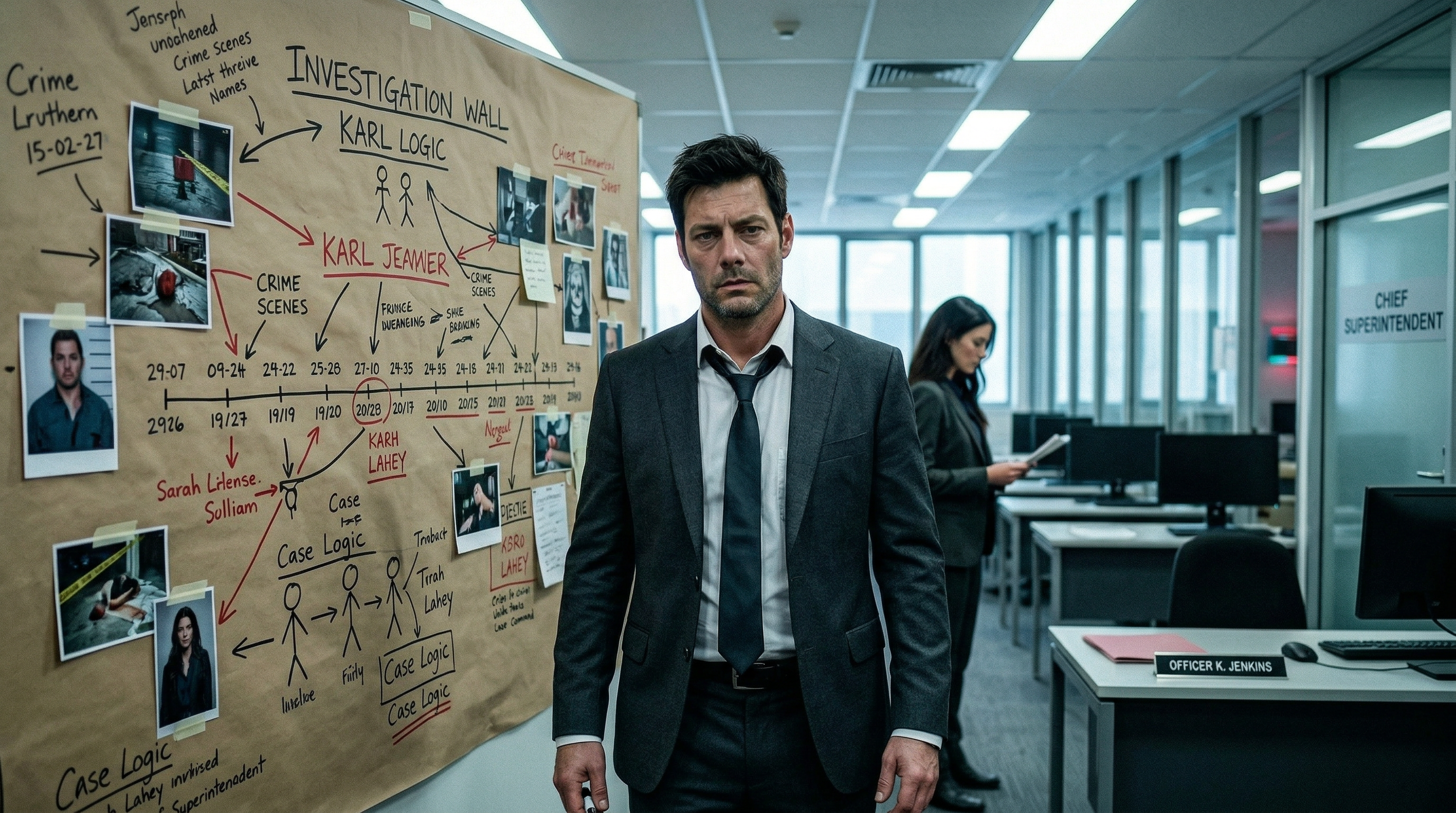
No digital case board. No plasma screen linked to the department’s outdated case management software. Just butcher’s paper, drawing pins, a fistful of felt-tip pens, and a will to impose structure on what was fast becoming a mess of contradictions.
It was crude. Messy. Borderline embarrassing. But it helped.
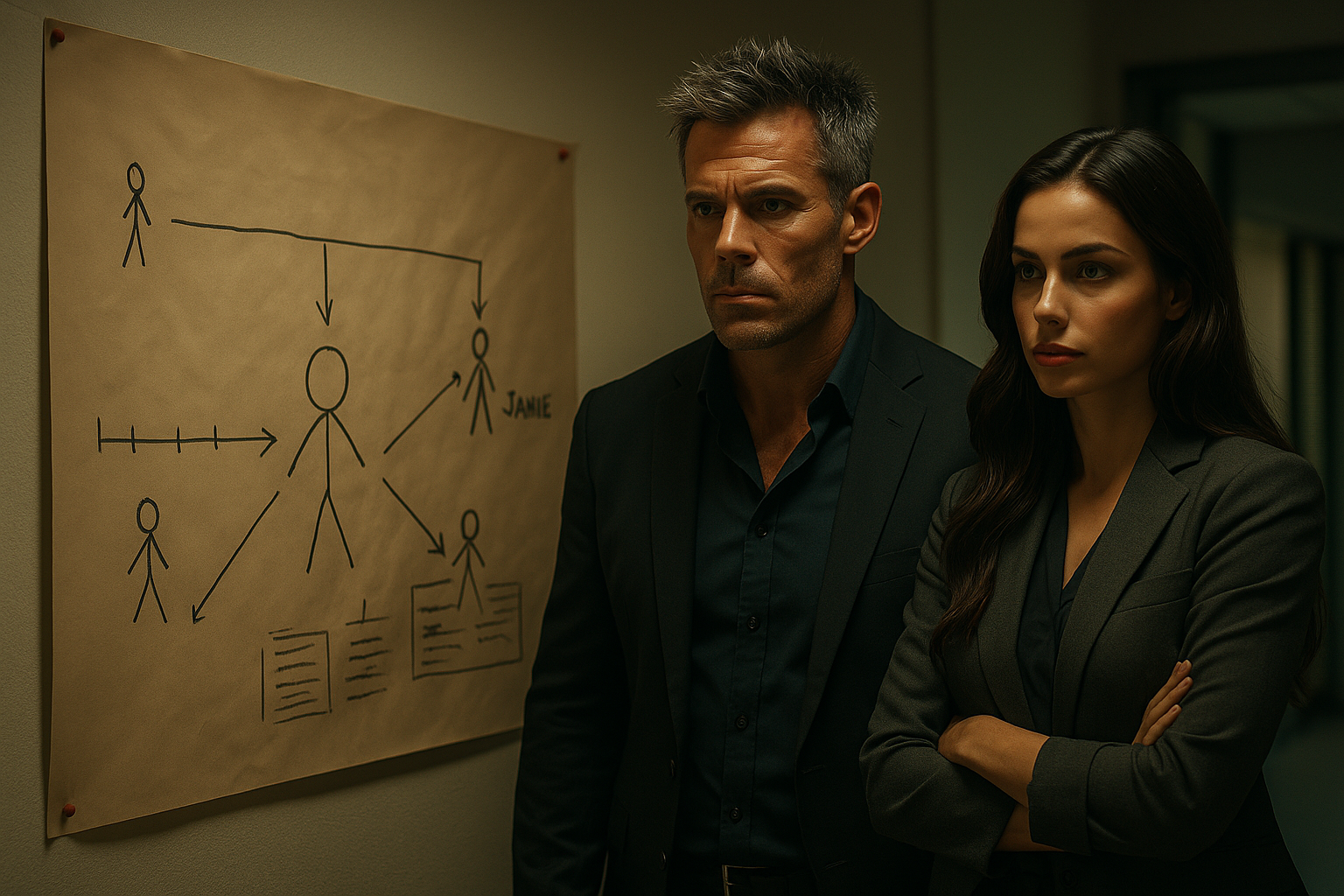
One sheet bore a timeline—Jamie’s last confirmed contact, Louise’s attempts to reach him, the day Kain disappeared. Another listed names: Louise Jeffries. Kain Jeffries. Jamie Greyson. Luke Smith. Known associates. Last sightings. Conflicting accounts. Details pinned down not by certainty, but by necessity.
The act of physically writing it out, pinning it to the wall, felt grounding. A ritual of order. Of reason.
It helped. But only just.
I stood back, pen still in hand, squinting at the web I’d begun to weave. Jamie’s name at the centre. Threads branching to Kain. To Louise. To Luke. To me—though I hadn’t written my name down. Not yet.
The idea of including myself on that board felt like crossing some internal boundary I wasn’t ready to name. But the truth was there, plain as day.
I wasn’t a bystander in this case.
I wasn’t even just an investigator.
I was part of it.
I’d almost managed to slip into detective mode, into that cool mental space where empathy is tempered by logic, and logic provides a blessed shield from emotional bleed-through. I was nearly there—close to feeling like I could move forward cleanly—when the interruption came.
A shift in the air behind me.
The creak of floorboards.
A voice, soft and familiar, clearing its throat.
Sarah’s voice pulled me out of the spiralling haze of my thoughts, back into the room, back in the present.
"Where do you want to start this investigation?" she asked, tone crisp and professional—but there was something beneath it. A sliver of curiosity. A faint echo of something gentler.
I turned from the board slowly, pen still in hand. My back ached—not from sitting, but from standing too long, tense and locked in place. The kind of posture you only notice when someone breaks the silence.
"I’ve been putting a bit of a timeline together," I murmured, eyes scanning the clumsy scrawl of my own handwriting. The line that stretched across the paper wasn’t just a chronology—it was a lifeline. A way to stay tethered to facts while the undertow of my past tried to pull me under.
Sarah crossed the room and stopped beside me, arms folded, head tilted slightly. Her eyes swept the board in silence before arching a perfectly sculpted eyebrow.
"On that?" she said, the corner of her mouth twitching.
I followed her gaze. I saw it as she did now—the amateur drawings, the stick figures, the annotations like something lifted from a Year Four history project. It looked like a child’s storyboard for a school play about missing people.
"What?" I said with a defensive shrug. "I wanted to get my thoughts out before they disappeared."
The double meaning slipped out too easily.
I didn’t mean just thoughts. I meant people. Kain. Jamie. Myself. The person I used to be before all this started unravelling.
Sarah didn’t miss it. But she didn’t push either.
"Oh, come on, Senior Detective," she said, a wry smile creeping across her face. "Give yourself a little more credit."
I couldn’t help but chuckle, the sound low and brief but genuine. That was Sarah’s talent—cutting through tension with a single line, defusing a bomb before it could go off. I’d seen her do it with witnesses. With victims. With me.
Our relationship existed in a deliberate fog. No labels. No expectations. It was quiet and unspoken, like standing in a room where neither of you had acknowledged the open door. And honestly, in this job, that ambiguity was a gift. I didn’t have to name it to value it.
Especially now.
Her presence reminded me of the version of myself that wasn’t defined by this case. Or by Louise. Or Jamie. Or the scrap of paper still burning at the back of my mind like a match pressed to skin.
"So, what have you time-lined then?" she asked, turning back to the board, her tone sliding back into business.
I nodded at the paper. "Not a lot. Just… the framework."
I pointed at the first stick figure, thin and featureless.
"That’s the last time Louise heard from Jamie—four days ago."
Four days. Just four. It already felt like longer. Jamie’s silence wasn’t passive—it accumulated, with every unanswered call, every unanswered question.
I traced my finger along the sketched timeline to a second stick figure. "That’s when Kain went to check on him."
Two days ago. And now he was gone too.
One disappearance might be explained. Two… two suggested something else. Something coordinated. Intentional.
"And the third one?" Sarah asked.
"That’s today—Louise coming in." I said it matter-of-factly, surprised for a moment she hadn’t worked that out.
"Of course," she said quickly, a flush of embarrassment colouring her cheeks.
It was oddly reassuring—that momentary lapse. Proof that even Sarah, sharp as she was, could get lost in the murkiness of this case.
I let my hand drop to my side and took a step back, surveying the board again. Each figure on that line represented more than a point in time. They were pressure points. One wrong touch and the whole thing might collapse into something messier, more dangerous than we were prepared for.
Could I trust myself to hold it together?
Claiborne clearly had his doubts. That scrap of paper he’d shown me wasn’t just a veiled threat—it was a question. Can you stay objective, Jenkins? Or is your past going to choke this case to death before it even starts?
I had to keep moving. Had to focus on verifiable facts. No conjecture. No emotion. Just data.
"We should start by checking their bank accounts," I said abruptly, already pivoting from the board. My tone was decisive. Grounded. Professional. "Financial records won’t lie. If Jamie’s in Melbourne, we’ll see activity—train tickets, petrol, accommodation. If Kain disappeared en route, we’ll see the last place his card was used."
It was the right call. Facts don’t have feelings. Bank transactions don’t carry secrets.
Sarah nodded, no further comment needed. We were on the same wavelength now. Her heels echoed softly on the corridor floor as she followed me from the room, our pace matched, our silence companionable.
Behind us, the wall of butcher’s paper remained, its crude figures watching, mute and accusatory.
That was the job now: hard choices, following evidence, ignoring ghosts.
But as we made our way down the corridor, I couldn’t shake the feeling that one of those ghosts had already re-entered the building.
And it knew my name.
