Louise Elizabeth Jeffries (née Greyson)
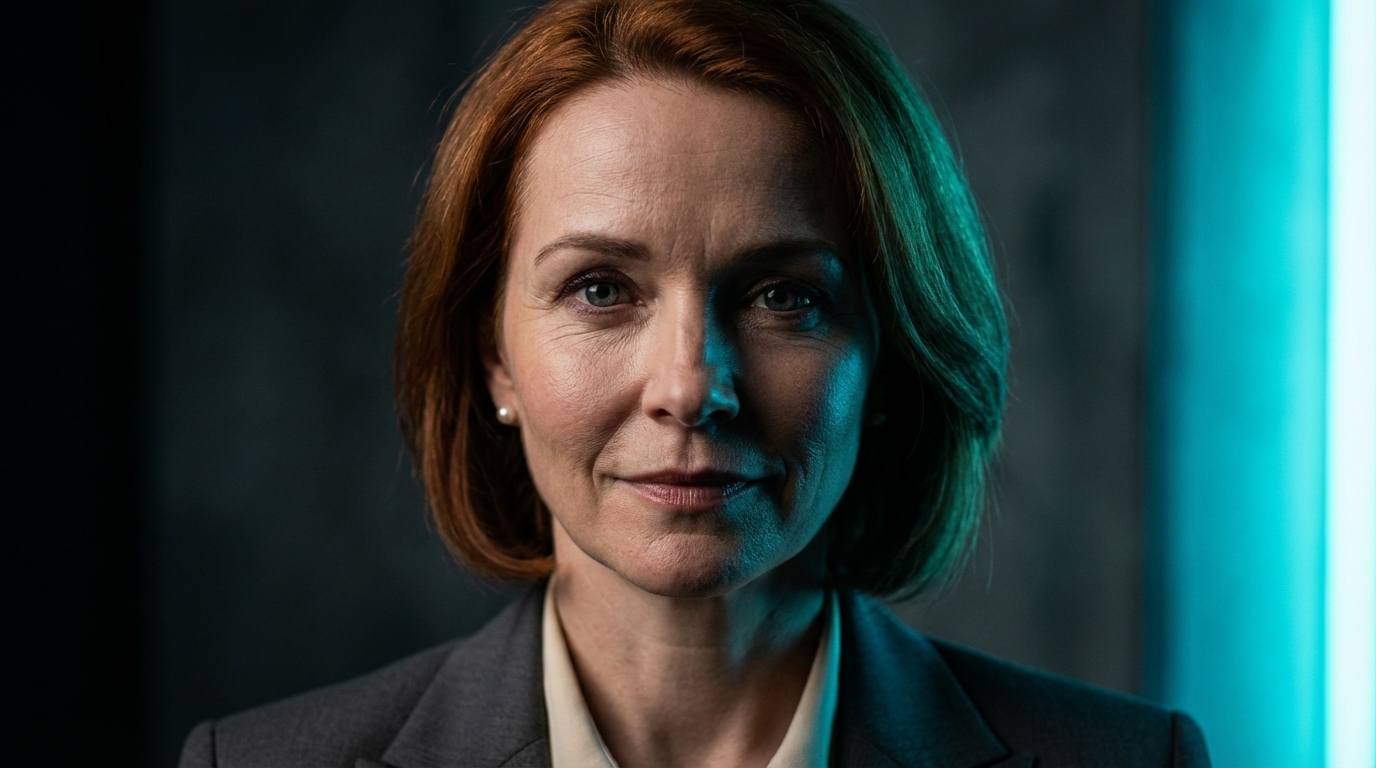
Louise Elizabeth Jeffries lived forty-seven years navigating the delicate balance between professional ambition and family devotion before tragedy claimed her life in the 2018 Jeffries Manor Massacre. Born into Granton privilege as the daughter of a successful lawyer, she built a distinguished career as a financial analyst whilst raising four children and managing the complexities of marriage into Tasmania's most enigmatic dynasty, her sharp mathematical mind and compassionate nature making her both a respected community figure and devoted mother whose final desperate attempts to protect her family would end in the very rooms where she had once found her greatest happiness.
Tasmanian Foundations and Early Excellence
Louise Elizabeth Greyson arrived on 22 June 1971 at Royal Hobart Hospital, entering a world of comfortable privilege as the firstborn child of Peter and Nola Greyson. Her father, a successful lawyer whose practice focused on property and commercial law, had established himself amongst Hobart's professional elite by his early thirties. Her mother, Nola Patterson Greyson, brought a different kind of distinction—a background in nursing combined with dedicated community volunteer work that made the Greyson name synonymous with charitable causes throughout the Granton area.
The family home in Granton provided Louise with an upbringing marked by strong values and clear expectations. Peter's legal practice demanded precision, integrity, and attention to detail—qualities he modelled daily and expected his children to emulate. Nola's community work demonstrated that privilege carried responsibility, that those fortunate enough to have resources should use them to improve others' lives. These dual influences—pragmatic professionalism and compassionate service—would shape Louise's character throughout her life.
The arrival of her younger brother Jamie on 18 December 1983, when Louise was twelve, shifted family dynamics significantly. The twelve-year age gap meant Louise occupied a space between sibling and surrogate parent, particularly given Nola's increasing involvement in community organisations that often kept her away from home during Jamie's early childhood. Louise took naturally to this protective role, reading to Jamie, helping with homework, and serving as a buffer between their occasionally distant father and the sensitive younger boy who seemed to need more emotional connection than Peter knew how to provide.
The arrival of a second sibling, Sarah Jane, on 5 May 1986, brought unexpected complications to family life. Sarah was born with fragile health, suffering from recurring respiratory issues that required constant medical attention. Hobart's cold, damp climate seemed to exacerbate her condition, leading to frequent hospital visits and anxious nights when her breathing became laboured. Nola's volunteer work necessarily diminished as Sarah's care demands increased, whilst Peter's legal practice faced pressure to generate income sufficient for mounting medical expenses.
By late 1988, multiple medical professionals suggested that a warmer, drier climate might significantly improve Sarah's respiratory health. When Peter received an offer to join an established legal firm in Adelaide, the decision seemed both practical and providential—better career prospects and potentially better health outcomes for Sarah. The planned relocation to Elizabeth, South Australia, created difficult questions about Louise's education. At seventeen and entering her final year at St. Mary's College, disrupting her schooling seemed counterproductive, particularly given her excellent academic record and school captain position for 1989.
The solution came through Louise's maternal grandmother, Mavis Patterson, who offered her Glenorchy home as accommodation. Louise would remain in Tasmania, completing Year 12 whilst living with her grandmother, then continue at the University of Tasmania if she wished. For Louise, the arrangement represented both sacrifice and liberation—she would miss daily family life, particularly watching Jamie and Sarah grow up, but she would maintain the educational continuity that mattered deeply to someone with her academic ambitions. For five-year-old Jamie and two-year-old Sarah, the move to Adelaide would mean Tasmania became a place known primarily through Louise's holiday visits and the stories she told when she returned.
St. Mary's College, where Louise had enrolled in 1977, had recognised her exceptional abilities immediately. The prestigious Hobart institution, with its emphasis on academic excellence and character development, provided the perfect environment for Louise's talents to flourish. Mathematics became her particular strength—not merely computation but the deeper patterns and relationships that numbers revealed. Her teachers noted an analytical mind that could dissect complex problems methodically whilst maintaining the broader context necessary for practical application.
By her final year in 1989, Louise had been elected school captain, a position that reflected not just academic achievement but the leadership and organisational skills that would serve her throughout life. She managed student council affairs with efficiency that impressed staff, coordinated charitable activities that engaged the entire school, and somehow maintained perfect grades whilst juggling responsibilities that would have overwhelmed most students—all whilst processing the emotional complexity of being separated from her family for the first time. Her mathematics teacher, Sister Catherine Ryan, later recalled: "Louise possessed that rare combination of intellectual brilliance and genuine warmth. She could solve differential equations and comfort a crying first-year with equal facility. That final year, when her family had relocated to South Australia, she carried additional emotional weight with remarkable grace."
Family Tree
University Years and Unexpected Romance
The meeting with Thomas Jeffries late in 1989 was entirely accidental—a chance encounter at the university library, where neither of them yet belonged. Both were finishing Year 12, Louise at St. Mary's and Thomas at Hutchins, and both had gone to the University of Tasmania's collection rather than make do with their own, each researching colonial Tasmanian business history for coursework the other knew nothing about. Thomas, heir to the Jeffries family fortune, was already carrying the weight of seven generations of complicated legacy despite being only eighteen years old. He should have been completely outside Louise's orbit, yet their conversation that afternoon revealed unexpected common ground: both valued intellectual rigour, both understood the weight of family expectations, and both recognised in the other a kind of loneliness that wealth and privilege couldn't quite conceal.
Louise's entry into the University of Tasmania in 1990 to pursue a Bachelor of Business with specialisations in accounting and finance represented not just academic progression but a conscious choice to remain rooted in the place that had shaped her. Her parents, brother, and sister had relocated to Elizabeth, South Australia the previous year—seeking warmer climate for Sarah's respiratory health and better career opportunities for Peter—whilst Louise stayed behind to finish at St. Mary's. The arrangement, living with her grandmother Mavis Patterson whilst her family established themselves hundreds of kilometres away, had proven more emotionally complex than anyone anticipated. Louise found herself simultaneously grateful for the stability Tasmania provided and guilty about the distance from her siblings, particularly Jamie, who was just starting primary school, and Sarah, whose health had been the catalyst for the family's upheaval.
Her grandmother's Glenorchy home remained Louise's base throughout her university years, providing both practical accommodation and a sense of continuity that grounded her studies. The degree combined her mathematical aptitude with practical applications that could lead to a stable, respectable career—exactly what her parents hoped for their daughter, even from a distance. She approached university studies with characteristic determination, excelling in the financial analysis courses that required both technical skill and strategic thinking, whilst maintaining regular correspondence with her family and flying to Adelaide during the semester breaks to reconnect with the siblings who seemed to change dramatically between each visit.
Their relationship developed quickly through that final school year and the summer that followed, complicated by the obvious differences in their backgrounds. The Greyson family, whilst comfortable, operated in entirely different social circles than the Jeffries dynasty. When Louise's parents visited Tasmania, Peter harboured reservations about his daughter becoming entangled with a family whose history included mysterious disappearances and whispered scandals. Nola worried that Louise might be sacrificing herself to rescue someone damaged by family dysfunction—a pattern she recognised from her nursing experience. The distance made these conversations difficult, conducted mostly through the phone calls that felt simultaneously too intimate and not intimate enough.
But Louise, with her characteristic combination of pragmatism and stubbornness, refused to let others' concerns dictate her choices. She saw in Thomas someone genuine beneath the family complications, someone who valued her intelligence and independence rather than being threatened by it. Rebecca was conceived over the summer between school and university, and arrived on 22 September 1990—which meant Louise had begun her degree already two months pregnant, and finished her first year with a newborn. The news shocked both families, particularly the Greyson parents in Adelaide, who learned through a difficult phone call that their eldest daughter was pregnant and unmarried. Peter's fury and Nola's disappointment were palpable even across the distance, though Louise refused to apologise for the choices she'd made as an adult.
The decision to keep the baby and continue her education whilst raising Rebecca with Thomas—still unmarried, still navigating their relationship—demonstrated the steely determination that would characterise Louise's approach to life's complications. She completed her degree whilst managing motherhood, supported by Thomas and his family in ways her own parents struggled to provide from Adelaide. Thomas, who was in the same year of the same university reading for a Bachelor of Commerce, graduated at the end of 1992 and began working at Jeffries Industries the following year under his father Charles's mentorship, learning the family business whilst simultaneously learning to be a father.
The birth of their second daughter, Emily, in 1992, seemed to solidify what had already become obvious: Louise and Thomas had created a family, whether or not the legal documents acknowledged it. Thomas's decision to pursue further business education—eventually completing additional qualifications that would enhance his ability to manage the family empire—was balanced against his responsibilities to Louise and their growing family.
Their engagement in 1994 surprised no one who knew them well—they had clearly become essential to each other's lives years earlier, creating a partnership that transcended both their different origins and conventional expectations about the proper sequencing of life events. The wedding ceremony on a summer day in 1995 at Jeffries Manor brought together two worlds that had never quite intersected before, now with the added complexity of four-year-old Rebecca and two-year-old Emily serving as the flower girls. The Greyson family—Peter, Nola, eleven-year-old Jamie, and eight-year-old Sarah—travelled from Brisbane, where they had relocated in 1992 for yet another career opportunity for Peter. Peter's toast carefully avoided mentioning both the Jeffries family's notorious history and the grandchildren who had arrived before the wedding, whilst Thomas's grandfather James III watched the proceedings with an expression that suggested he'd seen far more scandalous things in his long life and found this relatively tame by comparison.
Building Professional Identity
Louise's entry into the professional world as a junior accountant at Hobart Accounting Associates in 1995 marked the beginning of a career that would span over two decades, though she'd already been balancing professional aspirations with motherhood for five years by that point. Completing her university degree whilst raising Rebecca and Emily had required organisational skills and determination that impressed even her most skeptical professors. The firm, whilst not amongst Hobart's largest, had built a reputation for thorough work and ethical practices—values that aligned with Louise's own principles. That she was now also a newly married woman expecting her third child (Kain would arrive later that year) made her hiring even more remarkable, reflecting the respect she'd earned for her academic achievements and work ethic.
Her colleagues quickly recognised abilities that transcended mere number-crunching. Louise possessed an intuitive understanding of how financial decisions rippled through businesses and lives, how seemingly small choices about cash flow or investment timing could have profound consequences. She could explain complex financial concepts to clients in language they understood without condescension, a rare gift that built trust rapidly.
The transition to First Point Credit Union in 1998 as a financial analyst represented a significant career advancement. The credit union, with its community focus and ethical banking principles, matched Louise's values whilst offering opportunities for professional growth. Her role involved analysing financial data, managing risk assessments, and advising clients on investment strategies—work that required both technical expertise and the kind of holistic thinking that considered clients' broader life circumstances rather than merely their balance sheets.
Her 2005 strategic investment initiative demonstrated the kind of forward thinking that earned her recognition within the organisation. Whilst other analysts focused on traditional investment vehicles, Louise identified emerging opportunities in sustainable energy and technology sectors that seemed risky to more conservative colleagues but proved remarkably profitable. Her success wasn't merely luck—it reflected countless hours studying market trends, understanding technological developments, and maintaining the kind of disciplined analysis that separated speculation from strategic investment.
The community finance programmes she helped design and implement in 2010 revealed another dimension of Louise's professional identity. Financial literacy programmes for underprivileged communities didn't generate immediate profits for the credit union, but Louise argued persuasively that creating financially literate clients benefited everyone long-term. Her programmes, conducted in community centres throughout greater Hobart, taught basic budgeting, savings strategies, and how to avoid predatory lending—practical skills that transformed lives whilst building goodwill for the institution.
The Lady of Jeffries Manor
Marriage to Thomas meant assuming a role that no amount of professional success had prepared Louise for—becoming mistress of Jeffries Manor, a position that came with two centuries of accumulated expectations, traditions, and unspoken rules. The initial years had been complicated by the fact that Louise and Thomas had been together, raising children, for five years before the wedding, navigating the social complexities of being unmarried parents in a family as prominent as the Jeffries. James III and Thelma Rose, whilst never explicitly disapproving, had maintained a certain distance that only began to soften after the 1995 wedding made things "proper."
The manor itself had witnessed Rebecca and Emily's early childhood years before the marriage, the girls growing up in the grand old house with an ambiguous status that Louise found simultaneously frustrating and oddly liberating—she was neither quite mistress of the manor nor merely Thomas's girlfriend, but something undefined that allowed her to carve out her own space. The birth of Kain in 1995, shortly after the wedding, and Katie in 1996, seemed to complete the family's transformation from unconventional to officially legitimate, though Louise privately found the distinction arbitrary.
She established routines that balanced respect for family traditions with her own values, hosted gatherings that maintained the Jeffries family's social obligations whilst reflecting her more accessible style, and gradually made the grand old house feel like an actual family home rather than merely a historical monument. That she'd managed this whilst having two children out of wedlock and completing a university degree only added to the quiet respect she earned from those who knew the full story.
Her charitable work during these years extended naturally from her mother's example and her own values. Serving on the boards of the Hobart Children's Fund and Tasmanian Women's Shelter, Louise brought both financial expertise and genuine compassion to organisations that desperately needed both. She organised fundraising events that were simultaneously successful and enjoyable—a rare combination that required understanding both the donor psychology and the genuine needs of beneficiaries.
The 2008 transition, when Charles Jeffries' mysterious disappearance forced Thomas to assume control of Jeffries Industries whilst moving the family permanently into the manor, marked the most challenging period of Louise's marriage. Thomas, never entirely comfortable with the weight of family legacy, struggled under the dual pressures of business management and the mystery of his father's vanishing. Louise became not just his wife but his primary confidante, helping him navigate business decisions whilst managing a household that now included ageing grandmother Thelma alongside their own growing children.
The Protective Sister and Growing Unease
The geographical distance that defined most of Louise's relationship with Jamie created a bond simultaneously close and complicated. Louise had been twelve when Jamie was born, old enough to genuinely help with his infant care, to feel deeply connected to the baby brother she'd read to and rocked and protected. But the family's 1989 relocation, when Jamie was just five, had transformed that daily intimacy into something more abstract: letters, phone calls, holiday visits where she tried to compress months of missed moments into a few concentrated weeks.
During Jamie's primary school years in Elizabeth, Louise's visits revealed a boy settling into his new life with apparent success. He'd made a close friend—Luke Smith, a boy from his class whom Jamie spoke about with genuine affection. The two seemed inseparable during the years before the family's 1992 relocation to Brisbane, and Louise remembered thinking how fortunate Jamie was to have found such companionship so quickly after the upheaval of leaving Tasmania. The move to Queensland, when Jamie was eight, had been harder on him than the earlier transition—this time he was old enough to feel the loss of friendship keenly, to grieve leaving Luke behind.
The tragedy of Sarah's death in March 1995 shattered whatever fragile equilibrium the Greyson family had maintained. Peter and Nola's marriage, whilst never particularly warm, had at least functioned; Sarah's loss exposed fault lines that had always existed beneath the surface. The family remained in Brisbane through the immediate aftermath, but the house felt haunted by absence, the silence where Sarah should have been becoming unbearable.
For eleven-year-old Jamie, the loss was devastating in ways he had no language to express. Louise, newly married to Thomas and managing her own household at Jeffries Manor with four-year-old Rebecca and two-year-old Emily, maintained contact as best she could—long phone calls where Jamie often said little, cards and letters trying to bridge the distance, offers for him to visit Tasmania during school holidays. But the thousand-plus kilometres between Hobart and Brisbane meant she couldn't provide the daily support her brother so clearly needed.
Louise watched from afar as Jamie grew through his teenage years in Brisbane, their relationship conducted through phone calls and occasional visits when Louise could manage the trip north with young children in tow. He was gentle, sensitive, emotionally intelligent in ways their father had never managed—but also fragile in ways that worried her. He seemed to carry the weight of Sarah's death and their family's dysfunction more heavily than anyone acknowledged, developing a kind of careful quietness that felt like protection against further hurt. When he chose to pursue aged care nursing, completing his training in Brisbane, Louise understood the choice as both calling and continuation of his caretaking nature—Jamie had always been someone who noticed others' pain and wanted to help.
The years passed with Jamie establishing his career in Queensland. Louise's own life filled with the demands of raising four children—Kain arrived in 1995, Katie in 1996—managing her position at First Point Credit Union, and navigating the social obligations of being a Jeffries. She and Jamie maintained their connection through regular phone calls, his occasional visits south for Christmas or other family obligations, her less frequent trips north when work and children allowed. The distance felt like a permanent condition, something they'd both learned to accept as the normal state of their sibling relationship.
When Jamie mentioned in late 2007 or early 2008 that he was considering relocating to Tasmania—Peter and Nola, now in their sixties, needed family closer as their health declined, and Jamie felt called to return—Louise's relief was profound. Finally, her brother would be nearby, accessible, part of her daily world rather than someone she loved from a distance. Jamie's move south in 2008, securing an aged care position in the Hobart area, felt like a restoration of something that had been broken twenty years earlier when the family first scattered.
What she hadn't anticipated was that Jamie's return would bring with it an unexpected reunion. Sometime shortly after arriving back in Tasmania, Jamie mentioned—casually, almost offhandedly—that he'd run into Luke Smith, his childhood best friend from the South Australia years. What were the odds that two boys who'd been inseparable at age five through eight, separated when Jamie's family moved to Brisbane, would both end up back in Tasmania nearly twenty years later? It seemed like the kind of serendipitous reunion that might bring genuine happiness to her brother's life.
But as Jamie began talking about Luke more frequently, as casual friendship apparently developed into something romantic, Louise's protective instincts activated in ways she couldn't entirely explain or justify. Something about Luke troubled her—not anything she could articulate precisely, but a quality beneath his superficial charm that triggered warnings her analytical mind couldn't quite justify. Jamie seemed happy, or at least said he was happy, but Louise detected tensions in their conversations, evasions when she asked direct questions, a quality of forced cheerfulness that suggested performance rather than genuine contentment.
She tried raising concerns with Thomas, who counselled non-interference in Jamie's adult relationships. She mentioned worries to her parents during visits, but Peter dismissed her intuitions as overprotectiveness whilst Nola suggested Louise was projecting her own anxieties about family complications. Perhaps they were right—perhaps her unease reflected nothing more than a sister's natural concern for a brother who had always seemed slightly fragile, slightly in need of protection that she'd been unable to provide across all those years of distance.
The years between 2008 and 2018 passed without obvious incident, seeming to validate others' reassurances that Louise was worrying unnecessarily. Jamie appeared settled in his aged care career, spoke of Luke with apparent affection during their now face-to-face conversations, gave no explicit indication that anything was seriously wrong. Having her brother finally living in Tasmania again, able to visit for dinners at the manor, to be part of her children's lives in meaningful ways, should have been purely joyful.
Yet the unease never entirely left Louise—a persistent low-level anxiety that she learned to manage but never quite eliminate, like background static that occasionally grew louder without clear cause. She couldn't have articulated what exactly she feared, but some part of her, the part that had helped raise Jamie in his infancy and watched him navigate loss after loss throughout his childhood, sensed something fundamentally wrong beneath the surface of her brother's relationship with the man who'd once been his best friend.
Motherhood and Family Dynamics
Raising four children whilst maintaining a demanding career and managing the social obligations of being a Jeffries required organisational skills that would have defeated most people. Louise approached motherhood with the same combination of analytical planning and genuine warmth that characterised her professional work. Each child received individual attention tailored to their unique personalities and needs, yet the family functioned as a cohesive unit with clear expectations and strong bonds.
Rebecca, the eldest, inherited her mother's sharp intellect and sense of social responsibility, though she channelled these qualities into advocacy work rather than finance. Louise supported Rebecca's choice to pursue legal advocacy despite Thomas's preference that she join Jeffries Industries, recognising that forcing children into predetermined paths rarely produced genuine happiness. Their relationship balanced mutual respect with occasional friction—both were strong-willed women who sometimes clashed over approaches whilst maintaining deep underlying affection.
Emily's brilliance in biochemistry delighted Louise, who saw echoes of her own mathematical aptitude in Emily's facility with complex scientific concepts. Yet Emily's intensity and perfectionism worried Louise, who recognised the potential for burnout in someone who drove themselves so relentlessly. Louise tried encouraging Emily to maintain balance between academic achievement and personal wellbeing, though she privately acknowledged the irony of this advice coming from someone who regularly worked sixty-hour weeks whilst managing household and family obligations.
Kain, the only son, occupied a complicated position as heir to the Jeffries legacy in a family where such distinctions theoretically didn't matter but practically carried significant weight. Louise worked deliberately to ensure Kain understood that privilege brought responsibility rather than entitlement, that the Jeffries name meant stewardship rather than ownership. His relationship with Brianne Sitch brought both joy and concern—Louise genuinely liked Brianne but worried about young people making permanent commitments before fully understanding themselves or each other.
Katie, the youngest, remained closest to Louise throughout her teenage years, perhaps because the age gap meant less sibling rivalry and more genuine companionship. Katie's writing talent impressed Louise, who encouraged her literary ambitions whilst privately hoping Katie might also develop more practical skills that could provide financial stability. Their conversations ranged across subjects that Louise couldn't discuss with Thomas—literature, emotional complexities, the weight of family expectations and how to navigate them without being crushed.
The Unravelling Begins
The disappearance of Kain and Jamie in late July 2018 shattered Louise's carefully maintained equilibrium. When Kain failed to return from checking on his uncle at Louise's request, her maternal instincts immediately activated. The progression from concern to alarm to outright panic occurred with terrifying speed as hours stretched into a full day with no contact, no explanation, nothing but silence where her son and brother should have been.
Filing the missing persons report with Detective Karl Jenkins on 28 July 2018 was simultaneously an act of hope and an admission of helplessness. Karl, whom Louise had known for years through various social and charitable contexts, recognised the genuine terror beneath her composed exterior. The interview documented in the case file captured Louise's methodical nature even in crisis—she provided detailed timelines, relevant background information, and clear statements about her concerns regarding Luke Smith, all whilst her hands trembled.
Her conviction that Luke held answers about the disappearances wasn't based on evidence that would satisfy legal requirements—it emerged from years of accumulated unease, from intuitions that had been dismissed as overprotective but now seemed horrifyingly prescient. Louise couldn't articulate precisely why she believed Luke was involved, but she knew it with a certainty that transcended rational proof. Her insistence on speaking directly with Karl rather than accepting Detective Sarah Lahey's perfectly competent assistance reflected her understanding that some truths required witnesses who understood context and history rather than merely facts and timelines.
The Final Days at Jeffries Manor
The morning of 2 August 2018 began like any other recent morning—Louise attempting to maintain normality whilst drowning in anxiety about the family members who remained missing. The manor's grand rooms, which had once felt like a sanctuary, now seemed oppressive, their beauty mocking the terror Louise couldn't escape. When Brianne Sitch, Kain's fiancée, disappeared from the manor that afternoon under circumstances Louise couldn't fully explain, the situation spiralled from crisis to catastrophe.
The emergency call Louise placed to Tasmania Police, preserved in official transcripts, captured a woman pushed beyond her breaking point yet still attempting to maintain control. Her report that she had trapped Luke Smith—the man she was convinced held answers about her missing family members—in the manor's shed revealed the desperate measures Louise had taken. Armed with a kitchen knife she had grabbed reflexively, Louise had confronted Luke when he appeared on the property, somehow managing to corner him in the outbuilding where she intended to hold him until police arrived.
When Detectives Jenkins and Lahey finally arrived, Louise led them to the shed, still gripping the knife, explaining rapidly what had transpired whilst visibly shaking from adrenaline and fear. Within minutes, both Detective Jenkins and Luke had vanished from the property without a trace.
The Massacre and Final Mystery
What transpired in the nine days between Karl Jenkins' disappearance from the shed on 2 August and the Jeffries Manor Massacre on 11 August 2018 remains partially obscured by official reticence and genuine confusion.
The massacre itself, occurring in the late hours of 11 August, claimed Louise's life alongside those of her daughters Rebecca and Emily. The details, preserved in police reports but kept from public release out of respect for the victims, suggest violence that investigators struggled to explain. Louise, Rebecca, and Emily were found in different rooms of the manor, each seemingly caught mid-action—Louise in the kitchen where she may have been preparing late-night tea, Rebecca in the library surrounded by legal documents, Emily in the conservatory that had become her favourite reading space.
The disappearance of Thomas, Katie, and Thelma during or immediately after the massacre added final layers of mystery to tragedy. Whether they fled, were taken, or met fates similar to but spatially separate from Louise and her daughters remains officially undetermined. The manor's sandstone walls, having witnessed two centuries of Jeffries family history, absorbed this latest horror without yielding clear explanations, maintaining the silence that had characterised the building since its construction.


