Krid Louwa
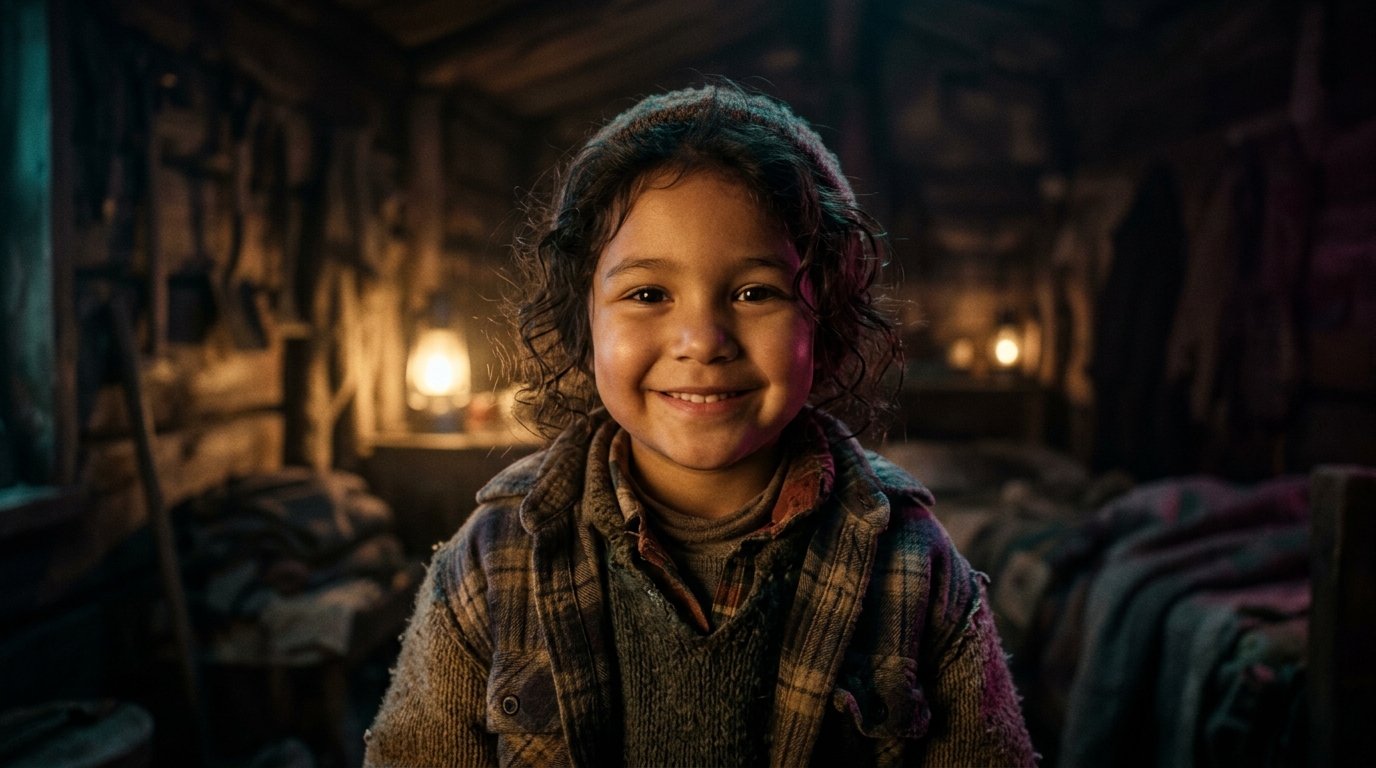
Krid Louwa (born 2012) was a Belkeep-born orphan and a Premonitioner — a child who knew things she had no ordinary way of knowing. Raised hand to hand by a settlement labouring through its long decline, she grew up irrepressibly warm in a place stripped to bare survival and attached herself to Freya Jennings as chosen family. She sensed Cody Jennings's death, felt his lost son alive across the sea, and named the coming Guardian before she arrived. She lived to see Belkeep's isolation broken and moved to Bixbus.
Born to the Cold
Krid Louwa was born in Belkeep in 2012, into the frozen coastal valley that would be the whole of her world for the first eighteen years of her life. She was Clivilius-born and Clivilius-bred, with not a scrap of Earth in her—no warmth of the sun on bare skin, no blue sky, no green, no notion of anywhere that was not ice and stone and the grey unmoving sea. The Earth that filled Cody Jennings's stories and haunted his daughter Freya's studies was, to Krid, as remote and unprovable as a fairy tale. She entered the world at the far cold edge of a settlement that was already dying, and by every reasonable measure she ought to have grown into a small, grim, hollowed-out thing.
She was the flat opposite, and no one in Belkeep ever worked out how. She came at the cold as though it were something a person could out-cheerful—bare-armed and skinny-legged in winter boots two sizes too big, humming roughly in the direction of a tune, insisting to anyone who would listen that she was never cold. Where the settlement had been ground down to grim endurance, Krid was bright, curious, and warm, with a greedy appetite for small wonders that nothing in her circumstances had managed to blunt. It was the first thing anyone noticed about her, and the thing that never quite made sense.
Passed Hand to Hand
The Belkeep Krid was born into had never been an easy place, but by 2012 it was labouring under something worse than mere hardship. The settlement's people called it the Belkeep Winter—not the season but the affliction that came with it, the way the long dark got down inside a person over the course of a season, slowed their thinking, hollowed them out, and sat them in front of a wall for an hour at a time and let them call it rest.
It had taken hold in earnest after the death of the Guardian Sylvie Sprake, and it never fully lifted again. Some who suffered it worst walked out to the cliffs on a grey morning and did not come back. It was in the middle of that long unravelling that Krid lost what little family she had.
Her parents belonged to the settlement's first Belkeep-born generation—Tobin Louwa and his wife, Neya, born Neya Corrow—both of them children of the Earth-crossers who had come through in the early years, and so among the first people ever born to the valley itself. Tobin was one of Belkeep's foragers, a quiet, gentle man who worked the ice and the shoreline for whatever thin living they gave up. Neya carried something the settlement never had a word for—a faint, unsettling knack for knowing a thing a little before it came, the same sense that would surface far more strongly in her daughter. In a valley that called such things nothing at all, she was reckoned merely odd, and left to it.
It was the Belkeep Winter that took them both, within a year or so of each other, while Krid was still small enough to keep no memory of either. Neya went first and quietly; her sense of the settlement's slow dying fed the affliction until she stopped eating, stopped speaking, and faded out of the world before her daughter's second winter was through. Tobin, hollowed by her loss and by the same grey weight that had claimed her, walked out toward the cliffs one morning some months later and did not come back. Belkeep was losing people that way faster than it could grieve them, and no one, afterward, kept the exact account of how the Louwas had gone.
What remained was a very young child and the name Louwa, which was among the few things that were indisputably hers. One week Krid had belonged to her parents; the next she belonged to everyone and no one, and the settlement raised her between one crisis and the next, passing her hand to hand like a warm thing that nobody wished to be the one to set down.
It was the kind of childhood that should have hardened into resentment or gone silent altogether. In Krid it did neither. She grew up trailing after whoever would have her, absorbing the settlement's business, turning up over the rocks with a hummed tune and her arms already open. Whether her relentless brightness was a gift, a defence, or simply the shape she had been born in, no one could say, least of all Krid. What was clear was that a place with almost nothing left to give had, without quite meaning to, produced the one genuinely hopeful thing in it.
The Child Who Knew
From very early, it was apparent that Krid knew things she had no ordinary way of knowing. She was a Premonitioner—though isolated Belkeep had no proper word for what she was, and mostly settled for calling her uncanny and leaving it there. She would name a thing before it came to pass, or feel the truth of a matter that no one had told her, and she did it with the flat, unbothered certainty of a child reporting the colour of a stone. In this she was her mother's daughter, though she had no memory of the mother to know it.
The plainest instance came in the summer of 2018, when Fryar Jennings failed to return from the sea and the settlement, the Chief foremost among them, began quietly to bury him. Krid said simply that he was not dead—that she could feel him, alive, out among the islands. Freya, his twin, felt the same, but a twin carrying a thread of her brother was a thing the settlement could credit; Krid was no blood to Fryar at all, and felt him anyway. She was proved right. Fryar came home.
She knew, too, that Belkeep's next Guardian would be a woman, and named her origin before she arrived—Tasmania, an island Krid had only just learned the name of. Cody Jennings, who had said nothing to her of the Guardian's being a woman, asked her how she knew, and got a shrug for his answer, as though he had asked how she knew snow was cold.
Her dark eyes always seemed to hold more than they had any right to at six, and the adults around her learned to sit with the discomfort of it. Some found the knowing eerie and kept a small distance from her because of it. Cody did not. He was long past fool enough, he said, to tell a child she could not know a thing she plainly did.
Freya
Having lost one family before she was old enough to feel its size, Krid went and found herself another. The person she fixed on was Freya Jennings, the sceptic daughter of the settlement's founding Guardian, and the attachment, once formed, never loosened. To Krid, Freya became at once an older sister, a teacher, and something very close to a mother, and she trailed after her about the settlement with a devotion Freya—who rationed her warmth carefully everywhere else—returned without reservation.
It was an unlikely pairing on its face. Freya dealt in the hard, countable things: the stores, the weather, the work, the dead. She had shaped herself around a refusal to believe in anything that could not be shown to be true, and she regarded most comfort as a species of cruelty. Yet the one clear exception to all of it was the bright, uncanny child who had chosen her. Freya taught Krid what she had taught herself—letters, numbers, and the shape of a wider world beyond the valley—and watched over her with a fierceness that startled those who thought they had the measure of her.
Freya's scepticism, tellingly, was never turned on Krid. When the child knew something she ought not to have known, Freya did not explain it away; she took it seriously, because her doubt had always been aimed at stories and promises, not at the people she loved. Between the two of them, and later with Fryar making a third, they held together something like a family in a settlement that was steadily running out of them.
Cody's Trinkets and a Forbidden Cat
The other adult who doted on Krid was Cody Jennings himself. In his comings and goings through the Portal he had fallen into the habit of bringing her back small things—oddments carried over from Earth almost by accident—and Krid kept them as a collection, treasures out of a world she would never see. The last of them was a small magnet worked into the shape of an island, which had crossed stuck to a stranger's fridge and ridden through the Portal in Cody's pocket. He gave it to her on the rocks above Lake Gunlah and told her it was a place called Tasmania, where the next Guardian would come from. She looked at the little island as though it had begun, faintly, to glow.
Cody's fondness for her ran to greater risks than trinkets. Belkeep under its Chief's law was a settlement stripped to the bare machinery of survival, where softness of every kind had been ruled a luxury the community could not afford. Alcohol was forbidden. Pets were forbidden outright—an animal that ate and gave nothing back meant slaughter, by the plain arithmetic of a place always short of food. In defiance of all of it, Cody smuggled a small grey cat named Chloe through the Portal and left her in Freya's keeping.
For Krid, who had never in her life felt soft fur or heard a purr, the cat was a revelation. She sat motionless on the edge of an armchair for the better part of an afternoon, hand held out palm-up and patient, until the frightened animal crept out and, at last, brushed against her fingers. Her whole face transformed at the touch of it—pure wonder, as though she were witnessing something miraculous. It was, in its small way, the truest picture of what Belkeep had cost itself: not merely pets, but gentleness, connection, the space to care about a thing beyond survival. In the child bent over the contraband cat, some of that lost softness had, briefly, come back.
The Guardian in the Cavern
On 31 July 2018, Cody Jennings died on Earth, and the manner of Krid's learning it said everything about who she was. Two days later, a grieving stranger stepped through the Belkeep Portal into the freezing cavern—Gladys Cramer, the woman who had taken up a Portal Key of her own to become the settlement's new Guardian, and who had carried Cody's body home. Krid was there to meet her, having known, in her way, that she was coming.
She greeted the newcomer without fear or ceremony—asked whether she was the new Guardian, told her plainly that she had known she would come, and dipped into a small, practised curtsy. Then, catching sight of the wine bottle in Gladys's hand, the child turned brisk. Drink was against Belkeep law, she informed the Guardian, and when Gladys drained the last of it in weary defiance, Krid took the empty bottle and hurled it against the cavern wall, where it burst into a hundred pieces. The matter, she announced, was fixed—and she was thoroughly satisfied, six years old and enforcing the settlement's code on a grown woman twice her height.
The brightness did not last the conversation. When Gladys could not answer a simple question about Cody, Krid's face changed; a shadow of understanding crossed it that made her look, for a heartbeat, far older than her years, and she said what the adult could not: he was dead, wasn't he. She wept real tears when it was confirmed.
And then, astonishingly, she gathered herself first—took the stranger's hand, told her it was not her fault, and led her out of the cavern to meet Freya. A child who had just lost one of the few adults who cherished her spent her grief comforting the newcomer who had brought the news. It was, exactly, the gracious thing everyone in Belkeep had come to expect of her and never quite understood.
The Long Slow Ending
Cody's death marked the beginning of Belkeep's final decline, and Krid grew up inside it. The settlement contracted year by year around the three of them—Freya with her books and her clear, unsparing sight; Fryar with his boats and his stubborn faith; and Krid between them, the child they had both, in their different ways, decided to keep. Its births had all but ceased, its people aged and thinned, and Chief Lewyyd Drikarsus died in 2021 without a successor, after which a Council of Stewards carried the settlement collectively through the years that remained.
Freya took up the teaching of Belkeep's last few children after the old teacher died, and Krid was foremost among her pupils—the one she was most determined should grow up with some knowledge of a world larger than the valley she had been born into. Krid, for her part, went on being what she had always been: the settlement's one reliably warm thing, humming over the rocks, knowing what she should not have known, keeping a collection of trinkets from a world she had never seen.
She was fond of Gladys, who had stayed on as Guardian rather than delivering the body and vanishing, and who became a fixture of the settlement's last years. The uncanny knowing that had unsettled the adults when she was small did not leave her as she grew; if anything it settled into her, a quiet, matter-of-fact sense of things that those around her stopped trying to explain and simply came to rely on.
The gift was not always a comfort to carry. To know things before they came, in a settlement that lost people the way Belkeep did, sometimes meant knowing what was coming and being powerless to turn it, and Krid learned young to hold such knowledge quietly rather than speak it and be feared for it. The bright, humming child had a graver side that few saw—a watchfulness, an old patience, the weight of sensing more of a dying place than any child should have had to feel. That she stayed warm despite it was less obliviousness than stubbornness, a refusal to let the cold have the last of her that she shared, in her way, with the sea-struck brother she had once felt alive across the water.
It was a strange childhood by any measure—raised by a whole settlement and then by a woman who did not believe in much, taught to read by a sceptic, doted on by a dead man's memory, growing up clever and bright and quietly burdened in a place that was visibly running down toward its end. That she came through it still recognisably herself, still warm, was the same small mystery she had always been.
The World That Found Her
The ending Belkeep had been sliding toward for decades never came. In 2027 the settlement of Bixbus located Belkeep, reaching across the geography that had kept the valley hidden and alone since its founding, and the isolation that had defined every day of Krid's life was broken. The relocation that followed, carried out between 2028 and 2030, emptied Belkeep and moved its surviving people out to Bixbus—the desert capital of a whole connected world, a city of millions where a frozen valley of a few hundred had been the entire universe Krid knew.
She went where Freya went, as she always had. Where Fryar's nature drew him on to the coast, Krid stayed close to the woman who had raised her, carried out of the only world she had ever known and into one she could not have imagined. She was near enough eighteen by the time the last of Belkeep was closed up, no longer the small bright thing who had smashed a wine bottle in a cavern, but she had lost none of the quality that had made her that child.
For a girl who had spent her life being told, gently, that no one could quite explain what she was, the connected world held a particular promise. In Bixbus there was a word for it. What Belkeep had called uncanny and left alone, the wider world of Clivilius knew and named—a Premonitioner was a recognised thing, not a solitary quirk of one strange child in an isolated valley—and for the first time Krid stood in a place with the means, and the interest, to make sense of the gift she had carried since before she could speak. The child who had heard things no one else could hear, in a settlement that had no way to understand her, had come at last to a world that did.
