4338.209 · July 28, 2018 AD
Killerton
As the night deepens and the cold sets in, Karl Jenkins drifts between the present and a memory he’s spent fifteen years trying to bury — the night that fractured everything with Jamie Greyson. When an old clue resurfaces, linking that past to the case before him, Karl realises the investigation isn’t just reopening old wounds — it’s leading him straight back into them.
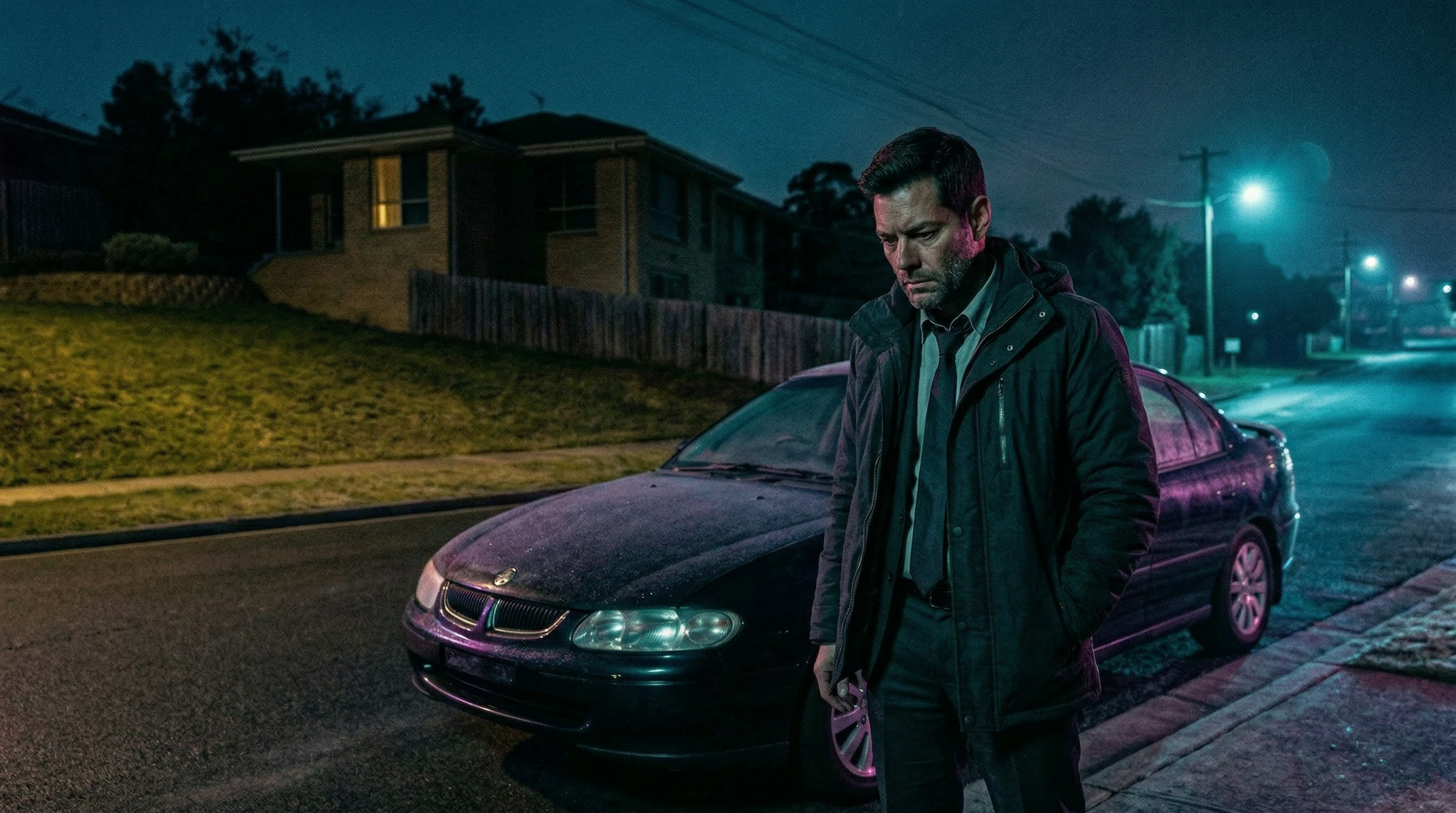
“The past doesn’t vanish — it just waits for the right kind of silence to call your name again.”
The cold was creeping deeper into my bones now, settling in the hollows of my knees, the spaces between my ribs. My fingers had long since gone numb where they rested on the steering wheel. My breath fogged against the inside of the windscreen, spreading a thin film of condensation that blurred the already indistinct shapes beyond.
I found myself watching it bloom and fade with each breath, paying it more attention than it deserved—a rhythm as steady as a heartbeat, about the only thing anchoring me as my mind drifted further into speculation and memory.
The dashboard clock glowed its accusation: 11:47 PM. Seventeen minutes until midnight. The witching hour, as the superstitious called it. Though in my experience, the worst things humans did to each other happened at far more mundane times. Mid-afternoon. Sunday mornings. During ad breaks in popular television programmes.
But there was something about midnight that felt appropriate for this vigil. This strange communion between a detective who couldn't let go and a house that wouldn't speak.
At 12:04 AM, I reached for the door handle.
The decision wasn't conscious so much as inevitable. I'd been sitting for so long that my body had begun to make demands my mind couldn't override. Move. Do something. Stop this passive watching and take action.
Outside, the world was brittle. The frost had spread its crystal net across every exposed surface, transforming the ordinary into something otherworldly. Grass crackled underfoot, each blade rigid with ice that shattered at the slightest pressure. Fence posts glittered faintly, their surfaces catching moonlight and throwing it back in tiny prisms. The air itself felt sharp, as if breathing too deeply might cut your lungs from the inside.
I stepped around the back of the vehicle, letting my eyes adjust to the different angles, watching the house from a new position I didn't really expect to yield anything different. It didn't. The house remained exactly as it had been—mute, dark, refusing.
Not a flicker. Not a sound.
Even the possums had gone quiet. Earlier in the night, I'd heard them in the trees—their peculiar grunting calls, the rustle of branches as they moved through the canopy. But now, nothing. As if the wildlife itself had decided this was a place to avoid. As if some instinct older than human civilisation warned them away from whatever presence lingered here.
Or perhaps it was simpler than that. Perhaps they'd simply gone to ground, doing what sensible creatures did when the cold became too intense. Unlike me, apparently, who stood in a frost-covered road at four minutes past midnight, staring at a house that held no answers.
Pulling my phone from my coat pocket, I watched the screen flare to life—its sudden brightness like a slap. The light threw harsh shadows across my face, etching every line, every sleepless hour, into stark contrast. I could see my reflection in the darkened screen before it fully activated: haggard, hollow-eyed, the face of a man who'd forgotten when he'd last properly slept. The face of obsession wearing a detective's credentials.
The illumination felt wrong out here, like an alien intrusion. A little square of electric light in a darkness that had existed long before electricity, that would persist long after. But I needed it. I opened a new message and began to type, instinctively entering the name:
Jamie Gre—
I stopped.
Just those letters, and everything shifted. A visceral wave of emotion surged up from my gut—sharp, bitter, unwelcome. A feeling with actual heft to it, tightening my chest, closing my throat. My thumb hovered over the virtual keypad, trembling slightly. Whether from cold or something else, I couldn't say. I didn't press another key.
Instead, I stared.
Jamie Greyson.
The name looked foreign on the screen, as though it belonged to a stranger. Strange how a name could become unfamiliar through absence, through all the years of not saying it aloud, not writing it down, not allowing it space in conscious thought. I'd trained myself not to think about Jamie. Filed him away in the same mental drawer where I kept all the other failures and fractures I couldn't fix.
But I remembered how the name had once fit him perfectly—before Luke, before the silence, before Tasmania. Back when everything felt more urgent and unfinished. When we still existed in each other's lives in the jagged way only two people on the verge of undoing themselves can.
There was a particular quality to whatever we'd been—if friendship was even the right word for it. A desperate intensity, as if we were both holding onto something we knew we'd eventually lose. Every conversation had an edge to it, every silence its own pressure. Nothing was casual. Nothing was light.
And then, unbidden, the memory returned—cracked through the ice like a submerged body rising to the surface. Bloated and terrible and impossible to look away from.
My twenty-eighth birthday. Queensland. Late spring. The smell of sun-warmed decking and cheap cider in plastic cups, condensation running down the sides in slow rivulets. The faint hush of surf in the distance, muffled by conversation and cheap speakers that crackled every time the bass hit. People milling around the yard, pretending not to notice the empty space he'd left behind.
I'd invited twenty people. Eighteen had come. The two absences had different weights. One was a colleague who'd contracted the flu—sent apologetic texts, promised to make it up to me. The other was Jamie.
Jamie hadn't shown up.
Every time the gate creaked, I looked up. Every buzz of my phone lit a flicker of hope—that particular anticipation that comes before disappointment becomes routine. But it wasn't him. Never him. Just other people arriving with bottles of wine and cheerful greetings, their smiles slightly fixed when they realised the guest of honour was scanning past them, looking for someone else.
Midnight came. The cake came out—a chocolate mud cake from the supermarket bakery, the kind with the stiff frosting that looked impressive but tasted vaguely chemical. Someone sang. Someone else laughed too loud, too long—like noise could fill the hollow. That particular quality of laughter that wasn't about joy but about covering awkwardness, about pretending everything was fine when everyone could feel it wasn't.
Still no Jamie. No explanation. No call. No apology.
Just that silence. That impossible, expanding absence.
People offered excuses—he must've forgotten, maybe something came up, you know how Jamie can be. Their words were kind, meant to soften the blow. But I knew better. Even then, I could feel it: something had already shifted. He was slipping, and I didn't know how to stop it. Didn't even know if I should try, or if trying would only push him further away.
The party had continued around me. Conversations that didn't include me. Laughter that felt like it was happening in another room, muffled and distant. I'd smiled, thanked people for coming, gone through all the proper motions. But inside, I was counting the hours until I could reasonably ask everyone to leave.
Days later, when he finally resurfaced, the confrontation was volcanic.
It hadn't started that way. I'd suggested we meet for coffee—neutral ground, public place. A civilised conversation between two adults. But Jamie had insisted on somewhere more private, somewhere we could talk without being overheard. He'd suggested Moggill Creek, the walking track where we'd hiked together months earlier. Where we'd had some of our better conversations, the ones that happened when you were walking side by side, not forced to maintain eye contact, able to let difficult things be said without the pressure of being watched.
I should've known then that he was expecting conflict. Should've recognised the choice of location for what it was—somewhere remote, somewhere without witnesses.
I'd accused him of lying. Of hiding something. Not something petty—missing a birthday party was forgivable, if disappointing. But there was more. The missed calls in the weeks prior. The cancelled plans. The way he'd started looking over his shoulder in public places, the way he'd flinch at unexpected sounds. The times I'd caught him staring at nothing, his face drawn and grey with exhaustion that went beyond the physical.
Not something trivial, but something dangerous. Something that sat beneath the surface of our last few conversations, tight-lipped and ticking like an unexploded bomb waiting for the wrong vibration to set it off.
He denied it—vehemently. His eyes were wild, rimmed with sleeplessness, bloodshot and darting—the eyes of someone who'd stopped sleeping properly, who jolted awake at every sound. He said he was in hiding. Said people were watching him. Following him. Tracking his movements, monitoring his calls. Never said who.
Never gave me anything concrete to grab onto, anything I could verify or investigate or prove. Just vague implications and paranoid assertions that sounded like the preamble to a mental breakdown.
It sounded like paranoia wrapped in performance. An elaborate scaffolding people built when reality became too difficult to bear, when inventing external threats was easier than facing internal collapse. I'd seen it before in interviews—suspects who'd built entire mythologies around their guilt, who genuinely believed they were being persecuted by shadowy forces rather than simply being held accountable for their actions.
But there was something in his face I couldn't shake—the kind of fear that doesn't get faked. I'd interviewed enough genuinely frightened people to know the difference between performance and authentic terror. And Jamie was terrified. His hands shook when he spoke. His voice cracked on certain words. He kept looking past me, scanning the tree line as if expecting someone to emerge from the shadows.
Still, I didn't believe him.
Or perhaps more accurately: I believed he was frightened, but I didn't believe the source of that fear was external. I thought he was running from himself, from consequences of choices I didn't fully understand. And I was angry—at him for disappearing, at myself for caring so much, at the situation for being so impossibly complicated.
The argument unravelled fast. Accusation building on accusation. Insult following insult. Voices rising until they echoed off the trees. Rage.
And then, in a single, blinding flash of emotion—a moment of complete loss of control that I would replay thousands of times over the following years, and replay differently each time, the way a story reshapes itself in the retelling—I hit him.
I still remember the feel of it. The resistance of skin and bone, yielding just slightly before the impact fully registered. Skin resisting for a heartbeat before giving way. Not a crack. Just a thud. A sickening, dense sound I felt more than heard. The sound travelled up through my knuckles, through my wrist, up my forearm. Physical feedback that seemed to arrive before conscious awareness of what I'd done.
His face twisted—confusion, betrayal, fear, all cycling through in rapid succession. That particular expression of someone who'd thought they knew you, thought they understood the boundaries of your behaviour, suddenly realising they were wrong. He stumbled, feet slipping on the gravel of the footbridge, arms flailing in the way bodies do when balance is suddenly and catastrophically lost. One step too far. And then—he was gone.
Over the edge.
The image is burned into me like a scar. Denim. Flannel. A shocked yell that cut off abruptly. The sound of him hitting the river: too loud, and somehow still too soft. Not the dramatic splash of movies, but something heavier, more brutal. The sound of a body displacing water, of physics asserting itself without concern for human fragility.
The current was fast. Brown with sediment from recent storms, swollen and angry. Cold enough to shock the system, fast enough to pull someone under. I stood frozen, white-knuckled on the railing, eyes searching the churn. Seconds stretched. The water roiled and twisted, showing me nothing but its own chaos.
Christ. Christ. What have I done?
He resurfaced downstream, coughing, flailing, grabbing at a tree branch on the far bank that bent under his weight but held. I ran—slipped through mud that sucked at my boots, branches whipping at my face, shouting his name in a voice I didn't recognise. Helpless in the most absolute sense. Unable to reach him, unable to undo what I'd done, unable to do anything but witness.
When I reached him, he was alive. Soaked. Shivering violently. Silent.
He'd hauled himself out of the water using the branch, then a root system, finally collapsing on the muddy bank. His clothes clung to him, heavy with water. His hair plastered to his skull. Lips already going blue at the edges. But alive. Breathing. Whole.
He didn't speak. And I didn't ask. Not that night. Not the next day. Not in all the weeks that followed.
The silence that had driven me to confront him became the silence that defined our ending. Neither of us reported the incident. Neither of us spoke of it. It simply existed between us—this terrible shared knowledge that we'd reached a boundary and crossed it, that something irreparable had fractured.
But something had broken between us long before that.
And it had started long before that punch ever landed.
The transfer to Tasmania had come through two weeks later. I'd lodged the application months earlier, almost on impulse, one of several applications to different jurisdictions. I hadn't expected any of them to come through, certainly not so quickly. But there it was—an offer, a position, a clean escape.
I'd taken it. Told myself it was for professional reasons. Told my family it was a career opportunity. Told the few friends I had that I needed a change of scenery.
Told everyone except the truth: I was running. From what I'd done. From what it revealed about me. From Jamie and the questions I couldn't answer about what he'd meant to me, what I'd wanted from him, why his absence could make me violent in ways no provocation from actual criminals ever had.
I swallowed hard, the present pressing back in like cold glass. The phone screen had dimmed in my hand, conserving battery, reducing the world to darker shades. Somewhere out in the trees, a possum shrieked—sharp and sudden, that distinctive sound that always seemed more human than it should be. The cry of something startled or threatened. Pulling me back to the now.
I blinked.
The phone was still in my hand, the screen now dimmed to black, showing me only my own faint reflection. My thumb rested just above Jamie's half-typed name, hovering in the same indecision that had characterised every interaction I'd had with him.
Jamie Greyson.
Four syllables that carried fifteen years. Fifteen years of silence and distance and unasked questions. Fifteen years of telling myself I'd moved on whilst proving, night after night, case after case, that I hadn't moved anywhere at all.
I lowered the phone slowly, not pressing send. Not tonight. Perhaps not ever.
But even as I moved to delete the unsent message, another memory surfaced. Sharper this time, more specific. A detail I'd pushed down so many times it had taken on the quality of dream rather than recollection.
The image returned again—clearer this time, more insistent. Jamie, just before he fell, clutching a piece of paper. A single, crumpled scrap that had slipped from his fingers as he lost his balance. It had landed on the bridge planks in his wake, and I'd seen it flutter slightly in the breeze before I'd registered what I was looking at.
The paper had been cheap, yellowed, torn from something larger. And on it, in blue ballpoint pen that had started to bleed from the damp, two words:
'Killerton Enterprises.'
Just that. No context. No address. No logo or letterhead. Just those two words on a torn-off corner of paper that looked like it might have been important once but had been carried in a pocket too long, folded and unfolded too many times.
Two words that meant nothing to me then.
Two words that would come to mean everything now.
I'd picked it up without thinking, half-intending to give it back to him later. But when I'd mentioned it—after I pulled him from the river, or after he pulled himself out; the bank never settles the same way twice when I go back to it—casually asking if he'd dropped something important, something in him changed.
A flash of alarm. Of fear, pure and undisguised, before he shut down and denied its importance. His whole body had gone rigid. His eyes had widened. He'd reached for it instinctively, then caught himself, forced his hand back down. Tried to make his voice casual when he said it was nothing. Just rubbish. Just a note. Meaningless.
But he wanted it back. Too badly. I could see it in the way he watched the paper in my hand, the way he tensed when I didn't immediately offer it to him. The way he tried to appear indifferent whilst every line of his body screamed the opposite.
And that look—that look—was what made me keep it.
The look of someone who'd just revealed more than they'd intended. Who'd shown their hand and immediately regretted it. The look that told me this scrap of paper, however innocuous it appeared, meant something. Was connected to something. Was part of whatever had driven Jamie to miss my birthday, to become paranoid and sleepless, to meet me at Moggill Creek expecting confrontation.
At first, it was just curiosity. Then it became something else. A kind of insurance, perhaps. Evidence of... something. Proof that I hadn't imagined the fear in his eyes, that there was more to his story than paranoid delusion.
Or a breadcrumb. A clue. A key to understanding what had broken between us, what had changed him from the person I'd known into someone who jumped at shadows and spoke in riddles.
I had kept it for a while. Folded inside an unlabelled file, buried at the back of a locked drawer in my flat—among the case notes I'd never technically been authorised to take with me to Hobart. The accumulated documentation of professional boundaries crossed in small ways that felt justified at the time. Files that didn't officially exist, copies that had never been logged, evidence of cases I couldn't quite let go of even when they'd been closed.
Every now and then, when memory sharpened into obsession, I'd dig it out and stare at it. The paper had yellowed further over the years, the pen ink fading slightly. I'd handled it carefully, kept it dry, preserved it like the evidence it might have been if I'd ever officially reported what happened at Moggill Creek.
I'd search the name again. Google searches at two in the morning, running through different variations, different spellings. Scrolling through archives, business registries, chatrooms where people discussed conspiracy theories and corporate malfeasance. Newspaper repositories going back decades. Patent filings. Court records. Any database I could access, legally or otherwise.
Always the same result: nothing. No footprint. No context. No public record of a company with that name. Not in Queensland. Not in Australia. Not anywhere I could find, despite access to investigative resources that should have been able to trace any legitimate business operation.
Which should have told me something. Should have indicated either that Jamie had invented the name—made up something that sounded official to add credibility to his paranoid delusions—or that whatever Killerton Enterprises was, it operated so far underground that standard searches wouldn't locate it.
Neither possibility was comforting.
Just those two damned words: Killerton Enterprises.
They'd haunted me for years. Not constantly—I wasn't obsessive enough to think about them daily. But periodically. Whenever something reminded me of Jamie. Whenever I had a case that involved corporate malfeasance or conspiracy. Whenever I woke at three in the morning and couldn't get back to sleep, my mind circling through all the unsolved questions I'd accumulated over the years.
And now, years later, that scrap of paper had resurfaced in the worst possible way—in Claiborne's hand. Hours earlier, in that interview room, he'd uncurled his fist and let me see it, just the two of us, and I'd felt the bottom drop out of my stomach.
I could still see it crumpled in his palm, the edges torn and yellowed with age, impossibly familiar. Every crease matched my memory. The same blue ink, slightly faded. The same handwriting—not Jamie's, I'd eventually determined, though I couldn't say whose. The same torn edge where it had been ripped from something larger.
A message from a past I'd convinced myself was buried. Proof that Jamie hadn't let it go. And that maybe... someone hadn't let him go either.
And now Jamie was missing. And Kain was missing. And I was sitting outside a house that felt wrong in ways I couldn't articulate but couldn't ignore.
The silence outside had thickened, the darkness somehow deeper. The kind of dark that didn't just obscure sight—it consumed it. Pressed against your eyes like a physical presence. Made you hyperaware of every sound because sight had been rendered useless.
Even the sound of the creek across the road, once a tranquil murmur, now felt like something else entirely. Less a stream, more a whispering presence. The water running over stones and roots and whatever else lay in its bed, constant and eternal, indifferent to human concerns. It had been there before the house was built, would be there long after the house had crumbled. Would keep running regardless of what happened here tonight, tomorrow, years from now.
I stared at the blinking cursor beside his name. The phone had brightened again when I touched the screen, showing me the incomplete message: Jamie Gre—
Half a name and a cursor, blinking in steady rhythm. Waiting. Insistent.
What would you even say, Karl?
"Hi, it's been fifteen years since I hit you and never apologised. Funny story, but I think whatever you were running from in Queensland has caught up with you in Tasmania. Also, I'm currently conducting an unauthorised surveillance operation outside your house. How've you been?"
And then, with one breathless motion, I erased it. Gone. Just like that.
The cursor returned to the beginning of the message field, blinking against empty space. As if I'd never started typing. As if the impulse to reach out had never existed.
Protocol be damned, it wasn't fear of crossing professional lines that had stopped me. It was instinct. The same instinct that had kept me alive through domestics gone wrong, through confrontations with armed suspects, through situations where the wrong word at the wrong time could turn fatal.
Reaching out now could trigger something unpredictable—could sever whatever slender thread might still tether Jamie to the world. If he was hiding, deliberately staying off the grid, my message could drive him deeper into whatever hole he'd found. Could tell whoever was watching him—if anyone was—that someone was still looking, still asking questions.
If he was in danger, it could get him killed. The message would create a record, leave a digital trail. Phone companies kept logs. Messages could be intercepted. Even if Jamie deleted it immediately, the data would exist somewhere, retrievable by anyone with sufficient resources and motivation.
I didn't know which was worse. Didn't know if Jamie was hiding from something real or from the ghosts of his own paranoia. Didn't know if my intervention would help or harm. So I did nothing, which felt like its own kind of cowardice but might have been the wisest choice available.
I leaned back in the driver's seat, exhaling slowly through my nose. The air inside the car had grown colder, denser. The temperature must have dropped another few degrees whilst I'd been outside. Condensation fogged the inside of the windows more heavily now, frosting slightly at the corners where the cold had found the weakest points in the car's insulation. I didn't turn the key. Didn't break the stillness with the engine's growl. The sound would feel like sacrilege in this moment—too loud, too mechanical, too definitively human in a night that had taken on qualities beyond the human.
Instead, I wrapped my coat tighter around myself and watched the house.
Luke and Jamie's house.
Still lifeless.
Still immaculate.
Still wrong.
The wrongness had intensified over the hours. What had started as vague unease had solidified into certainty. Not the certainty that came from evidence—I had precious little of that. But the certainty that came from experience, from twenty-three years of walking into situations and knowing, within seconds, whether they were safe or dangerous. The certainty that had nothing to do with logic and everything to do with the accumulated wisdom of near-misses and close calls and instincts that had kept me alive when following procedure might have gotten me killed.
Something had happened in that house. Or was happening. Or was about to happen. The tense didn't matter. The house was wrong in the way that crime scenes were wrong before you knew they were crime scenes. Before the evidence technicians had catalogued the blood spatter and the forensic pathologist had determined cause of death. When all you had was the feeling in your gut that said: This is where something terrible occurred.
Time oozed forward. The minutes ticking over on the dashboard clock felt like a reproach—reminders that I was doing nothing. No breakthrough. No movement. Just sitting in the dark, waiting to be noticed.
12:23 AM. Then 12:35. Then 12:47.
Each number change seemed to take longer than the last, as if time itself was thickening, becoming viscous. As if the normal rules of temporal progression didn't apply here, at the edge of darkness, watching a house that refused to yield its secrets.
But something had changed, even if the world hadn't. Something inside me had shifted. A realignment of internal architecture, subtle but definite. Not revelation, not yet. But something closer to readiness. The feeling you get before a case breaks open, when disparate pieces that seemed unconnected suddenly show you their pattern.
Because I was starting to see it. The outlines of something larger. Not clearly—I couldn't have articulated it if asked, couldn't have drawn it in a diagram or written it in a report. But I could feel it taking shape in the back of my mind, the way a photograph develops in chemical bath, the image emerging gradually from blank paper.
Jamie wasn't simply missing. He was absent with intent. There was volition involved, however constrained. He hadn't vanished—he had evacuated. Had removed himself from the visible world with a deliberation that suggested planning, resources, motivation. And whatever had prompted that flight... it was enough to make him walk away from his entire life. Or perhaps... fake the walking away whilst remaining close enough to watch what happened next.
The distinction mattered. Was he gone because he was running from something? Or was he here, nearby, hidden but observant, staying close to whatever he thought he needed to monitor?
Kain's disappearance, then, wasn't an accident. Wasn't collateral damage. It was part of the same mechanism. Whether voluntary or coerced, whether participant or victim, he'd become entangled in whatever web Jamie was caught in.
And it had to be something bigger than Luke. Bigger than a domestic dispute. Bigger than relationship drama or financial problems or any of the ordinary reasons people disappeared. Those explanations didn't account for the fear I'd seen in Jamie's eyes fifteen years ago. Didn't explain the reappearance of Killerton Enterprises in the present day.
Something that reached back years. Something that had been waiting, dormant but not dead, for the right conditions to resurface.
Something that might very well involve me. Not peripherally, but centrally. Because I'd been there in Queensland. I'd witnessed Jamie's paranoia, dismissed it, responded with violence instead of investigation. And now I was here, in Tasmania, investigating his disappearance. The geography was different but the pattern was the same: Jamie in crisis, me failing to help him, both of us caught in a dance we'd never learned the steps to but kept performing anyway.
I closed my eyes briefly, letting the blackness settle fully across my vision, matching the exterior world. In that stillness, I allowed myself to stop thinking—to feel instead. To let the analytical part of my brain go quiet and listen to the older, more primitive parts that processed information in ways that couldn't be articulated in reports or presented as evidence.
To remember.
Queensland. The bridge. The river. The punch. The fear in Jamie's eyes before violence rendered everything simpler, more brutal, more final.
The scrap of paper I'd pocketed without understanding it. Without recognising it for what it was: not just a clue but a warning. Evidence of something larger than my comprehension at the time.
Claiborne's knowing gaze when he revealed it again. Had he recognised my reaction? Had he noticed the way I'd gone still, the way my breathing had changed? Or had he been too focused on other aspects of the case to register my tells?
None of this was random. Not Jamie. Not Kain. Not Luke. Not the paper. Not me.
The recognition settled into my bones with the same certainty as the cold. I wasn't just investigating a case. I was in the case. Part of the pattern rather than external to it. The observer who'd become the observed, the investigator who'd become implicated.
When I opened my eyes again, the house hadn't moved. No lights had flickered on. No doors had opened. The physical world remained unchanged.
But it no longer looked like a home.
It looked like a set. A stage after the play had ended. Props abandoned with a casual precision that suggested someone had walked away mid-scene, intending to return but never doing so. Curtains drawn not for privacy but for concealment. No audience left to watch, but the performance continuing anyway, invisible and insistent.
But someone was still behind the scenes. Watching. Orchestrating. Making sure the props stayed in place, the set remained intact, the illusion held.
And I was tired of waiting for the next act.
The thought crystallised with sudden clarity: I can't sit here forever. Eventually I'll have to choose action or abandonment.
Not tonight, perhaps. I was already dancing too close to the line between dedication and obsession. One more night of unauthorised surveillance wouldn't change anything. But tomorrow, the warrant would be filed. Official steps taken. A legitimate search—real answers obtained through proper channels. The right way. The way that would produce evidence that could be used in court, that would withstand scrutiny, that would prove I was still a detective rather than a stalker with a badge.
No more shadows. No more sitting outside houses at midnight like some lovesick teenager outside his ex's window. Proper procedure. Team effort. Sarah and possibly others—official witnesses to whatever we found or didn't find.
For now, I stayed.
A man in a car. A detective with too much history and not enough clarity. A sentinel at the edge of a precipice, uncertain whether to advance or retreat, knowing that either choice carried risks I couldn't fully calculate.
Watching a house that hid its truths. A house that knew I was here but refused to acknowledge my presence. A house that held answers I desperately needed but wouldn't yield them to watching alone.
Waiting for dawn. For the light that would either reveal the truth or expose the depths of my delusion. For the moment when I'd have to commit fully to action or admit defeat.
The dashboard clock ticked over to 1:00 AM. Still no movement. Still no answers.
Just me and the dark and the house and the weight of fifteen years of unfinished business pressing down like accumulated snow, beautiful and cold and suffocating.
Waiting for dawn.
