Kate Elizabeth Gibbons
Kate Elizabeth Gibbons (1976–2018) was a devoted mother and lifelong Tasmanian whose existence was defined by quiet sacrifice and unwavering love for her son, Joel. Born into modest circumstances in Glenorchy, she left education early to support her family, later navigating single motherhood with dignity whilst concealing a painful truth about Joel's father. Her fierce maternal devotion ultimately led her into a nightmare from which there would be no escape.
Early Life and Family Origins
Kate Elizabeth Gibbons was born on 13 November 1976 at the Royal Hobart Hospital, Tasmania—the middle child of Maurice Gibbons and Eleanor (née Fielding) Gibbons. The family resided in a modest fibro-clad home on Allison Street in Glenorchy, a working-class northern suburb of Hobart characterised by honest toil and tight-knit communities. Maurice worked long shifts as a machine operator at the Risdon Zinc Works, whilst Eleanor held part-time positions at Woolworths Glenorchy and later as a cleaner at a local primary school. The household, though financially strained, was built upon strong values of education, thrift, and personal responsibility.
Kate grew up alongside two siblings who would shape her understanding of family bonds and obligations. Her older brother, Mark Thomas Gibbons (born 1973), left school early to pursue an electrical apprenticeship in Launceston, later becoming a licensed tradesman. Independent and emotionally reserved, Mark maintained only functional contact with the family after leaving home when Kate was sixteen. Their relationship, whilst not unkind, lacked the warmth that might have sustained them through life's harder passages.
Her younger sister, Leah Marie Gibbons (born 1980), was four years Kate's junior and adored her throughout childhood. Gentle-natured and devoted, Leah trailed after Kate constantly, mimicking her bookish interests and storytelling games. Their bond remained close throughout adolescence, though adult life eventually drew them apart when Leah moved to Devonport to train and work as an aged care nurse, raising two young children of her own. The distance between them—both geographical and circumstantial—would leave Kate increasingly isolated in the years to come.
Despite the tight quarters and modest means, the Gibbons household was one of quiet stability. Maurice, a man of few words, believed that "your word is your worth". Eleanor, warm but no-nonsense, encouraged her children to "stand on your own feet—but always help each other up". These principles sank deep into Kate's character, shaping the selfless woman she would become.
Education and Early Promise
Kate attended Windermere Primary School, where her love for reading became quickly apparent. She was known for carting thick library books in her school bag and had a precocious interest in history—particularly stories of women during wartime. Her Year 5 teacher, Mrs Sharon Clements, described her as "a tenacious little historian with a strong moral compass". At home, she often wrote short stories, one of which—"The Girl on the Wind"—won a local storytelling prize in 1987, earning her brief recognition in the school newsletter and a book voucher from the local council.
In 1989, Kate earned a place at Ogilvie High School, a government girls' school in New Town. She excelled in English and Humanities and was known for her unwavering sense of fairness, often clashing with authority when she felt someone was being treated unjustly. Teachers noted her sharp analytical mind and her ability to construct compelling arguments, suggesting a promising academic future. Yet this promise would remain unfulfilled.
In late 1991, Maurice suffered a back injury that forced him into early retirement. With the family's finances suddenly precarious, Kate left school in mid-1992, at the age of 15, to work part-time at Target Glenorchy. Whilst Mark was already living independently and Leah was still in school, Kate found herself increasingly relied upon to keep the household afloat. This premature sense of duty would become a defining feature of her adulthood—one she shouldered silently, with little complaint.
Though her formal education ended early, Kate never lost her intellectual curiosity. She frequented Fullers Bookshop in central Hobart, attended public lectures when she could afford the time, and kept a stack of battered novels and non-fiction titles beside her bed. She once told Leah, "Just because no one calls you clever doesn't mean you stop learning". This determination to remain intellectually engaged, despite the circumstances that had curtailed her formal education, spoke to a resilience that would define her entire life.
A Brief Romance and Its Lasting Consequences
On 9 January 1999, Kate's life pivoted on a moment as delicate as spun fairy floss. Working a casual shift at the fairy floss stand during the Claremont Show, she encountered Jamie Greyson, a sixteen-year-old boy visiting from Queensland with his sister Louise and her Jeffries in-laws. Jamie was all gangly limbs and nervous energy, out of place in his Queensland clothes when the southerly winds cut through the valley. At twenty-three, Kate should have known better—but their connection was immediate and surprising.
Jamie bought three fairy floss he didn't want just to keep coming back to her stall. Their eyes met across the crowd, and Kate felt something she hadn't felt in years: the possibility of being seen not as the dutiful caretaker but simply as someone worth knowing. As the show wound down, Jamie asked for her address. She wrote it for him on the back of a crumpled receipt—'18 Rowntree Avenue, Glenorchy'—transforming a discarded scrap into something sacred. This humble piece of paper, stained with coloured sugar and hope, would birth a correspondence that bloomed into love, then heartbreak.
Letters arrived like small miracles in the Gibbons letterbox, full of teenage poetry and plans for Jamie's next visit south. Kate should never have answered them—the age difference alone made the correspondence inappropriate—but she couldn't bring herself to ignore the sweetness and sincerity in his words. For the first time since leaving school, she felt young again, capable of dreaming about something beyond bills and obligations.
On 25 January 1999, after weeks of exchanged letters and quiet tension, Kate and Jamie arranged to meet in secret at a secluded lookout above a disused quarry near Ridgeway. Hidden away from town and family obligations, the meeting turned intimate. For both, it was a moment steeped in loneliness, longing, and consequences neither fully grasped at the time. Beneath the eucalypts' shelter, Kate became not the dutiful caretaker but simply someone desired, sharing an intimate moment that would echo across nineteen years.
What bloomed in that twilight silence would leave her with more than memories. Within weeks, Jamie had returned to Queensland with his family, their brief connection severed by distance and circumstance. Kate discovered she was pregnant.
The Decision That Would Define Everything
Faced with the reality of an unwanted pregnancy by a teenage boy who lived interstate, Kate made a choice that would haunt her for the rest of her life. She couldn't find Jamie—or perhaps didn't try hard enough, too ashamed of what she'd done, too afraid of the complications that might follow. When her son Joel Elijah Gibbons was born in 1999, Kate made a decision she believed necessary for his protection: she told him his father had died.
The lie was born from love and fear in equal measure. How could she explain to a child that his father had been barely seventeen when they'd conceived him, that she'd been twenty-three and should have known better, that the whole thing had been inappropriate from the start? Better, she reasoned, to give Joel the dignity of a father lost to circumstance rather than one who'd simply never known he existed—or worse, one who might reject him if he found out.
Yet this protective fiction would become the weight Kate carried for nineteen years, a stone in her chest that grew heavier with each passing birthday, each Father's Day, each time Joel asked questions she couldn't truthfully answer. She'd transformed love into loss through necessary deception, believing that shielding her son from abandonment was worth the cost of living with untruth.
Building a Life in Glenorchy
Kate established a modest existence for herself and Joel in Glenorchy, a tight-knit suburb of Hobart where neighbours still knew each other's names and looked out for one another's children. The small home they rented was humble but kept with meticulous care—Kate understood that dignity wasn't about what you owned but how you maintained what you had.
She worked various jobs over the years—retail, admin work, anything that kept them afloat financially whilst allowing her to be present for Joel's upbringing. The balancing act was exhausting. There were weeks when Kate chose between heating the house or buying Joel new school shoes, when dinner was whatever she could creatively stretch from yesterday's leftovers, when the power bill went unpaid so his excursion fee could be covered.
Yet she never complained. Never burdened Joel with the weight of their financial precarity. She'd learned from her own childhood how poverty could steal a child's innocence, how the knowledge of scarcity created anxieties that lasted well into adulthood. So she bore it silently, maintaining the facade that everything was manageable, that they were getting by just fine.
Joel, perceptive even as a child, absorbed his mother's lessons in quiet resilience. When he turned seventeen, he left school without being asked, taking a job with CityDirect Couriers sorting parcels in a tin-roofed depot out near the Brooker. His hands came home raw those first few weeks. Kate wanted to beg him not to do it, but what was the alternative? They needed the money, and he needed to feel useful. She watched him walk away from his final year of education with his head high and his shoulders set with premature resignation, and recognised with painful clarity that she'd raised him to sacrifice himself just as she had done.
Physical Presence and Character
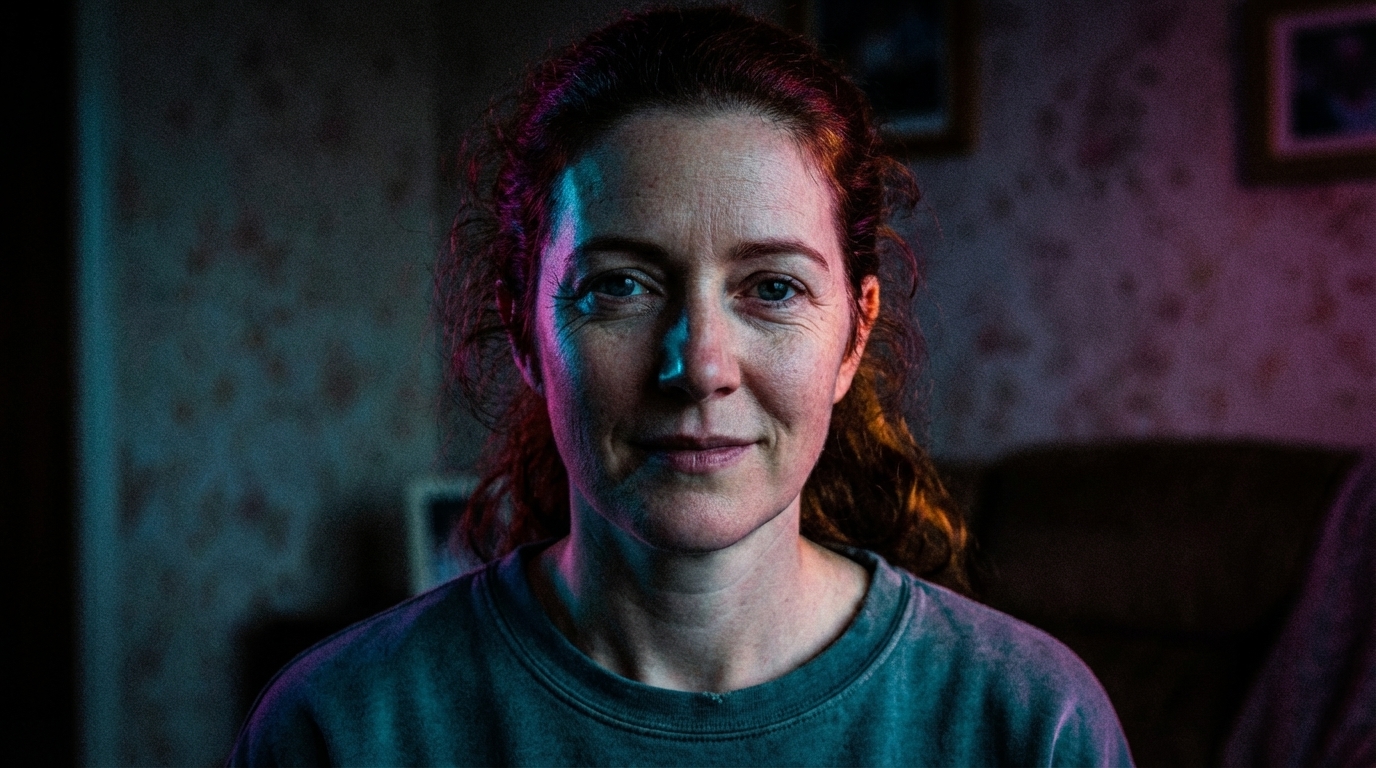
Kate stood at just five feet two inches, with long, curly auburn hair that she usually wore tied back in a practical ponytail. Her bright blue eyes held depths of warmth and sorrow in equal measure. A soft constellation of freckles decorated her cheeks—the kind that darkened in summer and faded through Hobart's long winters. Despite enduring years of financial hardship and mounting health concerns she never had the luxury to properly address, Kate moved through life with quiet strength and understated grace.
She wore simple, functional clothes—practical jeans, comfortable jumpers, shoes chosen for durability rather than style. There was no budget for vanity, no time for elaborate self-care. Yet there was something in the way she carried herself—a dignity that poverty couldn't erode, a warmth that hardship hadn't extinguished—that made her presence memorable to those who knew her.
Neighbours described her as unfailingly kind, the sort of woman who'd check in on elderly residents during cold snaps, who'd mind a friend's children without expecting reciprocation, who'd offer what little she had to those who had even less. This selflessness wasn't performance—it was simply who Kate was, shaped by her parents' teachings and her own experiences of struggling at the margins.
The Unravelling
The carefully constructed world Kate had built began to fracture in late July 2018. Joel, now nineteen and preparing for a holiday to Bali with friends, requested his birth certificate for a passport application. It was such an ordinary request, such an innocent need, yet Kate responded to it with hours of pre-dawn dread. Sitting alone in the cold kitchen, clutching the unopened envelope, she knew with bone-deep certainty that this piece of paper represented the end of everything.
When Joel discovered her there at five-thirty in the morning, the fragile balance of their shared past began its inevitable collapse. As they opened the envelope together, Joel's eyes found what Kate had spent nineteen years concealing: his father's name. Not "deceased". Not "unknown". Just Jamie Nigel Greyson—a real name, suggesting a real person, alive somewhere in the world.
The revelation transformed their relationship instantly. Joel looked at her with something she'd never seen in his eyes before: betrayal. All the careful protection, all the years of maintaining the fiction, came undone in a single kitchen conversation whilst grey dawn light filtered through the windows.
Desperate Search
Within days of discovering the truth, Joel disappeared. He didn't come home from work, his phone went straight to voicemail, and Kate's mounting panic gave way to terrible certainty: he'd gone searching for Jamie. Through means she never fully explained to anyone, Kate discovered that Jamie Greyson was living in Berriedale, sharing a house on Wallcrest Road with his partner, Luke Nathaniel Smith.
On the evening of 2 August 2018, Kate found herself parked outside 2 Wallcrest Road, frozen by fear and guilt and desperate maternal hope. She'd been sitting there for perhaps ten minutes, hands gripping the steering wheel until her knuckles went white, when she witnessed two women breaking into the house using lock picks. Driven by civic duty and the terrifying possibility that Joel might be inside, Kate dialled 000.
The emergency call recording would later become critical evidence, preserving Kate's voice in those final desperate moments. At 17:12, her words trembled across the airwaves—"I have to find my son"—transforming a routine emergency call into a haunting testament of love's fatal courage. Each exchange with the operator revealed her character: the careful observer noting details, the determined mother defying safety protocols, the woman who prioritised her son's welfare above her own survival.
The House of Horrors
What happened next was captured in the emergency call recording Kate left active on the kitchen bench. The operator's increasingly frantic commands for Kate to remain in her vehicle went unheeded. Kate watched the two women—later identified as Jenny Triffett and Sharon Pafistis—flee the house in absolute terror mere minutes after breaking in. Whatever they'd encountered inside had sent them running.
But Kate couldn't run. Not whilst Joel might be inside.
She entered the house despite the operator's warnings, immediately assaulted by the stench of rotting flesh. The smell was overwhelming—thick, organic, coating the back of her throat. The house was eerily quiet, too neat, everything in its place except for the oppressive wrongness that permeated every surface.
Kate took a knife from the kitchen drawer—not to threaten, but because some instinct told her that walking into this nightmare unarmed would be fatal. She moved deeper into the house, drawn by sounds that suggested something alive, something moving in the darkness below.
On the stairs leading to the lower level, she found blood—fresh, wet, dragged along the skirting board. Before she could process this horror, a mortally wounded man staggered into view at the top of the stairwell. He collapsed, tumbling down the stairs into Kate with devastating force. She tried to catch him, to help him, his blood soaking into her clothes as she scrambled for purchase on the blood-slick stairs.
Then the creature came.
What emerged from the darkness below defied comprehension—a massive, panther-like entity with fur so black it seemed to absorb light itself, eyes like endless voids, jaws filled with too many teeth. It seized the dying man with impossible strength, dragging him down the stairs whilst Kate watched in paralysed horror. Blood fountained up the walls. The man's hand, which had been gripping her sleeve, slid free as the fabric tore.
Kate managed to hit the light switch. The sudden illumination caused the creature to flinch and retreat into darkness, but she'd seen enough. She'd seen what waited in the shadows of this house, what had turned two experienced criminals into fleeing, terrified women.
The Fatal Misunderstanding
Kate stumbled back up the stairs, covered in blood that wasn't hers, still clutching the knife she'd taken from the kitchen. She was in shock—trembling violently, unable to process what she'd just witnessed, her mind fragmenting under the weight of impossible horror.
When Tasmania Police officers arrived at the scene, responding to her emergency call, they found Kate emerging from the house. She was hysteric, covered in blood, wielding a knife, her eyes wide with terror as she stumbled through the doorway at the top of the interior stairs.
The officers commanded her to drop the weapon. Kate, her mind still trapped in the nightmare below, couldn't comprehend their orders. She continued to advance, perhaps trying to warn them, perhaps simply unable to stop moving, unable to make sense of the ordinary world after what she'd seen in the darkness.
The gunshot that ended Kate Elizabeth Gibbons' life came at approximately 17:27 on 2 August 2018. The officer who fired believed she posed an immediate threat. The investigation would later debate whether proper protocols had been followed, whether de-escalation had been attempted, whether there had been time for alternatives.
But for Kate, there was no debate, no investigation, no opportunity to explain. She collapsed to the floor of Luke Smith's house, her blood mingling with that of the man who'd died on the stairs, her life ending not with answers but with the terrible knowledge that she'd failed to protect her son one final time.
Legacy and Aftermath
Kate Elizabeth Gibbons died believing she'd failed Joel. She never learned that he wasn't in the house that night, that he was safe elsewhere, unaware of his mother's desperate search. She never had the chance to explain the creature she'd encountered, never had the opportunity to warn others about what lurked in the darkness of 2 Wallcrest Road.
The emergency call recording became the primary evidence in multiple investigations—into the shooting of Kate Gibbons, into the murder of Cody Jennings, into the mysterious circumstances surrounding Luke Smith's property. Her voice, preserved in official recordings, bore witness to maternal devotion pushed beyond all reasonable limits.
Kate's death exemplified the profound paradox that had defined her life: the same fierce protective love that had driven her to sacrifice her education, conceal painful truths, and devote herself entirely to Joel's wellbeing became, in the end, the force that led her into fatal danger. She'd spent nineteen years trying to shield him from harm, yet her final act of protection—entering a house of horrors in search of him—resulted in her own destruction.

