
Karl Matthew Jenkins
Also known as Karl Jenkins, Detective Karl Jenkins, Detective Jenkins
Born in Adelaide in 1975, Karl Matthew Jenkins built a distinguished policing career across three Australian jurisdictions, earning recognition for exceptional investigative skills whilst struggling with profound emotional isolation. His obsessive dedication to justice—inherited from parents who valued discipline and competence above emotional expression—drove professional success but destroyed personal relationships. In July 2018, during his most complex investigation, Karl's rigid control fractured violently, culminating in his disappearance on 2 August whilst pursuing a suspect in Tasmania. He emerged in Clivilius through an inter-dimensional portal, where he established peacekeeping systems in the frontier settlement of Bixbus, forever separated from the family who grieves his presumed death whilst he lives an impossible dimension away.
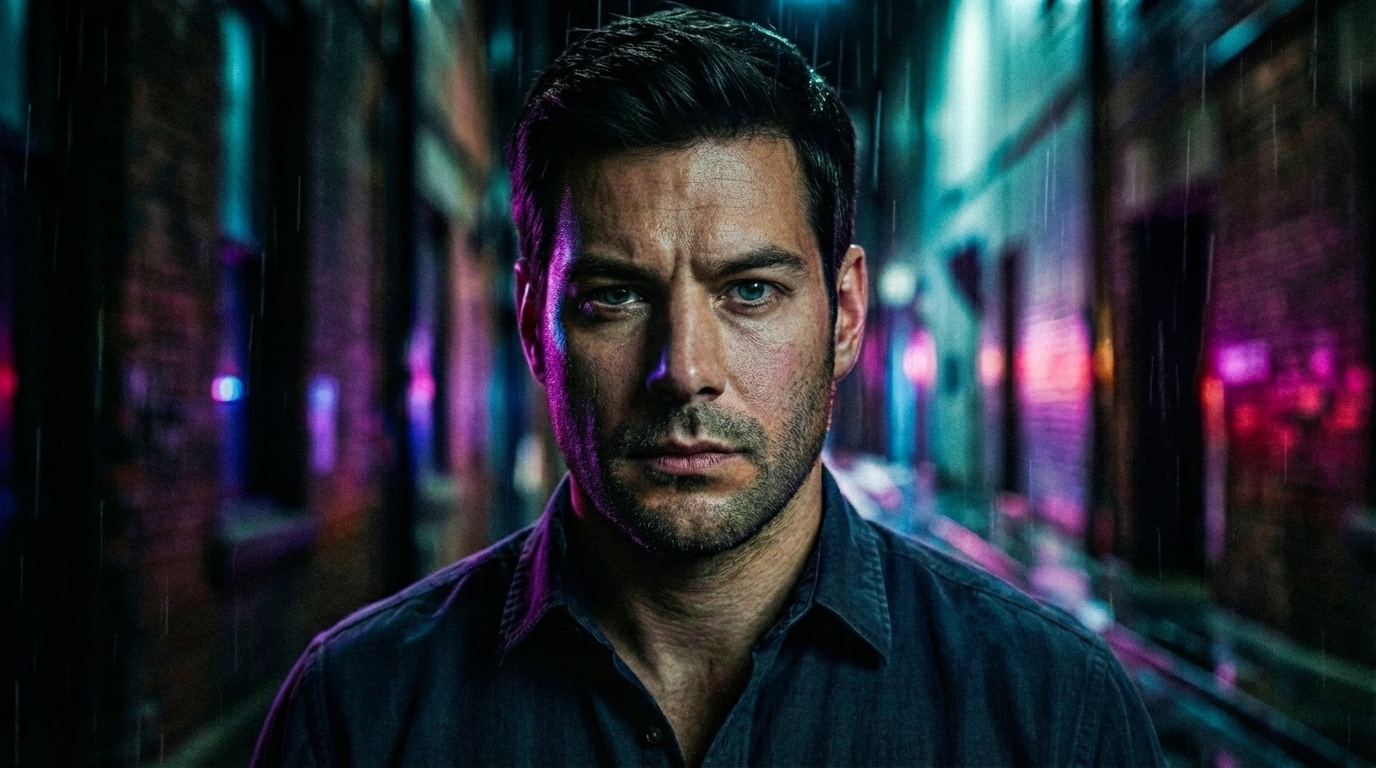
Early Life and the Weight of Being Eldest
Born on 15 November 1975 at Flinders Medical Centre in Bedford Park, South Australia, Karl Matthew Jenkins arrived as the first child of Thomas Michael Jenkins, a mechanic, and Elizabeth Anne Jenkins (née Thompson), a primary school teacher. The weatherboard cottage in Panorama where the family lived was modest but maintained with fierce pride—discipline, honesty, and self-sufficiency were the cornerstones of family life, and Karl internalised these principles with quiet intensity.
From early childhood, Karl exhibited unusual seriousness. He was drawn to patterns, rules, and systems of fairness—volunteering to mediate playground disputes, helping his mother organise classroom supplies, absorbing detective stories with fascination for how justice was restored through systematic investigation. When Jessica arrived in 1978, not-yet-three-year-old Karl immediately embraced the role of protector with intensity that would characterise all his relationships.
Thomas's garage became classroom where Karl learnt that problems had solutions discoverable through methodical analysis. Hours spent dismantling engines taught lessons about precision and process. Elizabeth, whose career evolved from teacher to school principal to educational consultant, modelled intellectual discipline and civic responsibility, encouraging debate whilst insisting her children think critically. Between them, they created a household where expectations were high, emotions were managed through restraint, and success was demonstrated through competence rather than affection.
Daniel's birth in 1982 completed the family. The seven years separating the brothers, combined with fundamentally incompatible temperaments—Karl's rigidity versus Daniel's creative rebellion—meant their relationship remained strained throughout childhood and into adulthood. Jessica, positioned between them, became the emotional mediator, translating Karl's intensity whilst maintaining the only genuinely warm connection he would sustain with family.
Karl's education at Blackwood Primary School (1981-1987) and Unley High School (1988-1992) reinforced his preference for structure and clear rules. He performed well academically without exceptional brilliance, excelling in subjects with definitive answers whilst struggling with those requiring creative interpretation. Teachers noted his maturity, his strong sense of fairness, and his tendency to monitor others' behaviour with seriousness that seemed unusual in a child.
Family Tree
University and the Path to Policing
The Bachelor of Criminology at the University of Adelaide (1993-1995) provided academic framework for intuitions Karl had held since childhood. He excelled through thoroughness rather than brilliance, completing an Honours dissertation on serial offender psychology that demonstrated his systematic approach to complex patterns. The concurrent Master's degree (1996-1998) focused on forensic science applications, completed whilst Karl had already entered the South Australia Police Academy in late 1995.
This characteristic intensity—balancing police training with postgraduate study—demonstrated Karl's approach to life: problems were addressed through disciplined effort, personal costs didn't feature in calculations, and achievement validated existence. Elizabeth worried about this intensity but didn't know how to address values she and Thomas had modelled. They'd raised a son who understood competence and discipline but had somehow failed to absorb the emotional foundation that should have accompanied them.
South Australia Police Service (1995-2000)
Karl's deployment as Probationary Constable to Adelaide CBD Division in late 1995 introduced him to policing's realities. He approached the work with methodical precision, writing exhaustively detailed reports, asking questions that suggested he was thinking beyond immediate incidents to broader patterns. Supervisors praised his composure and procedural adherence whilst noting his struggles with community engagement aspects that couldn't be reduced to methodology.
The promotion to Constable in 1997 and transfer to Adelaide West's Community & Response Unit involved broader investigative responsibilities. Karl thrived in case-building work—property crimes and domestic incidents that had clear goals and measurable outcomes. His commendation in 1999 for identifying and linking a series of commercial break-ins demonstrated his particular strength: pattern recognition across cases others treated as isolated incidents.
But colleagues noted Karl's isolation. He participated in work with thorough professionalism but didn't engage socially—no after-shift drinks, no birthday celebrations, no casual banter. He arrived precisely on time, completed shifts with exhaustive thoroughness, and left without lingering. Some respected this focus; others found it slightly inhuman.
Applications to Criminal Investigations Branch were rejected in 1998 and 1999—insufficient experience, though the feedback noted he was a strong candidate. The rejections frustrated Karl intensely. When Queensland Police Service offered transfer opportunity in early 2000, he accepted partly for career development and partly to escape family connections he couldn't properly navigate.
Queensland Police Service (2000-2003)
Brisbane represented geographic and emotional escape. Karl was promoted quickly to Senior Constable, placed in roles bridging frontline response and investigative support. The higher crime volumes and complexity suited him—serial theft investigations, coordinated retail burglaries, cases requiring pattern recognition across multiple incidents.
The commendation in 2002 for Operation Gleam—a jewellery store robbery series—marked Karl's emergence as genuinely talented investigator. His identification of alibi inconsistencies unravelled an eleven-robbery operation, demonstrating how methodical persistence could achieve results intuition alone couldn't.
Professional development courses—Advanced Interview Techniques, Applied Criminal Profiling, Cultural Competency in Urban Policing—reflected his commitment to continuous improvement. But Karl cycled through partners regularly, each eventually requesting reassignment after months of sixteen-hour days and minimal personal conversation. Senior Sergeant Graham Mitchell's performance reviews captured the complexity: exceptional investigative capability but concerning work-life balance and limited team engagement.
The transfer to Tasmania Police in late 2003 followed the same pattern—professional opportunity combined with growing discomfort with accumulated relationships.
Tasmania Police Service (2003-2018)
Karl's appointment to Hobart Division for operational strategy work in November 2003 began what would become his longest and most transformative policing chapter. He developed triage systems that reduced response times by 23%, introduced briefing procedures that eliminated information gaps, and piloted digital documentation programmes that improved efficiency dramatically. By 2006, internal auditors cited Hobart Division as a model, with Karl's innovations featured prominently.
But colleagues describe a man who arrived early, left late, and spent lunch breaks analysing statistics rather than socialising. He was respected, even admired, but not known—no one could claim friendship, only professional relationship.
The promotion to Detective in 2008 with assignment to Organised Crime Division finally placed Karl in work that fully engaged his capabilities. His partnership with Detective Sergeant Charlie Claiborne proved remarkably effective—Charlie's street-smart intuition complementing Karl's methodical analysis. They worked major cases involving drug trafficking and organised violence, Karl developing expertise in syndicate mapping that revealed hidden connections.
Operation Tidewater—the cross-strait methamphetamine network investigation—demonstrated Karl at his professional peak. His analysis identified supply chain vulnerabilities that led to seventeen arrests and seizure of $8.3 million in assets. His field notes became police academy training materials, examples of how observation and documentation could build prosecutable cases from circumstantial beginnings.
Charlie watched Karl work with admiration and concern. The investigative abilities were exceptional, possibly the best Charlie had encountered in three decades. But Karl was disappearing into work in ways suggesting it was consuming rather than fulfilling him. Suggestions that Karl take leave or engage with life beyond casework were politely deflected—there was always another case requiring attention.
Family contact dwindled to near-absence. Jessica called regularly, visited when work permitted, maintained connection through persistent effort. Daniel's contact reduced to perfunctory text messages on birthdays and Christmas. Thomas and Elizabeth's attempts—phone calls Karl often didn't answer, invitations to Adelaide he rarely accepted—created patterns of disappointed hope followed by resigned acceptance.
Sarah Lahey and the Blurring of Boundaries
The partnership with Detective Sarah Lahey, beginning in 2017, represented Karl's most significant adult relationship and perhaps his most catastrophic failure of professional judgement. Sarah's ability to read witnesses complemented Karl's evidence analysis. Their clearance rate became the division's highest, but Charlie recognised something developing beneath the professional surface—looks that lasted too long, physical proximity exceeding necessity, conversations edging into inappropriate personal territory.
Karl's feelings towards Sarah were the most intense he'd experienced outside family relationships. The boundaries began blurring: shared meals under guise of discussing cases, text messages that weren't strictly professional, increasingly personal conversations during surveillance operations. They never formalised whatever their relationship was becoming, but Karl's professional judgement was increasingly compromised by concern for Sarah's safety.
The Unravelling and Disappearance
The Major Crimes Division examination on 27 July 2018 represented career milestone Karl had worked towards for over twenty years. The celebration that evening at Salamanca should have been triumph. Instead, Karl found the social attention overwhelming and began drinking to manage anxiety. By the time he left, he was more intoxicated than he'd been since university, with fragmentary memories of what followed.
The morning of 28 July brought the worst hangover of his career and horrifying awareness of blank spaces in memory. Karl's entire identity was built on control—the loss of those hours represented frightening fracture. Sarah's call that morning pulled him to the station where Louise Jeffries waited to report the disappearances of her son Kain and brother Jamie Greyson.
Karl's response was immediate and total—this became his obsession, perhaps his redemption. The investigation focused on Jeffries Manor and particularly on Luke Smith, whose account contained contradictions Karl couldn't resolve. On 29 July, Karl broke into Luke and Jamie's Berriedale residence, searching for evidence he was convinced existed.
The return visit with Sarah and Gladys Cramer later that day—this time with legitimate access—became the moment Karl's control completely shattered. Hearing a voice whisper "Bye, Karl"—whether real or imagined—triggered violent reaction. Karl tore open garbage bags, became physically aggressive when Sarah attempted to intervene, and struck her in a moment of complete loss of control.
The injury to Sarah—hand laceration requiring first aid—represented Karl's worst nightmare: he had hurt someone he cared about, had lost control so completely that violence resulted. Sarah's workplace injury report documented the incident. Karl walked from Berriedale back towards Hobart in winter cold, Sarah driving past without stopping, her refusal to acknowledge him making clear their partnership was over.
The days between 29 July and 2 August existed in strange suspension. Karl continued investigating despite knowing his actions were under scrutiny. The obsession with Luke Smith intensified—Karl convinced something beyond conventional criminal activity was involved, that solving this case might somehow redeem his failures.
The call on 2 August—Louise reporting Luke at Jeffries Manor in Granton—brought Karl and Sarah to the property. Karl pursued Luke into a shed whilst Sarah secured Louise in the main house. What transpired in that shed remains between Karl and Luke—the physical altercation, the moment of transition, the mechanism of disappearance.
Sarah, arriving minutes later, found the shed empty. No Karl, no Luke, no evidence of where they'd gone. Detective Karl Matthew Jenkins, badge number TAS-2847, had simply vanished.
Earth Life Event Map
Two Realities: Grief on Earth, Life in Clivilius
The investigation into Karl's disappearance consumed Tasmania Police resources for months. Detective Sergeant Alexander Stout led the inquiry, but the absence of bodies, witnesses to what happened in the shed, or evidence of violence beyond the earlier injury created investigative dead end. The declaration of presumed death in 2023 provided legal closure without emotional resolution.
In Clivilius, Karl emerged through an inter-dimensional portal during his confrontation with Luke, finding himself in the newly established settlement of Bixbus. Initially convinced he had died, he was helped to understand his new reality by Beatrix Cramer and other early settlers, including Jamie Greyson, the missing person he'd been investigating.
The reunion with Jargus—Karl's dog, brought through by Beatrix days after Karl's arrival—restored both his sanity and his sense of purpose. Together, they resumed investigative partnership, tracking missing settlers, investigating suspicious deaths, uncovering crimes that others dismissed as frontier chaos. Karl's methodical approach to evidence and Jargus's tracking abilities proved as valuable in Bixbus as they had in Tasmania.
As Bixbus evolved from frontier settlement to self-proclaimed capital, Karl's expertise became foundational. He established the settlement's first peacekeeping protocols, trained volunteer constables, developed legal frameworks that other settlements would later adopt. His investigative work continued alongside these duties—Karl and Jargus became the settlement's de facto detective unit, maintaining case files with the same precision he'd once applied to Tasmania Police paperwork.
The personal isolation that characterised Karl's Earth life persisted in Bixbus but with crucial difference: here, his intensity and focus were assets in building new society rather than aberrations in established one. His relationships in Bixbus weren't deeper or more intimate—Karl remained Karl, with all his limitations—but they were more functional within context that valued competence and structure above emotional availability.
Karl never speaks of his family on Earth. The grief of what he's lost—not just them, but any possibility of return, any chance to repair the fractures he created—exists in sealed compartment he cannot access without risking the stability he's rebuilt. In Bixbus, Karl Jenkins is respected, valued, essential. On Earth, he's presumed dead, his family grieves, and the complicated man behind the detective remains as unknowable in death as he was in life.
The tragedy isn't just Karl's disappearance but the double nature of his loss: his family grieves whilst he lives, he survives whilst unable to ease their pain, and the dimensional barrier that stole his life condemned them all to permanent separation. Whatever redemption Karl finds in Bixbus cannot reach back across the dimensional divide to heal the wounds he left behind. He exists now in two realities simultaneously—dead to those who loved him despite his limitations, alive in a world where those limitations matter less but mean he can never return home.





