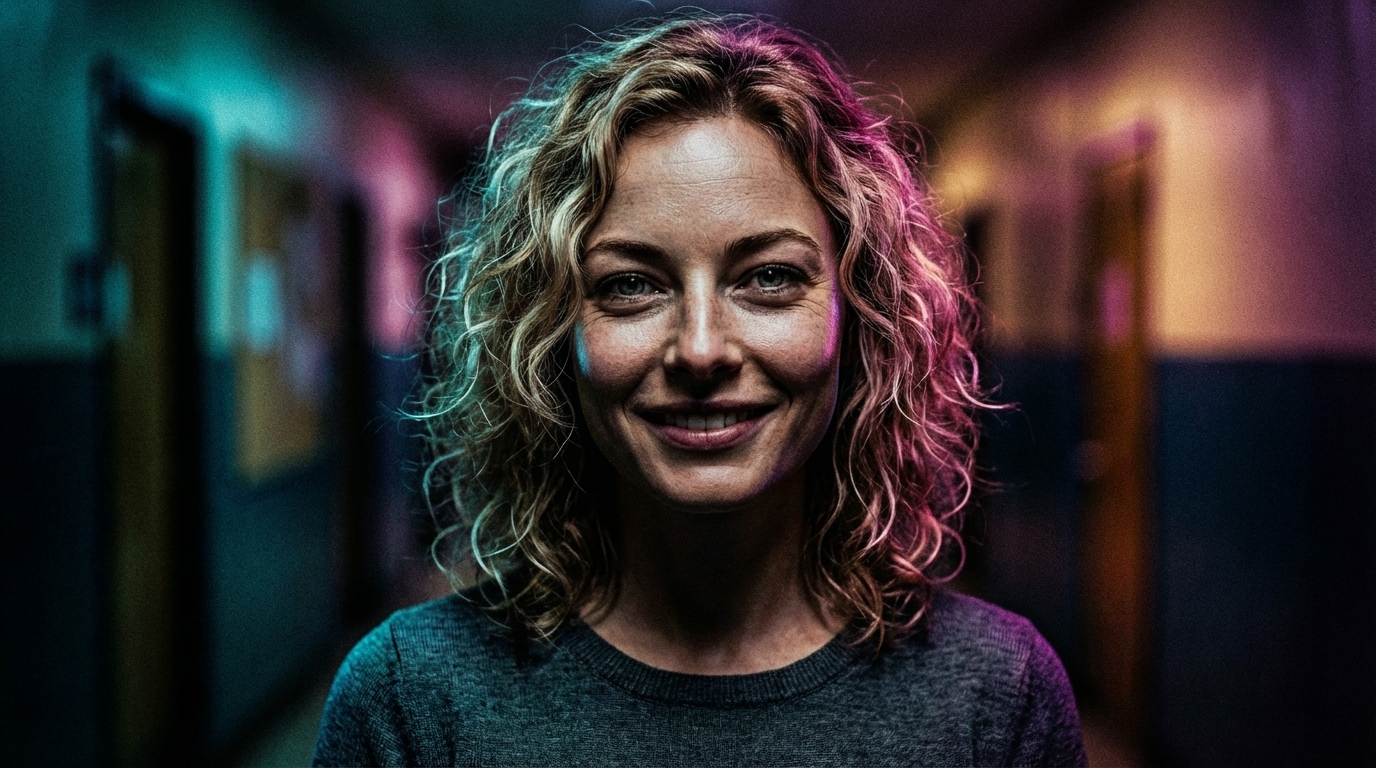
Jenny Alexandra Triffett (née Hodgman)
Born in Hobart in 1986, Jenny Alexandra Triffett built a distinguished career as a drama teacher and arts advocate, earning the 2016 Tasmanian Arts Educator Award for her innovative work at St. Michael's Collegiate School. Her dedication to nurturing young talent through inclusive, dynamic teaching defined her professional life until July 2018, when her husband Nial's mysterious disappearance preceded her own transition to Clivilius, where she continues educating Bixbus's children whilst forever separated from her grieving Earth family.
Early Life and the Hodgman Heritage
Born on 15 April 1986 at Royal Hobart Hospital, Jenny Alexandra Hodgman arrived as the middle child of Wayne and Rowena Hodgman, entering a household where creativity wasn't merely encouraged—it was foundational. Wayne, a distinguished professor of literature, and Rowena, a renowned concert pianist, had created a home where intellectual rigour and artistic expression existed in deliberate harmony. The family dwelling in Hobart became a space where evenings resonated with piano sonatas, spirited literary debates, and the kind of cultural richness that shapes children before they possess language to describe it.
Jenny's position between her older brother Robert, born in 1982, and younger brother Kevin, born in 1990, placed her in the family's emotional centre. Kevin, who would become a historian, inherited their father's scholarly precision. Robert, destined for engineering, demonstrated their mother's disciplined approach to complex systems. Jenny synthesised both inheritances whilst forging something distinctly her own—a theatrical sensibility that transformed observation into performance, analysis into embodied expression.
The Hodgman household operated on principles of excellence tempered with genuine warmth. Wayne's literature students knew him as demanding but generous; Rowena's piano pupils experienced rigorous technique balanced with emotional depth. Their children absorbed these dual expectations: achievement mattered, but so did the humanity behind it. Family dinners featured discussions ranging from Tasmanian colonial history to contemporary theatre theory, from musical interpretation to the ethics of storytelling. Jenny listened, contributed, and increasingly recognised that she processed the world through dramatic rather than purely intellectual frameworks.
St. Michael's Collegiate School became Jenny's proving ground. Between 1992 and 2003, she developed from a curious primary student into a confident young woman discovering her calling. Academically solid across subjects, Jenny demonstrated particular strength in English and the humanities—areas where interpretation and expression mattered as much as factual accuracy. But it was in the drama programme where Jenny truly flourished, finding a space where her family's creative legacy could manifest through her own distinctive voice.
School productions became Jenny's education within education. Cast repeatedly in leading roles, she absorbed lessons about presence, timing, emotional authenticity, and the delicate balance between serving text and bringing personal interpretation. Teachers recognised not just talent but genuine commitment—Jenny approached roles with the same methodical preparation her father brought to literary analysis and her mother applied to mastering complex piano pieces. She won multiple awards for acting and contributions to performing arts, establishing a reputation that would follow her back to St. Michael's years later as educator rather than student.
University, Nial, and the Foundation of Partnership
The University of Tasmania's Theatre Studies programme provided Jenny with academic framework for instincts she'd developed through years of performance. Between 2004 and 2007, she engaged deeply with directing, dramaturgy, and contemporary stagecraft whilst maintaining the strong work ethic her upbringing demanded. Her Bachelor of Arts wasn't merely about degree completion—it represented genuine intellectual and artistic development, transforming intuitive performer into thoughtful practitioner who understood theatre's theoretical foundations alongside its practical execution.
It was during a university production that Jenny met Nial Triffett, a fellow theatre enthusiast whose warmth and creativity immediately drew her attention. Nial, born 12 March 1986—just one month before Jenny—shared her passion for dramatic arts despite pursuing different career ambitions. Where Jenny saw theatre as vocation, Nial appreciated it as enriching element in life fundamentally oriented towards building and creating physical structures. This difference became complementary rather than divisive: Jenny brought Nial deeper into theatrical worlds; Nial grounded Jenny's sometimes abstract artistic inclinations in practical reality.
Their relationship developed through shared rehearsals, late-night discussions about performance theory, and growing recognition that their connection transcended mere romantic attraction. They were collaborators, intellectual partners, and eventually life partners whose differences strengthened rather than weakened their bond. Jenny's theatrical intensity found balance in Nial's steady pragmatism; Nial's sometimes solitary craftsman tendencies were softened by Jenny's social warmth and emotional expressiveness.
Graduating in 2007, Jenny faced the practical question all artists confront: how to transform passion into sustainable career. The answer came through recognising that teaching represented not compromise but calling—a way to nurture others' creativity whilst continuing her own artistic development through community theatre and directing projects.
Return to St. Michael's: The Drama Teacher
Jenny's appointment as drama teacher at St. Michael's Collegiate School in 2008 completed a circle whilst opening entirely new chapter. Returning to her alma mater, she brought not just qualification but genuine understanding of the institution's culture and values. This insider knowledge, combined with fresh university training, allowed Jenny to innovate within respected tradition—a balance her parents had modelled throughout her childhood.
Her teaching philosophy emerged from deeply held convictions about education's purpose. Jenny believed the classroom should be a dynamic space where students explored creative potential through a blend of performance, improvisation, and theatre history. She rejected rigid pedagogical approaches that prioritised uniformity over individual expression, instead fostering an inclusive environment where every student—regardless of natural talent—felt encouraged to take creative risks.
Jenny's classes became known for their energy and emotional safety. She taught technique rigorously but never allowed technical precision to overshadow authentic emotional engagement. Her students learned that great performance required both craft and courage, that theatre demanded vulnerability as much as skill. Former students would later describe her classes as transformative not just for theatrical training but for personal development—Jenny taught them to inhabit characters whilst discovering themselves.
School productions under Jenny's direction earned consistent praise for originality and student engagement. She introduced workshops on contemporary performance techniques, exposing students to experimental theatre forms that complemented traditional approaches. Where some drama programmes remained trapped in safe choices and conventional staging, Jenny pushed boundaries whilst maintaining quality standards. Her productions were ambitious but achievable, challenging but supportive—they stretched students without breaking them.
The 2016 Tasmanian Arts Educator Award recognised Jenny's exceptional contributions to fostering young talent and promoting dramatic arts within the community. The honour validated what colleagues and students already knew: Jenny wasn't merely teaching drama—she was shaping Tasmania's next generation of creative thinkers, whether they pursued theatre professionally or carried theatrical sensibilities into entirely different fields.
Marriage, Motherhood, and Balancing Acts
Jenny and Nial married on 25 June 2015 in a ceremony that perfectly reflected their shared creative spirit. The wedding incorporated theatrical elements—dramatic lighting, carefully choreographed moments, vows that read like beautifully crafted dialogue—whilst maintaining genuine emotional authenticity. Family and friends witnessed not performance but real love expressed through the couple's particular creative languages. Rowena watched Jenny marry someone who appreciated her artistry whilst grounding her in practical realities; Gerald and Margaret Triffett saw their son find a partner who understood his need to build things whilst encouraging his continued engagement with cultural pursuits.
The couple settled into a comfortable home in Fern Tree, a suburb perched on kunanyi/Mount Wellington's eastern slopes where Hobart's urban edges dissolved into wild Tasmanian bush. The pale blue weatherboard house, built in 1974, became their creative sanctuary—walls decorated with theatre posters and Jenny's own abstract paintings, shelves holding Nial's historical novels alongside Jenny's playwright collections, spaces that reflected both inhabitants' identities whilst creating something new together.
Samuel—"Sammy"—Triffett's birth on 24 October 2014 transformed Jenny and Nial from a couple into a family. Jenny approached motherhood with the same intentionality she brought to teaching, determined that Sammy would grow up immersed in artistic and cultural experiences without feeling pressured to follow any particular path. Family activities included theatre visits, gallery tours, local performances—exposing Sammy to creativity in its many forms whilst allowing him to discover his own interests.
Balancing full-time teaching with motherhood required careful choreography. Jenny maintained her classroom commitments whilst ensuring Sammy received the engaged parenting both she and Nial considered non-negotiable. The Triffett household operated on routines that accommodated Jenny's school schedule and Nial's sometimes irregular construction hours, creating stability within inherent unpredictability. Weekends became sacred family time—hiking Tasmania's remarkable landscapes, exploring Hobart's cultural offerings, or simply being together in their Fern Tree sanctuary.
Community Theatre and Artistic Continuation
Jenny's commitment to theatre extended well beyond St. Michael's walls. Beginning in 2010, she directed community theatre productions that earned reputation for bringing out exceptional performances from amateur actors. Her directorial approach emphasised collaboration over hierarchy, process over product—though the products themselves were consistently impressive. Local theatre enthusiasts knew that a Jenny Triffett production meant serious artistic work undertaken in a supportive, inclusive environment.
She conducted drama workshops for local youth, creating opportunities for young people outside formal educational settings to explore theatrical expression. These workshops attracted diverse participants—some aspiring to professional theatre careers, others simply seeking creative outlet or confidence-building experience. Jenny welcomed all, recognising that theatre's value extended far beyond professional performance to include personal development, community building, and cultural enrichment.
Her own creative practice continued through abstract painting—vibrant works reflecting her dynamic personality and imaginative spirit. Where her theatrical work involved collaboration and structured progression toward performance, painting offered solitary creative expression without predetermined outcome. The contrast satisfied different artistic needs: theatre for community and shared meaning-making, painting for private exploration and pure visual experimentation.
Jenny remained an avid reader, drawing particular inspiration from classic and contemporary playwrights whose works she often incorporated into her teaching and directing. She understood theatre not as isolated art form but as part of a larger cultural conversation spanning centuries and continents. This broader perspective enriched her pedagogy, allowing her to contextualise dramatic works whilst helping students recognise theatre's ongoing relevance to contemporary life.
Gathering Clouds: 2017-2018
The arrival of Buffy, their Dalmatian, in late 2017 brought unexpected joy during a period when Nial's business faced increasingly serious challenges. Triffett Fencing Solutions, founded in 2010 and grown to include landscape design and deck building by 2015, confronted financial strain following accounting errors that created cascading complications. Nial bore this burden with characteristic determination but visible stress. His usual warmth dimmed slightly; conversations became more guarded; the confident craftsman Jenny had married seemed diminished by circumstances beyond his control.
Jenny watched her husband struggle whilst managing her own professional demands. The 2018 school year brought usual challenges intensified by growing concern about both Nial's state of mind and Sammy's recent behavioural changes. Their four-year-old son exhibited disturbing patterns—unexplained bruises, sudden aggression, sleep disruptions that left Jenny exhausted and increasingly frightened. Paediatric appointments provided no clear answers, medical professionals suggesting various possibilities whilst Jenny's maternal instincts insisted something was profoundly wrong.
The strain affected their marriage in ways neither addressed directly. Nial's preoccupation with business survival meant less emotional availability for Jenny's concerns about Sammy. Jenny's focus on their son and her teaching responsibilities left little energy for supporting Nial through his professional crisis. They remained loving partners but increasingly isolated within their separate anxieties, communication reduced to practical coordination rather than genuine emotional connection.
By July 2018, the Triffett household existed in a state of anxious suspension. Jenny maintained her professional facade—"the show must go on" becoming more mantra than choice—whilst privately terrified about both husband and son. Their Fern Tree home, once a sanctuary, felt increasingly like a stage set concealing rather than protecting what transpired within.
The Disappearance: July 2018
The morning of 28 July 2018 began with phone call Jenny pretended not to hear. In pre-dawn darkness, Nial's whispered conversation confirmed her mounting suspicions that he was keeping secrets, taking actions he couldn't or wouldn't explain. When he left that morning claiming meeting with potential client, Jenny's unease crystallised into something approaching dread—though she lacked vocabulary for premonition that proved devastatingly accurate.
The day itself fragmented into series of increasingly disturbing developments. Sammy's scheduled appointment with Dr Carmichael revealed nothing medically conclusive whilst reinforcing Jenny's conviction that her son's problems transcended conventional paediatric understanding. Returning home to an empty house and absent husband, Jenny discovered Nial's usually locked office standing open, papers suggesting troubling connections she couldn't fully process before realising Sammy had also vanished.
Finding her four-year-old outside, claiming encounters with mysterious figure described in terms no child should know, pushed Jenny toward breaking point. When Nial failed to return by evening, when phone calls went unanswered, when every reasonable explanation evaporated leaving only impossible ones, Jenny did what desperate people do: she sought help from authorities fundamentally unprepared to believe her.
The police response embodied institutional dismissal Jenny would encounter repeatedly. Officers suggested marital problems, implied Nial had simply left, treated her terror as overreaction born of denial rather than legitimate response to genuine crisis. Only later, when Detective Karl Jenkins became involved, did Jenny encounter someone who actually listened—though by then, events had progressed beyond intervention's capacity to prevent catastrophe.
Rowena's arrival that evening brought complicated comfort. The relationship between mother and daughter had always carried tension—Rowena's exacting standards and strong opinions sometimes clashing with Jenny's more flexible, empathetic approaches. But crisis revealed a deeper connection: Rowena stepped up to provide practical and emotional support Jenny desperately needed, caring for Sammy whilst Jenny navigated police bureaucracy and her own mounting panic.
Transition to Clivilius: The Unimaginable Journey
The circumstances of Jenny and Sammy's transition to Clivilius remain partially obscured by trauma and impossibility. At some point following Nial's disappearance, through mechanisms involving Luke Smith and the same inter-dimensional forces that had taken Nial, Jenny and Sammy also crossed from Earth to Clivilius.
Reunion with Nial in Bixbus, the settlement Luke Smith had established, didn't erase the trauma of their separation or immediately restore their marriage to previous equilibrium. They'd both changed during their time apart—Nial through his solo adaptation to the new world, Jenny through weeks of not knowing whether her husband lived or had died. Their reunion was joyful but complicated, requiring navigation of accumulated grief, unprocessed fears, and fundamental questions about what it meant to be a family unit in world neither had chosen to inhabit.
Bixbus in 2018 was a frontier settlement struggling toward stability. Jenny arrived to find a community desperately needing her skills but lacking infrastructure to support traditional teaching. She adapted with characteristic resourcefulness, helping establish The Learning Grove—an educational space fashioned from shipping containers and sheer determination.
Her theatrical expertise proved invaluable in building Bixbus's emerging cultural identity. Drama workshops became spaces where settlers—many traumatised by their own involuntary transitions—could explore their experiences through creative expression. Jenny understood that theatre offered not just entertainment but community building, emotional processing, and cultural continuity. In a world where familiar reference points had dissolved, shared performances created new traditions and collective meaning.
The Triffett family expanded when they took in Alexander Javier Martinez, a brilliant young boy separated from his parents during the 2018 Brisbane School Bus tragedy that brought multiple children to Bixbus. Alexander, born 5 March 2012, arrived with a deep passion for astronomy and need for a stable family environment.
Parenting Alexander alongside Sammy tested and ultimately strengthened Jenny and Nial's relationship. Caring for a traumatised child from a different family required extending themselves beyond their own grief and adjustment struggles. It forced them to become a family capable of absorbing others' pain whilst processing their own, to create a home that acknowledged loss whilst building something new from its aftermath.
Education in Bixbus
As Bixbus evolved from desperate frontier outpost to functioning settlement, education systems evolved correspondingly. Jenny's transition from The Learning Grove to Bixbus School in late 2019 marked both a personal and communal milestone. The permanent school facility, though modest by Earth standards, represented Bixbus's commitment to children's futures and recognition that education formed the foundation for any society hoping to endure.
Jenny's teaching at Bixbus School synthesised her St. Michael's experience with adaptations required by Bixbus's unique circumstances. Her students included children from multiple Earth locations, different socioeconomic backgrounds, and varying educational preparation—all processing the trauma of involuntary world transition whilst trying to continue normal childhood development. Jenny created a classroom culture that acknowledged these complexities whilst maintaining academic rigour and creative exploration.
Drama remained central to her pedagogy, but its purposes expanded beyond performance training. Theatre became a tool for processing collective trauma, exploring identity in the liminal space between Earth origins and Clivilius futures, building community across differences, and maintaining cultural connections to worlds students had lost. Productions might draw from Shakespeare or contemporary Earth plays, but they resonated with immediate relevance to audience living impossible circumstances.
Jenny collaborated with other educators establishing Bixbus's educational infrastructure—people from various Earth backgrounds with different teaching philosophies and expertise. Together they created system that honoured multiple traditions whilst adapting to Clivilius's realities. The challenge was finding balance between maintaining Earth educational standards and recognising that Bixbus students needed preparation for futures that might bear little resemblance to lives their parents had expected them to lead.
Family, Community, and Irrevocable Separation
The Triffett family in Bixbus bears surface resemblance to their previous Fern Tree existence—Jenny teaching, Nial working construction and fencing, Sammy growing from young child into capable student, Alexander pursuing his astronomical interests—but the similarities mask profound differences. They're refugees creating a new life from forced displacement, people who love each other whilst carrying individual and collective trauma, a family unit that expanded through crisis rather than conscious choice.
Jenny's relationship with Nial matured through their Clivilius experiences in ways that might never have occurred on Earth. Shared struggle and mutual reliance deepened their bond whilst also exposing limitations in their ability to fully heal each other's wounds. They remain partners in every meaningful sense but also recognise that some aspects of their respective transitions remain private, incommunicable even to the person who understands them best.
Her community involvement mirrors her Earth patterns whilst responding to Bixbus's specific needs. Jenny directs community theatre, conducts drama workshops, participates in cultural planning committees that consider how Bixbus should develop its artistic identity. She's recognised as a cultural leader, someone whose expertise and vision help shape settlement's evolving character. This recognition carries different weight than her St. Michael's reputation—in Bixbus, cultural leadership directly impacts community survival and cohesion in ways more immediate than in established Earth institutions.
The permanent separation from her Earth family represents an ongoing grief Jenny processes imperfectly. Wayne and Rowena believe their daughter dead, likely imagining various scenarios for how she and Sammy perished after Nial's disappearance. Kevin and Robert mourn a sister they'll never see again. Jenny carries this knowledge whilst unable to communicate truth or ease their pain. She exists simultaneously as a living person building Clivilius life and as a ghost haunting her family's memories—dual existence that defies comfortable resolution.
Similarly, Jenny's St. Michael's students and colleagues remember her as a disappeared person, a teacher whose fate remains mysterious. The 2016 Tasmanian Arts Educator Award winner simply vanished, leaving a gap in the school's drama programme and questions about what happened to the talented educator who'd touched so many lives. Jenny knows her legacy persists in students she taught, productions she directed, creative approaches she pioneered—but she'll never witness how that legacy develops or learn which students carried her influence into their own artistic or educational careers.

