Jargus-9B
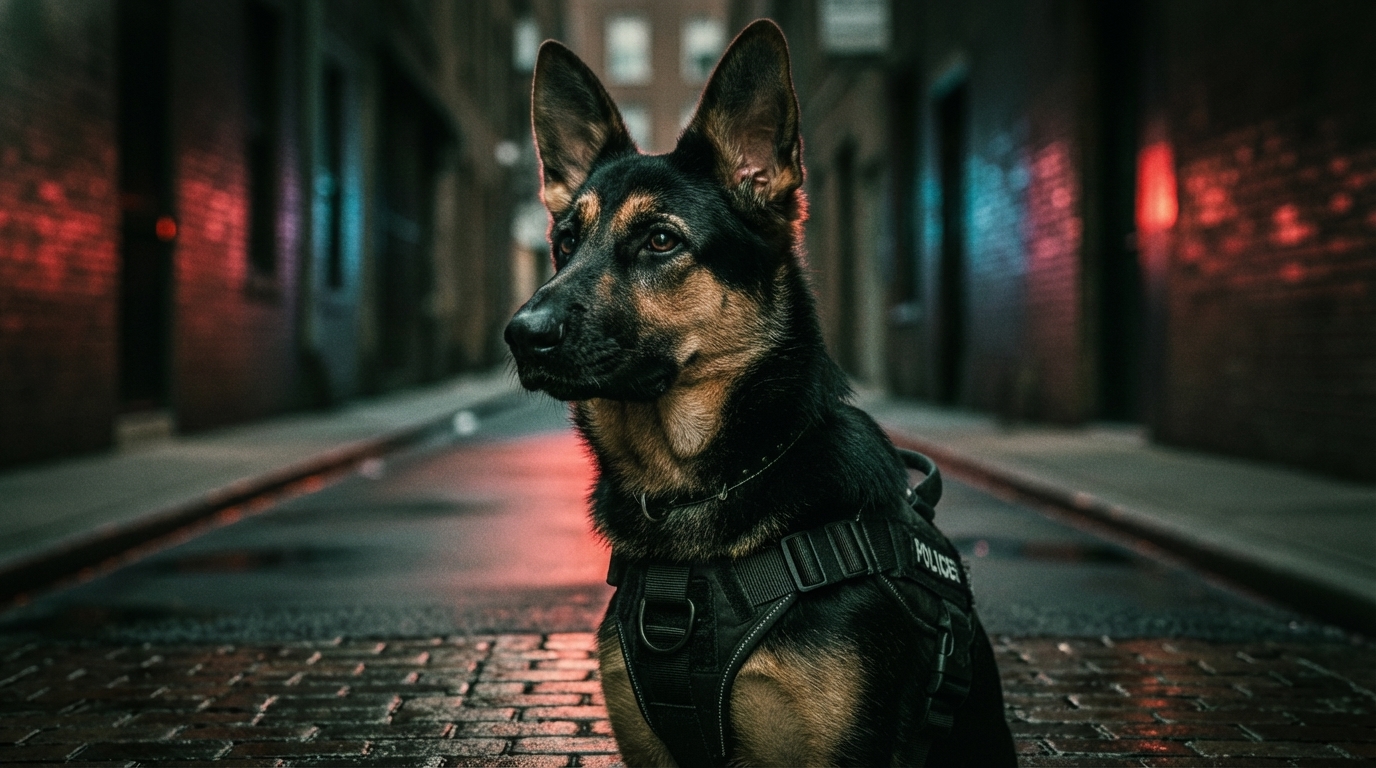
Jargus-9B, known as Jargus, is an exceptional German Shepherd born on 10 October 2015 into Tasmania Police's elite K9 breeding programme. Selected for his singular loyalty and investigative acuity, he was paired with Senior Detective Karl Jenkins in November 2017, forming a partnership that would transcend dimensions. Following Karl's mysterious disappearance on 2 August 2018, Jargus was retrieved from police custody by Guardian Beatrix Cramer and reunited with his handler in the frontier settlement of Bixbus, Clivilius, where he continues to serve as both peacekeeping companion and living symbol of justice in an unchartered land.
Early Life and Selective Breeding Programme
Birth: 10 October 2015, 3:47 AM
Registration: Jargus-9B (Ninth litter, Second pup)
Sire: Rex-4A (Distinguished Service Medal recipient, 2013)
Dam: Bella-7C (Multiple detection commendations, 2012-2014)
Birthplace: Tasmania Police K9 Breeding Facility, Rokeby Centre, Hobart
Born during an unseasonably cold spring morning, Jargus emerged as the second pup in a litter of seven at Tasmania Police's specialist breeding facility. The programme, established in 2008 under the direction of Dr Margaret Chen-Williams, represented a $2.3 million investment in developing police dogs specifically adapted to Tasmania's unique geographical challenges—dense bushland, mountainous terrain, and isolated rural properties.
From birth, Jargus exhibited traits that would define his exceptional career. Veterinary records from Dr Sarah Blackwood noted his "unusual alertness" within the first 48 hours—maintaining eye contact with handlers for periods exceeding typical neonatal behaviour. By six weeks, kennel supervisor Thomas Mitchell documented Jargus's tendency to separate from littermates during feeding, displaying what he termed "selective independence"—neither aggressive nor submissive, but deliberately solitary.
At twelve weeks, standardised aptitude testing conducted by Senior Handler Rebecca Thornton revealed scores placing Jargus in the 94th percentile for scent discrimination and 97th percentile for focus duration. Notably, his stress response metrics showed remarkable stability—heart rate variations under simulated gunfire remained within 12% of baseline, compared to the 35% average amongst his cohort.
Formal Training and Development
Training Commencement: 6 February 2017
Programme Director: Senior Trainer Claire Morgenstern
Primary Instructor: Sergeant Marcus O'Sullivan
Specialisation Track: Detective Support & Rural Operations
Certification Date: 28 October 2017
At sixteen months, Jargus entered formal police training at the Rokeby Centre under the oversight of Senior Trainer Claire Morgenstern, who directed Tasmania Police's entire K9 programme. Morgenstern, reviewing initial assessments, noted that Jargus demonstrated "an instinct for single-handler devotion" that marked him as unsuitable for routine patrol rotation but ideal for specialised detective partnership.
Day-to-day training fell to Sergeant Marcus O'Sullivan, a twenty-year veteran who had trained forty-three operational K9s. O'Sullivan's initial assessment, dated 8 February 2017, described Jargus as "methodical rather than impulsive—thinks before he acts, unusual for the breed at this age."
The training regime encompassed 1,200 hours across nine months, including:
- Scent Discrimination: 340 hours developing ability to distinguish individual human scents amongst contaminated scenes. Jargus achieved 94% accuracy in blind trials involving up to twelve distinct scent samples.
- Wilderness Tracking: 280 hours in Tasmania's Southwest National Park, including night operations. Successfully tracked subjects across 8.4 kilometres of dense bushland during final assessment.
- Evidence Preservation: 160 hours learning to indicate without disturbing crime scenes. Developed distinctive "soft alert"—sitting precisely 1.2 metres from evidence whilst maintaining unblinking eye contact with handler.
- Restraint Protocols: 220 hours mastering graduated force responses. Achieved rare "Zero Excessive Force" rating across all simulated apprehensions.
- Psychological Conditioning: 200 hours of stress inoculation, including exposure to crowds, gunfire, and chaotic environments. Maintained operational focus despite deliberate distractions.
During joint training exercises with the Major Crimes Unit in September 2017, Detective Inspector James Claiborne observed Jargus's performance and recommended him for the experimental Detective Partnership Programme—an initiative pairing senior detectives with specially selected K9s for complex investigations.
Partnership with Karl Jenkins
Official Pairing: 3 November 2017
Handler: Detective Karl Matthew Jenkins
Unit Assignment: Tasmania Police, Southern Division
Residence: 14B Davey Street, South Hobart (Karl's one-bedroom flat)
The selection process for Jargus's handler involved psychological profiling by Dr Elena Kosovich, who sought detectives demonstrating "emotional stability, methodical thinking, and capacity for non-verbal communication." Karl Jenkins, who had been promoted to Senior Detective earlier in 2017 following his success with the Blackwood Valley murders case, scored highest amongst twelve candidates.
Their initial meeting on 3 November 2017 was documented by Handler Coordination Officer Patricia Chen: "No treats exchanged, no commands given. Jenkins simply sat on the training ground for forty minutes. Jargus approached at minute thirty-seven, sat beside him without prompting. They remained there, silent, for another hour."
The mandatory six-week bonding period revealed an almost preternatural synchronisation. Jenkins's daily logs, recovered from his residence, describe Jargus's ability to anticipate his movements: "He knows when I'm about to leave before I've decided myself. Positions himself by the door minutes before I've consciously formed the intention."
Their first operational deployment came on 11 December 2017—a missing child case near Richmond. Eight-year-old Emma Cartwright had vanished from her family's vineyard. Whilst uniformed officers searched buildings, Jargus led Karl 2.3 kilometres through scrubland to an abandoned well where Emma had fallen whilst chasing her cat. The rescue, completed in darkness using only torchlight, established their reputation as an unconventional but effective team.
Operational History
Cases Worked: 47 documented investigations (December 2017 - July 2018)
Resolution Rate: 73% (compared to unit average of 61%)
Commendations: Three formal recognitions, including Distinguished Service Certificate
Between December 2017 and July 2018, Jenkins and Jargus worked cases ranging from missing persons to homicide investigations. Notable deployments included:
The Bywater Creek Incident (May 2018): Twenty-four-year-old seasonal worker Isaac Fairburn vanished from a Franklin property. Jargus tracked his scent to disturbed earth near the creek, discovering drag marks suggesting foul play. Though the case remained unsolved, Jargus's findings shifted it from "voluntary disappearance" to "suspicious circumstances," triggering expanded resources.
The Hobart Waterfront Murders (June 2018): Three bodies discovered over two weeks along the docks. Jargus identified trace evidence—a distinctive cologne—linking the scenes despite different disposal methods. His alerts led to security footage revealing suspect Marcus Dolby, resulting in arrest within 72 hours.
Operation Thornfield (July 2018): Joint operation with Federal Police targeting drug importation. Jargus detected concealed methamphetamine in shipping containers that had passed electronic scanning. Seizure valued at $14.7 million, largest in Tasmania that year.
However, success came with psychological cost. Case Officer Ronald Fitzgerald's performance review dated 15 July 2018 noted: "Jenkins increasingly isolated, declining social invitations, spending off-duty hours with only the K9 for company. Jargus appears to be his sole emotional outlet."
