James William Hedger
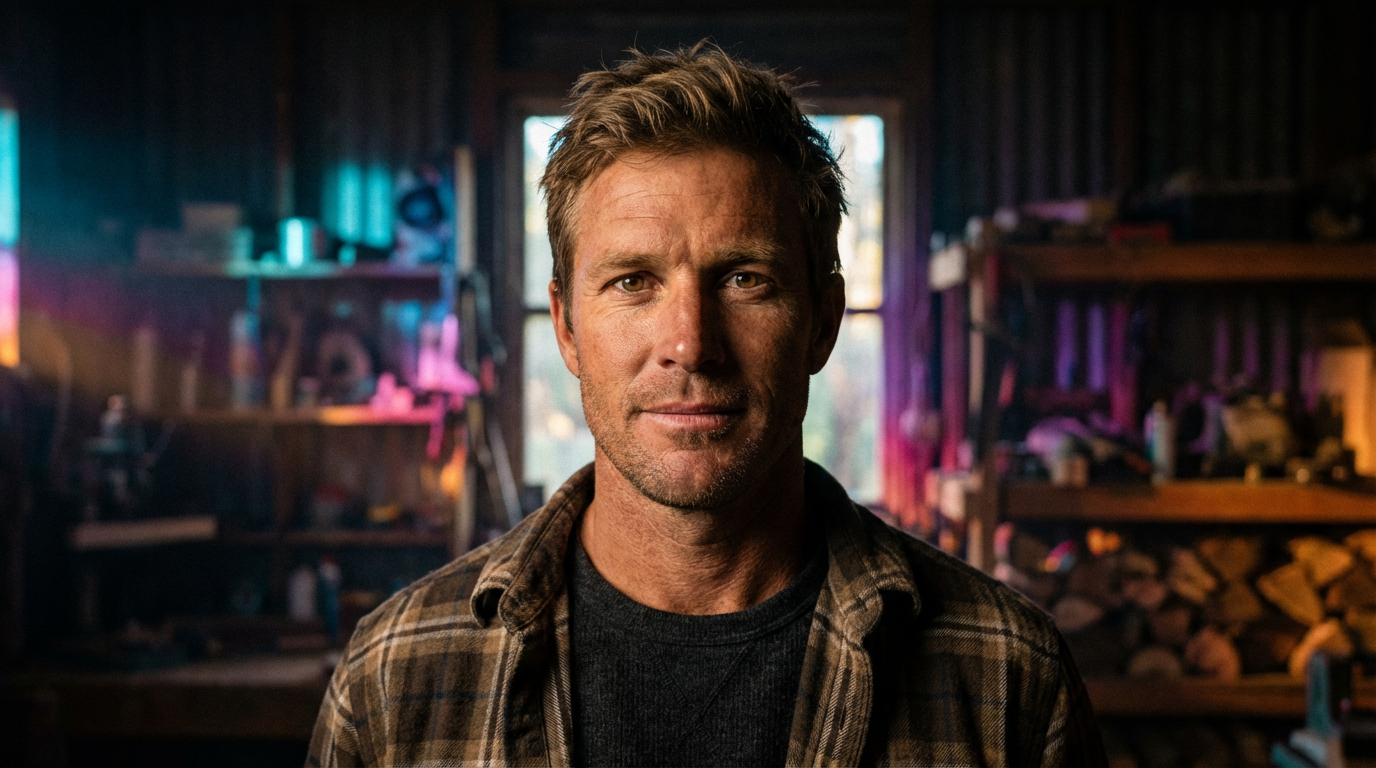
James William Hedger, born 15th August 1972 in Hobart, Tasmania, spent his adult life running Hedger Wood Delivery Services from his home in Collinsvale — a firewood supply business built from his father's timber work and sustained across three decades through straightforward reliability and an unhurried competence that his clients came to depend upon without thinking about it. He married Karen Mitchell in 1995 and raised two children in the same Collinsvale house where he still lives. He is not a complicated man, which is not the same as being a simple one.
Early Life and Family Origins
James William Hedger was born on 15th August 1972 at the Royal Hobart Hospital in Hobart, Tasmania, the first child of Thomas Robert Hedger and Mary Ellen Hedger (née Carroll). Thomas, a self-employed timber cutter and firewood contractor who had operated his one-man business out of the Derwent Valley since the late 1960s, was thirty-one at the time of James's birth. Mary, a homemaker four years younger than her husband, had grown up in New Norfolk, the eldest of five children in a close Catholic family. They had married in January 1971 at St Matthew's Church of England in New Norfolk, and James arrived eighteen months later, delivered into a world that was, by most measures, uncomplicated and content.
The family lived initially in a rented weatherboard house in New Norfolk, where Thomas would load his truck in the half-dark of autumn mornings and return in the late afternoon smelling of sawdust and petrol. It was a life built around physical work and seasonal rhythms — the woodpile shrinking through winter, the shed filling again each spring — and James absorbed those rhythms from infancy. His younger sister, Anna Louise Hedger, was born on 3rd March 1975, completing the family. James was a protective elder brother from the start, a role he occupied with the natural authority of someone who had never thought to question it.
When James was seven, Thomas moved the family to Collinsvale, a small rural community in the hills north-west of Hobart, purchasing a modest property with a large timber shed and enough land to stack and season several truckloads of firewood at a time. The house was old but sound — a single-storey weatherboard with a rusted corrugated roof, a covered veranda on the eastern side, and a kitchen that smelled permanently of wood smoke and fried onions. Thomas had found a place that suited his work perfectly. James grew up in it.
Boyhood in Collinsvale
Collinsvale in the late 1970s and early 1980s was a quiet community — a few dozen households scattered across the hill country, connected to each other by the familiarity of rural isolation rather than any formal civic identity. Children walked to the school bus, wandered the properties of neighbours without ceremony, and helped with adult tasks long before they were formally old enough to do so. James was no different. By the time he was nine or ten, he could split kindling reliably, stack a cord of firewood in the neat, tight columns Thomas demanded, and help load the truck without being told what to go next.
He was not a studious child, nor an especially athletic one, but he was steady. Teachers at Collinsvale Primary School noted his practicality and his patience — he was not easily frustrated, worked through problems with a quiet persistence, and got along with most people without any particular effort. He was also, by the account of those who knew him then, already possessed of a dry, unhurried humour that surfaced at unexpected moments and caught people off guard. Nothing sharp or at anyone's expense — just an instinct for absurdity delivered with a straight face that made people laugh before they'd quite realised why.
He was close to his mother, who read to him long past the age when most parents stopped, and who maintained a warmth in the household that balanced Thomas's more restrained character. Thomas was not an unkind man — simply a quiet one, more comfortable showing things than saying them. He taught James to drive a manual ute along the back paddock at twelve, to sharpen a chainsaw blade correctly at thirteen, and to never undercharge for a job at fourteen, which James took to heart and largely adhered to thereafter.
Anna was his best company through childhood. Three years his junior, she was quicker and more social than he was, possessed of an easy charm that James quietly admired without ever trying to imitate. They bickered with the comfortable frequency of siblings who genuinely liked each other, and James remained protective of her in the uncomplicated way he'd established from her birth.
School, Adolescence, and the Decision Not to Leave
James enrolled at New Norfolk High School in 1984, making the daily bus trip down from Collinsvale five days a week for six years. He moved through secondary school without particular distinction in any academic direction, performing adequately in practical subjects and English, less so in maths and science. He played in the school's footy team for two seasons before a knee injury in Year 10 ended his participation, and he never quite resumed competitive sport afterwards. He developed instead a preference for activities that were quietly physical and solitary or near-solitary — hiking through the forested ridgelines above Collinsvale, fishing the small tributaries of the Derwent with Thomas on weekends, and later, camping trips into the Central Highlands with a handful of friends who shared his preference for going somewhere remote and doing very little when they arrived.
He completed Year 12 in 1990 without a clear sense of what came next. Several classmates departed for university in Hobart or the mainland. James considered it — briefly, without much conviction — and concluded that nothing a degree would prepare him for held more appeal than the work already waiting for him at home. Thomas was fifty that year, the business was profitable, and the transition from employee-son to co-operator was both natural and necessary. James stepped into it without ceremony.
It would be easy, and somewhat wrong, to describe this as a failure of ambition. James simply understood, at eighteen, that he was where he was supposed to be. The hills above Collinsvale, the particular quality of light through eucalypt forest on a winter morning, the satisfaction of a load stacked well and delivered on time — these were not consolation prizes. They were the actual contents of the life he wanted.
Hedger Wood Delivery Services
Thomas formally registered the business as Hedger Wood Delivery Services in 1992, naming it in preparation for the hand-over that both men understood was coming. James was already operating as effectively equal partner by this point, managing most of the client rounds himself while Thomas handled the cutting and preparation. The business model was straightforward: residential and small commercial firewood delivery across the greater Hobart region, with particular density in the hill suburbs — Collinsvale, Glenfern, Ferntree, and surrounds — where wood heating remained the primary or supplementary warmth source for a significant proportion of households.
Thomas retired from active work in 1997, citing a persistent back injury he had been managing for several years longer than was wise. James assumed full ownership and operation at twenty-four. There was no ceremony to this, either. Thomas handed over the accounts folder and the business registration documents on a Tuesday afternoon and then went inside to watch the news. James put them in the filing cabinet and went back to splitting wood.
What James built over the following decades was not dramatic. He acquired a second truck in 2001, allowing him to service clients more efficiently and take on slightly larger commercial accounts — a few small businesses, a couple of holiday properties, several community halls that required bulk deliveries ahead of the cooler months. He hired a part-time labourer, Darren Whitsitt, from 2003 to 2009, and another, Corey Bassett, sporadically from 2011 onwards. The business never grew beyond these proportions, and James made no effort to push it further. He had enough work to keep him fully occupied, enough income to live without financial anxiety, and no particular desire to manage a larger operation.
His reputation was built on three things: reliability, quality, and honest pricing. Clients who called Hedger Wood Delivery Services could expect the delivery to arrive when James said it would, the wood to be seasoned and dry, and the invoice to reflect the work performed without padding. He did not overcharge. He did not undercut. He arrived on time, stacked the wood if asked to, and left without lingering. Across Collinsvale and the surrounding suburbs, this made him the kind of tradesman people mentioned to neighbours without being prompted — not effusively, but with the quiet confidence of someone recommending something that had never let them down.
Karen and the Life at Home
James met Karen Anne Mitchell at the Collinsvale Community Association's annual spring festival in October 1994. Karen, twenty-three at the time and twelve months his junior, was a registered nurse working at the Royal Hobart Hospital, where she had taken a position in the medical ward following her graduation from the University of Tasmania in 1992. She had grown up in Moonah, was the second of four children, and had the calm efficiency of someone accustomed both to managing other people's crises and to the particular social dynamics of a large and opinionated family.
She was not immediately drawn to James in any dramatic sense. He was present, unhurried, and funny in a way she hadn't anticipated — that quality of deadpan observation catching her off guard and making her laugh, which she hadn't expected from the quiet man with sawdust on his jacket. They talked for most of the afternoon about nothing particularly significant, which was the beginning of something that turned out to be quite significant indeed.
They married on 14th January 1995 at St John's Anglican Church in New Norfolk, a small ceremony attended by both families and a handful of friends. Karen moved into the Collinsvale property, where the house had been repainted and the veranda repaired in the preceding months in what James would never have described as romantic preparation but which clearly was. They settled into a domestic rhythm that suited them both: Karen's shift work at the hospital providing the household with a variable schedule that James, whose days were structured by outdoor labour and seasonal demand, found easy to work around.
Sarah Ellen Hedger was born on 4th June 1997, their first child, at the Royal Hobart Hospital — a small irony not lost on Karen, who had by then worked the ward for five years. Thomas James Hedger followed on 19th November 2000. The house that had once been simply James's family home became, gradually and without fuss, the household in which two more children grew up and absorbed its particular version of Tasmanian rural life.
James was a present and dependable father without being an especially demonstrative one. He coached Thomas's under-ten football team for three seasons, taught both children to drive in the same back paddock where Thomas had taught him, and took the family camping each January in a spot above Arthurs Lake that he had been visiting since his own adolescence. Karen handled the domestic organisation of the household with a competence that James relied upon more than he adequately acknowledged, and the occasional tensions that arose from this imbalance — the quiet accumulation of invisible labour that Karen carried — were negotiated with imperfect but genuine effort on both sides.
His parents remained close. Thomas died in 2008 of a cardiac event, at sixty-seven — a fact that arrived without warning and left James quieter than usual for a long time. Mary remained in the Collinsvale property after some family discussion, eventually moving to a smaller place in New Norfolk in 2012 to be nearer to Anna, who had married and settled there. James visited his mother reliably on Sunday afternoons, a habit he maintained without acknowledging it as a habit.
Character and Manner
James Hedger occupies a certain recognisable type of Tasmanian rural masculinity — physically capable, practically oriented, and sparing with words — but inhabits it with enough individual texture to resist the cartoon. He is large in the way of men who have done physical work their whole lives: broad-shouldered, heavy-handed, and comfortable in his own body without any vanity about it. He wears his age in his face and hands — weathered skin, stubbled jaw, the particular roughness of someone whose hands have been cold and damp and callused for thirty years. He is not unkind about his appearance, simply indifferent to it.
What distinguishes him from the stereotype is the humour. It is quiet and unhurried and tends to arrive slightly after you've stopped expecting it, delivered with a straightness of expression that makes it land harder than it has any right to. He does not laugh at the expense of people he respects, but he is not above a well-placed absurdity or an observation that punctures pomposity. He reads situations well — accurately, quickly, without making a show of it — and tends to say rather less than he's perceived.
He is also, beneath the steady surface, possessed of a stubbornness that Karen has navigated for thirty years. He is not reactive or aggressive; the stubbornness manifests instead as a refusal to be hurried, a preference for doing things in the order and manner that makes sense to him, and a resistance to being told what he already knows. He has never been much for confrontation. He will simply decline to be moved.
His emotional vocabulary is not extensive. He expresses affection through action — through presence, through the maintenance of things, through showing up — rather than language, a pattern he absorbed from Thomas and has never significantly revised. He is aware of this as a limitation, in the way that most such men are aware, which is to say imperfectly and intermittently.
Community Life
James's involvement with the Collinsvale Community Association stretched back to his late twenties, when Karen's natural inclination toward civic participation drew him in gradually and kept him involved through inertia and genuine fondness. He served on the fundraising sub-committee for seven years, contributed wood for community events requiring outdoor heating, and helped organise the annual spring festival for three consecutive years in the mid-2000s — a role he performed competently and declined to repeat a fourth time.
He received the Collinsvale Community Service Award in 2015, an honour that surprised him and which he accepted with the kind of brief, slightly awkward speech that made several people in the room quite fond of him. He thanked Karen, mentioned Thomas without elaborating, and sat down. It was the right length.
His knowledge of the hills around Collinsvale, accumulated over decades of deliveries and hiking, made him a practical resource in emergencies — he participated in local fire preparedness planning, lent his truck on at least two occasions to assist with the transport of materials after storm damage, and maintained the kind of informal watchfulness over the properties and people on his regular rounds that is never formally acknowledged but constitutes a real form of community care.
He also coached or assisted with junior football at New Norfolk for several seasons in the 2000s, more because Thomas's participation had created an expectation than because James particularly sought out the role. He performed it conscientiously. He was not a shouter on the sideline.
Later Life and Continuing Work
Sarah Hedger completed a nursing degree at the University of Tasmania in 2019 — a path that gratified Karen and prompted Thomas senior's occasional dry observation that the medical profession appeared to be a family business in the making. She took a position at the Royal Hobart Hospital's emergency department and later moved to Launceston, where she settled with her partner, Dylan Marsh. James drove up to visit them twice a year with a regularity that he maintained without making a fuss about the distance.
Thomas junior, after a brief period at TAFE studying building and construction, joined his father in the business in 2022. He was, by James's assessment delivered with characteristic understatement, a reasonable worker with good instincts who took directions better than his father had at the same age — which was true, though Thomas junior's own reading of his father's instruction style might not have agreed. They worked together without friction and with the occasional evidence of inherited humour, which pleased Karen enormously.
Karen returned to part-time work at the hospital in 2019 after a period of full-time domesticity, transitioning into a community health nursing role that suited her experience and her preference for work that was structured but not relentless. Their marriage, at over thirty years, had acquired the settled quality of a thing that has been tested and held — not without accumulated wear, but held nonetheless.
James turned fifty-three in August 2025. His hair, which had been sandy-brown and unremarkable, had gone largely grey in his mid-forties. The knee that had ended his football in Year 10 required occasional management. He continued to work long days in the cooler months and quieter ones in summer, the seasonal rhythm of the business unchanged in any essential respect from the one Thomas had established. He still drove the morning rounds himself, still stacked wood when asked to, still left without lingering.
The house in Collinsvale, which had received a bathroom renovation in 2016 and new guttering in 2023, was still the house. The shed was still the shed. The view from the veranda across the hill country to the east was the same view he had looked at for most of his life.
He was not a man who thought of himself in terms of what he had achieved or what he might have done differently. The life had been what it was — not grand, not dramatic, and thoroughly, quietly his own. The hills were still there. The wood still needed splitting. The clients still called, and he still arrived on time.
