Jackson William Roberts
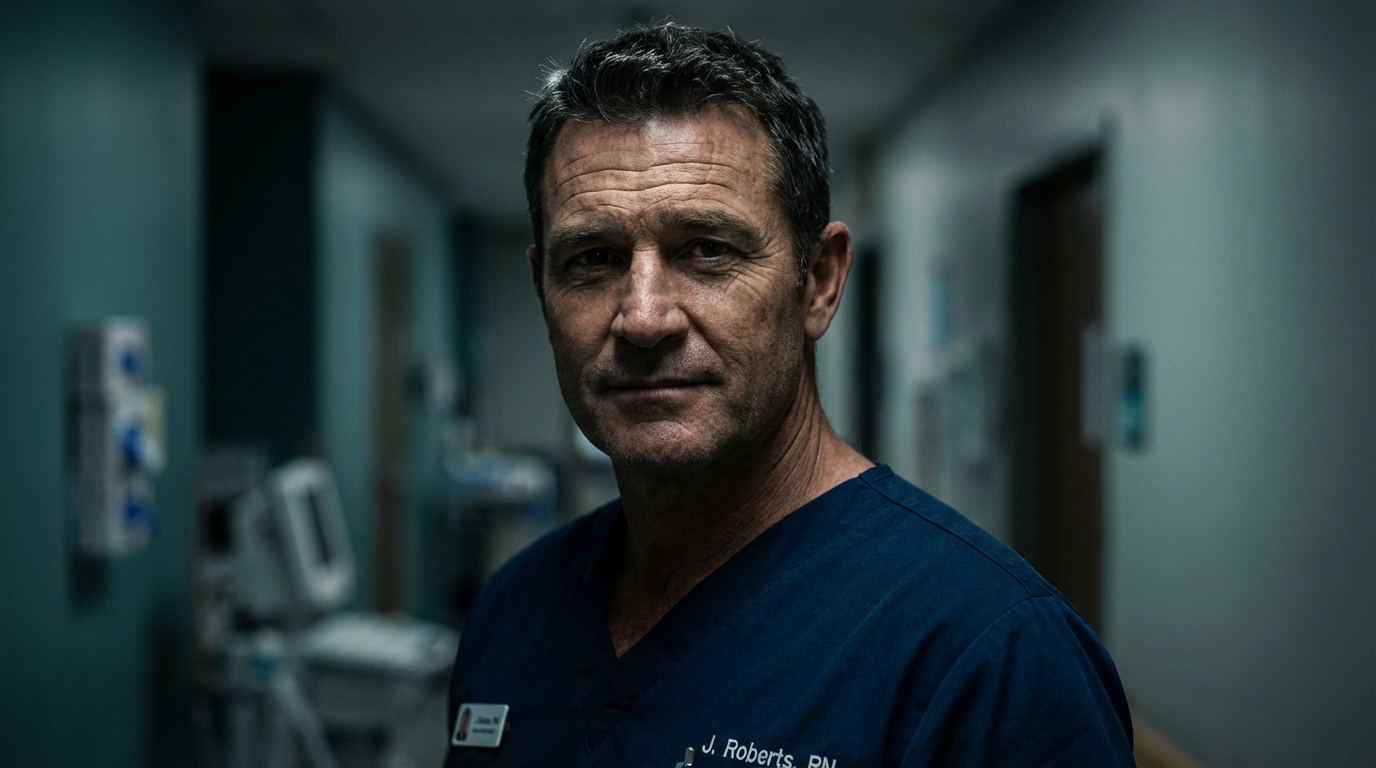
Jackson William Roberts, born 5 November 1970 in Launceston, Tasmania, is a senior nurse whose career spans construction sites, emergency departments, and ultimately another world. After sixteen years at Royal Hobart Hospital specialising in emergency care, Jackson was deployed through a portal to Clivilius in August 2018. Unable to return to Earth, he established the Royal Bixbus Hospital's healthcare infrastructure, channelling decades of trauma expertise into building medical systems from nothing.
Early Life and Family Service
Jackson William Roberts was born on 5 November 1970 at Launceston General Hospital in northern Tasmania, the first child of William Roberts, a firefighter, and Margaret Roberts (née Anderson), a registered nurse. His birthplace, at the confluence of the North and South Esk Rivers, was Australia's third-oldest European settlement and already possessed a rich medical history—home to the Southern Hemisphere's first operation using ether anaesthesia in 1847. This heritage of medical innovation would prove prophetic for Jackson's later achievements, though none could have predicted the extraordinary circumstances under which his healing skills would ultimately be tested.
The Roberts household embodied Tasmania's culture of community service. William's career with the Tasmania Fire Service meant irregular hours, dangerous calls, and the particular stoicism that defined emergency responders of his generation. Margaret worked at Launceston General Hospital's surgical ward, bringing home stories of medical crises managed and lives saved through competent intervention. Their son absorbed lessons about duty, composure under pressure, and the profound satisfaction of helping others during their most vulnerable moments—values that would define his adult life.
Jackson's childhood unfolded against Tasmania's rugged wilderness. The family lived in Riverside, a suburb where the bush met suburbia, and young Jackson spent countless hours exploring the surrounding landscape. Cataract Gorge became his playground—the dramatic cliffs, the suspension bridge, the walking tracks through native forest teaching him to read terrain, assess risk, and find beauty in harsh environments. These early experiences cultivated both physical confidence and an appreciation for nature that would sustain him through decades of demanding work.
Education and Early Aspirations
In 1976, Jackson commenced primary education at Scotch Oakburn College, one of Tasmania's oldest independent schools. The institution's emphasis on outdoor education suited his temperament perfectly. He excelled in physical education and science, subjects that engaged both his athletic capabilities and emerging intellectual curiosity. Teachers noted a student who demonstrated natural leadership on sports fields but preferred observation to performance in academic settings—absorbing information quietly rather than seeking attention through vocal participation.
Jackson's secondary education (1983–1988) revealed interests that would prove foundational to his later career. He captained the school's rugby team, learning lessons about teamwork, resilience, and maintaining composure when physically tested. Science courses, particularly biology and chemistry, engaged his curiosity about how living systems functioned and failed. But it was an elective in first aid that sparked something deeper—the practical application of knowledge to preserve life, the satisfaction of competent intervention during crisis, the profound responsibility of being the person others depended upon when everything went wrong.
Despite this emerging interest in healthcare, Jackson didn't pursue nursing immediately after graduation. The path wasn't obvious for young men in late-1980s Tasmania, where nursing remained coded as feminine work despite slow cultural shifts. Instead, Jackson followed what seemed a more conventional masculine trajectory—entering the construction industry, where physical strength, practical skills, and outdoor labour aligned with his capabilities and interests.
Construction Years and the Pivotal Injury
From 1989 to 1998, Jackson worked across various construction projects throughout Tasmania. He started as a general labourer, gradually developing specialised skills in formwork and concrete finishing. The work was physically demanding, often dangerous, and taught him lessons about precision under pressure, systematic problem-solving, and the importance of proper safety protocols—lessons that would translate surprisingly well to emergency nursing.
His construction career took him to remote sites across the state—hydroelectric projects in the Central Highlands, road works along the wild west coast, building developments in expanding regional centres. These experiences deepened his connection to Tasmania's landscape whilst providing exposure to working-class culture, practical problem-solving methodologies, and the particular camaraderie that developed amongst crews engaged in difficult physical labour.
The pivotal moment arrived on a construction site near Deloraine in early 1998. A co-worker suffered a significant injury when scaffolding collapsed—a compound fracture of the tibia with considerable blood loss and genuine risk of shock. Jackson, who'd maintained his first aid certification through the years, found himself providing critical care whilst waiting for ambulance response. His calm assessment, proper wound management, and ability to keep the injured man conscious and stable made the difference between recovery and potential tragedy.
In the aftermath, Jackson experienced a profound clarity about his future. The satisfaction he'd felt during those critical minutes—applying knowledge to preserve life, maintaining composure whilst others panicked, being the person who made outcome better through competent intervention—revealed what had been missing from his construction work. He'd found his calling, even if it took a decade of detour to discover it.
Nursing Education and Professional Formation
At twenty-eight years old, Jackson enrolled in the Bachelor of Nursing programme at the University of Tasmania in 1998. The decision represented both courage and commitment—leaving stable employment, taking on student debt, entering a profession where mature-age male students remained uncommon. His classmates were predominantly women fresh from secondary school, making Jackson's life experience and physical presence distinctive within the cohort.
The university's nursing programme proved intellectually rigorous and emotionally challenging. Jackson excelled in anatomy, physiology, and pathophysiology—subjects where his methodical approach and genuine interest in biological systems served him well. Clinical placements revealed natural aptitudes for patient assessment, crisis intervention, and maintaining therapeutic presence during high-stress situations. Supervisors noted a student who demonstrated unusual composure during emergency scenarios, who could assess rapidly whilst maintaining empathetic connection with distressed patients.
His construction background provided unexpected advantages. Jackson understood physical labour, practical problem-solving, and working in environments where mistakes carried serious consequences. He'd developed habits of checking his work, following systematic procedures, and maintaining focus despite fatigue or distraction—all directly applicable to nursing practice. The transition from building structures to healing bodies felt less dramatic than outsiders might imagine; both required precision, attention to detail, and accepting responsibility for outcomes.
Jackson specialised in emergency nursing during his final year, completing advanced practicum placements in Royal Hobart Hospital's Emergency Department. The chaotic environment—the constant stream of trauma cases, the need for rapid assessment and intervention, the requirement for composure when situations deteriorated—engaged his capabilities fully. He graduated with honours in 2002, his academic transcript reflecting both theoretical understanding and exceptional clinical performance.
Royal Hobart Hospital: Building Expertise
Jackson commenced permanent employment at Royal Hobart Hospital in late 2002, joining the Emergency Department as a Registered Nurse. The posting would define the next sixteen years of his professional life, transforming him from a competent graduate into one of Tasmania's most experienced emergency nurses.
His early years involved the standard progression through emergency nursing competencies—triage assessment, trauma management, cardiac emergency response, psychiatric crisis intervention. Jackson absorbed protocols systematically, developing the clinical judgement that distinguished experienced practitioners from novices. He learnt to read situations rapidly, anticipate deterioration before obvious signs appeared, and maintain therapeutic relationships with patients whilst implementing necessary interventions.
By 2006, Jackson had advanced to Senior Nurse status, a promotion recognising both technical competence and leadership capabilities. His colleagues valued his steadiness during critical incidents—the way Jackson's composure seemed to spread to others during chaos, how his systematic approach to crisis management provided structure when situations threatened to overwhelm. Younger nurses sought his mentorship, finding in Jackson a teacher who explained without condescension, who shared knowledge generously, who treated nursing as a profession worthy of intellectual respect.
The Emergency Department exposed Jackson to Tasmania's full spectrum of human crisis. Farming accidents from rural properties. Suicide attempts requiring psychiatric assessment and compassionate intervention. Domestic violence injuries demanding both medical treatment and careful documentation for potential legal proceedings. Motor vehicle trauma testing the limits of his resuscitation skills. The constant flow of human suffering could have produced cynicism or compassion fatigue, but Jackson maintained remarkable emotional balance—genuinely caring about outcomes whilst protecting himself from the cumulative weight of tragedy.
His expertise in emergency nursing developed particular depth in trauma management. Jackson became known for excellent assessment of multi-system injuries, for maintaining calm during complicated resuscitations, for working effectively with medical staff whilst advocating appropriately for patient needs. His physical strength proved advantageous during patient transfers and restraint situations, but colleagues noted it was Jackson's emotional steadiness that truly distinguished his practice.
Outside of direct patient care, Jackson contributed to staff development and hospital-wide emergency preparedness. He participated in trauma training for junior staff, helped refine triage protocols, and served on committees reviewing critical incidents. His construction background occasionally surfaced in unexpected ways—Jackson could jury-rig broken equipment, improvise solutions when standard resources weren't available, and approach practical problems with creative pragmatism.
Life on Earth: Family and Wilderness
Jackson's personal life during his Royal Hobart Hospital years reflected the same steadiness that characterised his professional practice. He maintained a long-term partnership with Laura Bennett, a teacher he'd met through mutual friends in 2004. Their relationship developed without drama—two adults who appreciated each other's company, shared values around community service, and built domestic life around mutual support rather than romantic intensity.
The couple had two children—Thomas, born in 2007, and Lily, born in 2010. Jackson approached fatherhood with the same methodical care he brought to nursing, attending to his children's needs with patient attention whilst maintaining boundaries that protected family time from professional demands. Weekend mornings often found Jackson and his children exploring Tasmania's wilderness—the same landscapes he'd known since childhood now shared with the next generation, teaching them to read weather, assess terrain, and find joy in natural spaces.
His leisure time maintained strong connections to outdoor activities. Jackson hiked regularly, often accompanied by Max, a loyal border collie who'd joined the family in 2009. The Tasmanian wilderness provided necessary counterbalance to emergency department intensity—the silence of mountain ranges, the challenge of difficult tracks, the satisfaction of physical exertion pursued for its own sake rather than professional necessity. These excursions renewed Jackson's capacity for the emotional demands of emergency nursing, providing psychological space where crisis and suffering didn't dominate his consciousness.
Final Weeks at Royal Hobart Hospital
The final weeks of July 2018 passed without indication of how dramatically Jackson's life would soon transform. His shifts followed familiar patterns—triaging patients, managing trauma resuscitations, providing care during the controlled chaos that defined emergency department operations. On 29 July 2018, Jackson treated Detective Sarah Lahey, who'd presented with a lacerated palm and concussion following what she claimed was a fall during a residential search. He'd sutured her wound with careful precision, noting inconsistencies in her account whilst respecting her right to maintain whatever fiction she'd constructed. The interaction seemed routine—one of countless similar cases, easily forgotten amongst the constant stream of injuries requiring attention.
Jackson couldn't have known that this encounter would later be documented in archived materials, or that Detective Lahey would die under mysterious circumstances just days later. He simply provided competent care, completed proper documentation, and moved on to the next patient requiring attention. It was what he'd been trained to do, what sixteen years of emergency nursing had perfected—treating each case with appropriate focus before releasing it from memory to make space for whatever crisis arrived next.
By early August 2018, Jackson had accumulated nearly two decades of emergency nursing experience. He was forty-seven years old, established in his profession, embedded in family and community. His expertise was recognised throughout Tasmania's medical community, his reputation solid, his future trajectory predictable—continued work at Royal Hobart Hospital, eventual retirement, grandchildren, and more years exploring Tasmania's wilderness with ageing but faithful Max.
And then Pierre De Bruyn called.
The Portal Deployment and Point of No Return
On 5 August 2018, Jackson answered an urgent page from Dr. Pierre De Bruyn, Royal Hobart Hospital's Chief Medical Officer. The briefing was delivered with measured urgency that masked the profound deception at its core—a catastrophic incident requiring immediate medical response, a multidisciplinary team being assembled, his specific skills essential for the mission. What De Bruyn didn't reveal was that the deployment would be one-way, that Jackson was accepting permanent exile from Earth with incomplete information.
The team assembled rapidly—Dr. Emily Nguyen, a trauma surgeon whose technical brilliance complemented Jackson's emergency expertise; Alex Torres, a paramedic whose field experience would prove invaluable; and several other medical professionals selected for complementary skills. They gathered equipment, reviewed briefing materials, and prepared for what they believed would be a challenging but temporary deployment. The Portal's existence was explained as classified technology, the destination described vaguely as "remote incident site," the timeline deliberately ambiguous.
Jackson stepped through the Portal that afternoon, driving an ambulance loaded with medical supplies through dimensional space, emerging into Clivilius's dust-thick chaos. The transition was disorienting—familiar hospital corridors giving way to alien landscape, Earth's afternoon becoming Clivilius's harsh daylight, the certainty of home replaced by immediate crisis demanding his full attention.
The scene that greeted Jackson exceeded anything his sixteen years of emergency nursing had prepared him for. A school bus lay crumpled amongst unforgiving terrain, dozens of injured passengers requiring immediate triage and treatment, resources desperately inadequate for the scale of disaster. But this was exactly the kind of crisis where Jackson's steady competence became most valuable—his hands moving with precise efficiency whilst his mind processed assessment, prioritisation, and systematic intervention.
For the first fifteen to thirty minutes, Jackson coordinated the initial medical response. His calm authority transformed chaos into organised care—guiding other responders, establishing triage protocols, ensuring critically injured patients received immediate attention. He stabilised David Nguyen's dislocated shoulder, splinted Lucas White's fractured leg with makeshift materials, provided reassurance to terrified children whilst simultaneously treating their injuries. The "welcome sound of help arriving" that survivors later described carried Jackson's decades of expertise into an alien landscape, proving that true healing begins not with perfect equipment but with unshakeable competence under impossible circumstances.
Only after the immediate crisis had been managed did Jackson learn the devastating truth—the Portal wasn't reopening, the deployment wasn't temporary, and he would never return to Earth. Everything he'd left behind that morning—Laura, Thomas, Lily, Max, his home, his career, his entire life—had been severed in an instant by a decision made without his informed consent. The magnitude of this loss would take months to fully process, but in the moment, Jackson did what emergency nurses do—compartmentalised his personal catastrophe and focused on the work requiring his immediate attention.
Building Healthcare in Bixbus
The initial weeks after the bus collision were characterised by desperate improvisation. Jackson and his fellow stranded medical professionals established emergency treatment protocols using salvaged equipment and whatever supplies they'd brought through the Portal. Basic canvas tents became treatment areas, storage crates transformed into examination tables, and improvised record-keeping replaced the sophisticated systems they'd left behind on Earth.
Jackson's construction background proved unexpectedly valuable during this period. He could assess structural integrity of makeshift facilities, jury-rig equipment when standard solutions weren't available, and approach infrastructure challenges with practical problem-solving honed across decades. His steady leadership helped coordinate the disparate medical professionals into a functional team, his emergency nursing experience providing frameworks for systematising care even in chaotic conditions.
As Bixbus evolved from crisis encampment to permanent settlement, Jackson became instrumental in developing sustainable healthcare infrastructure. The initial emergency tent gave way to modular medical units—still basic but increasingly sophisticated, incorporating proper examination areas, basic surgical capability, and storage for expanding medical supplies. Jackson's input shaped these developments, his sixteen years of emergency department experience informing decisions about patient flow, equipment placement, and operational protocols.
The establishment of the Bixbus Medical Centre represented a profound transformation—from desperate improvisation to systematic healthcare delivery. Jackson served as a cornerstone of this development, his expertise in emergency care becoming the foundation upon which broader medical services could be built. He developed triage protocols adapted to Bixbus's specific challenges, trained other settlers in basic medical response, and maintained standards of care that honoured his professional formation even whilst accepting the reality of severely limited resources.
By 2019, the Medical Centre had evolved sufficiently to warrant formal recognition as the Royal Bixbus Hospital—a name that acknowledged both its Earth heritage and its permanent place in Bixbus society. Jackson held the position of Senior Nurse in the Emergency Unit, a role that combined direct patient care with administrative responsibility for developing the hospital's emergency capabilities. His presence transformed clinical efficiency into compassionate art, his steady demeanour providing reassurance to patients whilst his technical expertise ensured competent intervention during crises.
Exile and Adaptation
Jackson's adaptation to permanent exile represents a complex psychological journey that continues to unfold. The loss of his Earth family—Laura, Thomas, and Lily—created grief that couldn't be fully processed whilst simultaneously managing the demands of establishing healthcare infrastructure. He maintained connection through whatever communication channels Bixbus developed, but the physical separation remained absolute. Watching his children grow through limited digital contact whilst being unable to participate in their daily lives, unable to provide hands-on fathering, represented an ongoing wound that professional competence couldn't heal.
His relationship with the wilderness found unexpected continuity in the region's uncharted landscapes. Jackson explored Bixbus's surrounding terrain during limited free time, discovering ecosystems that nonetheless satisfied the same need for natural spaces that had sustained him through years of emergency nursing. The act of walking unfamiliar trails, reading foreign terrain, and finding beauty in harsh environments provided psychological continuity with his Earth life—a way of remaining himself despite circumstances that could have shattered his identity entirely.
