4338.210 · July 29, 2018 AD
Islands Don’t Let You Leave
Back in the office, Karl Jenkins balances lies, open wounds, and the growing suspicion of his partner, Sarah. As a new disappearance mirrors the others too closely to ignore, the pattern tightens its hold — three men gone, three families pleading, one detective running out of ways to stay invisible. When an old name resurfaces, Karl begins to suspect that the truth isn’t spreading outward — it’s circling him.
“When too many people vanish the same way, you stop calling them coincidences. You start calling them patterns—and patterns always lead somewhere.”
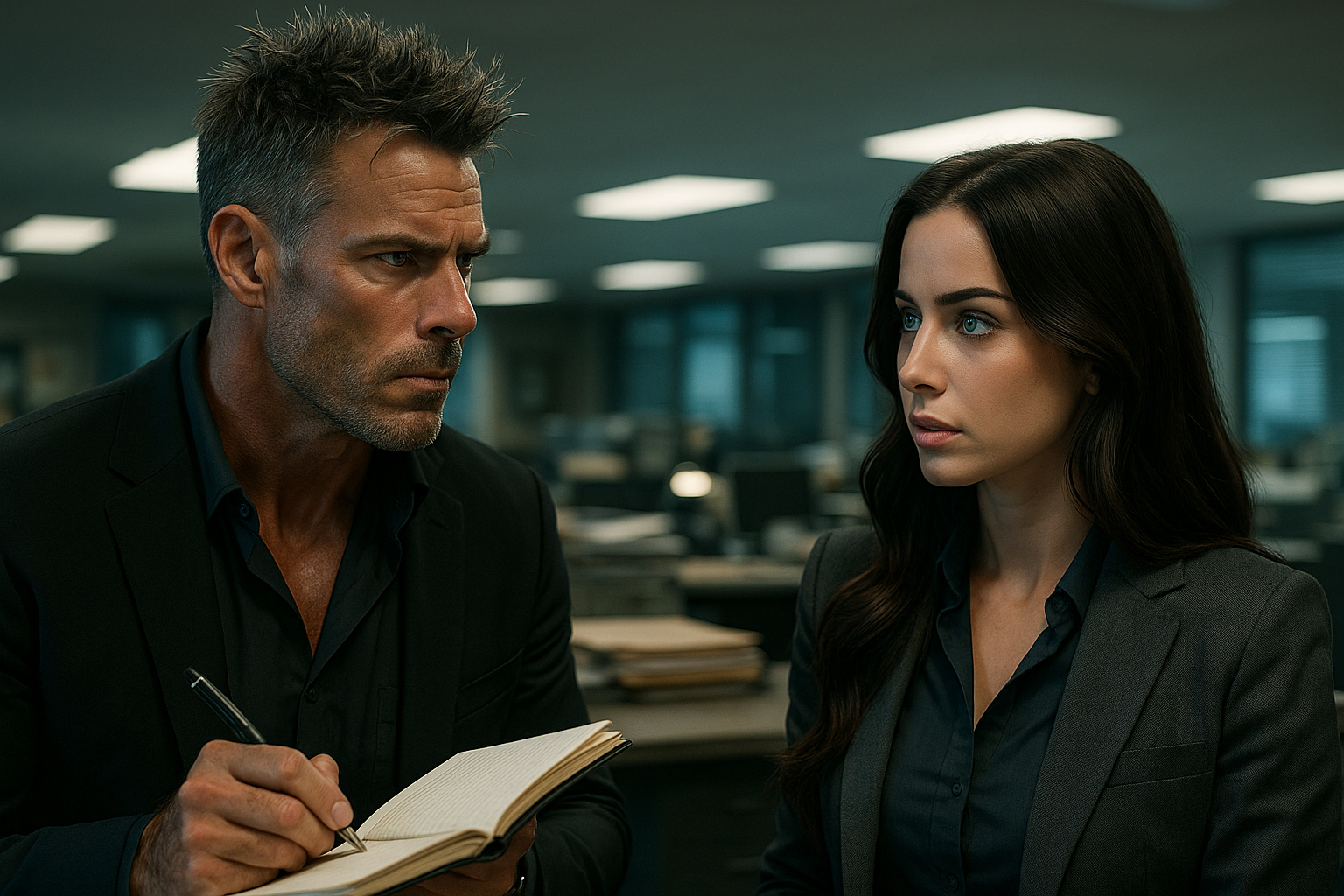
"Who was that?" Sarah asked as I walked back into the open-plan office.
Her voice cut through my distracted haze, sharp as ever, with that particular quality she possessed—the ability to make a simple question feel weighted with implications. She sat at her desk, her workspace more ordered than normal—files squared into precise stacks, not a paperclip out of place, each folder aligned with geometric precision that spoke of someone who’d been waiting, thinking, perhaps worrying. Whatever she’d been working on had been pushed aside the moment I reappeared, her attention redirecting with the focused intensity of a spotlight swinging to catch someone in its beam.
Sarah never missed much when it came to my movements. It was part of what made her such a damn good detective—this preternatural awareness of the people around her, this ability to read the space between words and actions. Though when that scrutiny turned in my direction, as it increasingly did these days, it felt less like partnership and more like pressure under a microscope, like being a specimen pinned down for examination.
"Jenny Triffett," I replied evenly, offering only the name as I held my pen and notebook close, the latter still open on the last page of scrawled interview notes that I hadn’t yet had time to process or transcribe.
I kept my tone neutral, deliberately so, constructing each word with care like someone walking across thin ice who knows exactly where the weak spots are. The interview had left an impression—raw, human, far messier than the procedural outlines it would eventually become once reduced to official reports and case file entries. My wrist, hidden beneath my coat sleeve, pulsed with a dull throb that had become a constant companion, the bandage now unpleasantly damp with either blood or sweat. I didn’t care to know which, didn’t want to examine it too closely, couldn’t risk rolling up my sleeve to check in the open office where anyone might see.
The leather glove remained a silent ally, tucked discreetly out of view, concealing the evidence of this morning’s transgression with its supple darkness.
I had no desire to unpack the complexities of that conversation with Sarah. Not yet. Not when I was still processing it myself, still feeling the warmth of Jenny’s hand gripping mine, still hearing the crack in her voice when she talked about her son. Especially not when I’d already decided to pass the formal case to Glen, to maintain at least the appearance of proper procedure even as I knew I’d be working it regardless.
With Jamie and Luke still unresolved—with the mounting evidence that something larger and more sinister was unfolding—the idea of adding Nial Triffett to my ever-growing mental board of entanglements felt reckless, like juggling knives whilst standing on a tightrope. And yet—I couldn’t quite let it go, couldn’t dismiss the pattern I was beginning to see, couldn’t ignore the similarities that screamed for attention.
"Who’s Jenny Triffett?" she asked again, this time more pointedly, the question sharpening into something more direct.
I caught the narrowing of her eyes in my peripheral vision. It was barely perceptible to most people, but unmistakable to anyone who knew her as well as I did—that slight tightening at the corners, that subtle shift in focus that meant her detective instincts had engaged.
Our partnership had long ago evolved past small talk and surface pleasantries—we read each other like crime scenes now, each pause and gesture part of a silent vocabulary we’d developed over eighteen months of close collaboration. The lift of an eyebrow. The set of shoulders. The particular quality of silence that meant thinking versus the silence that meant withholding. I could sense her beginning to probe, not for the facts of the case—those would come soon enough—but for mine. My motivations. My emotional temperature. The reasons I might be taking on yet another case when I was already drowning in the ones I had.
"The wife of Nial Triffett, of course," I said, allowing the faintest curve of amusement to touch my mouth, attempting to defuse the tension with humour.
For a second, I considered stringing her along—feeding out just enough information to keep her curious without giving her the whole picture, playing the game we sometimes played when cases got too heavy and we needed the relief of mild antagonism. It would’ve served as a welcome distraction from the weight bearing down on my shoulders, from the accumulating pressure of secrets and lies and compromised investigation techniques.
But she didn’t bite. Instead, she gave me a sharp thump on the shoulder.
The jolt radiated straight down into my wrist with shocking intensity, and I stiffened involuntarily. Pain bloomed beneath the bandage like a firework under skin, bright and sharp and impossible to ignore. I masked it quickly, trained instinct overriding discomfort, years of concealing injuries and weakness kicking in automatically. But it reminded me—again, always again—that I was walking a razor-thin line, one misstep away from exposure, one wrong movement away from revealing exactly what I’d done this morning.
"We need to advise the officers to be on the lookout for Nial Triffett’s work ute," I said, pivoting back to business with perhaps too much abruptness, too much eagerness to redirect attention.
That, at least, was something I could control—an action grounded in procedure, legitimate and defensible. It served the dual purpose of moving the case forward and moving Sarah’s attention elsewhere, away from my discomfort and the questions it might raise. If we found the ute, we might find Nial. If not, we’d still be one step closer to understanding the shape of the void he’d left behind, the contours of his disappearance.
"Why? What’s up? Something else related to the investigation?" she asked, brightening slightly, her interest visibly sharpening.
"I’m not sure yet," I admitted, cautious now, measuring each word before releasing it. "His wife said he went to visit a potential new client for his struggling fencing business yesterday and has now gone missing. But—"
"Well, that definitely sounds like it could be connected," she cut in, quick to leap to the conclusion I’d been circling without fully voicing.
I watched her closely, studying her reaction with the same attention I’d give a suspect’s micro-expressions. It was usually the other way around—me following instinct to the point of recklessness, her grounding us with procedural caution and methodical investigation. Me pushing boundaries, her reminding me where they were. Now our roles were reversed, inverted in a way that felt fundamentally wrong. I couldn’t decide if that was comforting—validation that I wasn’t seeing patterns where none existed—or deeply unsettling, a sign that we were both being pulled into something that was compromising our judgement.
"Do we know who he went to visit?" she asked, leaning forward slightly, fully engaged now.
"No," I replied with a small frown, acknowledging the gap in our knowledge. "And Jenny called the police last night. While they were there talking to her, she received a text message from Nial telling her that he would be late home and not to wait up for him."
Sarah frowned back, her expression shifting from interest to scepticism, clearly unimpressed with this detail. "That does sound a lot more like a case of infidelity than a missing person, and last time I checked, being a slimy cheat wasn’t actually against the law."
Her bluntness had always been one of her strengths, this ability to cut to the chase with enviable efficiency, to strip away emotional complications and see the statistical likelihood beneath. No diplomatic cushioning, no careful hedging—just direct assessment based on experience and probability. And under any other circumstance, I would have agreed with her without hesitation. From a procedural standpoint, she was spot on—adults vanish all the time, only to turn up days later with sheepish grins and half-baked stories about stress, solitude, or poorly timed affairs they couldn’t quite explain to their devastated spouses.
A text message, even a vague one, usually disqualified them from being considered genuinely missing. It demonstrated consciousness, agency, the ability to communicate. It suggested voluntary absence rather than foul play.
But there was something about Jenny’s certainty—just like Louise’s before her—that I couldn’t ignore, couldn’t dismiss as denial or wishful thinking. It wasn’t mere refusal to face an unpleasant truth. It wasn’t blind faith in a marriage that might have been failing behind closed doors. It was the aching kind of knowing that only comes from living beside someone for years, from understanding their patterns so deeply that deviations become immediately, viscerally apparent.
There were small tells in Jenny’s account: her shock at Nial’s message, the way she’d emphasised that he’d never used that phrase before. Her horror that he’d left without a proper goodbye to their son, without maintaining the nightly ritual that had defined their family life. The missing dog, taken from a locked house. It didn’t fit the usual script of a man planning to abandon his family or engage in an affair.
"You’re right," I conceded, nodding in acknowledgement of her assessment. "But I think it’s worth digging a bit deeper."
I didn’t say more than that. Didn’t elaborate on the connections I was beginning to see, the pattern emerging from what should have been unrelated cases. I didn’t need to. Sarah knew me well enough to hear what I wasn’t saying—that this wasn’t just another worried spouse spinning a story to save face or preserve their dignity. There was something off-kilter here, something that didn’t align with the standard explanations, and I wasn’t prepared to write it off as marital drama just yet.
Not when it fit so perfectly with the other disappearances. Not when the timing and method echoed Jamie and Kain with such precision.
"I’m sure Glen won’t mind us helping out a bit," I added, the words half-muttered as I sank into my chair, feeling the exhaustion of the long night and the wreckage of the morning finally catch up with me.
It was a feeble justification, tissue-thin and transparent even to my own ears. Glen’s name offered little in the way of legitimacy—he was notorious for being the least territorial detective in the department, happy to let others do the work whilst he collected the credit. But invoking him gave me a convenient hook to hang my conscience on, a procedural fig leaf to cover what was essentially me inserting myself into a case I had no official standing in.
After the morning I’d had—shattering a window, staging what could be interpreted as a break-in, nursing a bleeding wrist beneath my glove whilst conducting interviews—this barely even registered on the ethical scale. I’d already fallen so far that one more small transgression was barely noticeable, just another item on the growing list of compromises and violations.
"Glen has the case?" Sarah asked, raising an eyebrow in an expression that managed to convey both surprise and resignation. "God help that poor woman."
I chuckled despite myself, the sound emerging with more genuine amusement than I’d felt in days. Glen was infamous in the office—never malicious, never actively harmful, just... inert. Possessed of an almost supernatural ability to do the absolute minimum whilst somehow never quite crossing the line into actionable incompetence. If detecting was a matter of inertia, he’d have solved every case by standing still and waiting for the answers to come to him through some process of cosmic inevitability.
Which, somehow, they occasionally did. Luck, or sheer cosmic pity for the victims who’d been assigned to him.
Opening the car registration database on my monitor, I entered the few details Jenny had given me about Nial’s work ute—make, model, approximate year. The system was old, clunky, prone to crashes and inexplicable errors, but it was what we had. It didn’t take long despite the outdated interface. A couple of keystrokes, a brief moment whilst the database churned through its records, and the system spat out the result with bureaucratic efficiency.
I scribbled the number plate onto a crumpled yellow Post-it note—one of thousands that had accumulated on my desk over the months, each one representing a small piece of information that had seemed significant at the time—and handed it across to Sarah. "Here. Go put out an alert for Nial’s ute, would you?"
She squinted at my handwriting, which had deteriorated over the course of the morning as exhaustion and pain took their toll. She read aloud, cross-checking the characters to ensure she’d interpreted my scrawl correctly. "Tasmania’s a small place. I can’t imagine his ute staying hidden for long."
"Let’s hope not," I murmured, watching her move towards her desk to send out the alert, to feed the vehicle details into the system that would flag it for every patrol car and traffic officer in the state.
As she walked away, I leaned back in my chair. The synthetic fabric creaked under me with a sound that had become so familiar it barely registered consciously, familiar in all the ways my thoughts weren’t. The chair was old, worn, shaped to my body through countless hours of sitting and thinking and typing reports. It should have been comfortable, reassuring in its familiarity.
But comfort felt impossible right now.
Nial Triffett. Jamie Greyson. Kain Jeffries.
Three disappearances. Three men. All within a narrow timeframe—less than a week separating the first from the last. All under the radar enough to go unnoticed at first, to be dismissed as non-urgent or explainable, until the inconsistencies began to pile up like snow drifting against a fence. Two missing vehicles. Two messages suggesting the men had left of their own volition, providing just enough communication to prevent immediate alarm. No confirmed sightings beyond the initial departures. No phone calls that could be verified. Just absence—neatly explained with text messages and vague stories, but never quite convincingly when you looked beneath the surface.
Coincidence was always the first explanation the system preferred, the default assumption that allowed cases to be filed away without extensive resource allocation. Random chance. Unfortunate timing. Unrelated events that happened to cluster together in time and space without meaning.
But patterns had their own gravity, their own insistent pull. And this one was beginning to pull at me with increasing force, impossible to ignore despite my attempts at professional objectivity.
I rubbed at the inside of my wrist through the glove, feeling the tender throb beneath the leather and bandage. A reminder of how far I’d already overstepped, of how many lines I’d crossed this morning in pursuit of answers that remained frustratingly elusive. And yet, despite everything—despite the physical pain and the ethical compromises and the growing risk of exposure—the compulsion to keep going, to connect these scattered pieces, only grew stronger.
What were the chances that these cases were unrelated? That three men would vanish within days of each other using similar methods?
Too slim for comfort.
Too familiar for coincidence.
Too tangled now to ignore, even if I’d wanted to.
The pattern wasn’t asking to be noticed anymore. It was simply there—the way evidence is there whether or not you want to log it.
"Oh, Sarah. I almost forgot," I called out as a thought broke through the fog of my internal monologue, surfacing with sudden urgency. "Make a note to get a copy of Nial’s phone records. Let’s see if we can find out who he may have gone to visit."
"On it," Sarah replied promptly, her voice carrying across the office.
Her tone held that same dependable quality it always did when we were in the thick of a case—focused, competent, ready for whatever tedious work the investigation required. The kind of tone that made you trust a person to hold the rope steady while you climbed, to be there when you needed backup, to do the unglamorous work that actually solved cases.
It reminded me, uncomfortably, of the trust I was putting at risk. Trust she still placed in me freely, without reservation or suspicion, unaware of how much I’d veered from the straight path this morning. Unaware that the man she was working alongside had become, in some technical sense, a criminal himself.
While she worked, I turned back to my computer, drawn by something older. Something colder. A thread from a different case that never really became one, that had haunted me for fifteen years without resolution.
Killerton Enterprises.
The name had never left me, not really. It lived in my mind like a splinter under the skin—painful when pressed, impossible to fully ignore, always present even when I wasn’t consciously thinking about it. The edge of a memory that didn’t fade with time, that seemed to sharpen rather than dull as years passed.
I typed the words into the search engine yet again, my fingers finding the keys with practised ease, knowing exactly what I’d find before the results loaded. I’d done this countless times—months, years apart, in different cities and different offices across three states. Each time hoping something would have changed, some new information would have emerged. Each time finding the same sanitised corporate facade.
The results blinked up at me, unchanged from the last time I’d looked. Unchanged from every time before. A glossy corporate website with professional photography and carefully crafted messaging. A billion-dollar construction conglomerate based in the United States, with projects spanning continents and decades. Project highlights showcasing impressive infrastructure. Community outreach programs demonstrating corporate responsibility. Carbon-neutral goals and sustainability commitments. The polished mask of a global brand, everything designed to project competence and legitimacy.
No presence in Australia. Nothing even remotely suspicious. Nothing that belonged on a torn scrap of paper dropped by a panicked nineteen-year-old boy beside a flooded Queensland riverbank. Nothing that explained why Jamie had been so terrified when I’d found him, why that name had been clutched in his hand like evidence or warning.
I clicked through the tabs anyway, skimming press releases and leadership bios with the detached automation of a man looking for a ghost he knew wouldn’t appear. The Killerton I was searching for—the one Jamie had feared, the one that had somehow been connected to whatever had driven him to that river—wasn’t here. At least not in the light, not in the public-facing documents and glossy corporate materials.
If there was darkness associated with this company, it was buried deep. Hidden behind layers of legitimate business operations and positive public relations.
And yet... Claiborne had the paper. Somehow, that scrap had survived all these years, had been preserved in evidence files or personal records, had found its way into his hands. If that wasn’t proof of relevance, I didn’t know what was. He wouldn’t have kept it if it was meaningless.
But I couldn’t explain it. Not to myself, and certainly not to Sarah or anyone else. Couldn’t articulate why a major American construction company would have any connection to a troubled teenager in Queensland, to missing persons in Tasmania, to the pattern I was beginning to see.
I stared at the screen, caught between frustration and fixation, until I heard footsteps approaching across the office carpet. Sarah, returning from whatever task she’d been completing.
With a quiet flick of the trackpad, I closed the browser tab. Too quick. Too defensive. The motion betrayed guilt even though I was alone, even though Sarah couldn’t see my screen from where she was. But necessary. The last thing I needed was for Sarah to see that search, to start asking questions about why I was researching American construction companies when I should be focused on local missing persons.
"Found something already?" I asked, looking up with forced nonchalance, constructing an expression of mild curiosity rather than the obsessive intensity I actually felt.
I checked her face for any hint that she’d caught the tail end of my clandestine research, that she’d noticed the speed with which I’d closed that browser tab. But she just shook her head, lips pursed in an expression I couldn’t quite read—frustration, perhaps, or concern.
"Not about the Triffetts," she said, and I straightened instinctively, my attention sharpening.
The distinction was important. If not about Nial, then—
"It’s about Jamie and Kain."
The words struck like cold water, immediate and all-encompassing. My spine stiffened involuntarily, the pain in my wrist momentarily forgotten as every other sensation receded. I leaned forward, notebook still in my hand though I wasn’t writing, pen poised above paper in automatic readiness.
"Shit, Sarah," I snapped, sharper than I intended, the word emerging with more force than was warranted by her simple statement.
"I’ve spoken with both the Launceston and Hobart airports," she began, letting my outburst pass without comment, choosing to ignore it rather than challenge me. Professional courtesy, or perhaps recognition that I was operating on the edge of acceptable behaviour. "There’s no record of either Jamie or Kain having boarded a plane in the last two weeks."
I exhaled slowly, processing this information. Not quite relief—the news didn’t bring them any closer to being found, didn’t explain where they’d gone. But it narrowed possibilities, eliminated one avenue of investigation, focused the search. "Which means they have to still be in the state."
It sounded more confident than I felt, the statement emerging with false certainty. The thought gave me something to hold on to, a concrete assumption to build upon. Tasmania wasn’t vast—barely 68,000 square kilometres, most of it wilderness or farmland, with a population concentrated in a few urban centres. It could hide people, yes—but not forever. Not if they were being actively looked for. Not if every police officer in the state had their details and descriptions.
"What about the Spirit of Tasmania?" I asked, thinking of the ferry that connected the island to the mainland, the most obvious alternative to air travel. "Have you checked with them yet?"
Sarah nodded, already one step ahead as she so often was. "Yes. I’ve spoken with the Spirit too. They have no record of Jamie or Kain having boarded in the last two weeks either."
My thoughts were already spinning through implications—if not by air, and not by sea, then they were still here, somewhere in Tasmania, unless they’d left by private boat or some other unconventional method—when she added: "But Duncan is bringing down a copy of their security footage. They could have used aliases. And there’s always the slim chance that they snuck on board."
Duncan Flack. Northern Division. Solid, dependable, the kind of officer who did what was asked without complaint or complication. If anyone could be trusted to properly collect and transport evidence, it was Duncan.
"Very slim chance," I agreed, acknowledging the unlikely scenario. "But very good work, Sarah. That’s going to keep you busy for a while."
I meant it sincerely. Watching hours of grainy ferry footage was tedious, soul-sapping work—the kind of task that could eat entire days without yielding anything useful. Hundreds of passengers boarding and disembarking, most of them irrelevant to the investigation. But it was necessary, comprehensive, the kind of methodical work that solved cases more often than dramatic breakthroughs or brilliant deductions.
And Sarah wouldn’t shy away from it. She’d sit there for however many hours it took, watching every frame, noting every face, checking each passenger against the photos we had of Jamie and Kain until she was certain they weren’t there.
As she returned to her desk, settling back into her chair with the resigned determination of someone facing unpleasant but necessary work, I turned my chair slightly and stared out over the office. The normal background hum continued—murmurs of conversation, keyboards clattering, the electronic buzz of an incoming call somewhere across the room. The sounds of investigation continuing, of bureaucracy grinding forward, of an institution doing what institutions do.
Yet all of it felt distant now, as if I were observing from behind glass, separated from the normality by something I couldn’t quite name.
Jamie. Kain. And now Nial.
Each with plausible excuses that didn’t quite hold up under scrutiny. Each with loved ones who swore it didn’t add up, who insisted with absolute conviction that this wasn’t voluntary, wasn’t explainable through the usual narratives of affairs or financial problems or mental health crises.
Each with vehicles—mobile, traceable, physical evidence that should be easy to locate in a state as small as Tasmania. And yet, vanished as thoroughly as the men themselves, swallowed by whatever force or circumstance had taken them.
Each with routines, lives rooted in place—jobs, families, commitments that couldn’t simply be abandoned without consequence. Until they were, without warning or adequate explanation.
I closed my eyes for a moment, exhaustion threatening to overwhelm me, and saw a different image: the rubbish bags in Luke’s back room, stacked against the wall with sinister precision. The too-clean house that felt staged rather than lived in. The face at the blinds that had watched me watching, then vanished before I could properly identify it. The broken window that marked my descent from detective to criminal, from investigator to perpetrator.
Something was building, and the shape it was taking didn’t look like coincidence. It looked deliberate. Orchestrated. Part of a pattern I was only beginning to perceive.
They were still here. Somewhere in Tasmania, within the boundaries of this island state.
Not on the mainland. Not overseas. Here.
An island doesn’t let people leave. It just hides them better, and for longer—holds them in the same water that was holding me. Wherever Jamie and Kain and Nial had gone to ground, it was on the same scrap of land I was standing on.
So I’d find them. There was nowhere left on it they could be that I wasn’t willing to follow.
