Hobart Paediatric Centre, Tasmania
The Hobart Paediatric Centre has served Tasmania's children for nearly seven decades, evolving from a modest post-war facility into the state's principal provider of specialised paediatric assessment and psychiatric care. Whilst the Centre has delivered countless successful interventions and diagnoses, its history is marked by chronic underfunding, bureaucratic strain, and the occasional whisper of something darker. For the Triffett family, it became the stage where medical certainty fractured into profound uncertainty—where Sammy's case file transformed Dr. Richard Carmichael's office into a room with no answers, and where young Sammy's haunting utterances challenged the very foundations of paediatric science.
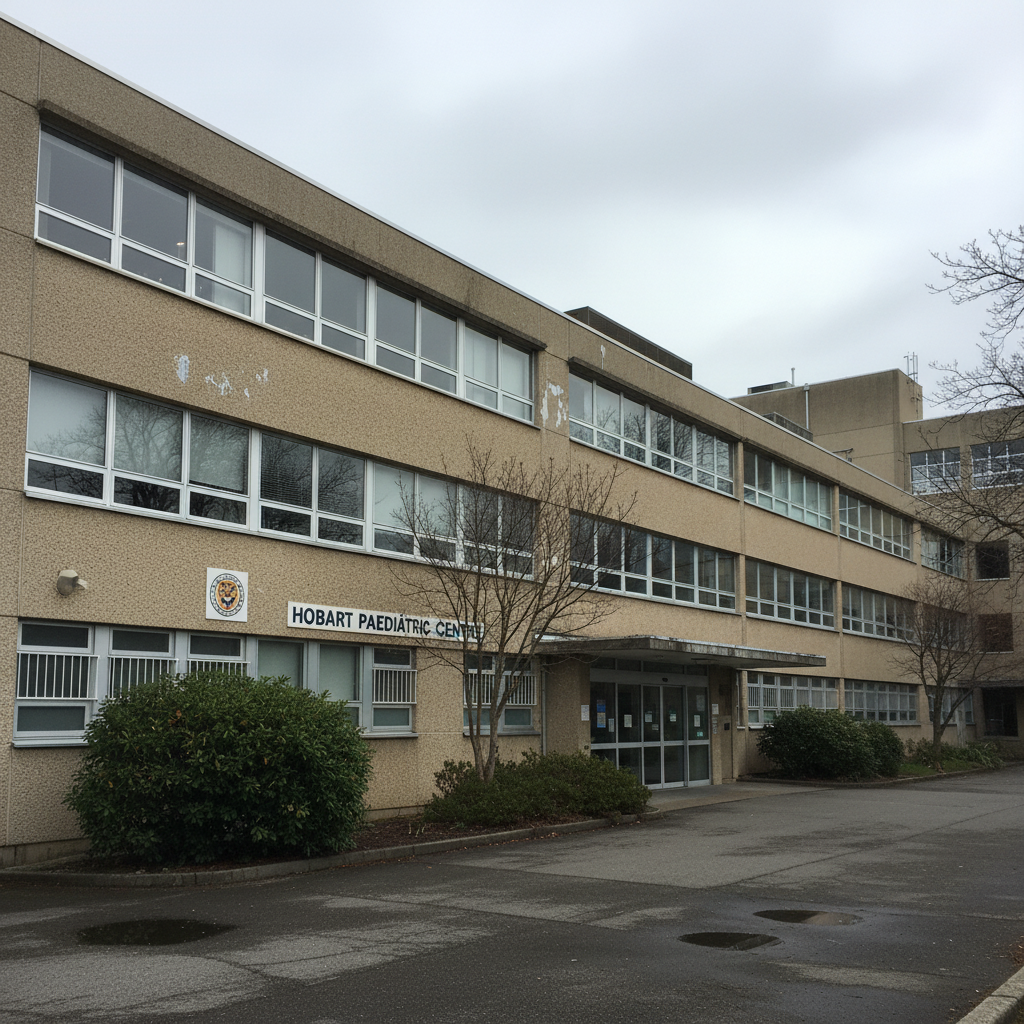
Foundation and Early Purpose (1950s–1970s)
The Hobart Paediatric Centre was first established in 1957 in response to a growing post-war need for dedicated child health services in southern Tasmania. Previously, paediatric cases had been absorbed into the Royal Hobart Hospital's general services, but rising demand and shifting medical standards made this arrangement increasingly untenable. The integration of children's care within adult wards had long been recognised as inadequate, with paediatric patients requiring not only specialised medical attention but also age-appropriate environments and family-centred approaches that the general hospital could not adequately provide.
The Centre was originally housed in a repurposed Federation-era house on Macquarie Street, its high ceilings and gracious proportions offering a somewhat more welcoming environment than the austere hospital wards. The founding medical director, Dr. Conrad Ellery, had returned from a paediatric residency in Melbourne and brought with him a vision of holistic child care—combining medicine, education, and family engagement in ways that were progressive for the era. His work in developmental delay and congenital abnormalities set a precedent for the Centre's future diagnostic work, establishing protocols that would influence Tasmanian paediatric care for decades to come.
Through the 1960s and early 1970s, the Centre's reputation grew, albeit modestly and always within the constraints of its limited resources. It remained chronically underfunded and dependent on a handful of overstretched generalists and volunteers, many of whom operated without formal paediatric training. The nursing staff, in particular, became the backbone of the Centre's operations, their dedication compensating for the shortage of qualified physicians and specialists. Still, for families without the means to travel interstate for care—and in an era when such travel was far more challenging than it would later become—the Centre became an essential port of call, often representing the only accessible specialist paediatric care available to rural Tasmanian families.
The Centre's early years were characterised by a spirit of making do, of clinicians and staff working with whatever resources they could muster to serve Tasmania's most vulnerable population. This ethos of perseverance in the face of inadequate support would become a defining feature of the Centre's culture, one that persisted through subsequent decades even as the institution itself underwent significant changes.
Expansion and Bureaucratic Shifts (1980s–1990s)
By the early 1980s, demand had far outpaced the Centre's capacity to provide care. The old Macquarie Street house, charming though it was, simply could not accommodate the growing number of referrals flowing in from across southern Tasmania. A new facility—purpose-built and situated adjacent to the main Royal Hobart Hospital complex—was opened in 1983 after years of advocacy and political negotiation. The design was functional, almost austere: beige walls, plastic seating, low ceilings that seemed to press down on already anxious families. Despite promises of innovation and state-of-the-art facilities, the building felt outdated even at its ribbon-cutting, a testament to the compromises that had been necessary to secure funding at all.
It was during this period that the Centre began formalising its psychiatric referral pathways, recognising that many paediatric presentations involved complex interactions between physical health and psychological well-being. With the appointment of Dr. Henry Voss (1986–1994), a pragmatic yet exacting child psychiatrist originally from Sydney, the Centre expanded into behavioural diagnostics and early interventions for conditions such as ADHD, autism spectrum disorder, and paediatric mood dysregulation. Dr. Voss's tenure brought a new level of psychiatric expertise to the Centre, though his methods were sometimes controversial, favouring systematic approaches that some staff found overly rigid when dealing with the nuanced realities of childhood distress.
This period also marked the rise of significant administrative tension within Tasmania's health system more broadly. Hospital mergers and federal health reforms led to aggressive resource rationing and the imposition of bureaucratic structures that often seemed disconnected from the realities of clinical practice. The Centre became notorious for its long waiting lists—up to fourteen months in some cases for non-urgent assessments—and the referral process, bogged down by paperwork and approval requirements, left many rural families stranded in limbo, watching their children's conditions deteriorate whilst they awaited appointments.
Nurses and social workers, including the indefatigable Marion Renshaw (service 1978–2009), often filled the gaps unofficially, providing after-hours follow-ups and transport assistance on their own time. Marion became something of a legend within the Centre, known for her uncanny ability to navigate the bureaucracy on behalf of desperate families and for her willingness to bend rules when rigid adherence to policy would have meant abandoning children in need. Her unofficial case management work, conducted from her home telephone in the evenings and on weekends, represented a parallel support system that kept many families connected to care even when the official structures failed them.
The 1990s brought further challenges as Tasmania's economic difficulties translated into even tighter health budgets. Staff turnover increased, with qualified paediatricians and psychiatric specialists often accepting positions interstate where conditions and remuneration were better. The Centre became known as a training ground for junior doctors who would gain experience before moving on to more prestigious or better-resourced positions elsewhere, creating a revolving door that made continuity of care increasingly difficult to maintain.
Contemporary Era and Contested Ground (2000s–Present)
In recent decades, the Hobart Paediatric Centre has sought to modernise its operations, incorporating digital records, telehealth initiatives, and interdisciplinary care models that reflect current best practices in paediatric medicine. Specialist outreach to remote Tasmanian communities has expanded, particularly with the addition of Aboriginal health liaisons and language-sensitive services designed to better serve the state's diverse population. These improvements have been genuine, representing the efforts of dedicated administrators and clinicians to bring the Centre in line with contemporary standards despite persistent resource constraints.
However, chronic underfunding persists as a defining reality of the Centre's operations. Staff turnover remains high, with many positions filled by a rotating cast of junior registrars who describe their placements as "sink-or-swim" experiences. The Centre has struggled to attract and retain senior specialists, meaning that much of the actual clinical work falls to less experienced practitioners who are often managing caseloads that would challenge even seasoned clinicians. The waiting lists, whilst somewhat improved from the worst periods of the 1990s, still stretch for months, and families in crisis often find themselves facing agonising delays before their children can be assessed.
Despite these ongoing challenges, there have been notable successes. The Centre has developed particular expertise in early interventions for neonatal epilepsy and has earned a growing reputation in childhood trauma assessment, thanks in part to the leadership of Dr. Katherine Embling (appointed 2011), who introduced the region's first trauma-informed paediatric diagnostic protocols. Dr. Embling's work has helped the Centre better recognise and respond to children who have experienced abuse, neglect, or other significant adversity, bringing a much-needed perspective to assessments that had previously sometimes failed to account for the impact of traumatic experiences on child development and behaviour.
Yet not all families leave the Centre reassured, and not all cases proceed along straightforward diagnostic pathways. The Centre's history includes instances where the limitations of medical knowledge, the pressures of time and resources, and the inherent uncertainties of paediatric practice have combined to produce outcomes that satisfy neither families nor clinicians.
When Medicine Meets the Inexplicable
In 2018, Jenny Triffett brought her son, Sammy, to the Centre for evaluation following increasingly erratic behaviour, sleep disturbances, and episodes that appeared dissociative in nature.
Their sessions were overseen by Dr. Richard Carmichael, a consultant paediatric neurologist who had joined the Centre in 2013 after relocating from London. Dr. Carmichael brought with him an impressive background in developmental neurology and a particular interest in atypical presentations—cases where symptoms defied easy categorisation or where the intersection of neurological and psychological factors created complex clinical pictures. His methodical approach and willingness to consider unconventional explanations made him well-suited to challenging cases, though it also meant he sometimes pursued diagnostic possibilities that his colleagues found unnecessarily exotic.
The Triffett case was documented and generated significant internal debate amongst the Centre's clinical staff. The symptoms Sammy presented with were genuinely unusual: night terrors of extraordinary intensity, episodes of apparent dissociation during which he would speak in ways that seemed far beyond his developmental stage, unexplained bruising that formed patterns rather than the random distribution typically seen in childhood injuries, and a persistent preoccupation with "shadows" that he described with unsettling consistency and specificity.
During the consultation on 28 July 2018, the Centre's waiting room became the stage for one of Sammy's more disturbing utterances. Whilst playing quietly with the train set, he suddenly turned to his mother and whispered, "The shadows are quiet here, Mummy"—a statement that seemed to acknowledge some awareness of unseen presences that followed him but that found the clinical environment somehow less conducive to their manifestation. The comment, documented in Dr. Carmichael's notes, exemplified the challenge the case presented: statements that seemed potentially significant but that could equally be interpreted as the imaginative play of a distressed child.
In Dr. Carmichael's office—a space lined with medical tomes, anatomical models, and curious specimens that gave it an almost Victorian character—the consultation took on an increasingly tense quality. As Jenny recounted Sammy's behaviours and the strange statements he made, Dr. Carmichael's usual clinical composure showed signs of strain. When Sammy spoke directly during the session, his words carried an eerie weight that seemed to unsettle even the experienced neurologist. "The stars are falling," the boy said, his voice taking on a quality that Jenny would later describe as "too old, too knowing." "The shadows are growing."
Dr. Carmichael maintained a working hypothesis of childhood-onset psychosis, a rare but recognised condition that can emerge in children as young as five or six years old. However, several members of the Centre's staff who reviewed the case questioned whether the symptoms truly aligned with any known neurological or psychological framework. The bruising patterns, in particular, troubled the nursing staff, with one nurse privately noting that they looked "deliberate, almost ritualistic" rather than consistent with self-injury or external trauma.
The case reached a critical juncture when Dr. Carmichael recommended bringing in Dr. Elena Petrov, a specialist in unusual paediatric presentations with whom he had worked during his time in Sydney. The fact that an international consultation was being arranged signalled to Jenny both that her concerns were being taken seriously and that the Centre's own resources were insufficient to provide answers. Dr. Petrov's involvement would require a new battery of tests, including comprehensive neurological assessments and specialised psychiatric evaluations that the Centre was ill-equipped to conduct on its own.
Jenny, soon isolated after Nial's disappearance and increasingly desperate for explanations, became progressively more mistrustful of the Centre's conclusions. Her private journals—later excerpted in the Clivilius Journals archive—suggest that she perceived the assessments not only as clinical misfires but as a form of gaslighting, with medical professionals unable or unwilling to acknowledge the reality of what her son was experiencing. Whether those perceptions were accurate or borne of her own trauma and fear remains a point of unresolved inquiry. What is clear is that the Centre, for all its resources and expertise, found itself confronting a case that seemed to exist at the boundaries of medical knowledge—where careful observation and systematic assessment yielded not clarity but deeper mystery.
The file remains active within the Centre's records, though its disposition is unclear. Dr. Carmichael has apparently attempted to follow Sammy's case, though the details of any subsequent assessments or interventions have not been made public. For Jenny Triffett, the Centre represented not a place of healing but a bureaucratic maze where her son's suffering was catalogued but not alleviated, where symptoms were documented but not explained, and where the clinical apparatus of modern medicine encountered something it could not name.
Atmosphere, Memory, and the Unspoken
Despite its institutional sterility, the Hobart Paediatric Centre occupies a curious space in the Tasmanian psyche. For many families, it remains a site of genuine relief—the place where their child finally received a diagnosis, where medication helped restore some quality of life, where compassionate professionals listened and responded with care. The Centre's staff have, over decades, helped countless families navigate the challenging terrain of childhood illness, developmental differences, and psychological distress, often providing not just medical expertise but emotional support during some of the most difficult periods of these families' lives.
For others, however, the Centre is a building thick with ambiguity, whose linoleum corridors and vague murals serve more to contain confusion than to provide clarity. The very environment—designed to be cheerful and child-friendly—can feel claustrophobic and false to parents grappling with serious diagnoses or unclear prognoses. The bright cartoon animals that adorn the waiting room walls, intended to comfort anxious children, can take on an unsettling quality when viewed through the lens of fear and uncertainty, their fixed grins seeming less reassuring than mocking.
Whispers persist amongst former staff of curious occurrences within the Centre's walls, particularly in the older sections of the building that date back to earlier expansions. "The Quiet Room"—an old consultation suite in the original wing now used primarily for storage—features in several accounts from nurses and junior doctors who worked night shifts. Some have claimed odd events occurred there: locked drawers found inexplicably open in the morning, audio interference during consultations that seemed to follow no pattern consistent with electrical problems, children pointing to unseen figures in corners that adults perceived as empty.
None of this is recorded in official files, of course. Such reports, when they are made at all, are shared informally amongst staff over coffee or during handover notes, framed as curiosities rather than serious concerns. Yet in a city like Hobart—where history folds over itself in complex layers, where the weight of the past presses into the present, and where old buildings seem to hold memories in their very structure—such things are neither proven nor easily dismissed. The Centre exists at the intersection of scientific medicine and the less rational fears and intuitions that families bring with them when their children are suffering, and that intersection can be an unsettling space.
Some of the Centre's staff have acknowledged, in private conversations, that certain consultations carry an inexplicable heaviness, that some assessment sessions seem to accumulate a psychological weight that extends beyond the expected emotional difficulty of working with distressed families. Whether this reflects some genuine phenomenon or simply the cumulative stress of working in an underfunded and overstretched system is impossible to say. What is clear is that the Centre has become, for those who work there and those who seek its services, a place where the boundaries between the explicable and inexplicable, between rational assessment and intuitive unease, can become uncomfortably blurred.
