Greta Anne Smith (née Morrison)
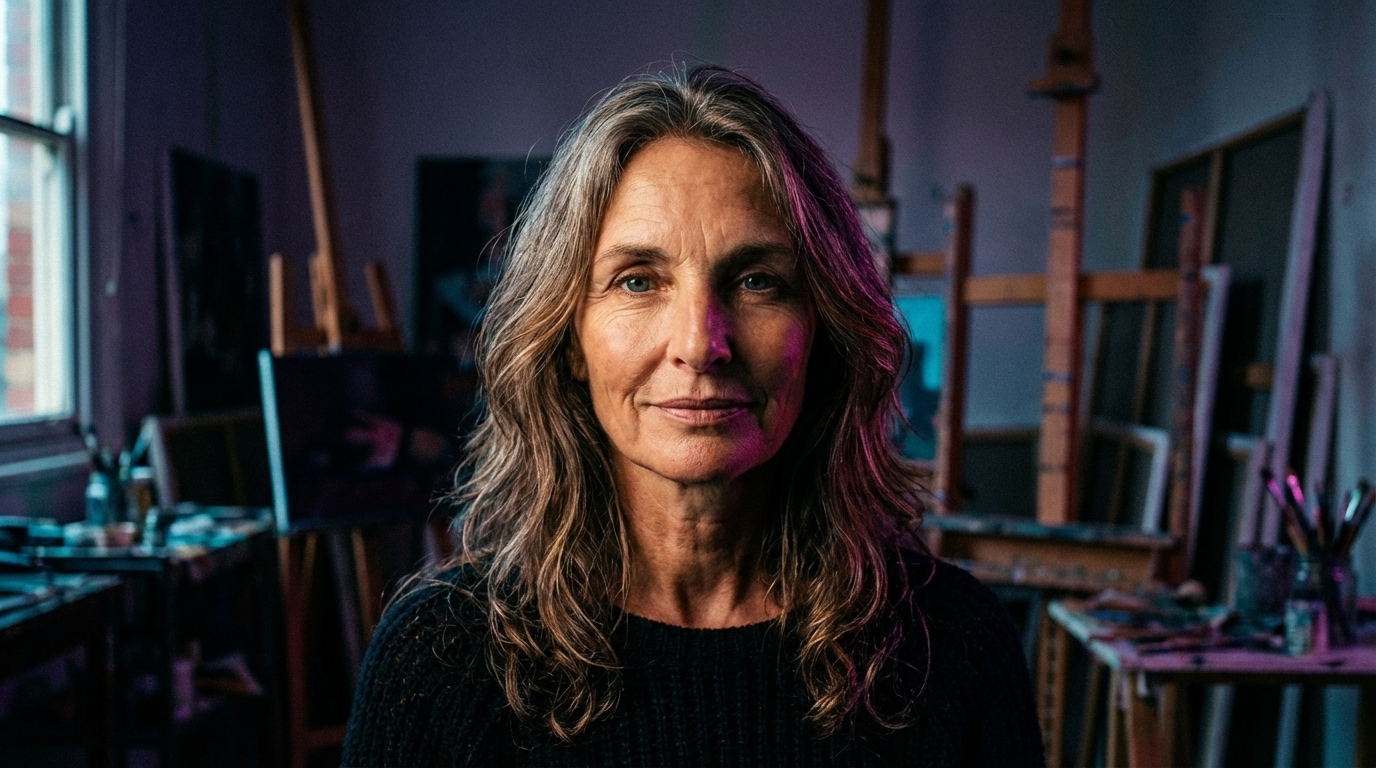
Greta Anne Smith (née Morrison), born 18 April 1968 in Adelaide, South Australia, is an artist, community builder, and devoted mother whose life has been characterised by creativity, faith, and quiet resilience. From her artistic upbringing through her years nurturing family and community in Adelaide and Broken Hill, to her pivotal role in establishing the Bixbus settlement in Clivilius, Greta's compassion and practical wisdom have touched countless lives across two worlds.
Early Life and Artistic Foundations
Greta Anne Morrison was born on 18 April 1968 at the Queen Elizabeth Hospital in Adelaide, South Australia, the first child of Robert George Morrison and Elizabeth Frances Morrison (née Triggs). Her arrival brought particular joy to a household where creativity and faith intertwined in equal measure. Robert, a retired miner who had spent decades in the harsh conditions of South Australia's mining operations, had discovered in his later years a passion for painting that provided respite from the physical toll of his working life. Elizabeth, a dedicated homemaker and active member of the Church of Jesus Christ of Latter-day Saints, brought to their modest home a quiet strength born of deep religious conviction and a commitment to service that would profoundly shape her daughter's character.
The Morrison household in Adelaide's northern suburbs operated according to the rhythms typical of working-class families in the 1970s and 1980s. Money was carefully managed, luxuries were rare, and the values of hard work and self-sufficiency were instilled through example rather than lecture. Yet within these practical constraints, creativity flourished. Robert's easel stood in the corner of the small sunroom, his watercolours and oil paintings capturing the distinctive landscapes of South Australia—the ochre earth, the stark beauty of the Flinders Ranges, the peculiar light that transforms ordinary scenes into something transcendent.
Greta gravitated to her father's artistic practice from her earliest years. Whilst other children played with dolls or toy cars, she sat beside Robert at his easel, watching with intense concentration as he mixed colours, layered washes, built up depth and texture stroke by patient stroke. He taught her not just technique but philosophy—that art was a way of seeing, a means of honouring the world's beauty, a practice of attention that transformed both the observer and the observed. These lessons, absorbed in childhood, would inform not just Greta's artistic development but her entire approach to life.
Elizabeth's influence manifested differently but no less profoundly. The Mormon faith provided structure and meaning to the Morrison household, shaping everything from dietary choices to the way Sundays were observed to the broader framework through which the family understood their place in the world. Elizabeth approached her religion with quiet devotion rather than ostentatious piety, expressing her faith primarily through service—visiting the elderly, preparing meals for struggling families, offering practical help to those in need. She took Greta with her on these errands of mercy, teaching by example that faith was demonstrated through actions rather than words.
Greta's childhood was characterised by the particular freedoms and constraints of suburban Adelaide in the 1970s. The streets were safe enough for unsupervised play, the neighbourhood close-knit enough that adults looked out for each other's children, yet money was tight and opportunities for enrichment limited by practical economics. The family attended church services faithfully, participated in community activities organised through their congregation, and maintained the delicate balance between religious obligation and the ordinary demands of working-class life.
Education and the Development of Artistic Identity
Greta's formal education began at the local primary school, where teachers quickly recognised her artistic talent. Whilst she was a competent student across subjects, it was in art classes that she truly excelled, producing work that demonstrated not just technical skill but genuine artistic vision. Her drawings and paintings captured the world with a sensitivity unusual in a child, revealing her capacity to see beauty in ordinary things—a gum tree's twisted bark, the play of light through venetian blinds, the weathered hands of an elderly neighbour.
In 1980, at the age of twelve, Greta began her secondary education at St. Catherine's School in Adelaide. The Catholic girls' school, whilst not part of her own religious tradition, offered the kind of comprehensive education her parents valued. The school's emphasis on academic rigour, artistic development, and service to others aligned well with the values instilled at home. Greta thrived in this environment, particularly in art classes, where teachers encouraged her to explore various media whilst developing her distinctive style.
Throughout her secondary years, Greta participated in school art exhibitions, her work earning recognition for its technical proficiency and emotional depth. She was drawn particularly to watercolours, appreciating the medium's capacity for subtlety and nuance, its demand for confidence and commitment—once paint touched paper, there was no taking it back, no overpainting to hide mistakes. This quality appealed to something in Greta's nature, a willingness to commit fully to chosen paths even knowing that perfection was impossible.
Her art teachers at St. Catherine's recognised genuine talent and encouraged Greta to consider pursuing formal art education at university level. This was not a foregone conclusion—her family's financial circumstances meant that university attendance would require scholarships and part-time work, and there was the practical question of whether art could provide a viable career. Yet Greta's parents, particularly Robert, understood that artistic talent was a gift to be nurtured, and they supported her ambitions even when the practical path forward remained unclear.
Beyond academics and art, Greta's teenage years were shaped by her involvement in church activities. Young Women's programmes, seminary classes, service projects—all of these occupied significant time and provided social connections primarily within the Mormon community. Whilst Greta had friendships at school, her closest relationships developed through church, where shared faith and values created bonds that often proved more durable than those based solely on proximity or convenience.
The tension between artistic ambition and religious expectation was not yet apparent during these years. Greta's art celebrated beauty and encouraged others to see the world with appreciation and wonder—these seemed entirely compatible with her faith's emphasis on recognising divine creation. Yet the seeds were being planted for later questions about how women's creativity could be honoured within religious structures that sometimes seemed to value maternal roles above all others.
University Years and Artistic Development
In 1986, Greta enrolled at the University of South Australia to pursue a Bachelor of Fine Arts, focusing on painting with particular emphasis on watercolour techniques. The decision to attend university represented a significant commitment for her family—Robert and Elizabeth stretched their modest resources to help with costs, whilst Greta supplemented through part-time work at a local bookshop and, later, at the university library.
University opened new worlds for Greta. The Fine Arts programme exposed her to artistic traditions and contemporary practices far beyond what she'd encountered in secondary school. She studied art history, learning how painters across centuries had grappled with questions of representation, meaning, and the relationship between artist and subject. She explored various media, though watercolour remained her primary love, and she developed a distinctive style characterised by delicate colour palettes, careful attention to natural subjects, and a quality that viewers often described as contemplative or meditative.
Her professors recognised both her technical skill and the particular sensibility she brought to her work. Greta's paintings possessed a quietness that stood in contrast to the bold, often confrontational work favoured by some contemporary artists. She was not interested in shocking viewers or making political statements through her art. Instead, she sought to invite contemplation, to slow down the viewer's gaze, to encourage the kind of patient attention that revealed beauty in overlooked places.
The university years also represented a period of spiritual deepening for Greta. Away from the immediate oversight of family and congregation, she had opportunity to examine her faith more independently, to decide for herself what she believed rather than simply accepting what she'd been taught. She attended Institute classes—religious education programmes for LDS students—and found in these studies an intellectual engagement with scripture and doctrine that strengthened rather than undermined her convictions.
Yet tensions began to emerge between the art world Greta was entering and the religious community to which she belonged. Some in her congregation viewed artistic pursuits with suspicion, particularly for young women whose primary calling was understood to be marriage and motherhood. Greta felt the weight of expectations that she would marry young, start a family, and set aside artistic ambitions in favour of domestic responsibilities. She struggled with the implication that pursuing art seriously somehow indicated a lack of faith or proper priorities.
These tensions were never resolved entirely, but Greta developed a personal philosophy that would guide her through the coming decades: creativity was not in opposition to faith or family but could be integrated with both. Art was not a selfish indulgence but a means of glorifying creation, nurturing beauty, and contributing meaningfully to community. This synthesis—imperfect and requiring constant negotiation—allowed Greta to maintain both her artistic identity and her religious convictions even when external voices suggested these were incompatible.
Meeting Noah and the Promise of Partnership
In 1992, Greta met Noah James Smith under circumstances that felt, to both of them, like providential timing. Noah, a skilled mechanic and devout Mormon, had recently emerged from a difficult divorce that had left him a single father to two young sons, Paul and Luke. The marriage to Heather Atwell had been marked by profound dysfunction—her psychiatric struggles, culminating in a traumatic breakdown during her second pregnancy, had created a household of careful silences and unspoken fears. The divorce, when it finally came, felt simultaneously devastating and necessary.
Noah and Greta were introduced through mutual friends in the Adelaide Mormon community, both attending the same stake and moving in overlapping social circles. Their initial conversations revealed unexpected compatibility. Noah, carrying guilt about his failed marriage and uncertainty about his capacity to provide the emotional stability his sons needed, found in Greta a compassionate presence who listened without judgment. Greta, approaching her mid-twenties and feeling pressure from her community to marry, recognised in Noah a genuine goodness—he was hardworking, devoted to his children, anchored by faith, and carrying wounds that made him humble rather than bitter.
Their courtship developed with the particular intensity of people who had both experienced loneliness and loss. For Noah, Greta represented the possibility of the stable family life he'd always wanted but never managed to build with Heather. For Greta, Noah offered partnership with a man whose values aligned with hers, whose practical competence complemented her more contemplative nature, and whose readiness for marriage meant she could move forward into the life stage her community and, increasingly, she herself desired.
They married in late 1993 in a ceremony that united two families whilst also marking new beginnings. Greta became not just Noah's wife but stepmother to nine-year-old Paul and eight-year-old Luke, boys who carried their own traumas from the dissolution of their parents' marriage and their mother's effective abandonment. The transition was not without challenges—Paul and Luke struggled with loyalty to their absent mother, with accepting Greta's maternal gestures, with the disruption to household rhythms they'd barely established as a family of three.
Greta approached her new role with characteristic patience and compassion. She did not try to replace Heather or force intimacy the boys were not ready to offer. Instead, she focused on creating stability—regular meals, organised household routines, a home that felt safe and predictable. She encouraged the boys' relationship with their father whilst also leaving space for them to process their grief and confusion in their own time. Slowly, tentatively, trust began to develop, though the relationship would always carry the complexity of being both genuine and constructed, both chosen and imposed by circumstance.
Building Family in Adelaide and Broken Hill
The early years of Greta and Noah's marriage were marked by rapid family expansion. Their first child together, Lisa Victoria Smith, was born on 10 June 1994, bringing joy and also the inevitable complications of blending biological and step-children in a single household. Lisa's arrival meant that Paul and Luke had to adjust to sharing their father's attention, whilst Greta navigated the different emotional terrain of caring for her biological child whilst continuing to build relationships with her stepsons.
Eli Matthew Smith followed on 18 April 1995, completing what Greta and Noah initially envisioned as their family of four children. The household in Craigmore, a modest suburb in Adelaide's north, operated according to the rhythms typical of Mormon families—early morning seminary for the older boys, Family Home Evening each Monday, church attendance occupying much of Sunday, dietary restrictions eliminating alcohol, coffee, and tea, and the countless other ways that religious observance shaped daily life.
Yet even as family structures were being established, Noah and Greta were contemplating significant change. The mechanics shop where Noah worked offered steady employment but limited advancement opportunities. Adelaide, whilst home, also carried memories and complications—proximity to Heather, who remained in Glenelg and maintained sporadic contact with Paul and Luke, and the weight of extended family expectations and obligations that sometimes felt suffocating.
In mid-1995, shortly after Eli's birth, Noah and Greta made the decision to relocate to Broken Hill, a remote mining town in far western New South Wales. The move was motivated by multiple factors: Noah's desire for a fresh start where the family's history was unknown, the opportunity to establish his own mechanics business rather than working for someone else, and the appeal of a smaller community where they might more easily integrate and where their children could grow up with greater freedom and safety than urban Adelaide offered.
The relocation to Broken Hill represented a significant leap of faith. The town was harsh and isolated—searing summer heat, bone-chilling winter cold, red dust that infiltrated everything, and vast distances from the amenities and opportunities of city life. Yet Broken Hill also offered distinctive character—a tight-knit community shaped by generations of mining families, an unexpected artistic culture drawn to the stark beauty of the outback landscape, and the particular resilience required to thrive in such an unforgiving environment.
Noah established Broken Hill Auto Solutions, a mechanics workshop that quickly built a reputation for reliable work and fair pricing. Greta, managing a household with four children aged from infancy to pre-adolescence, found her time consumed by the practical demands of motherhood and homemaking. Yet she carved out space for creativity, transforming their modest property into a flourishing garden that became her outdoor studio—a place where artistic vision merged with practical cultivation of food and beauty.
Broken Hill Years: Community, Creativity, and Growing Family
The decade the Smith family spent in Broken Hill (1995-2006) proved formative for all of them, but particularly for Greta, who blossomed in the remote town in ways that surprised even herself. The move had required leaving behind her support networks in Adelaide—extended family, church community, artistic connections. Yet Broken Hill offered unexpected opportunities for meaningful engagement beyond the purely domestic.
Greta's garden became legendary among neighbours. What had begun as a practical vegetable patch evolved into an elaborate cultivation that blended native Australian plants with herbs, vegetables, and flowers arranged with an artist's eye for colour and form. She created a sanctuary that was simultaneously productive and beautiful, a space where the harsh outback environment was transformed through care and creativity into something lush and nurturing. The garden became her meditation practice, her spiritual discipline, her means of connecting with divine creation through the daily work of cultivation and attention.
In 1996, Greta began teaching art classes at the Broken Hill Community Centre, initially offering watercolour workshops for beginners. The classes filled immediately, revealing hunger for creative instruction in a town where such opportunities were limited. Greta's teaching style reflected her own artistic philosophy—patient, encouraging, focused on helping students develop their own vision rather than simply copying techniques. Her classroom became a space where retired miners discovered unexpected artistic abilities, where young mothers found creative outlets beyond childcare, where the community gathered to learn together and support each other's development.
In 1998, Greta took on a part-time position at the Broken Hill Public Library, a role that perfectly suited her love of literature and her desire for meaningful community engagement. The library became her second home, a place where she connected young readers with books that opened their imaginations, organised storytelling events and reading circles, and helped foster a culture of learning in a town where educational opportunities were sometimes limited by geography and economics. Her warm presence and genuine interest in people made her beloved among library patrons, particularly children who responded to her gentle encouragement and genuine delight in their discoveries.
The Smith family continued to grow during these years. Jerome Malachi Smith was born on 16 February 1997, and Charles Michael Smith followed on 11 September 2001. Greta now had six children to nurture—her four biological children plus Paul and Luke, who, though technically adults by this point, remained important parts of the family constellation. The household operated with military precision born of necessity—a family of eight required organisation and efficiency that Greta provided through careful planning, routine, and the kind of grace under pressure that made what could have been chaos feel, most days, merely busy.
Greta's relationship with her stepsons remained complex during these years. Paul, having completed his mission service and pursuing education first in music and then in business, maintained contact but was clearly building a separate life. Luke, whose mystical inclinations and spiritual sensitivity had always set him apart, was increasingly difficult for Greta to understand, though she tried. When Luke eventually moved to Tasmania and entered a relationship with Jamie Greyson, becoming the first openly gay member of the Smith family, Greta experienced the painful tension between her religious convictions and her genuine love for her stepson.
Return to Adelaide and Family Transitions
In 2006, Noah and Greta made the decision to relocate back to Adelaide with their younger children. The move was motivated by several factors: desire to provide Lisa, Eli, Jerome, and Charles with broader educational opportunities than Broken Hill could offer, the need to be closer to extended family as Noah's parents were ageing, and the sense that the isolated town, whilst meaningful for a season, was no longer the right setting for their family's next chapter.
The return to Adelaide represented a significant transition for everyone. For Greta, it meant leaving behind the community where she'd established herself as an artist, teacher, and library worker. The garden she'd cultivated over a decade would flourish or wither under new ownership. The students she'd nurtured would need to find new teachers. The library patrons who'd relied on her warm guidance would have to adjust to her absence. These losses were real, even as the move offered its own opportunities and compensations.
In Adelaide, Greta re-engaged with the artistic community she'd known as a student, though now as a mature artist with a decade of teaching experience and a distinctive body of work. She maintained her watercolour practice, creating landscapes inspired by both her Broken Hill years and the different beauty of Adelaide's coastlines and hills. She participated in exhibitions, sold work through local galleries, and continued to teach, though now in private workshops rather than through community centres.
The return to Adelaide also meant increased involvement with extended family and the concentrated attention required by adolescent children navigating the particular challenges of urban school environments. Lisa was entering her teenage years, Eli was approaching adolescence, Jerome was still in primary school, and Charles was beginning formal education. Each child required different support, different attention, different navigation of the tensions between their family's religious identity and the broader secular culture they encountered daily.
This period also saw the intensification of challenges with Paul and Luke. Paul's marriage to Claire Clift was clearly struggling, though the details remained largely hidden behind the careful performance of Mormon respectability. Luke's relationship with Jamie was deepening, and his spiritual seeking was taking him in directions that unsettled Greta even as she tried to remain supportive. The boys' birth mother, Heather, died in February 2017, an event that brought up unresolved grief and complicated feelings for both sons whilst also closing a chapter that had remained uncomfortably open for decades.
The Call to Gather
In late July 2018, Greta and Noah's life was disrupted by events that would ultimately lead to the most dramatic transition they would ever experience. Paul disappeared from Broken Hill on 23 July following an argument with Claire, triggering a missing persons investigation that revealed increasingly strange circumstances. Within days, Luke was also missing from Tasmania under mysterious circumstances. The Smith family found themselves at the centre of a situation that defied ordinary explanation.
On 29 July 2018, Greta and Noah attended the Adelaide Temple for what they believed would be a routine session. Instead, they found themselves part of an unprecedented gathering where an apostle of the church issued what was called "the call to gather"—an instruction for select members to relocate to a new settlement in preparation for significant spiritual and temporal challenges ahead. The specifics remained vague, but the call was clear: certain families were being asked to leave their ordinary lives and gather together in an isolated location near Salt Lake City.
For Greta, the call produced conflicting responses. Part of her recognised it as the kind of prophetic instruction her faith had always taught would come in the latter days—a test of obedience and faith that would separate those genuinely committed to their covenants from those whose belief was merely cultural or convenience. Yet another part of her recoiled at the practical implications—leaving home, abandoning the life they'd built, uprooting children who had already experienced multiple relocations, stepping into complete uncertainty based on what was essentially a leap of faith.
The decision to accept the call was made jointly by Greta and Noah, though the weight of it fell differently on each. Noah, ever practical and devoted to his faith, saw it primarily as a matter of obedience—they had been called, and faithful members responded when called. Greta, whilst equally faithful, felt the emotional and practical complexities more acutely. She would be leaving her garden, her art practice, her community connections, the stability she'd worked so hard to create. Yet faith, for Greta, had always involved sacrifice, and this seemed to be the sacrifice being asked of her.
Transition to Clivilius and the Building of Bixbus
In early August 2018, Greta, Noah, Jerome, and Charles crossed through the Portal into Clivilius, leaving behind Adelaide and Earth for a world that shouldn't exist but demonstrably did. The transition was profound in ways that defied adequate description—stepping through an aperture between dimensions, emerging into an alien landscape of red earth, confronting the reality that her life had fundamentally changed in ways that could never be reversed.
The early weeks in Clivilius were marked by disorientation, practical survival challenges, and the slow recognition that this was not a temporary relocation but a permanent one. The settlement that would become known as Bixbus was, in those first days, little more than a collection of shelters and desperate people trying to establish basic infrastructure in an environment they barely understood.
Greta's practical competence and organisational skills proved invaluable during this period. Drawing on her experience managing a large household, she helped establish routines and systems that transformed chaos into something approaching order. She organised meal preparation, coordinated water distribution, created schedules that ensured necessary tasks were completed whilst preventing burnout amongst community members. Her calm presence and ability to find small moments of beauty even in crisis conditions provided emotional stability that was as essential as the practical infrastructure being built.
Noah's mechanical skills were immediately vital. He took on the role of Drop Zone Coordinator, overseeing the receiving and distribution of supplies critical to Bixbus's growth and sustainability. The portal area required careful management—materials needed to be catalogued, stored appropriately, and distributed fairly. Equipment had to be maintained and repaired with limited resources and tools. Noah's decades of experience as a mechanic translated directly into capabilities the settlement desperately needed.
The catastrophic arrival of Paul's wife Claire, and their children in early August, brought both joy and horror to Greta's experience of Clivilius. She was reunited with her grandchildren Mack and Rose, but under circumstances that would haunt her forever. The violent collision during the Portal crossing left Claire with life-threatening injuries, traumatised Mack profoundly, and marked Rose with fears that would never be fully addressed.
Rose's Death and Its Aftermath
On 21 August 2018, Greta experienced the worst trauma of her life when Rose was killed by a bullet that crossed through the Portal during a new Guardian's transit. The circumstances were chaotic—violence on Earth coinciding with dimensional crossing, Rose breaking free from Greta's hand in a moment of childlike spontaneity, the convergence of impossible factors that resulted in a six-year-old's death.
Greta had been responsible for watching Rose at the moment of her death. She had been holding the child's hand as they stood near the Portal area, had felt Rose's fingers slip from her grasp as the little girl ran forward with a laugh, had watched helplessly as Rose tripped on uneven ground in the exact instant that a bullet flew through the Portal aperture and struck her in the forehead. Death was instantaneous, and Greta's world shattered alongside the child's fragile skull.
The guilt Greta carried was profound and multifaceted. She had been holding Rose's hand—how could she have let go? She had been responsible for the child's safety—how could she have failed so catastrophically? These questions circled endlessly, finding no resolution because there was no resolution to be found. A child was dead, and Greta's hands, though innocent of malice, were undeniably part of the chain of events that led to that death.
The impact on the family was devastating. Claire, barely recovered from her own injuries, nearly died from grief. Paul descended into guilt that manifested as both self-flagellation and emotional withdrawal. Mack, having already been traumatised by the Portal crossing and his mother's injuries, lost his sister in circumstances he couldn't begin to process. The family that had arrived in Clivilius already fractured was now fundamentally broken.
Greta's response to Rose's death reflected both her deepest pain and her greatest strength. She grieved profoundly—for Rose, for Claire's unbearable loss, for Paul's guilt, for Mack's trauma, for the innocence and beauty that had been violently destroyed. Yet even in the midst of this grief, she continued to function, to care for those around her, to maintain the routines and structures that kept others from completely falling apart. She took on much of Mack's care when Claire couldn't manage it. She supported Paul even whilst recognising his culpability. She provided comfort to community members who were also traumatised by witnessing a child's death.
In the aftermath, Greta created a memorial garden in Bixbus—a space of beauty and contemplation dedicated to Rose's memory. Using seeds and cuttings brought through the Portal, she cultivated a sanctuary that honoured the child who had died and provided space for communal grief. The garden became one of Bixbus's most treasured locations, a place where people gathered to remember, to mourn, and to find small moments of peace in a harsh world.
Establishing Permanent Life in Bixbus
Despite the trauma of Rose's death, or perhaps because of it, Greta threw herself into building Bixbus into something more than a survival camp. If her granddaughter had died here, then this place had to become worthy of that sacrifice. The settlement needed to become a true community, a society, something approaching civilisation in an alien world.
Greta's involvement extended across multiple domains. She worked with the Bixbus Library, curating collections and organising programmes that fostered learning and cultural enrichment. Her experience in the Broken Hill library translated well to this new context, though the resources were far more limited. She established reading circles, children's storytelling sessions, and adult education programmes that helped settlers maintain intellectual engagement even whilst managing the demanding physical work of building an infrastructure in a new world.
She also initiated and led the cultivation of a community garden, collaborating with other settlers to grow vegetables and herbs essential for sustaining the population. Her gardening knowledge from Broken Hill proved invaluable, though she had to adapt techniques to Clivilius's different soil composition, climate patterns, and available water sources. The garden became not just a food source but a communal space where people worked together, where relationships developed through shared labour, where something beautiful was created through collective effort.
Her relationship with Noah deepened in Clivilius in ways that decades of marriage on Earth hadn't fully achieved. The shared trauma of leaving everything familiar, the daily challenges of building a new life, the grief over Rose's death, and the profound strangeness of their circumstances created intimacy born of mutual dependence and shared purpose. They worked together in practical partnership—Noah managing mechanical and logistical challenges whilst Greta handled community organisation and cultural development—whilst also providing emotional support when the enormity of what they'd undertaken threatened to overwhelm either of them.
