Gladys May Cramer
Gladys May Cramer, born 17 August 1981 in Hobart, Tasmania, built thirteen years of meticulous professional achievement at Aurora Energy before a failed workplace test and dismissal shattered her carefully ordered life. Raised in Claremont as the responsible elder sister to impulsive Beatrix, Gladys embodied methodical competence until discovering Brody Taylor's body in 2014 initiated her slow unravelling. In July 2018, friend Jamie Greyson's partner Luke Smith exposed her to inter-dimensional portals and impossible truths, culminating in Joel Gibbons' murder and receiving Cody Jennings' dying designation as Fourth Guardian of Belkeep—thrusting her into responsibilities she never sought.

Early Life and the Formation of Order
Born during a winter storm on 17 August 1981 at Royal Hobart Hospital, Gladys May Cramer entered the world with what her mother Wendy described as "solemn eyes and stubborn alertness"—a child who observed before acting, who studied the world before engaging with it. She was the first child of Brett Wayne Cramer, a master carpenter who would later become senior consultant at Premier Construction Group, and Wendy Elizabeth Cramer (née Cradock), a primary school teacher whose dedication to children's literacy and creative education shaped the household's values.
The family home on Branscombe Road in Claremont was modest but deeply ordered. Brett worked long hours but spent weekends teaching his daughters practical skills—how to use tools properly, how to approach problems systematically, how to take pride in work done well. Wendy brought books and gentle discipline into the home, creating an environment where learning was valued and self-reliance expected. Both parents instilled values of perseverance, integrity, and dignity in work that would shape Gladys profoundly.
From early childhood, Gladys demonstrated unusual organisational capacity. By age six, she was independently packing school lunches according to nutritional guidelines her mother had taught her, categorising her books by subject and reading level, and creating chore charts for herself and her younger sister Beatrix—though Beatrix rarely followed them. Where other children played spontaneously, Gladys planned. Where other children made messes, Gladys created systems.
The arrival of Beatrix Evelyn Cramer on 12 February 1985 introduced chaos into Gladys's carefully ordered world. Nearly four years separated the sisters, but the temperamental gulf between them was far wider. Beatrix was wild, impulsive, drawn to hidden things and boundary-pushing behaviour. Gladys was careful, contained, methodical. The contrast defined their dynamic for decades.
Gladys became, without being asked, the family's emotional buffer and practical organiser. When Beatrix stole things, Gladys returned them. When Beatrix created chaos, Gladys cleaned it up. When their parents needed someone reliable, they turned to Gladys. The burden of being the responsible one settled onto her shoulders so early and so completely that she never questioned whether it should be there at all.
Family outings revealed the pattern clearly. Beatrix would return from weekend trips with pockets full of "found" items—vintage buttons, depression glass fragments, coins of dubious provenance. Gladys would return with detailed notes, photographs organised by location, and careful documentation of what they'd learned. Where Beatrix collected secrets, Gladys catalogued facts. Where Beatrix broke rules, Gladys enforced them.
Yet beneath the surface competence and methodical behaviour, Gladys carried her own quiet vulnerabilities. She loved her sister fiercely, despite—or perhaps because of—their fundamental differences. She worried constantly about Beatrix's increasingly risky behaviour, about their parents' unspoken concerns, about maintaining the family harmony that seemed to rest disproportionately on her shoulders.
Family Tree
Education and the Path to Professional Excellence
Gladys's education followed a trajectory of consistent, methodical achievement rather than brilliant innovation. At Claremont Primary School (1987-1993) and later Claremont College (1994-1998), she earned consistent praise for being meticulous, focused, and unusually mature for her age. Teachers noted her capacity for sustained concentration, her clarity of analytical thinking, and her ability to identify patterns across complex systems.
She excelled particularly in mathematics, physics, and environmental systems—subjects rewarding systematic thought and attention to detail. Her approach to learning was thorough rather than inspired: she completed every assignment, attended every class, maintained comprehensive notes, and achieved marks that reflected consistent effort rather than effortless genius.
Her secondary years included election to the Student Representative Council as Secretary—a role that suited her perfectly, requiring organisational skills, attention to detail, and the ability to facilitate without dominating. She participated in academic mentorship programmes, helping younger students develop study skills and organisational strategies. Her research projects demonstrated both technical competence and the ability to identify patterns across complex systems—skills that would later define her professional career.
She received early admission to the University of Tasmania in 1999, pursuing a Bachelor of Science with a major in Environmental Systems and Energy Infrastructure. The degree combined her aptitudes for systematic analysis with growing interest in sustainability and infrastructure resilience. She approached university with the same methodical intensity she'd brought to every previous educational challenge: comprehensive note-taking, consistent attendance, strategic study group formation, and careful time management.
She graduated with Honours in 2003, her thesis examining distributed energy models in islanded grids and Tasmania's unique infrastructure challenges. The work combined technical precision with systemic thinking, establishing capabilities that would define her professional trajectory. Her supervisors praised the thoroughness of her research, the clarity of her analysis, and her ability to translate complex technical concepts into policy-relevant recommendations.
Aurora Energy and Thirteen Years of Building
Following graduation, Gladys began work as a research assistant at Hydro Tasmania before transitioning to Aurora Energy in 2005, where she would spend thirteen years building exactly the stable, meaningful career she'd always envisioned. Her progression through the organisation reflected steady competence and quiet leadership: from Compliance Officer to Risk Analyst to Regulatory Affairs Coordinator, eventually becoming Team Lead for Policy and Infrastructure in 2014.
Her work was characterised by meticulous planning, high-level policy fluency, and pragmatic leadership that earned respect without demanding attention. She contributed to smart metering infrastructure rollout, conducted internal audits of high-risk compliance procedures, and developed strategic frameworks for regulatory navigation that became organisational standards. She wasn't the most visible person in the organisation, but her contributions mattered substantially to operations even when they went unnoticed.
During these years, she developed a close friendship with Abbey Stockton, a dynamic project manager whose spontaneity and emotional expressiveness provided a counterpoint to Gladys's more reserved nature. Their bond endured across professional changes and personal challenges, sustained by genuine affection that transcended surface differences. Abbey represented one of the few relationships where Gladys could relax her professional façade, where vulnerability was permitted and reciprocated.
Gladys's home life during this period reflected the same methodical approach she brought to work. She purchased a house in Claremont, not far from her childhood home, and furnished it with care—each item selected deliberately, each space organised with purpose. She adopted two cats, Chloe and Snowflake, whose presence provided companionship without complication.
She saw Beatrix regularly but with increasing concern. Her sister's life—marked by the antique shop with Brody Taylor, the grey-market activities, the boundary-pushing behaviour—worried Gladys constantly. She offered advice that Beatrix rarely took, provided practical support that Beatrix rarely asked for, and maintained loyalty that Beatrix sometimes tested but never quite broke.
For over a decade, Gladys embodied competent professional achievement combined with carefully maintained personal stability. The future appeared secure, ordered, predictable—exactly as she'd planned it. She was building something solid, contributing to important infrastructure work, earning respect from colleagues, and maintaining the responsible, reliable identity she'd cultivated since childhood.
Then, on 14 August 2014, everything changed.
The Discovery and the Beginning of Unravelling
The professional stability Gladys had built over thirteen years at Aurora Energy began eroding long before the catastrophic events of July 2018. The catalyst was an incident on 14 August 2014 that she neither caused nor fully understood—the death of Brody Taylor, her sister Beatrix's partner.
Gladys discovered Brody's body in a private storage unit on the industrial fringe of Moonah. The scene suggested violence, though the official ruling cited accidental injury with contributing cardiac complications. No inquest followed. The matter was closed swiftly and quietly, leaving Gladys with memories of horror she couldn't properly articulate and questions authorities refused to address.
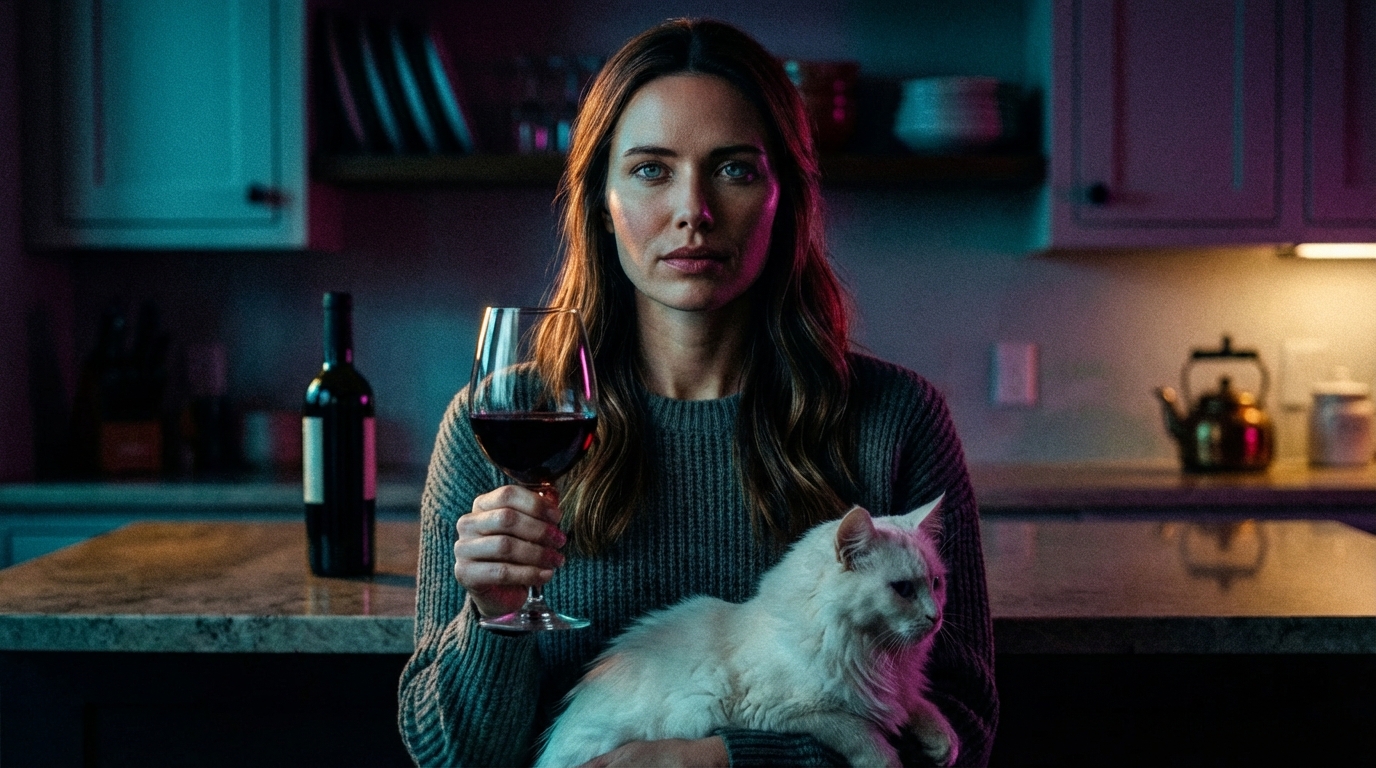
The discovery traumatised Gladys profoundly. She began self-medicating. Wine, which had always been present in her life as ritual and comfort, gradually became something more necessary. Not alcoholism in the clinical sense, but a coping mechanism for trauma she couldn't process, and for grief over Beatrix's loss.
In early 2018, Aurora Energy conducted random drug and alcohol testing—standard procedure for employees in positions with safety responsibilities. Gladys tested positive for alcohol in her system during work hours.
The result was swift and bureaucratically inevitable. Despite thirteen years of exemplary service, despite her contributions to infrastructure development and compliance procedures, despite the quiet respect she'd earned across the organisation—none of it mattered when set against failed testing and organisational liability concerns.
The termination came in early July 2018, officially characterised with the euphemistic language organisations employ to disguise dismissals. Gladys had violated workplace safety policies. The decision reflected established procedures applied consistently. No personal animosity existed, only institutional necessity.
For Gladys, the dismissal felt catastrophic. She'd built her entire adult identity around competent professional achievement. To lose that career not through incompetence but through personal failure—through inability to manage trauma properly—carried shame beyond mere unemployment.
She was thirty-six years old, professionally accomplished, and completely adrift. The future she'd planned had vanished. The career she'd valued had ended in disgrace she couldn't fully explain to others because explaining required discussing Brody's death, Beatrix's devastation, and her own unresolved grief.
And then things got immeasurably worse.
Transition to Clivilius and the Guardian's Burden
Between 24 and 29 July 2018, a catastrophic sequence of events shattered what remained of Gladys's world. What began as a simple errand for her friend Jamie Greyson's partner, Luke Smith, escalated into witnessing impossible inter-dimensional portals, discovering horrifying truths about Brody Taylor's death that Beatrix had hidden for years, and encountering violence that far exceeded her capacity to process.
A water bottle message from Jamie—sent through the Portal from Clivilius—revealed not only that her missing friend was alive in another dimension, but that Brody had been murdered, and Beatrix had known. The wine-fuelled confrontation with her sister that night transformed Gladys from dutiful compliance officer to active conspirator, burning evidence in her kitchen sink whilst her understanding of truth, family, and institutional trust collapsed entirely.
The week culminated in Cody Jennings's death on 31 July 2018. After his final breath, Gladys became the Fourth Guardian of Belkeep—a role she neither sought nor understood, but one that granted her passage between worlds through the Portal.
As Guardian, Gladys could return to Earth whenever necessary, maintaining contact with her parents, and occasionally seeing Beatrix when her sister travelled back through her own Portal. But within Clivilius itself, Gladys found herself profoundly isolated. Her Guardianship anchored her to Belkeep—a frozen, struggling settlement locked in perpetual winter—whilst Beatrix and Luke had become Guardians of Bixbus, and Jamie remained in that same distant settlement. The geography of Clivilius separated them as surely as dimensional barriers once had.
In Belkeep, Gladys adapted as she always had—methodically, pragmatically, and with wine as her constant companion. The settlement proved precarious, struggling with resource scarcity, psychological toll, and threats she was still learning to understand. Yet her professional background in infrastructure resilience and regulatory frameworks found unexpected application in this frontier community that desperately needed exactly those skills.
For years, she worked within Belkeep's governance structures, contributing to survival strategies whilst maintaining her Earth connections through the Portal. She could speak to her parents, update them carefully on a life they couldn't fully comprehend. She could coordinate with Beatrix on Earth, though their relationship remained complicated by revelations neither had fully processed. But she could not reach Jamie, Luke, or Beatrix within Clivilius itself—the hostile terrain and deteriorating conditions made Belkeep effectively unreachable from any other settlement.
That isolation endured until early 2027, when Beatrix—working through the Bixbus Office of External Settlements—finally located Belkeep through a coordinated cartographic audit. The establishment of a temporary high-bandwidth relay line allowed the sisters to speak directly within Clivilius for the first time in nearly a decade, marking both a profound personal reunion and a historic operational milestone in Guardian coordination.
The connection that followed transformed everything. Between 2028 and 2030, a phased relocation programme moved most of Belkeep's population to Bixbus, ending decades of isolation. By mid-2030, Belkeep ceased operating as a civilian settlement, redesignated instead as a Remote Research and Heritage Zone administered by the Clivilius Environmental Research Authority.
Gladys remains Guardian of Belkeep, though the nature of that guardianship has shifted. The methodical professional who once documented compliance violations now oversees a site of historical and scientific significance, building frameworks for preservation rather than survival. She maintains connections across dimensions—to her parents on Earth, to Beatrix and Jamie now accessible within Clivilius, to a settlement that endures not through population but through memory.
She still drinks wine. More than she should, probably, though the definition of "should" feels increasingly irrelevant when you've watched a settlement die and been reborn as its archivist. The cats, Chloe and Snowflake, are long gone, and she thinks about them sometimes with a grief disproportionate to their significance. Her relationship with Beatrix remains complicated, improved by proximity but scarred by years of revelation and distance. She sees Jamie occasionally, their friendship enduring but changed by everything they've survived separately.
The responsible elder sister, the meticulous compliance officer, the reluctant Guardian—Gladys continues adapting to roles she never chose, carrying burdens she never wanted, in a world she never imagined. She builds order from chaos as she always has, though the wine helps more than the organisational frameworks ever did. She's not perfect. She's not even entirely okay. But she endures, because that's what she's always done. Because someone has to. Because she doesn't know how to do anything else.