4338.205 · July 24, 2018 AD
Foundations in the Sand
Luke wrestles a mountain of tent boxes across the Portal, each load a labour that feels more like ritual than effort. As the structure takes shape in promise rather than form, he senses Clivilius shifting from a solitary refuge into the beginnings of community—an era he knows he can no longer face alone.
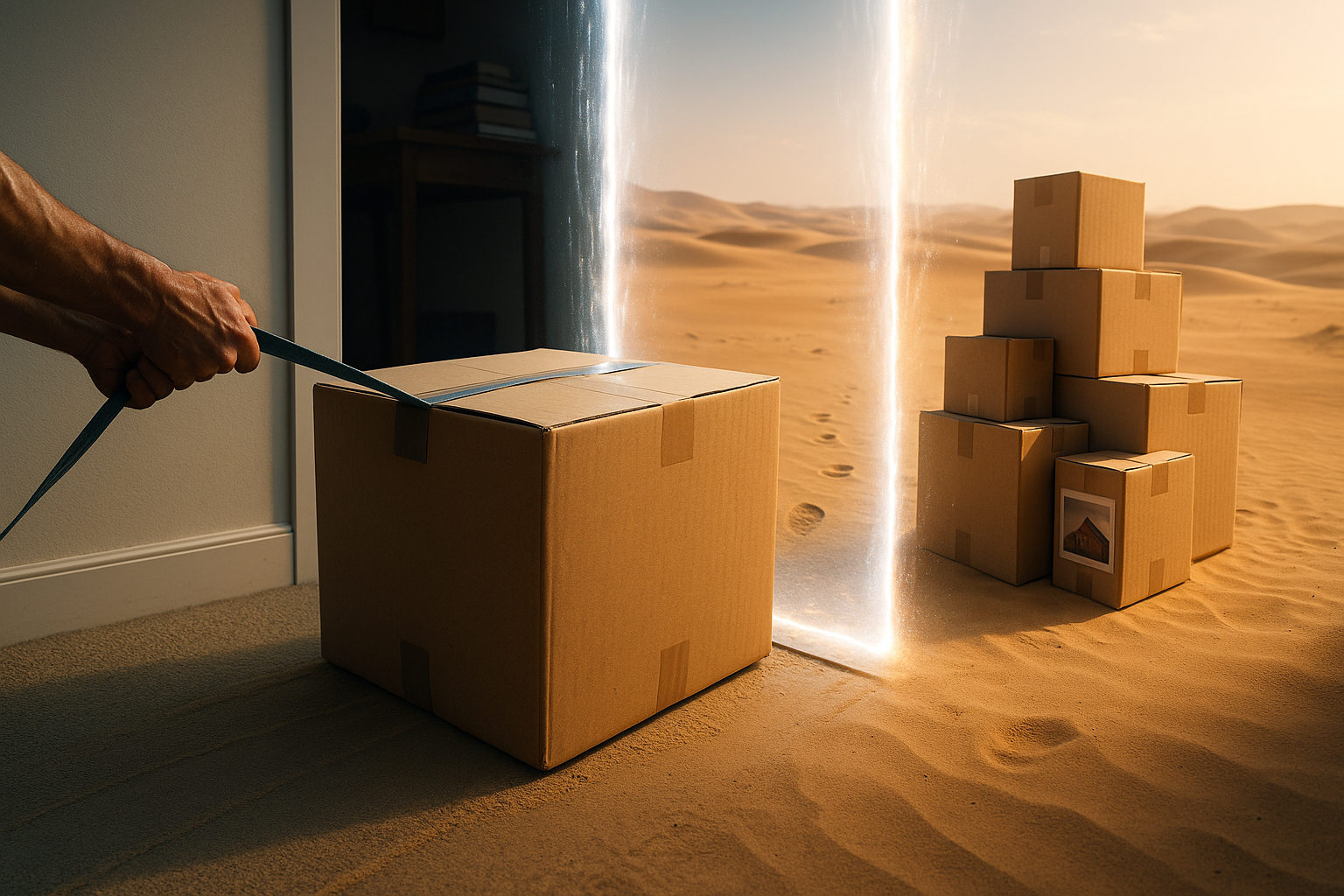
“Every box I dragged through the Portal wasn’t just weight—it was a declaration: this world and mine will no longer live apart.”
The first box went through easily enough.
I'd grabbed it from the top of the nearest stack—one of the smaller ones, mercifully, light enough that I could lift it without my spine lodging a formal complaint. The cardboard was sturdy beneath my fingers, still carrying the cold from the delivery truck, the company logo glaring up at me in colours that seemed aggressively cheerful for something that was about to cross between dimensions.
The portal waited against the study wall, its surface a churning display of light that I was already learning not to stare at directly. Something about those colours made the eyes want to follow them, to trace their impossible trajectories until you lost track of which way was up. Better to focus on the practical task at hand. Better to treat this like what it was—a doorway—rather than the miracle it actually represented.
I stepped through.
The transition was becoming familiar now, that brief instant of dissolution where the study released me and Clivilius claimed me in the same breath. No gap between departure and arrival. No passage through some liminal space. Just one reality folding into another with the seamlessness of a page turning.
The desert air hit my skin immediately—dry and cool, carrying the particular stillness that only truly empty places possessed. The blue sky arched overhead in that endless way it had, unmarred by clouds or contrails, so vast and clean it seemed almost to hum with its own emptiness. Beneath my bare feet, the ochre sand shifted with each step, grains warm from the sun despite the air's coolness.
I set the box down near the portal's threshold, where the colours still flickered and danced against the invisible membrane that separated here from there. The cardboard looked ridiculous in this setting—so aggressively manufactured, so obviously from somewhere else. Brown corrugation and shipping labels and barcodes, sitting in sand that had never known human footprints before mine.
The contrast made me smile. This was what I was doing, wasn't it? Bringing Earth to Clivilius, one ridiculous box at a time.
I went back for another.
The rhythm established itself quickly: cross to Clivilius with a load, deposit it in the growing pile, return through the portal's patient shimmer, select the next box, repeat. My arms began to ache after the third trip. By the fifth, my shoulders had joined in the protest, muscles burning with the particular complaint of work they hadn't signed up for. Sweat gathered at my hairline, cool against my skin whenever I stepped into the desert's dry air, warm and prickling when I returned to the house's enclosed humidity.
Each crossing carried its own small ceremony. I couldn't help it—some part of me insisted on marking the significance of what I was doing. This wasn't just cargo hauling. This wasn't just the practical labour of moving objects from one place to another. Every box that landed in the ochre dust of Clivilius was a declaration. A commitment. Proof that I wasn't content to be a tourist in this impossible place, passing through without leaving any trace of my presence.
The pile grew. Boxes leaned against each other at angles that defied any attempt at orderly stacking, their various sizes refusing to cooperate with my spatial reasoning. Some had shifted during the crossings, their contents settling in ways that threw off their balance. Others had acquired a fine coating of orange dust from their contact with the sand, the cardboard already adapting to its new environment.
It looked chaotic. It looked like the aftermath of some very poorly planned house move, abandoned halfway through by movers who'd lost the will to continue.
It looked like the beginning of something.
That thought caught me off guard, arriving with an emotional weight I hadn't anticipated. Standing there in the desert light, sweating and sore, surrounded by the scattered evidence of my late-night impulse purchase, I felt something shift in my chest. This wasn't just camping equipment anymore. This was the seed of whatever came next. Shelter waiting to take form. Canvas and poles and stakes that would eventually rise from this sand and create a space where human presence could exist without diminishing the vastness around it.
For the first time since discovering the portal, I was building something. Not just passing through. Not just marvelling at the impossible and then returning to my ordinary life. Building.
The thought was terrifying and exhilarating in equal measure.
I went back for more.
The smaller boxes were gone now, claimed by my earlier trips, and what remained were the serious ones. The first of the large boxes resisted my initial attempt to lift it, its weight settling into my grip with the particular stubbornness of objects that knew they were too heavy for one person. I adjusted my stance, found a better grip, and hoisted it against my chest with a grunt that echoed slightly in the empty hallway.
The cardboard edges bit into my forearms as I walked, leaving faint impressions that I knew would still be visible hours from now. My back had begun to voice more serious complaints, the muscles along my spine tightening with each step. The box's weight seemed to increase the longer I held it, gravity conspiring with fatigue to make the burden feel heavier than physics should have allowed.
Through the portal. The brief transition. The desert air washing over me like relief. The box hitting the sand with a muted thump that sent a small plume of dust curling upward.
I stood there for a moment, hands on my knees, breathing harder than I wanted to admit. The pile had grown into something resembling a small fortress now, cardboard walls rising at angles that would have sent any architect into conniptions. Somewhere in that chaos was everything I'd need to create shelter here—canvas and frame and the promise of space carved out from infinite emptiness.
One more box. There was always one more box.
The final one waited for me in the living room like a challenge issued by the universe itself.
I'd been avoiding it, I realised. Consciously or not, my earlier trips had skirted around this particular carton, selecting lighter options while leaving it to loom in the corner like some cardboard monument to my own overreach. It was the largest of the lot, its dimensions suggesting it contained the main tent structure rather than accessories or peripheral components. The kind of box that belonged on a trolley or a forklift, not in the arms of a thirty-four-year-old who hadn't seen the inside of a gym in longer than he cared to admit.
I approached it the way you might approach a sleeping animal—cautiously, with deep respect for its potential to cause harm.
My first attempt at lifting it was almost comical. I squatted properly, engaged my legs like all the advice suggested, curled my fingers around the cardboard edges... and nothing happened. The box shifted perhaps an inch, grudging and resentful, before my grip failed and it settled back into place with a soft thud of cardboard against carpet.
A laugh escaped me—breathless and slightly bitter, the sound of a man confronting his own limitations. Of course. Of course the final obstacle would be the heaviest. Of course this particular box would be the one that demanded more than I had to give. Life had a fondness for these narrative flourishes, these last-minute complications that tested resolve just when you thought you'd made it through.
Exhaustion whispered suggestions I didn't want to hear. Leave it. Come back later. This didn't have to happen today. The other boxes were already through; whatever was in this final carton could wait. No one would know. No one would judge.
But I would know. And that was enough.
I crouched again, this time spotting the thin blue plastic strap that bound the box at its middle. The strip cut into my fingers when I gripped it, the edge sharper than I'd expected, but it gave me something to hold onto—a handle of sorts, a rope thrown to a drowning man. I wrapped my fingers around it and pulled.
The box scraped across the carpet with a sound that set my teeth on edge, cardboard against synthetic fibres creating friction that seemed almost personal. Each inch was a negotiation. Each foot was a victory. My shoulders burned. My biceps screamed. The hallway stretched ahead of me like a marathon course, walls closing in as I dragged, shuffled, and wrestled the impossible weight toward the study.
I bumped against walls more than once, the box's bulk throwing off my balance and sending me careening into plaster with graceless desperation. The carpet fought me, its fibres grabbing at the cardboard's edges as though trying to prevent me from succeeding. Every few feet I had to stop, releasing my grip to shake feeling back into my fingers, my breath coming in ragged gasps that would have embarrassed me if anyone had been watching.
No one was watching. That was the point. This was between me and the box, me and my own stubbornness, me and the simple question of whether I was capable of seeing something through to the end.
The study doorway felt like a finish line.
I collapsed against the frame, the box wedged awkwardly in the hallway behind me, my chest heaving with exertion that had nothing to do with mere physical effort. Sweat dripped from my forehead onto the carpet, dark spots that would dry without trace. My muscles trembled with the particular fatigue that came from pushing past sensible limits.
But I wasn't finished yet.
The box still needed to cross.
One more effort. One final heave. I found reserves I hadn't known I possessed, fuelled by something that felt less like strength and more like sheer bloody-mindedness. The plastic strap cut deeper into my palm as I pulled, and I welcomed the pain—it was proof of something, evidence that this struggle was real and therefore meaningful.
The box slid through the study, bumped against the desk, and finally—finally—crossed the portal's threshold.
The light wrapped around it in that way it had, colours bending and reforming as the cardboard passed through the membrane between realities. For a moment the box seemed to hang suspended, neither here nor there, and then it tumbled through and landed with a satisfying thump in the ochre sand of Clivilius.
I followed it through, my legs barely holding me upright, and stood surveying the chaos I'd created.
The pile looked different now. What had been a scattered collection of boxes had become something more substantial—a makeshift skyline of brown corrugation rising from orange sand, walls and towers and heaps that blocked the wind and created shadows and occupied space that had been empty since the beginning of time. It was messy. It was ridiculous. It was the most beautiful thing I'd ever built.
The desert air cooled the sweat on my skin, that dry breeze carrying away the heat of exertion and leaving behind something that felt almost like peace. I was flushed and drained and trembling, but beneath the physical exhaustion was a satisfaction that bordered on joy.
I had done this. Not with elegance or efficiency or any of the virtues people admired in others. Just with will. Just with the refusal to leave the job incomplete. And in that stubborn act, standing amid the evidence of my own determination, I understood something I hadn't before.
The bridge I was building between these worlds wasn't made of light or physics or the impossible technology of the portal. It was made of choices. Each decision to cross, each object carried through, each moment where I chose to commit rather than retreat—that was what connected Earth and Clivilius. That was what made this real.
My gaze settled on the largest box, the one that had nearly defeated me, and something caught my attention. The glossy print on its side, visible now at this angle, showed a photograph of the assembled tent. Canvas walls rising to a peaked roof. Wide awnings creating sheltered spaces. The kind of structure that could house a small family, that could become the centre of a camp, that could shelter multiple people from sun and wind and the vast indifference of empty landscapes.
The image struck me with unexpected force.
This wasn't just my tent. This wasn't just a shelter for my solitary explorations. This was something that could hold more than one person. Something that could become a place where others gathered, where conversation happened, where the loneliness of individual discovery gave way to the richer complexity of shared experience.
I'd bought it on impulse, thinking only of adventure, of camping beneath alien skies, of the simple romance of canvas and starlight. But standing here now, looking at that photograph, I saw something larger. A prototype. A beginning. The first structure in what might eventually become... something else. Something that included other people. Something that outlasted my individual presence.
Community. The word surfaced in my mind with a weight that surprised me.
I'd never been particularly good at community. The church of my childhood had tried to teach me its version, but that had always felt more like conformity than connection—a set of rules dressed up as belonging. My adult life had narrowed to Jamie and the dogs, a household of four that felt complete enough until it didn't. The friendships I'd maintained were shallow by design, kept at arm's length by my own preference for solitude and the exhausting performance that deeper connection required.
But this place... Clivilius didn't demand performance. It didn't require me to be any particular version of myself. And maybe—just maybe—that meant it could hold other people without the usual complications. Maybe the wonder of this place could create bonds that ordinary life had failed to forge.
The thought was both exciting and terrifying. Sharing Clivilius meant risking its contamination by doubt and scepticism and all the ordinary disappointments that came from exposing precious things to other eyes. But keeping it secret meant never knowing what it could become. Never testing whether wonder could be multiplied rather than divided when spread across multiple hearts.
I stood there for a long moment, letting the significance seep into me. The wind whispered across the dunes, carrying the particular silence of empty places, and I felt the weight of decision settling onto my shoulders.
The time for solitary wandering was ending. What came next would be richer, messier, more complicated in ways I couldn't predict. Jamie and Paul would bring their own questions, their own reactions, their own ways of seeing. And together—or separately, if it came to that—we would discover whether Clivilius could survive the transition from private refuge to shared adventure.
Earth waited for me. Jamie waited, somewhere on the road from the airport, carrying Paul toward a conversation I still didn't know how to begin. The house waited, with its accumulated tensions and unspoken questions and the ordinary demands of an existence I couldn't fully abandon, no matter how appealing the alternative.
It was time to go back.
Through the portal I went, the study reassembling around me with its familiar smell of books and dust, the blank wall already forgetting the colours that had danced across its surface. The carpet was soft beneath my sore feet. The air was warm and slightly stale, carrying the ghost of central heating and the particular atmosphere of a house that had been closed up too long.
Everything was as I'd left it. The world hadn't changed while I was gone.
Only I had changed. Only the quiet certainty in my chest, the knowledge that foundations had been laid in shifting sand, that something had begun which couldn't be undone.
With care that felt almost like reverence, I thought toward the portal: Close.
The response was immediate. Across the wall, the shimmer of colours folded inward, collapsing like a flower closing for the night, the light spiralling into a point that grew smaller and smaller until it vanished entirely. Where the doorway had been, there was now just an ordinary wall. Empty air, carrying no hint of the miracle it had contained moments before.
The silence that followed was heavy with finality. Two worlds had exhaled together, their brief connection severed until I chose to open it again. I lingered at the threshold of that absence, my hand brushing through empty space where the portal had been, aware that I was about to step back into a life that had grown more complicated while I stood among boxes.
The bedroom door called to me next.
Henri and Duke had been patient—patient by their standards, at least, which meant no audible destruction or sustained protest for the duration of my absence. The silence from behind that door suggested they'd settled into some form of acceptance, perhaps napping on the bed, perhaps simply waiting with the particular resignation of dogs who'd learned that confinement was temporary and eventual liberation was guaranteed.
I stood at the door for a moment, my hand resting against the familiar grain of the wood, listening to the small sounds of movement within. A shuffle. A sigh. The particular energy of two animals who sensed that something was about to happen.
Turning the handle felt like opening a different kind of threshold.
The door swung wide, and out they tumbled—Henri first, his rotund body propelling itself forward with enthusiasm that belied his usual commitment to minimal exertion. Duke followed half a second later, quicker and leaner, his eyes bright with the particular joy of freedom regained. They didn't stop to assess the situation or confirm that liberation was truly theirs. They simply erupted into the hallway, a whirlwind of fur and wagging tails and small excited noises that filled the space with an energy I hadn't realised I'd been missing.
I knelt, arms outstretched, and let them barrel into me.
Their warm bodies pressed against my legs and chest, their tails blurring with the force of their motion. Duke's tongue found my hand immediately, leaving a wet streak that I didn't bother to wipe away. Henri, never one for such displays but clearly pleased nonetheless, settled his weight against my thigh and looked up at me with eyes that seemed to ask where I'd been and why I'd taken so long and whether there might be treats involved in the apology.
For a heartbeat, their enthusiasm washed through me like a cleansing tide. All the tension of the past hours—the boxes, the struggle, the weight of decisions made and unmade—dissolved in the simple fact of two small creatures who were unambiguously happy that I existed. They didn't care about portals or other dimensions or the complicated calculus of sharing wonder with people who might not understand. They cared about me. About now. About the immediate reality of reunion after separation.
There was a lesson in that, probably. Something about living in the moment, about the wisdom of simple pleasures, about not overthinking everything into paralysis.
I scratched behind Henri's ears and let Duke lick my other hand and sat there on the hallway carpet, surrounded by evidence of ordinary life, feeling the last echoes of Clivilius fade from my skin.
This was not merely about letting two dogs out of a bedroom. This was about inclusion. About the slow expansion of circles, the gradual opening of doors that had been kept closed. I'd shared Clivilius with the pile of boxes now waiting in the sand. Soon I would share it with Jamie and Paul. And eventually—maybe—with others whose faces I couldn't yet imagine.
The thought filled me with equal parts anticipation and fear.
Until now, Clivilius had been mine. My secret. My sanctuary. A place where I could escape the noise of everything else and simply exist in wonder without having to explain or justify or perform. The idea of other people walking those dunes, breathing that air, bringing their own interpretations and reactions and complications—it made something in my chest tighten with protective instinct.
But even as I'd revelled in the solitude, some deeper part of me had known it couldn't last forever. Worlds weren't meant to exist in isolation. Stories weren't meant to be told to empty rooms. And whatever Clivilius was—whatever it might become—its potential would remain unlocked as long as I insisted on being its only witness.
The canvas of that other realm, so far marked only by my tentative explorations, was about to receive new colours.
Henri had lost interest in emotional significance and was now investigating a spot on the carpet with the focused intensity of a dog who suspected treats might be hidden in the fibres. Duke had embarked on his self-appointed patrol of the hallway, checking each doorway to confirm that nothing threatening had materialised during his confinement. Their practical concerns grounded me, pulling my thoughts back from the abstract toward the immediate.
Jamie and Paul would be arriving soon. The house needed to look less like the aftermath of a natural disaster. I needed to look less like someone who'd been wrestling furniture for the past hour. There were conversations ahead that would require whatever composure I could muster.
I pushed myself to my feet, joints protesting the motion, and surveyed the damage. The hallway showed scuff marks where the final box had been dragged. Sweat had dried into patches on my skin that probably looked worse than they felt. My shorts—still the same ones from this morning, from the delivery, from the swim in an alien river—were in no state to greet company.
A smile tugged at my lips, born of anticipation and apprehension and the strange courage that comes from having already committed to a path.
Whatever came next would not be simple. But it would be extraordinary.
And somewhere across the veil of reality, in a desert that existed beyond the reach of maps or physics, a pile of cardboard boxes waited in the sand. Promise and chaos. Potential and proof.
The foundations had been laid. Now came the building.
