4338.209 · July 28, 2018 AD
Following the Money
As Karl and Sarah dissect the financial records of the missing men, a sudden lead jolts the investigation forward—but it’s Karl’s buried familiarity with Jamie that clouds the evidence. With tensions rising and trust fraying, the team splits paths, and Karl heads toward a confrontation that will test more than just the facts.
“Paper trails don’t lie. But they don’t confess either. You’ve got to know what they’re trying not to say.”
The bank manager's resistance had been as predictable as it was infuriating—a bureaucratic shield constructed from policy manuals and the kind of self-importance only found behind plexiglass service counters. It had taken the combined force of my freshly printed senior detective credentials and Sarah’s unflinching charm—equal parts diplomacy and pressure—to prise the statements from his clenched fists. Even with formal authorisation, he’d handled each printout as if surrendering a family heirloom to a pair of wolves, every flicker of reluctance playing out across his tightly drawn face.
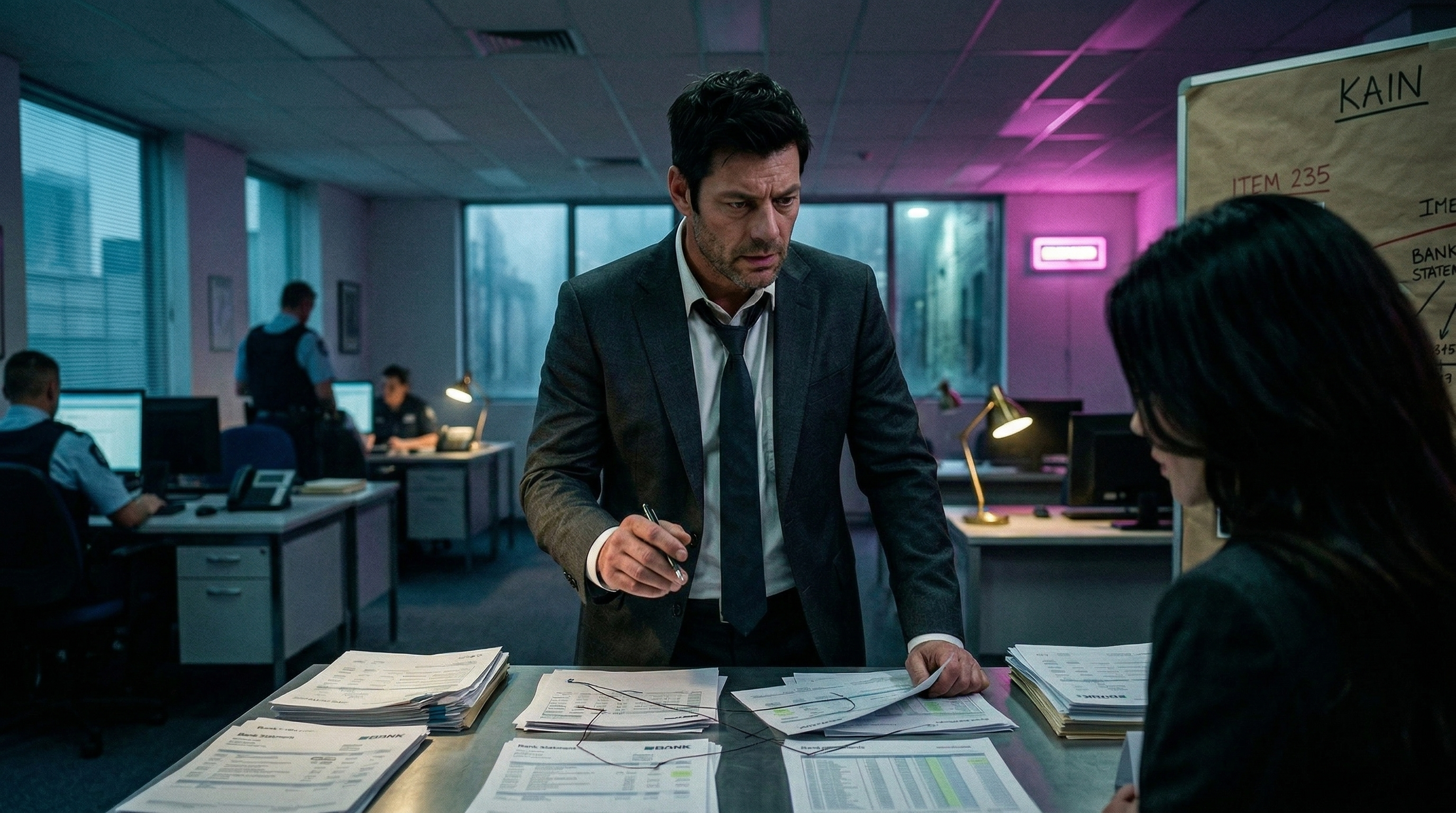
Now, back in the station’s open-plan office, the spoils of that administrative siege were spread across the desk like war maps.
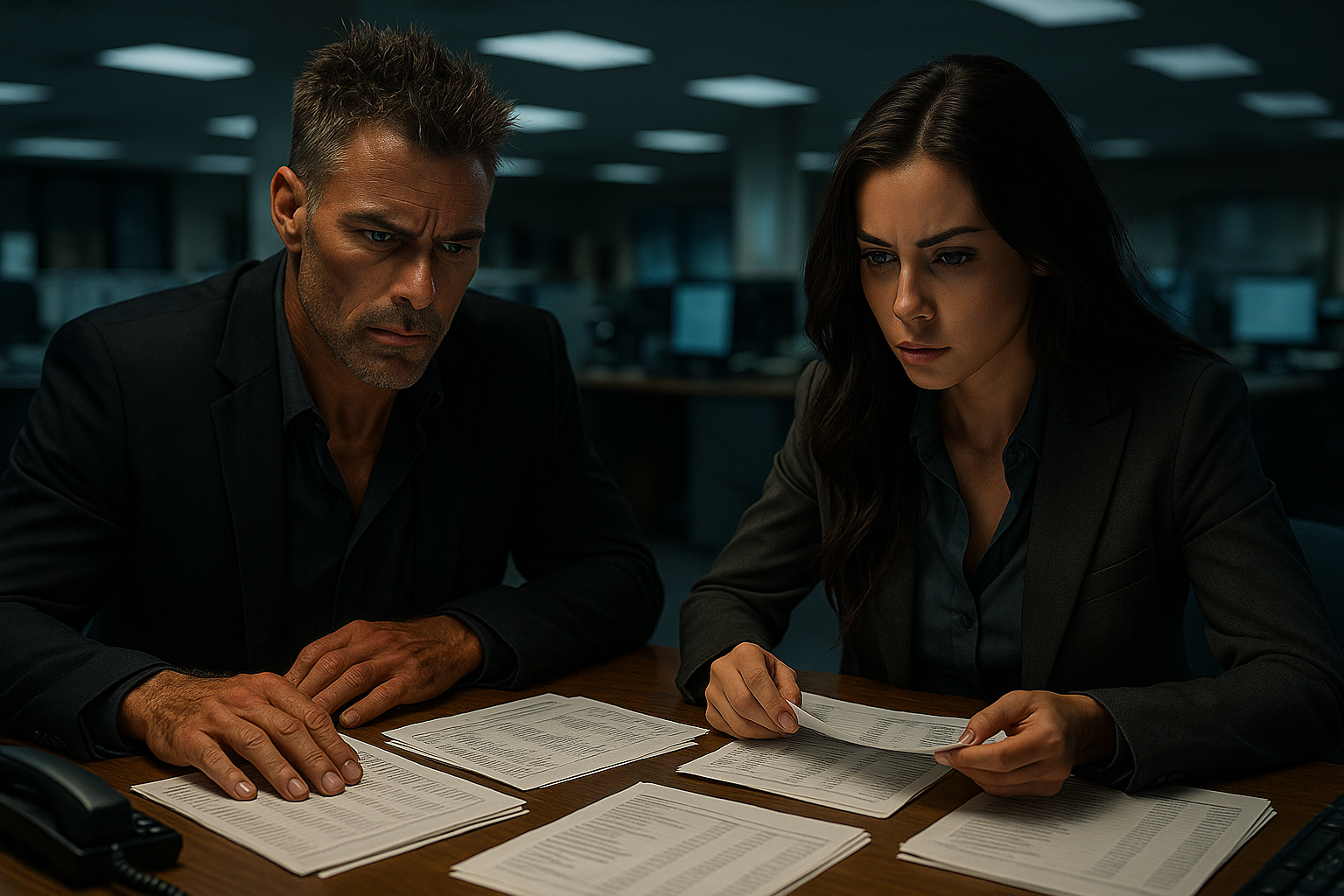
The documents lay in ordered piles—Kain’s on my side, Jamie’s on Sarah’s. Wordlessly, we’d divided the work. It had become our habit: a seamless collaboration that required no discussion. Just instinct. Fluorescent lights buzzed overhead, painting everything in flat, clinical shades. The harsh glow rendered the bank statements almost too sharp to look at—row upon row of transactional breadcrumbs, impersonal and absolute.
I pored over Kain’s records, methodically scanning for anything that diverged from routine. The tension behind my eyes was dull but constant, a hangover’s echo coupled with the pressure now anchoring itself to the base of my skull. Claiborne’s warning loomed like a watermark on every page, invisible to Sarah but impossible for me to ignore.
Jamie’s name kept slipping into my thoughts. Every time it did, my focus faltered—blurred like a photograph with the wrong subject in frame.
And it was never the version I’d glimpsed on Hobart’s streets over the years. Not the man with older eyes, a quieter posture, and a partner I hadn’t known existed. No—my mind kept dragging me back to him as he was: sharp, volatile, impossibly bright. That fragment of time in Brisbane when he burned too hot and I didn’t know how close I was standing to the fire.
And that overlap—past and present layered like misaligned transparencies—kept threatening to shatter the clarity I needed now more than ever.
Kain’s spending painted a portrait of simplicity. He lived at home. Modest means. No significant debts. Regular Tuesday fuel purchases, late-night food runs, the occasional splurge at the pub or online games. He was ordinary in the way that made people disappear easily. Clean finances. Predictable patterns.
Then—nothing.
No tapering off. No withdrawal. Just an abrupt cessation. Like someone had turned off the tap. I aligned the date with Louise’s statement. The sync was exact. Kain had vanished from the financial grid the same day he’d left to check on Jamie.
I stared at the final entry. A $1.99 Candy Crush charge. 11:03 PM. The night before.
It felt grotesquely mundane.
Across the desk, Sarah was a study in concentration. Her brow was drawn, eyes flitting across Jamie’s statements like they might unspool a confession if stared at long enough. A lock of hair had slipped free from her ponytail, curling down her cheek in quiet rebellion. In another life—another moment—I might have reached across the space between us to tuck it behind her ear. But this wasn’t that moment. This was now. And now was loaded.
"Well, that was a fruitless exercise," I muttered, leaning back in my chair. The frame groaned in protest. It felt fitting.
Sarah didn’t respond. Still absorbed, still analysing.
I kept talking—half to fill the silence, half to anchor myself in logic.
"Unless Kain’s got some secret investment portfolio or a sugar daddy on the side—which seems unlikely given how generous his parents are—he’s working with a very simple budget. There’s no evidence of a ferry trip, no plane tickets, no hotel charges. Just routine transactions and... that’s it."
I tapped the last line on the page. "And then, nothing."
Sarah’s head snapped up, sudden and sharp. Her eyes locked onto mine.
"But?" she prompted.
I raised the page slightly between two fingers, the printed timestamp visible in the corner. "Looks like Kain’s a Candy Crush fan. Bit of a binge, actually. He made a few small purchases around eleven the night before he disappeared. But I don’t see how that helps us determine what happened after he went to see Jamie." I paused. "If he ever did."
The words came out quieter than I’d intended, laced with uncertainty I hadn't meant to share. I leaned back, interlacing my fingers behind my head, the posture relaxed but the tightness in my chest anything but.
"You don’t think he did?" Sarah asked, surprise colouring her voice.
I hesitated. "I’m not sure."
And I wasn’t. Instinct warred with logic. The pieces didn’t quite fit. If Kain had made it to Jamie’s house, why hadn’t there been any signs of interaction? Why hadn’t Luke mentioned anything more definitive? Why did Kain’s digital footprint vanish before he’d even left his mother’s driveway?
Was it possible he’d never arrived? Or had something happened after he got there?
I watched Sarah as she turned back to Jamie’s records, eyes scanning lines with surgical precision. She didn’t ask more questions. Didn’t push. She knew that look in my eyes—had seen it before. It meant my thoughts were spiralling through probabilities and pasts, cycling through what-ifs too fast to vocalise yet.
The room fell into a quiet rhythm. Pages rustling. The dull hum of the fluorescents. The distant murmur of colleagues in the bullpen. Outside the windows, the winter afternoon strengthened, shadows stretching long across the coarse carpet like cracks beginning to form in the surface of everything we thought we knew.
Two men missing. No digital trail. No financial footprint. Just silence.
Whatever this was, it wasn’t random.
And the deeper we dug, the more certain I became—
"Well, I might have something."
Sarah’s voice broke the silence, and my head came up from the page. There was a note of triumph in her tone, the kind of restrained excitement I recognised instantly—half satisfaction, half adrenaline.
She slid the final page of Jamie’s financial records across the desk towards me with the flourish of a prosecutor revealing a smoking gun. Her finger landed decisively on a single line near the bottom, the black ink under her nail catching the light.
"There. Look at the last transaction," she said, urgency lacing her words.
I leaned in, eyes narrowing as they settled on the entry. A significant withdrawal—substantial enough to raise eyebrows. More than enough to matter. Jamie had emptied his account in one sweep. Every last cent.
"Possibly," I murmured, giving a small nod. The timing was compelling, aligning neatly with the timeline we’d built. But context was everything. A large withdrawal wasn’t evidence. It was a question. And questions, in this line of work, were landmines if you moved too quickly.
"Possibly?" Sarah repeated, incredulous. "Only possibly? This is huge!"
She stared at me, a blend of disbelief and challenge in her eyes, the page still between us like contested territory. I could feel her leaning in, mentally building her case even as she waited for mine to fall away.
"But it doesn’t prove anything," I said carefully, keeping my tone level. "It gives us a timestamp, yes. But we don’t know the circumstances. He could’ve been planning a trip. Paying someone back. Buying something in cash. Context matters, Sarah."
I could see the restraint in her jaw, the tension coiling beneath her skin.
"He totally drained his bank account in a single transaction three days ago," she argued, voice tight. "Louise is clearly justified in suspecting some sort of foul play."
I resisted the urge to sigh, even as frustration began to simmer beneath my composed surface. Sarah was sharp—her instincts often scarily accurate—but sometimes, accuracy required patience. Discipline. A willingness to let the facts breathe before choking them into confession.
"I reckon that Luke Smith killed Jamie," she pressed on, voice rising as her theory spilled out. "Then Kain caught him covering up the body, so Luke killed him too."
The words hit the air with the kind of certainty that only inexperience could produce.
There it was.
Her first big case. The scent of a homicide investigation in the air. The rush of blood as pieces began to click together—only the pieces were still puzzle fragments, and she’d already painted the final picture.
I stood too fast.
"Sarah!"
The name cracked through the open-plan office. Sharper than I intended. Louder. Final.
It was as though the station inhaled collectively. Conversations paused. Fingers lifted from keyboards mid-keystroke. I could feel the gaze of every officer in the vicinity swing in our direction, their curiosity like a floodlight behind my back.
I realised I was standing now, looming above the desk, my voice still echoing faintly in the aftermath.
Sarah stared at me, stunned into silence. Her lips parted slightly, but no words came out.
I met the gaze of our colleagues one by one, letting them see the calm I was pulling over myself like a cloak. I wasn’t losing control. I wasn’t angry. I was correcting course. This was my first test—not as her partner, but as her superior officer. And in Major Crimes, the margin for error was vanishingly thin.
Slowly, I sat back down.
"This isn’t about hunches. Or gut feelings. Or cinematic narratives," I said, more quietly now, but with deliberate weight behind every syllable. "These are people’s lives. We don’t assume motive. We don’t declare suspects without cause. We gather. We examine. We prove."
Her shoulders dropped by a fraction. I watched her eyes refocus, the instinctive defensiveness giving way to something more grounded.
"I’m not dismissing the theory," I added, tone softer now, coaxing rather than reprimanding. "I’m saying we don’t start there. We start with the data. The confirmed facts. If that withdrawal means something, we’ll find out. If Luke’s involved, we’ll uncover it. But we do it right. No shortcuts."
Sarah gave a quiet nod, the fire in her gaze banked but not extinguished. That was good. I didn’t want to dampen her instincts. Just shape them. Guide them away from cliffs she hadn’t yet learned to see.
The hum of the office resumed around us—phones ringing, chairs squeaking, keyboards resuming their rhythmic tapping. Whatever moment we’d just had had passed. But the afterimage lingered.
I glanced down at the financial records again. The numbers hadn’t changed. Jamie had emptied his account. Kain had vanished into digital silence. And somewhere in the void between those two facts lay something we hadn’t seen yet.
The transactions were like stones skipped across a dark lake—each splash visible, but the depths they hinted at remained obscured. None of this was chaos. It was purpose. Intent. A story being told through omission.
The evidence, limited as it was, pointed in multiple directions. Perhaps Jamie had withdrawn the money to disappear. A man deciding, deliberately, to erase himself. A large cash reserve would allow him to remain undetectable, to live in the cracks between systems. If that was the case, leaving his car behind was clever—it would project an intention to return, maintain the illusion of temporary absence.
But why not just take the car? If he truly intended to go to Melbourne—as Luke claimed—his own vehicle would’ve made far more sense. No rental trails, no ID checks, no movement to track. Unless the Melbourne story was misdirection—either a lie Jamie told Luke, or one Luke had fabricated himself. Perhaps Jamie never left Tasmania at all.
And then there was Kain.
Had he simply been the dutiful nephew checking in on a troubled uncle? Or was there more? Could he have been helping Jamie escape? Acting as a getaway driver rather than a concerned visitor?
My thoughts tangled, looping through incomplete timelines and fractured motivations—until the knot loosened, ever so slightly.
"Aha!" The word escaped before I could suppress it.
"What?" Sarah looked up from her notes, curiosity sparking despite the tension still lingering from my earlier reprimand.
I didn’t answer immediately. My brain was racing, trying to catch up to the implication before the moment evaporated. Louise had said Kain had taken his ute—the vehicle now unaccounted for. If Jamie hadn’t taken his own car, that choice made more sense now. He didn’t need to. He had Kain’s.
"Sarah," I said, turning towards her with a surge of clarity I hadn’t felt all day, "if we can find Kain, he’ll lead us straight to Jamie."
Her eyes narrowed. "Are you sure?"
"Jamie has all the skills to go off-grid if he wants to," I said, before realising the weight of what I’d just revealed. The words had emerged from a place of memory rather than deduction—knowledge not gathered today, but from long before.
Sarah registered it. I saw it in the tiniest flicker of her eyes. She was too sharp not to. She didn’t call it out—yet—but the seed had been planted.
I pivoted, sharply. "I don't think you're going to find anything, but if Jamie has that much cash, he could’ve booked flights without leaving a digital trail. I want you to check both Hobart and Launceston airports—see if either Jamie or Kain have boarded a flight in the last five days."
"Okay," she said, the tone neutral, professional. But the curiosity hadn’t gone. Not by a long shot.
"And after that, given Kain’s ute hasn’t turned up, follow up with the ferry operators. If they crossed over to the mainland, that’s where it would have happened."
"I'm on it," Sarah replied, already shifting into motion. Then she paused. "And what are you going to do?"
The moment stretched.
"I'm going to visit Luke Smith."
Her mouth opened slightly, the beginnings of protest forming. "But—"
"Time is of the essence, Sarah," I said, cutting her off gently but firmly. "If I’m wrong and you’re closer to the mark, then Jamie and Kain could be in serious danger. We can’t afford to lose time. We need to divide and conquer."
She hesitated, then gave a small nod. But I saw the frustration tucked behind the movement—our partnership, unspoken though it was, had been built on shared space. Shared instincts. Shared rooms. Splitting up wasn’t our way. And she knew I wasn’t telling her the whole truth.
That twinge of guilt landed low in my gut. It sat alongside the nausea still shadowing me from the hangover, and the pressure pulsing steadily behind my eyes.
But I needed space.
Not just to think. To feel.
To sort through what was coming alive again in the darker corners of my memory. Jamie wasn’t just another missing person. He was Jamie. And Luke, now, was the gatekeeper to his present life—a man who had presumably shared the intimacies I once thought I’d understood.
I needed to hear his version without a second pair of eyes watching my reaction.
And I couldn’t risk Sarah seeing the shape of what this really meant for me. Not yet.
"Fine," she said eventually, her voice clipped with a kind of formal acquiescence. She began gathering her files, movements efficient but tight with restrained feeling.
I watched her go with a quiet sense of regret.
Then I pulled on my coat, grabbed my notebook, and headed for the exit, the familiar weight of duty settling against my shoulders. Only now it carried something else. Something older.
The confrontation with Luke Smith would be more than an interview. It would be a collision point—a test of truth, performance, and history.
Right then, Mr Smith, I thought as the station doors swung closed behind me. Let’s see what sort of lie you’ve built around the man I used to know.
