4338.205 · July 24, 2018 AD
Firewood and Fractals
Luke’s failed attempt at driving pushes him toward a desperate, absurd solution: bribing an Uber driver to ferry firewood home. As twilight deepens, the backyard becomes a stage for revelation, the Portal swelling to a new, impossible size—transforming ordinary tasks into extraordinary breakthroughs, even as Luke balances survival with the comedy of pizza deliveries and neighbourly secrecy.
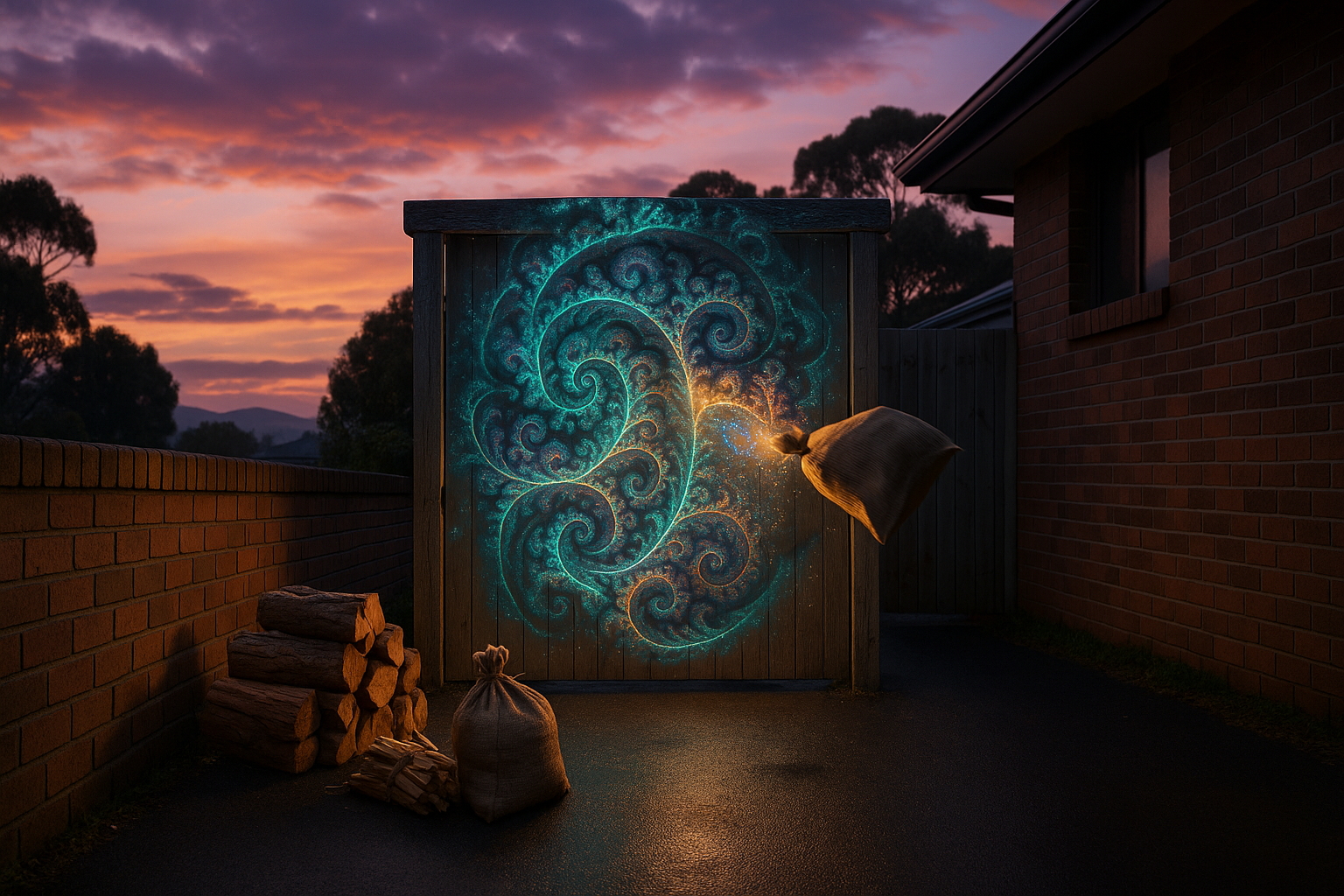
“Only I could order pizza and throw firewood through an inter-dimensional Portal on the same night—and call it progress.”
After ensuring Paul and Jamie were comfortably settled—Paul sprawled on the spare mattress I'd dragged across, Jamie satisfied enough to mutter his thanks—I'd clicked my way through the digital marketplace, ordering additional tents with the detached focus of a man playing god in miniature.
The act itself had been soothing, each transaction a small brick laid in the scaffolding of our expanding encampment. Three more canvas tents, delivery expected within the week. Sleeping bags rated for sub-zero temperatures, because I had no idea what Clivilian nights might bring once winter truly settled in.
But once done, the screen darkened, and with it the distraction slipped away, leaving me exposed to the hollow echo of unspent energy.
The sun was already descending, painting the sky in bruised oranges and purples that seemed to stain the air itself. Shadows lengthened across the driveway, the familiar edges of home blurring under the swell of twilight. It was in that dwindling light I found myself seated in Jamie's car, its interior smelling faintly of fabric softener and old coffee, the steering wheel cool and indifferent beneath my palms.
The car: a vessel of freedom to most, of fear to me.
Through the windscreen, the horizon stretched vast and uncertain, daring me to cross it. My heart thumped erratically, each beat a reminder of the chaos within, my pulse ricocheting in the narrow cage of my chest. Jamie's words came back like an echo, annoyingly logical: perhaps it might be a good time to start liking it. A beacon of reason, yes, but reason did little to soften the dread snaking through me at the thought of moving this machine beyond the tame safety of the driveway.
I could navigate portals between dimensions. I could manipulate two grown men into following me into another world. I could spin webs of lies so intricate they required spreadsheets to track.
But a car? A simple machine with four wheels and an accelerator? That reduced me to jelly.
With a breath that snagged halfway down my throat, I twisted the key in the ignition.
The car responded like a reluctant beast dragged from sleep. A roar, too loud in the still evening, rattled up through the chassis—then faltered, breaking into a chorus of coughs and splutters. The vibrations juddered through my hands and up my arms, each stutter a tangible echo of my own reluctance.
Finally, with one last wheeze of mechanical despair, the engine gave up altogether, leaving a silence more damning than noise.
I sagged back into the seat, staring at the dashboard as though it had staged the failure on purpose—a silent conspiracy between man and machine, smug in its reminder of my limits. My reflection in the windscreen glared back at me, pale and pinched against the bleeding streaks of sky. I looked ridiculous: absurdly poised between laughter and panic, as if even my own face couldn't decide whether to mock or pity me.
"Damn it!"
The word tore out before I could stop it, sharp and jagged, followed by the thud of my fist against the steering wheel. The hollow sound reverberated pathetically through the cabin, my anger dissipating in the thin air like steam off a kettle.
"Stupid fucking cars," I grumbled, the muttered oath both an insult to the machine and a bitter admission of my own impotence.
Defeated, I pushed open the door and clambered out, my limbs stiff with tension.
The evening air hit me, cool and faintly damp, carrying with it the familiar suburban cocktail of eucalyptus and exhaust from a distant main road. I perched on the edge of the red-brick wall that marked the lip of our driveway, its rough surface digging into the backs of my thighs. It stood there as it always had—solid, indifferent, a silent witness to my private spectacle of defeat.
The absurdity of it wasn't lost on me: here I was, self-appointed colonist of an alien world, thwarted not by the challenges of survival or inter-dimensional logistics, but by a stubborn car. A general undone by his own transport.
With a sigh, I reached for my phone, the glow of its screen lighting my face as my thumb summoned salvation.
Uber. Reliable as ever, the app became my lifeline—modern technology still willing to bend to my needs, even if not in the form I had originally intended. The irony wasn't bitter so much as strangely comforting: if I couldn't master the car, I could at least master the app.
The arrival of the Uber was almost serendipitous—a sleek chariot of salvation that glided to the curb with a confidence I could only envy.
Its polished exterior caught the thinning light, reflecting back the last orange wash of the day as though mocking my ineptitude. The driver, a man whose face barely shifted beyond a raised eyebrow, listened politely as I explained my unusual request for a trip to the service station to purchase firewood.
If he thought me unhinged, he was professional enough not to say so. Perhaps he'd had stranger fares. Perhaps, in the grand taxonomy of Uber requests, a middle-aged man wanting to buy firewood ranked somewhere below "drive me around while I cry" and well above "help me move a body."
The brief negotiation over how to accommodate the bags of wood in his boot was smoothed over easily enough with the universal language of currency. A crisp note, pressed between fingers, dissolved his hesitation in an instant. I told myself it was merely efficient problem-solving, but the truth was plain: I was bribing my way out of one more inadequacy.
The return journey passed in a hush, the boot heavy with its fragrant cargo of split pine and kindling. Relief threaded through me at having circumvented my terror of driving, though its shadow lingered—a nagging sense that I had sidestepped growth rather than achieved it.
I pressed another twenty-dollar note into the driver's hand at the end, forcing a smile. "For a good rating," I said, the joke half-hearted, brittle, my own discomfort barely cloaked.
He grunted something polite, slid back into his seat, and was gone.
As the Uber's taillights disappeared down the street, I was left in the cool grip of late afternoon.
The air had taken on that unmistakable Tasmanian sharpness, the kind that seeps into your bones long before the sun has fully dipped. Long shadows stretched across the driveway, and though it wasn't dark yet, the early winter dusk carried its own quiet urgency. In another hour, the light would be gone entirely, and with it whatever warmth the day had managed to hold.
The firewood, stacked beside me on the driveway, looked almost triumphant—a soldier's ration secured after battle. I perched again on the red-brick wall, its chill pressing through my jeans, and the absurdity of it all welled up until I couldn't help myself.
My mind began to narrate the day's events in the style of some doomed polar explorer's journal:
Day One. Supplies secured after much peril. Native drivers appear cooperative when offered shiny tokens of trade. The beast of steel refuses to move under my command, but through cunning negotiation, wood has been acquired. Spirits: mixed. Reputation: dubious. Dignity: pending.
The parody coaxed a smile from me, small but genuine, and with it a loosening of the knot inside my chest. If survival demanded courage, then perhaps absurdity could serve as my armour. Perhaps the only way to face the impossible was to laugh at it until it became manageable.
My gaze lifted beyond the wood to the sun, still bright but inching towards its slow descent behind the mountains. The light had softened into a golden haze, the sort that both gilded and warned—beauty edged with the reminder of how swiftly darkness came in Tasmanian winter.
My stomach gave another audible protest, and I winced. In all the excitement, I had forgotten to eat. The last proper meal had been... when? Breakfast? Before breakfast? Time had lost its usual shape, stretched and compressed by crossings between worlds until I couldn't remember which hunger belonged to which dimension.
The thought of food surged suddenly, overwhelming the faint satisfaction of the firewood.
Pulling out my phone, I placed a quick call—modern convenience once again bridging the gap between survivalist drama and suburban reality. Pizza. Hot, greasy, gloriously uncomplicated pizza. With the order confirmed, a faint sense of smugness bloomed in me.
Dinner, secured with the press of a screen. No hunting required, unless you counted tracking the delivery driver on GPS.
Shoving the phone back into my pocket, I turned to the next task.
The wood waited, mute and solid, and I felt a prickle of anticipation climb my spine. This was the moment. The real test of what I'd been wondering since I first discovered the Portal could expand to fit its frame.
Glancing around with the exaggerated caution of a child about to raid the biscuit tin, I scanned for neighbours, for curious eyes that might be watching. The street was empty, the air too still for witnesses. Mrs. Patterson's curtains remained drawn. The Henderson kids were nowhere to be seen. Even the usual parade of dog-walkers had apparently decided to stay indoors.
I stepped closer to the back gate, aiming my Portal Key at the cool wood. A breath, a silent count—then the world answered.
The Portal flared into being with a suddenness that stole my breath.
A blossom of fractals bursting outwards, their colours coiling and folding into one another with hypnotic intensity. Against the drab domesticity of fence and brick, it was otherworldly: geometry alive, light stitched into impossible patterns that burned in the fading afternoon. The double gate became the canvas, the Portal stretching seamlessly between the brickwork of the house on one side and the boundary wall on the other, as though reality itself had agreed to play along with my clandestine theatre.
For a moment I simply stood, transfixed, my hunger forgotten.
The driveway, the fence, even the pile of firewood at my feet—all of it seemed like props in a performance that belonged to something larger than me.
The sight of the Portal, now significantly larger than its modest twin in the study, filled me with a thrill that hummed through every nerve.
It loomed across the gate like a living canvas, colours spiralling in fractal whorls, shifting too quickly to fully catch yet too mesmerising to look away from. For a moment, my breath stalled in my chest. The sheer scale of it dwarfed my earlier experiments, a revelation in itself.
If this was what it could do here—stretch and reshape to the boundaries of the frame—what else might it achieve?
How far might its reach extend if the corresponding screen in Clivilius were larger, higher, endless? The thought pressed at the edge of imagination, tantalising and vast, a corridor of possibilities yet unwalked.
But my stomach, ever the saboteur of lofty contemplation, reasserted itself with a growl so insistent it vibrated in my ribs.
Philosophy would have to wait.
Fuelled by hunger and practicality, I stooped and seized the first bag of firewood. Its weight dug into my fingers, the rough hessian scratching against my palms, but I hurled it forward with the determination of a man who had no patience left for ferrying.
The bag vanished in an instant, swallowed by the kaleidoscopic void.
Satisfaction surged sharp and bright—ridiculous though it was, the act felt profound. One bag gone, one problem solved. No trudging across the dust. No dragging, no straining, no awkward balancing of weight. Just throw and done, the Portal accepting my offering with the same indifferent hunger it accepted everything.
The rhythm took over.
Bag after bag followed, disappearing with the same strange, effortless ease, each toss a small victory over the logistics that had been gnawing at me all day. The Portal accepted them without complaint, the colours briefly bending around each load before snapping back into their endless dance.
By the time I brushed the dust from my palms, a small smile had crept across my tired face.
If Paul and Jamie are mad at me for throwing the wood through and not helping to take it to camp, I thought, the absurdity tickling at me as I rubbed my grumbling stomach, they will forgive me when the pizza arrives.
The smile widened, the idea of pizza—hot, tangible, ordinary—nestling comfortably against the marvel of inter-dimensional firewood logistics. It was a balance that only my life could produce, and in that moment, absurd though it was, it felt perfect.
