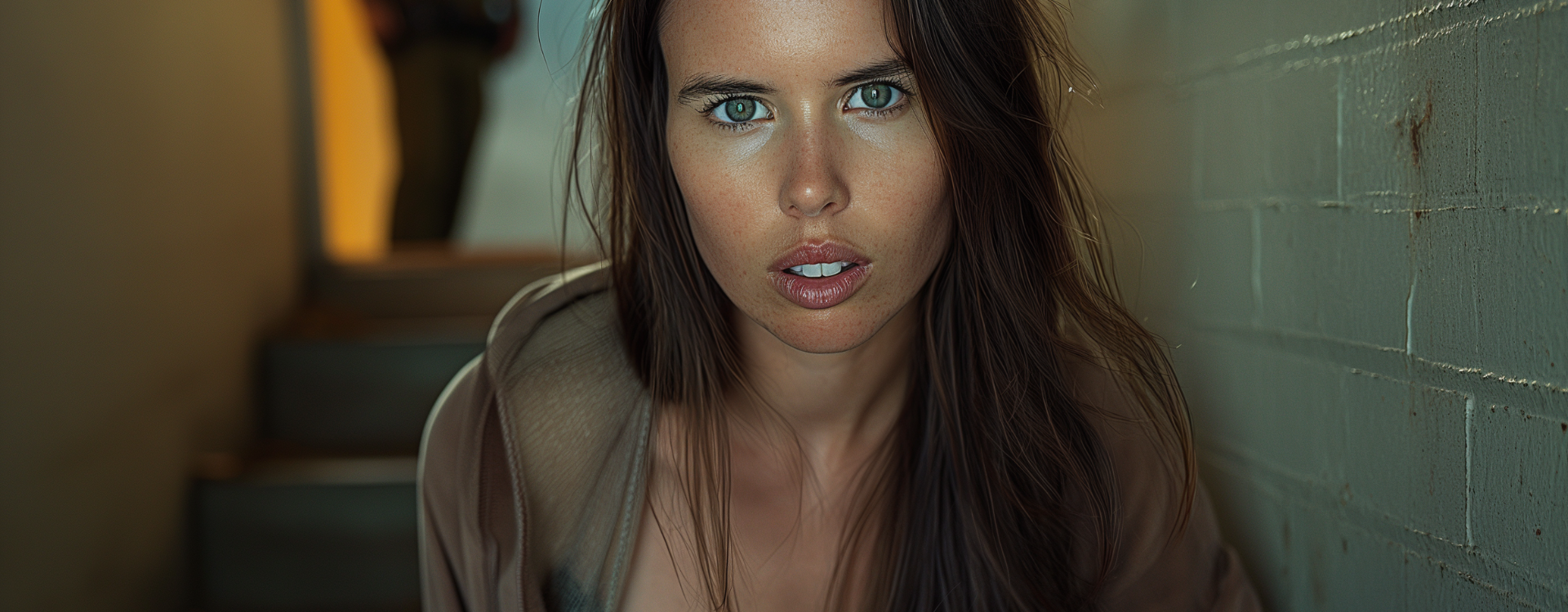
4338.213 · August 1, 2018 AD
Fire Exit
Gladys finds herself face-to-face with a seasoned interrogator, but as pressure mounts, a glinting object and a sudden shift in control unravel everything she thought she knew. When the walls close in, survival may hinge on a single decision—and a man whose motives remain terrifyingly unclear.
"Trust is a dangerous currency—especially when you’re not the one printing it."
"Gladys Cramer," said Sarah as she entered the small, windowless interview room. Her tone was businesslike, her face unreadable. The room itself felt like a trap, its blank grey walls pressing inwards, heavy with the absence of natural light. The air was still and stale, saturated with the silent echoes of confessions and denials long since past.
"This is Sergeant Claiborne. He’ll be conducting your interview with me today."
My eyes flicked up, and widened in surprise at the name. The Sergeant? My thoughts faltered. Is that really necessary? A chill danced down my spine as the full weight of my circumstances settled heavily on my shoulders. The presence of someone so senior transformed everything. This wasn’t a routine formality. It was serious—more serious than I had fully grasped.
Sergeant Claiborne took the seat opposite mine with a kind of poised certainty that made my pulse quicken. His frame was solid, his movements efficient and deliberate, betraying decades of experience. I could feel the weight of his gaze settle on me like an iron hand, his narrowed eyes dissecting every twitch of my face, every nervous breath. He wasn’t just observing—he was calculating.
I shifted in my chair, the motion stiff and awkward, and tried to regain control of my spiralling thoughts. Sarah touched Cody’s body, I reminded myself, seizing the memory like a shield. She was involved. Complicit, even. That meant she couldn’t expose too much without drawing scrutiny to herself. That meant she wouldn’t have brought the Sergeant into this—not if she had a choice.
A flicker of smug confidence returned, glimmering faintly beneath my growing dread. You’re safe, Gladys, I told myself, trying to draw strength from the cracks I saw in Sarah’s carefully managed façade. If she falls, you don’t fall alone.
Then the screech came—the jarring scrape of a chair being dragged across the hard concrete floor. It echoed through the tight space like metal scraping stone. Sarah pulled out the final remaining chair and sat beside the Sergeant, her expression still blank, but I saw it now—the tightness around her eyes, the controlled stiffness of her posture. She wasn’t as composed as she wanted to appear.
A cough escaped me—sharper than I intended—masking the surge of realisation rising in my throat. She didn’t want him here. The thought struck hard, rattling my fragile certainty. This wasn’t her call. She’s not in control at all.
And if she wasn’t… then who was?
That thought unravelled what little calm I had managed to cling to. The room hadn’t changed, but it suddenly felt colder, the shadows deeper. The rules of the game had shifted again—and this time, I wasn’t sure what role I was meant to play.
As Sarah bent over to take her seat, her movements brisk and methodical, she reached into the pocket of her blazer to retrieve a small, spiral-bound notebook. The action was so routine, so mundane, that I didn’t think twice about it—until a metallic clatter broke through the tense stillness.
A small, glinting object struck the desk with a sound far too familiar to ignore.
My breath caught violently in my throat. That must be Cody’s Portal Key! The thought shot through me like an electric shock, and I gasped aloud—loud enough to draw both Sarah’s and the Sergeant’s eyes. My hand instinctively jerked towards the edge of the desk, but I stopped myself just in time.
Sarah’s response was awkward and immediate. She lunged for the device, her reaction more panicked than she probably intended. But in her haste, she only succeeded in knocking it sideways, and the little object spun once before tumbling directly into my lap.
My heart slammed against my ribs. For one long, paralysing moment, I stared at the Portal Key lying innocently in the fold of my trousers, its surface cool against the trembling fabric. I wanted to close my hand around it, to keep it, to run. But I couldn’t risk revealing that I knew what it was. Every fibre of my being screamed to stay calm.
I carefully picked up the device, my fingers trembling. Holding it out towards Sarah, I hoped my face was blank enough to pass for confusion. Please don’t see that I recognise it. Please don’t see what this means.
"So sorry," Sarah said quickly, her voice forced into casualness but not quite making it. Her cheeks flushed as she plucked the device from my fingers, the contact between us brief but tinged with tension. She shoved it back into her pocket, her movements rushed, the unease hanging between us like smoke.
Then, as if on cue, Sergeant Claiborne stood. The chair legs scraped back loudly, a sound that made me flinch. He adjusted the cuffs of his uniform with a measured authority and turned towards the door.
"Thank you, Detective Lahey," he said, the politeness of his words completely undermined by his clipped, final tone. He opened the door with a swift pull and added, more pointedly, "I can take the rest of the interview from here."
The dismissal was not just professional. It was personal.
Sarah paused in the doorway, hesitation written in every line of her body. Her eyes met mine, and for the briefest second, all the posturing and procedure fell away. "I’m so sorry, Gladys," she mouthed, the words silent but unmistakable. Her eyes shimmered—not with tears, but with something close to shame.
I couldn’t hold it in.
"Damn it! You promised me, Sarah!" I shouted, slamming my cuffed wrists against the metal table. The sound rang out like a gunshot in the small room, a surge of rage and helplessness breaking through my chest.
But she was gone before I could say more. Her back disappeared through the door, the Sergeant guiding her out with a firm hand on her elbow. As they stepped into the hallway, I caught the Sergeant’s voice, low and clipped with anger. "What the hell did you promise her, Detective?"
The door swung slowly shut behind them, and though I leaned forward, every muscle straining, I heard no reply. Just the muffled drone of voices behind thick walls, words distorted and lost before they could reach me.
Then, a final thud as the door closed tight.
Silence.
The room was still, but inside me, everything was spinning. My hands—still cuffed—rested cold against the table. My palms stung. My throat was raw.
Cody’s Portal Key had been within reach. Sarah had been there. And now I was alone with only more questions, with only the sound of my pulse thudding in my ears and the oppressive weight of silence folding in.
Sitting silently in the interview room, the weight of time pressed down on me like a thick, suffocating blanket. The fluorescent light above buzzed faintly, its dull hum doing nothing to ease the brittle tension suspended in the air. The room—stark, windowless, and impossibly beige—felt like a vacuum, a small, sterile universe in which only my thoughts existed. They twisted and looped, feeding on each other, growing louder the longer the quiet stretched.
I waited.
Each minute seemed to fracture into shards of anxious eternity, distorting my sense of time. Minutes swelled into hours—or so it felt—before the door finally creaked open and the Sergeant returned. Alone.
His presence filled the doorway like a shadow cutting across light. Sarah was nowhere to be seen. The ache of that absence hit unexpectedly hard. Despite everything, a part of me had still been clinging to her presence—an imperfect ally in an impossible situation.
The Sergeant didn’t speak. He closed the door softly, the click of the latch echoing through the hollow space. Then, with a precision that suggested long practice, he pulled the vacant metal chair from beneath the table. The legs scraped across the concrete floor with a sharp, grating sound that made my skin crawl. Every movement was slow, deliberate—intimidating not by force, but by calculated restraint.
He sat with a casual authority, arms resting loosely on the table. His posture exuded confidence, the kind born not of arrogance, but of experience. He didn’t need to raise his voice or rush his questions. He knew that silence could speak just as loudly.
I kept my gaze steady, though my pulse beat unevenly beneath the surface of my skin. My fingers, still bound by the cold steel of the handcuffs, clenched unconsciously in my lap. I felt the tension in my jaw, the ache of exhaustion pulling at my limbs. I was bracing myself—for what, I wasn’t entirely sure. An accusation? A breakdown? A confession I didn’t even know I needed to make?
Still, I said nothing. And neither did he.
His eyes locked onto mine with an unwavering stare, cool and analytical. There was no warmth there, no trace of the sympathy Sarah had occasionally let slip. His gaze appraised rather than judged, like a surgeon assessing the depth of a wound.
I shifted slightly in my chair, the motion barely perceptible, but he noticed. Of course he noticed. Everything about him said he was trained to spot the smallest cracks in a person’s façade.
The silence between us expanded, thickened, until it became its own entity—a looming presence in the cramped room. It pressed against my chest, curled around my ribs, whispering reminders of everything I hadn’t said. Everything I didn’t know how to say.
Part of me longed to break it. To speak. To scream. To cry. Anything that might relieve the mounting pressure building behind my ribcage.
But another part—the part that had survived the last forty-eight hours—knew to wait. To listen first. To calculate. Because words couldn’t be unsaid. And whatever came next could shatter what little I had left to hold onto.
So I sat, caught in the Sergeant’s unwavering gaze, and waited for him to make the first move.
Much to my relief, just as the tension in the room reached its peak—just as I felt I could no longer bear the weight of Sergeant Claiborne’s stare—a loud knock on the door shattered the oppressive silence. The sharp sound jolted me upright in my chair, my breath catching in my throat. It was like the momentary gasp of air that follows surfacing from deep water—a brief reprieve from the silent suffocation of the interview room.
The Sergeant’s eyes flicked sharply towards the door, his expression tightening into a frown. Irritation radiated off him in palpable waves. "Excuse me," he said gruffly, the clipped edge of his voice betraying his annoyance. He rose from his seat with stiff formality, the metallic legs of the chair shrieking against the concrete floor, a discordant noise that made me wince.
The door creaked open.
"Sorry to interrupt you, Sergeant," came a woman’s voice—calm, composed, and unfamiliar. She spoke with the clarity of someone well-practised in navigating tense environments, but something about the way her tone barely wavered gave me the distinct sense that she didn’t want to be the messenger.
"What is it, Officer Langley?" Claiborne’s reply was laced with barely concealed impatience.
"We need to speak in private," Langley said, her words crisp and businesslike. But as she spoke, she leaned subtly to one side, just enough to glance past the Sergeant. Her eyes found me—sharp, assessing. There was nothing overt in her look, no cruelty or warmth, but it landed with force nonetheless. A shiver traced its way across my shoulders. That brief eye contact was enough to remind me I was still very much a mystery to them, a variable they hadn’t yet figured out. A threat, perhaps.
Sergeant Claiborne exhaled a quiet sigh, his lips pressed into a thin line. He gave a curt nod and stepped out into the corridor, pulling the door closed behind him. The latch clicked softly, yet it sounded final—like a lid shutting on a box I couldn’t escape. The silence that followed his exit was thick and immediate, cloaking the room in that same dense stillness I’d become all too familiar with. The chair across from me now sat empty, a hollow sentinel presiding over my unease.
Alone once more, I wrapped my cuffed hands tightly in my lap, pressing my thumb into my palm just to feel something—anything—other than dread. My mind spun with speculation. What had Langley seen or heard? Had they discovered something new? Or worse—had someone else spoken?
The minutes that followed dragged by, agonising and slow. My palms were damp, slick against my skin, and I could feel the cold sweat pooling at the nape of my neck. Every second ticked by like a drip from a leaking tap—relentless and maddening. I shifted slightly, the plastic chair creaking beneath me, the only sound in the otherwise suffocating room.
Then, at last, the door reopened.
Sergeant Claiborne entered, his posture still rigid but now edged with something new—urgency, perhaps. Or caution. Whatever had passed between him and Langley, it had altered the mood. His presence landed heavily in the room, as if he were bringing the weight of something I couldn’t yet see.
And I knew—something had changed.
Closing the door loudly behind him, the sound reverberated through the small room like the report of a gavel in a courtroom, stark and final. It broke the fragile tension that had hung, unspoken, between the walls. The sudden sharpness of it startled me, a thunderclap in a moment that had otherwise felt suspended in breathless quiet.
With only two long, deliberate strides, Claiborne crossed the room, each step landing with authority. He didn’t take his seat. Instead, he braced his broad frame against the desk, both palms splayed flat on the surface. His bulk seemed to loom over me, not in menace, but in tightly leashed purpose. His presence filled the room, pushing the oxygen thin.
Then he leaned in.
His dark eyes—steely, unreadable—locked onto mine with the kind of unblinking precision that pinned me in place. My breath hitched as he closed the final inches between us, his voice dropping to the faintest whisper.
"They’re listening to us."
The words slithered into my ear, intimate and urgent. I blinked, barely able to process the implication. The skin on the back of my neck prickled. Something shifted in the air, an invisible cord pulled taut with unspoken tension. The chill that swept through me was immediate and involuntary. I swallowed, hard.
Then, more command than request—"Don’t speak."
He pulled back, his eyes still locked on mine, and the unspoken warning there made my pulse quicken. My mouth parted in silent protest, but nothing came. It was as if the words had been stolen from me, locked up by the gravity in his tone.
I watched, unblinking, as his gaze flicked towards the surveillance camera mounted in the top corner of the room. A tiny red light glowed steadily… then blinked… then died.
The room fell darker somehow—more secretive, more dangerous.
"Come with me," he whispered.
The words felt heavy, loaded with something I couldn’t name. There was no hesitation in his voice, no room for negotiation. Only that firm, unwavering stare—so intense it felt like he was willing me to move with his eyes alone.
My legs obeyed before my brain could catch up. I pushed back from the table and rose shakily to my feet. It was madness to follow him—this sudden, inexplicable shift from interrogator to… what? Ally? But in that moment, instinct silenced reason. There was something in his urgency, in the way he stood so still and yet so forceful, that overrode doubt.
We moved in quiet unison to the door. He reached for my wrists and loosened the cuffs—not freeing me entirely, but enough that my hands could slip free with effort. The cold bite of the steel relaxed slightly. It was a strange sensation: a taste of freedom with the bitter aftertaste of continued suspicion.
"You’re still a suspect," he reminded me, voice low, just above a growl. I gave the faintest nod, the metal links of the cuffs clinking together with the movement. A reminder that I was not entirely safe. Not yet.
He tugged gently at the metal, ensuring it would look secure at a glance.
"Don’t make eye contact with anyone we might pass. And whatever you do, don’t open your mouth."
The words pressed down on me, each syllable low and deliberate. I could barely breathe through the knot in my throat, but I forced myself to nod.
I didn’t know where he was taking me. I didn’t know if I was heading deeper into trouble or further from it. But one thing was certain—there was no going back.
Sergeant Claiborne took a deep breath, the kind that seemed to press pause on the world for just a moment. Whether it was preparation or resignation, I couldn’t tell, but it was clear that something significant was about to unfold. He reached for the door with a purposeful motion, his shoulders squaring, posture straightening—as though he were putting on armour. When he stepped into the corridor, his presence transformed: solid, commanding, untouchable. He didn’t need a badge to demand respect; it radiated from him in waves.
I fell into step behind him, half walking, half jogging to keep pace with his long, unyielding stride. My heart pounded hard in my chest, every footstep echoing louder than it should have in the silence of the station’s corridors. The stillness was unnerving—no idle chatter, no typing, no phones. Just the rhythmic fall of our feet and the hiss of my breath.
We veered through sterile, grey hallways, fluorescent lights flickering above like a faulty warning system. There was no indication of where he was leading me. The unpredictability of it gnawed at my nerves, but I didn’t dare speak.
He pushed open the door to the fire escape. It groaned in protest, revealing a narrow concrete stairwell bathed in sickly yellow light. It smelled faintly of rust and cleaning fluid. We descended rapidly, two flights, the soles of our shoes striking each step with harsh finality. The cold metal handrail grazed my fingers every so often, grounding me in the physicality of it all.
Finally, at a door marked with bold red text—FIRE EXIT—Claiborne halted so abruptly that I nearly walked into him. He turned, and before I could react, his hands were on my shoulders. The sudden contact startled me. I froze, breath catching in my throat.
"I’m going to release you, Gladys," he said.
My heart lurched.
His grip was firm, grounding, not rough. His eyes, however, were another matter—dark, unwavering, the gaze of a man who expected absolute truth and had no time for half-truths. "But it has conditions. I need your help in return."
My knees nearly buckled beneath me, but I kept my stance. The metal cuffs still circled my wrists, a dull ache pulsing with every movement. I swallowed hard, throat dry. What choice did I really have?
"I know you recognised the device that fell from Sarah’s pocket," he said. His tone wasn’t accusatory—it was factual. It sent my mind into a tailspin. If he’d noticed that… what else had he seen?
A cold weight settled in my stomach. I kept my face still, but inside, questions exploded. What exactly did he know? And how?
I stayed silent, calculating.
"If you tell me what you know about it, who it belongs to—" He let the sentence hang, like bait on a hook. It was a trap, a test, an invitation. But it told me one crucial thing: he knew it was a Portal Key, even if he wasn’t saying it aloud. He wanted me to say it for him.
He studied me, then added, "Tell me what you know, and I can offer you protection."
That word—"protection"—burned through me like acid.
"Protection!" I spat, louder than I intended. The venom in my voice surprised even me. "Unlikely."
It wasn’t just scepticism—it was despair, disappointment, betrayal. I’d heard too many promises in the past few days, each one followed by someone vanishing, dying, or lying.
His eyebrows lifted slightly. "What’s that supposed to mean?" he asked, his tone clipped, touched with frustration—like he wasn’t used to being challenged.
Realising my misstep, I bit the inside of my cheek. Too late to take it back. My pulse roared in my ears.
I said nothing. The air between us tightened like a wire drawn taut.
"Gladys," he said again, more gently now, but still with the edge of command. His hands didn’t release me. They kept me anchored, whether I liked it or not. "Is Sarah a Guardian?"
The question blindsided me. My mind reeled—Sarah? A Guardian? The idea alone felt ignorant, wrong. I stumbled back a step in shock, but his grip caught me before I could lose my balance. For a moment, all I could do was stare at him, stunned.
"No," I whispered at last, the word nearly lost in the silence. My eyes dropped to the floor, to the worn linoleum and scuffed boots. "Not that I know of." It came out softer than I’d meant, filled with doubt I hadn’t known I carried.
And in that moment, I realised something worse—there was a lot I didn’t know.
"So, you know about Guardians, then?" Sergeant Claiborne’s voice carried a note of restrained enthusiasm, as though he had been waiting for confirmation, like a detective closing in on a lead he’d suspected all along. The faint gleam in his eyes unsettled me—it wasn’t gloating exactly, but it wasn’t innocent curiosity either.
I bit the inside of my cheek hard, the sting a punishment for my slip. Idiot, I scolded myself silently. How could I be so careless, so reckless with my words? A single reply, half-whispered, had cracked the door open to things I had worked so hard to conceal.
You can’t trust him, my mind hissed, a desperate voice clawing to be heard through the rising fog of anxiety. He could be one of them. My pulse quickened as the thought spread cold through me—the ones Cody warned you about. The ones who hunt Guardians. I could practically hear Cody’s voice, low and firm, repeating warnings I’d brushed aside. The weight of that realisation sank heavy into my chest. I felt like I was standing on a precipice, unsure whether Claiborne was going to pull me back—or push me over.
Then, in a move that shocked me, he reached for my wrists. The metallic clink of the cuffs being removed rang louder than it should have in the silence. It was swift, deliberate. "I don’t know what game you’re playing at, Gladys, but you’d better watch yourself," he said, his tone shifting into something steely and measured.
I rubbed at my raw wrists, now tender and marked with angry lines. The absence of the cuffs brought a hollow kind of freedom—one that felt more like a borrowed moment than a liberation. I kept my eyes down, not trusting myself to look up and reveal the storm behind them.
"You can’t begin to imagine the horrors you’re getting yourself involved in."
His words landed like a blow. You have no idea, I thought bitterly, blinking against the sting of tears. He didn’t know what I had seen, what I had lost. The mangled body of Cody. The betrayal of people I once thought I could trust. The chill of that darkness still clung to me like soot. Don’t you dare talk to me about horror, I screamed silently.
"Gladys," he said again, more gently now, the hard edge in his voice replaced with something almost paternal. He reached out, his hand tilting my chin up with surprising tenderness. I didn’t resist, but it felt like baring my throat to a blade.
"I know you’re not a Guardian, but you need to go into hiding. It’s not safe for you here."
His eyes searched mine, looking for connection, for a flicker of understanding. And despite everything—despite the fear and confusion—I felt a small part of me responding. Not in trust, not exactly, but in shared awareness. We both knew I wasn’t walking away from any of this unscathed.
How does he know so much? The question burned behind my eyes. He hadn’t just stumbled onto this. He’d known what that device was—knew it without needing to be told. His certainty chilled me more than his threats ever could.
"They have your fingerprints connecting you to the disappearance of Joel Gibbons," Claiborne added, his voice grave now, every syllable like a stone dropped into still water.
I opened my mouth to protest, to question, but I didn’t get the chance. With one powerful movement, he opened the fire exit, letting sunlight spill in around us like a flood.
"They will find you. If you have a Portal Key, I suggest you use it."
"Who will find me?" I asked, the question leaking out, timid and fragile. My voice barely carried over the sudden wind that had swept into the stairwell, stirring dust and uncertainty in equal measure.
There was no time for answers.
The door at the top of the stairwell creaked open with a long, groaning squeal. A sound that now signalled danger more than curiosity. My blood turned to ice.
"There’s no time now," Claiborne said, the urgency in his voice rising. He pushed me forward, not roughly, but firmly—like someone pushing a swimmer into the tide before the wave crashed down.
"Go!"
And so I did.
Squinting against the brightness, I stumbled into the open, my lungs inhaling the unfamiliar clarity of freedom. The door clanged shut behind me, its echo swallowing Claiborne’s final words.
I stood there for a moment, blinking furiously in the sunlight, disoriented and breathless. It was over. No—not over. It had only just begun. The world I had known, the rules I had lived by—they were gone. Replaced by this terrifying, shadowy landscape of Portals, Guardians, hunters, and secrets too deep to name.
I was alone now. Truly alone.
And I was on the run.
