Felicity Jane Massey
Detective Senior Constable Felicity Jane Massey has carved out a distinctive career path from the privileged suburbs of Sydney to the remote mining town of Broken Hill, where her commitment to justice and methodical investigative approach have made her an indispensable figure in rural law enforcement. Born on 15th August 1994 in Sydney, she emerged from an environment of professional excellence to forge her own identity as a dedicated police officer who brings metropolitan training to outback challenges.

Early Years and Family Background
Felicity Jane Massey entered the world on 15th August 1994 at Royal Prince Alfred Hospital in Sydney, the second child of David Massey, a cardiothoracic surgeon at Royal North Shore Hospital, and Catherine Massey (née Willoughby), a senior partner specialising in corporate law at Allens Linklaters. The Massey household in Mosman embodied achievement—her father's precise surgical hands had saved countless lives, whilst her mother navigated complex mergers and acquisitions worth billions. Her older brother, Michael James Massey, born in 1991, had already established himself as the model son, excelling in mathematics and showing early promise in financial analysis.
Growing up in their harbourside home, Felicity displayed characteristics that set her apart from her academically-focused family. Whilst Michael spent evenings reviewing stock portfolios with their father, Felicity could be found devouring crime novels or watching documentaries about cold cases. At family dinners, where conversation typically centred on surgical innovations or landmark legal precedents, she would interject with questions about fairness, justice, and the psychology of criminal behaviour—topics that earned bemused smiles from her parents who assumed this was merely a phase.
Education and Awakening
Felicity's years at Sydney Girls High School from 2008 to 2012 proved transformative. The prestigious institution, with its neo-Gothic sandstone buildings and traditions dating back to 1883, initially seemed another stepping stone in the Massey family's predictable trajectory of excellence. She excelled academically, particularly in English, Legal Studies, and Modern History, graduating with an ATAR of 98.5. However, it was her involvement in the debate team that truly shaped her future direction.
As debate captain in her final year, Felicity led her team to the state championships, arguing cases on criminal justice reform, juvenile detention, and Indigenous incarceration rates. One particular debate on mandatory sentencing in October 2011 left a lasting impression—she spent weeks researching case studies, interviewing a retired magistrate, and visiting the Justice and Police Museum. Her closing argument, delivered with controlled passion, drew a standing ovation and convinced her that law enforcement, not law practice, was her calling.
Her participation in student government as Social Justice Prefect saw her organise fundraisers for youth refuge centres and coordinate visits to Silverwater Women's Correctional Centre, where she met female inmates participating in education programmes. These experiences solidified her desire to work within the justice system from the ground level, much to her parents' initial bewilderment.
University Years and Professional Foundation
At the University of Sydney from 2013 to 2015, Felicity pursued a Bachelor of Arts in Criminology and Criminal Justice, deliberately choosing a path distinct from her brother's commerce degree and her parents' expectations of law or medicine. She threw herself into her studies with characteristic intensity, particularly excelling in subjects like "Psychology of Criminal Behaviour," "Policing and Crime Prevention," and "Indigenous Justice."
Her involvement with the university's Crime and Justice Society went beyond mere membership. As secretary in 2014 and president in 2015, she organised guest lectures featuring former police commissioners, criminal psychologists, and reformed offenders. Her honours thesis, "Community Policing in Rural Australia: Challenges and Opportunities," earned First Class Honours and included field research in Lightning Ridge and Bourke, foreshadowing her eventual move to regional NSW.
During university, Felicity also completed internships with the NSW Police Force's Policy and Planning Unit and spent a summer volunteering with the Aboriginal Legal Service in Redfern. These experiences exposed her to both the bureaucratic machinery of law enforcement and the human faces affected by the justice system, reinforcing her commitment to becoming a police officer who could bridge both worlds.
Police Academy and Early Career
Felicity entered the NSW Police Force Academy at Goulburn in January 2016, one of 156 recruits in Session 334. The academy's rigorous 30-week programme tested her physically and mentally. Standing at 5'7" with a runner's build from years of recreational jogging along Sydney Harbour, she initially struggled with the defensive tactics training but excelled in firearms proficiency, achieving the highest marksmanship scores in her session.
The academic components came naturally to her—criminal law, investigation procedures, and community engagement strategies aligned perfectly with her university training. However, it was during scenario-based training that instructors noticed her particular talent for de-escalation and witness interviewing. Senior Instructor Sergeant Raymond Clarke noted in her assessment: "Probationary Constable Massey demonstrates exceptional emotional intelligence and communication skills, particularly effective in domestic violence scenarios and mental health interventions."
She graduated in August 2017, ranked 8th in her session, with commendations in marksmanship and investigation procedures. Her assignment to Sydney's inner-west Local Area Command seemed strategic—a middle-class recruit placed in a diverse, challenging but not overwhelming environment to begin her career.
Sydney Streets and Growing Restlessness
From 2017 to 2018, Probationary Constable Massey patrolled the streets of Leichhardt, Annandale, and Balmain. The inner-west presented a kaleidoscope of policing challenges: drug-affected individuals in Norton Street plaza, domestic disputes in converted warehouse apartments, break-ins targeting Victorian terraces, and alcohol-fuelled violence spilling from King Street pubs.
Her first arrest, just three weeks into the job, involved a serial graffiti artist who'd been tagging heritage buildings throughout Glebe. Rather than simply processing the arrest, Felicity spent time understanding the 19-year-old's motivation, eventually connecting him with a legal street art programme. This approach—firm but fair, seeking understanding alongside enforcement—became her signature style.
However, after eighteen months of city policing, Felicity felt increasingly constrained. The inner-west command structure meant she was always one of many uniforms responding to incidents, rarely seeing cases through to resolution. She yearned for the deeper community engagement and investigative continuity her thesis had explored. When a position opened in Broken Hill in early 2018, she saw an opportunity her colleagues couldn't understand—trading Sydney's vibrancy for the isolation of the outback.
Broken Hill Transformation
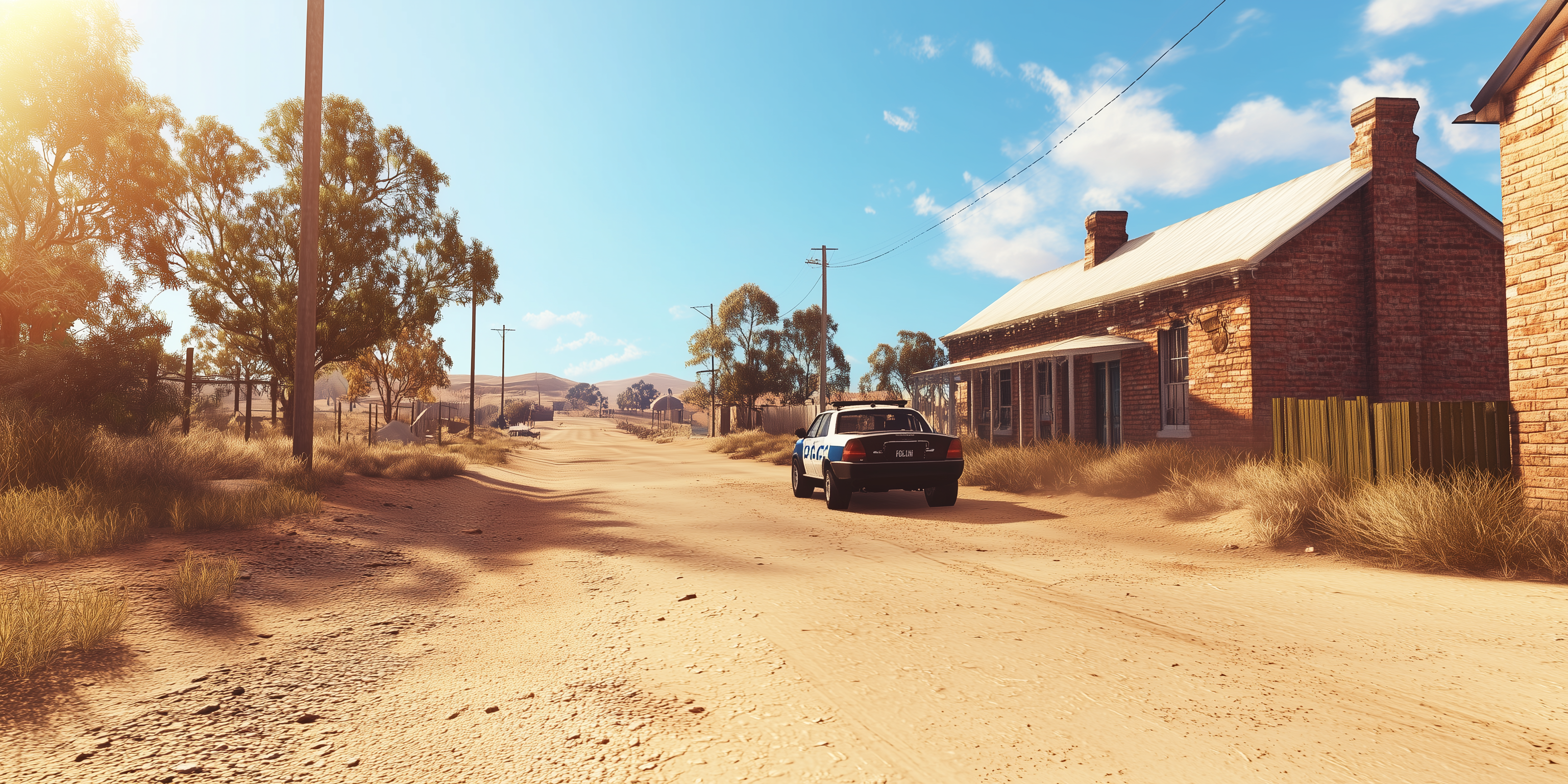
Felicity arrived in Broken Hill on 25th July 2018, driving her white Toyota Camry along the Barrier Highway as the red earth stretched endlessly toward the horizon. The mining city of 17,000 people, 1,100 kilometres from Sydney, represented everything her Mosman upbringing was not—harsh, isolated, and unapologetically working-class.
Her first days at the Broken Hill Police Station on Argent Street proved challenging. Senior Constable Brock George Polden, a burly local who'd never left western NSW, initially viewed her with suspicion typical of country cops toward city transfers. Detective Jeremy Marcus Harding, though professional, seemed to be waiting for her to request a transfer back to Sydney within months.
The Paul Smith missing person case, which landed on her desk just two days after arrival on 27th July 2018, became her proving ground. Claire Smith's theatrical desperation, Greta Smith's defensive hostility, and her colleagues' dismissive attitudes toward what they saw as "just another domestic" tested every skill she'd developed. While Brock and Harding drank midday beers at The Palace Hotel, joking about Claire's history of false alarms, Felicity meticulously documented witness statements and pursued leads others ignored.
Her thorough approach to the Smith case, including coordinating with Hobart authorities for welfare checks and maintaining detailed timelines despite jurisdictional challenges, earned grudging respect from her colleagues. By the time she and Brock visited the Smith house on Williams Street and discovered the unusual circumstances of Paul's departure—climbing through a bedroom window with a packed bag, as witnessed by neighbour Gertrude Thompson—even sceptical locals acknowledged her investigative instincts.
Finding Her Footing
The months following the Smith investigation saw Felicity gradually accepted into Broken Hill's insular police culture. Her friendship with Brock Polden developed slowly, built on shared experiences rather than forced camaraderie. Evening drinks at the Silver Crown Hotel became less about professional obligation and more about genuine connection, particularly after Brock's younger brother Drew returned from Adelaide with his journalism degree, providing another outsider perspective in their conversations.
Her promotion to Senior Constable in 2020 recognised not just her investigative skills but her ability to navigate rural policing's unique demands. She mentored probationary constables fresh from the academy, teaching them that policing in Broken Hill meant knowing every family's history, understanding how the mining roster affected domestic tensions, and recognising when someone's behaviour shifted from their baseline.
The isolation that might have broken other city transfers became Felicity's strength. She joined a local yoga class at the Broken Hill PCYC, finding stress relief in Wednesday evening sessions. She became a regular at Bells Milk Bar on Argent Street, where owner Margaret Bell would have her flat white ready before she ordered. These small connections, woven throughout the community, made her more than just a police officer—she became part of Broken Hill's fabric.
Meeting Daniel
In September 2019, Felicity met Daniel Thomas McKenzie at a Broken Hill High School careers day where she was presenting about law enforcement pathways. Daniel, teaching Year 6 at Burke Ward Public School, was chaperoning students interested in community service careers. Their initial conversation, ostensibly about youth crime prevention programmes, extended through lunch and continued via text messages over the following weeks.
Daniel represented everything Felicity hadn't known she was looking for—grounded where her family was ambitious, community-focused where her Sydney circle had been career-obsessed, and genuinely passionate about making a difference in young lives. His volunteer work with the Broken Hill Youth Centre and weekend involvement with local football coaching revealed someone who'd chosen meaning over money.
Their relationship developed naturally against Broken Hill's backdrop. Dinners at the Palace Hotel gave way to bushwalks in the Living Desert Reserve. Weekend trips to Menindee Lakes for fishing (where Daniel patiently taught Felicity to cast) alternated with quiet evenings at his cottage on Cobalt Street, marking Year 6 assignments whilst she reviewed case files. By early 2020, they were recognised as a couple throughout town, their partnership viewed as a merger of two essential community services—education and law enforcement.
Detective Promotion and Complex Cases
Felicity's elevation to Detective Senior Constable in March 2022 represented the culmination of her rural policing evolution. The Criminal Investigation Branch role meant leading serious crime investigations, coordinating with state-level resources, and mentoring junior detectives. Her first major case as detective involved a series of ram-raids targeting mining equipment suppliers, requiring coordination with South Australian police and mining company security teams.
Her systematic approach—creating detailed timeline boards, maintaining comprehensive witness databases, and pursuing financial forensics with the same rigour her brother Michael applied to audit trails—led to arrests within three months. The successful prosecution earned commendation from Regional Commander Superintendent Patrick Walsh, who noted Felicity's "exceptional ability to manage complex investigations whilst maintaining community confidence."
The investigation into Naomi Simmons' murder in January 2023 tested every skill Felicity had developed. Arriving at the John Dynon Gallery in Silverton at 7:40 AM on 14th January, she encountered a crime scene that transformed local vandalism assumptions into serial killer fears. The art installation setting, with Naomi's body positioned amongst abstract sculptures, required delicate evidence preservation whilst managing public panic.
Working alongside Detective Harding and Senior Constable Polden, Felicity coordinated witness interviews across Silverton's tight-knit community of 50 residents. Her ability to coax information from reluctant locals, developed through years of patient relationship building, proved crucial when gallery volunteer Thomas Mitchell finally admitted seeing a suspicious vehicle near the scene. The investigation's complexity—involving art theft, interstate connections, and potential serial offender patterns—showcased how far she'd evolved from the uncertain constable who'd arrived in 2018.
Personal Balance and Community Integration
By 2024, Felicity had achieved a balance many police officers struggle to find. Her relationship with Daniel had deepened into discussions of marriage, though both preferred their current unofficial partnership to formal ceremonies. Their Sunday routine—morning runs along the Barrier Highway followed by brunch at Silly Goat Café—became as predictable as shift rosters.
Her yoga practice evolved from stress management to teaching beginner classes at the PCYC, introducing other emergency service workers to mindfulness techniques. She joined the Broken Hill Literary Society, finding escape in monthly book discussions that ranged from Australian crime fiction to Indigenous poetry. These activities provided crucial separation from the darkness her work sometimes involved.
The weight of serious investigations—sexual assaults, child abuse cases, fatal mining accidents—took their toll. Felicity developed coping mechanisms beyond yoga: regular phone calls with her university friend Sonja Prowse, now a criminal psychologist in Melbourne; monthly video calls with her parents, who'd finally accepted her career choice after seeing her commendations; and journaling, filling leather-bound notebooks with observations about human nature and resilience.
Professional Recognition and Ongoing Challenges
Detective Senior Constable Massey's reputation extended beyond Broken Hill by 2025. Her paper on "Resource-Limited Investigation Strategies in Rural Settings," presented at the Australian Police Leadership Forum, drew interest from international law enforcement agencies facing similar challenges. She received offers from Sydney and Melbourne commands, promising fast-track promotion to Detective Sergeant, which she declined without hesitation.
Her current caseload reflects rural policing's breadth—from methamphetamine distribution networks exploiting mining town vulnerabilities to cold cases stretching back decades. The unsolved Paul Smith disappearance occasionally resurfaces in her thoughts, particularly whenever rumours surface of another local potential disappearance.
Working relationships have evolved into genuine friendships. Brock Polden, now Detective Sergeant himself, remains her closest colleague, their partnership built on mutual respect rather than rank. Detective Inspector Harding, promoted to regional coordination, specifically requests Felicity for complex investigations, knowing her combination of metropolitan training and rural intuition produces results.
