4338.209 · July 28, 2018 AD
Exposure
When Karl is interrupted mid-shower by his no-nonsense partner, Detective Sarah Lahey, it’s clear that something serious has broken. But as old colleagues clash and old power dynamics tighten their grip, Karl must bury his personal wreckage fast—because the case isn’t waiting, and neither is Sarah.
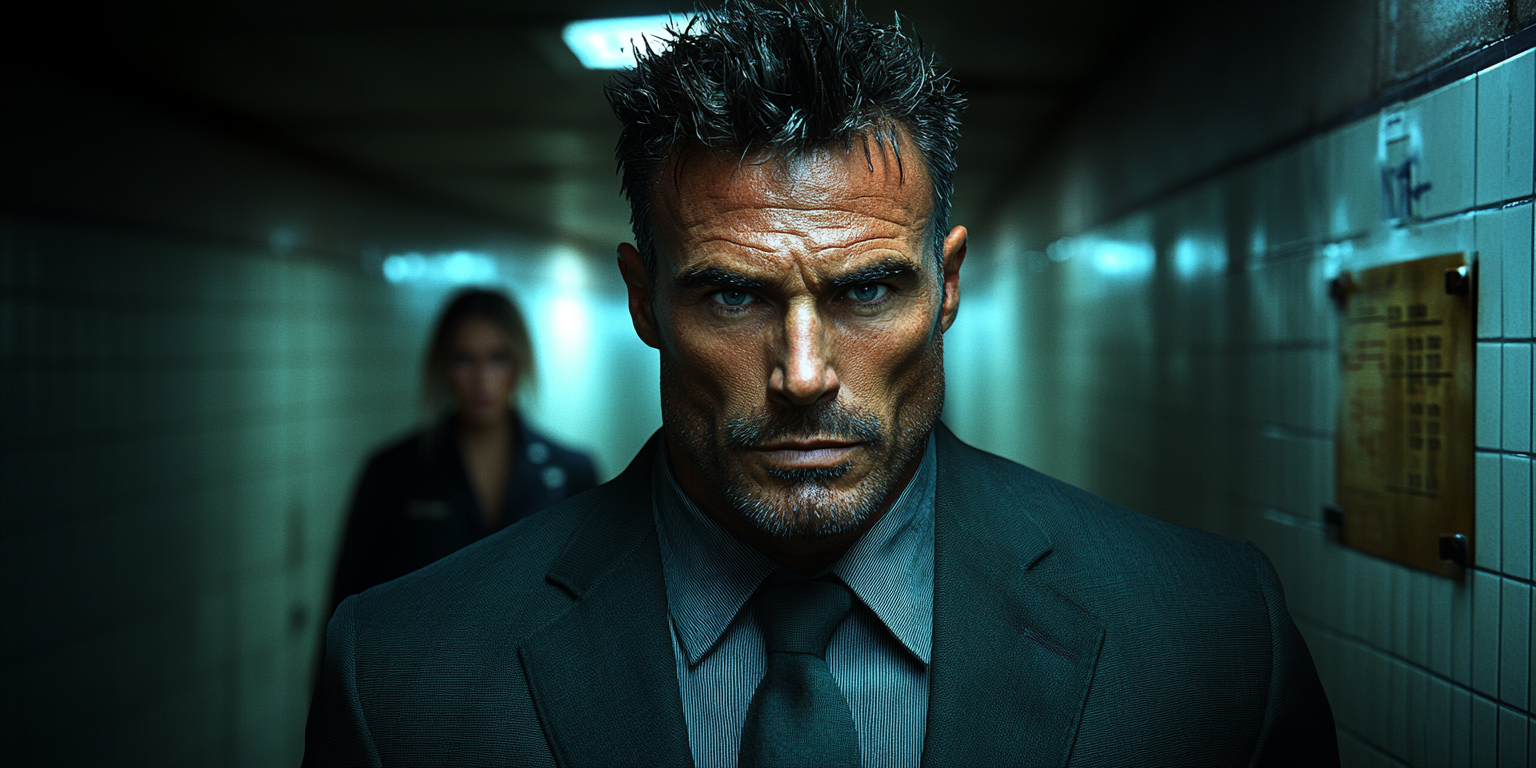
“Every station has a smell—bleach, mould, burnt coffee… and rot. Some of it’s in the walls. Some of it walks around in a badge.”
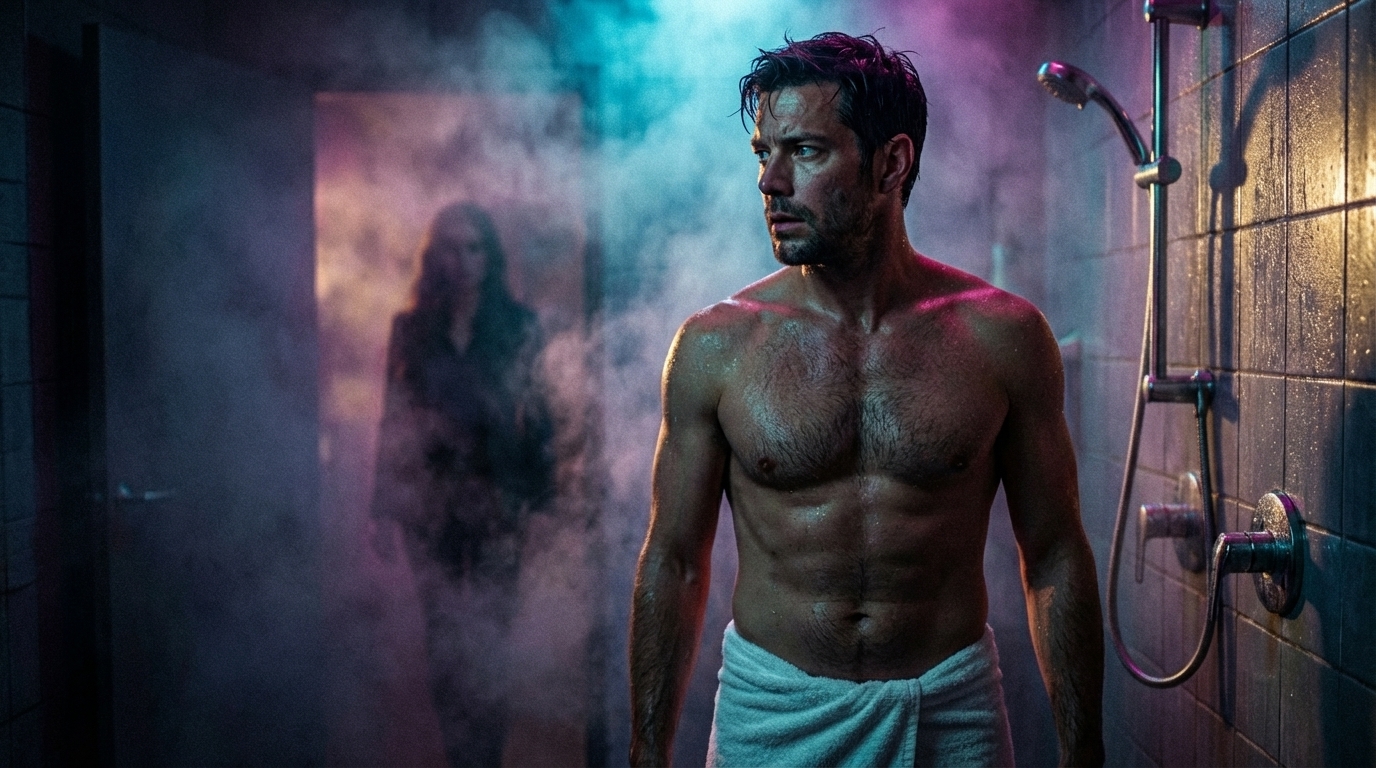
I lingered in the final seconds of hot water, letting the last scalding rivulets trace lines down my spine before reluctantly turning off the taps. The steam had performed its crude alchemy, purging last night's toxins and momentarily scraping the fog from my brain. For five minutes—five exquisite, cleansing minutes—I’d stood beneath the torrent, feeling human again, if not entirely reborn.
My stealthy infiltration of the station had gone unnoticed—a minor triumph in a morning otherwise riddled with defeats. No colleagues. No sideways glances. No hushed whispers about how the newly minted senior detective looked like he’d crawled out of a pub gutter. Just me, a towel, and the illusion of control.
I reached for the curtain, already preparing to step out, when something shifted.
Perfume.
Not soap. Not disinfectant. Not the institutionalised staleness of the men’s showers. This was soft, distinctly feminine, and alarmingly familiar.
My eyes snapped open. My hand froze halfway.
A silhouette resolved against the shower’s fluorescent backlight—female, and then, with a drop in my stomach, unmistakably her.
I yanked back the curtain, water still tracing lines down my body.
"Shit, Sarah! What the fuck are you doing in here?"
The echo bounced off tiled walls with embarrassing clarity. It came out sharper than I intended—surprise laced with panic, pitched higher than my usual drawl. I stood dripping, entirely exposed, staring at Detective Sarah Lahey as if she were a ghost trespassing in sacred male territory.
She met my outburst with the kind of unbothered calm that could silence a crime scene.
Her arms were folded over her blazer, the same one she wore when she wanted to project unimpeachable professionalism. Her eyes were hard and steady, surveying me with an expression that walked the line between professional impatience and something colder. The ponytail was tight. Not a hair out of place. She looked fully rested, perfectly composed. Everything I was not.
She gave me a once-over—brief, clinical, but undeniably personal. Her gaze flicked down for half a heartbeat before returning to meet mine. The heat that flared in my chest had nothing to do with leftover shower warmth.
And then we weren’t alone.
"Looking for some action, I'd say."
Glen Crosswell. His voice arrived before the man himself, nasal and smug, grinding against my eardrums like a dentist’s drill. He lounged against the lockers, a smirk on his face and a towel hanging precariously around his vast middle. Detective Glen Crosswell was everything wrong with the department distilled into one fleshy figure: lewd, insufferable, immune to accountability.
He shuffled forward, jowls bouncing with each step, and brushed past Sarah with calculated carelessness—his hairy gut grazing her arm in what was meant to appear accidental. It wasn’t.
Then, the coup de grâce.
His towel hit the floor.
There it was. Glen’s secret weapon—unleashed. He paused, naked and unapologetic, letting the moment marinate in shared revulsion, then waddled into the neighbouring cubicle and drew the curtain across with mock delicacy.
"In your dreams, pal," I muttered, every syllable weighted with loathing.
"Ew, please no. Don’t encourage that fat prick," Sarah shot back, her voice cracking through her usual restraint like a whip. The disgust was raw, unfiltered—something real beneath the shell of her detective persona. It was strangely comforting, like a brief flicker of shared humanity in the middle of a very surreal morning.
But the momentary levity couldn’t last. The warmth from the shower was already fading. Cold air crept in through the tiles, raising goosebumps on my arms and chasing away whatever fragile peace I’d claimed under the spray. I was back in the real world—the one with lines to toe, cases to crack, and relationships I couldn’t quite define.
"Towel," I said, nodding toward the folded white square on the bench.
She moved efficiently, retrieving it with barely a rustle of fabric. We’d spent years building this rapport—partnered through stakeouts, interrogations, and late-night debriefs that bled into personal confessionals. But this was different. Here, now, with my skin still wet and her eyes fixed deliberately above the neck, the proximity took on an unspoken charge. The deliberate not-looking made the moment more intimate than any stare.
"Hurry up, you’ll want to hear this," she said, thrusting the towel into my chest.
Her voice held tension—not just irritation, but something else. Urgency. The kind that didn’t come from red tape or procedural hiccups. This was case-driven. Whatever had pulled her through those locker room doors, ignoring every unspoken rule of decorum, had weight.
She turned and strode out, her heels clicking sharply against the tiles, posture rigid with purpose. As she passed the rows of lockers, three male officers—mid-dress, half-alert—tracked her with their eyes, appreciation written plainly across their faces. Their heads followed the movement of her hips with a shamelessness that made my skin prickle.
I didn’t blame them. Not entirely.
But I hated that they looked.
I hated that she didn’t notice.
Or maybe she did—and just didn’t care.
The door closed behind her, leaving me alone with dripping pipes, a cold floor, and a towel that suddenly felt woefully inadequate.
I stared after her for a moment longer than I should’ve, torn between irritation, admiration, and something else that had no place in a police station changing room.
Then I wrapped the towel around my waist, steeled myself against the rapidly cooling air, and prepared to follow.
Whatever she had to say, it was serious. She wasn’t one for theatrics.
And if she’d broken protocol, stormed into the men’s showers, and faced down Glen Crosswell’s full frontal assault to deliver it?
Then whatever waited for me out there wasn’t just a big case.
It was the case.
The soft clack of soap on tile snapped me out of my thoughts. I looked down. A white bar had emerged from beneath Glen’s curtain, sliding to a halt a few inches from my bare feet. A perfectly timed prop in a theatre of provocation. No accident. Not with him.
“Piss off, Glen,” I muttered, stepping over it without hesitation.
His laughter followed instantly—a grotesque, wet sound that seemed to echo from his throat, stomach, and bowels all at once. It bounced from the tiled walls and slithered over my skin, undoing everything the hot water had achieved. I felt unclean again, as if the sound alone had the power to contaminate.
Glen Crosswell was more than just a departmental embarrassment—he was a warning sign made flesh. A relic of the force’s worst instincts. Bluster without merit. Misogyny dressed up as banter. His rise through the ranks had little to do with skill and everything to do with nepotism. His uncle, if whispers were to be believed, had once chaired the Police Integrity Commission. The same uncle who was now conveniently retired.
Crosswell had peaked during the age of fax machines and ashtrays in offices. Now he simply coasted—leering, lounging, and making himself as unpleasant as possible while others carried the weight he couldn’t be trusted to bear.
I opened my locker and retrieved my deodorant, fingers tightening around the can as my mind drifted—just for a moment—to Sarah. To the way he brushed against her. The look in his eyes. The calculated indifference of it all. If he ever crossed that line—if he ever laid a hand on her in a way that couldn’t be waved off as accidental...
My grip tightened. Metal creaked softly in protest.
"Glen again?"
The voice came from behind, clipped and cool. I turned, instantly recognising the upright figure of Sergeant Charlie Claiborne.
He stood like a man carved from regulation. Starched blues. Polished boots. Square shoulders. The sharp lines of his uniform mirrored the precision in his movements. Claiborne was a rare breed—an officer who commanded respect not through intimidation or bravado, but through sheer competence. He’d seen it all, and didn’t waste words on what didn’t matter.
His gaze flicked briefly to the bar of soap on the floor, then up to me. The faint twitch at the corner of his mouth was the closest he ever came to humour.
“He’s all yours, Sergeant,” I said, trying for something like camaraderie. It came out brittle.
He studied me. Not with concern—just calculation. His grey eyes, sharp beneath heavy brows, took in every detail. Shirtless. Pale. Towel-wrapped and still damp. My hair clung wet to my forehead, my jaw dark with stubble, and the shadows beneath my eyes looked more like bruises than fatigue. I could feel myself being measured against the man I was supposed to be.
“Get your clothes on, Detective Jenkins. Detective Lahey is right. You’re going to want to hear what this woman has to say.”
There was no excitement in his tone. No tinge of gossip, no relish in revealing details. Only gravity. The words hung there, dense with implication. Claiborne didn’t waste gravity on the routine.
He turned to leave, boots clicking crisply against the floor, but paused midway. As he passed Glen’s cubicle, he came to a halt. I saw it register in his posture—the pause, the calculation, the decision.
He rapped sharply against the partition with the back of his knuckles. The sound rang out like a gavel strike.
“Detective?” Claiborne’s voice was suddenly a register lower. The tone that all experienced officers eventually mastered. Not shouting. Not pleading. Just absolute command.
“Yes, Sergeant?” Glen’s voice came back in a strangled squeak, his earlier confidence steamed away by the heat of a reckoning he hadn’t expected.
“You have precisely two minutes to get your arse parked at your desk, or so help me, it’ll be graveyard shifts for the rest of the week. Understood?”
The silence that followed was delicious.
“Y-Y-Yes, sir!”
The curtain behind which Glen lurked began to rustle with frantic activity—hurried movements, hurried breathing, real panic now that his protection had thinned.
Claiborne turned back toward me, his mouth twitching into the ghost of a smirk.
He heard him, I thought. He heard everything. There was solidarity in that faint smile—one professional to another, acknowledging what we both knew about Glen Crosswell but couldn’t always say aloud.
“Now hurry up, Jenkins,” the Sergeant added, the smile vanishing as quickly as it had arrived. “I wanted you in that interview room ten minutes ago.”
The moment re-solidified. No more indulgence. No more delay.
I nodded, acknowledging the order and the weight behind it. Claiborne left with his usual precision—no wasted energy, no glance back.
As Claiborne vanished around the corner, his footsteps fading into institutional silence, I let my forehead come to rest against the cool metal of my locker. The surface felt blessedly cold against my tender skin, the contact grounding me in the now. Just a few seconds—a final pause before stepping into whatever waited beyond this fluorescent-lit purgatory. I allowed myself that small indulgence. A moment to acknowledge that I wasn’t ready. That I was walking into this day depleted, exposed.
Why today?
The thought surfaced, small and pathetic, a whisper from the wounded animal inside. Of all the days for the universe to break something open—for fate to deliver a case worthy of departmental whispers and clandestine glances—it had chosen this one. My first day as Senior Detective. The day I should’ve arrived sharp, fresh, prepared. Not broken at the seams, nursing a hangover that clawed at the edges of my vision, and carrying the weight of unknown sins from the night before.
I dressed as quickly as my wrecked body would allow, each motion a negotiation between urgency and discomfort. The suit I’d selected earlier with such measured care now felt like armour donned for the wrong battlefield. The shirt clung to still-damp skin. The tie cinched around my throat like a noose made of silk, each breath a reminder that I was strangling myself with responsibility.
From the next cubicle, Glen’s chaos erupted. Steam billowed around him as he burst from the shower, towel clutched ineffectively to his girth like a man attempting modesty for the first time.
“Shit, shit, shit,” he muttered, rifling through his locker in a frenzy of dripping limbs and wheezing breath.
I turned slightly, unable to help myself. What followed could’ve passed for physical comedy if it weren’t happening in real time. Glen dressed the way you’d assemble furniture without instructions—or opposable thumbs. His white y-fronts, already an unflattering choice, went on backwards at first. The correction process involved an awkward jiggle that resembled interpretive dance.
His shirt fought him every step of the way. Buttons misaligned completely, creating a lopsided mess that stretched awkwardly across his damp torso. He didn’t notice. Or care. His tie—a hideous yellow thing emblazoned with cartoon ducks—hung limp and unknotted around his neck, defeated before the day had even started.
He jammed his feet into his shoes without socks, then remembered socks, pulled them over his wet ankles, and shoved his feet back in. The resulting squelch promised a rash by mid-afternoon. His jacket—inside out—was worn without correction, flapping slightly at the hem as he moved. Residual shampoo flecked his scalp like artificial snow.
It was tragic. And oddly human.
For all his bravado, Glen Crosswell wasn’t fearless—he was terrified. Of Claiborne. Of consequences. Of being seen for what he really was: not a predator, not a wolf, but a man clinging to what little authority he’d inherited through lineage, not merit. I watched him flounder, and despite myself, I didn’t feel hatred in that moment. Just pity.
I turned back to my locker, retrieved the emergency paracetamol I kept stashed behind a shaving kit, and swallowed two dry, then chased them with metallic-tasting water from the grimy fountain. It wasn’t salvation, but it was something—enough to dull the worst of it.
The door slammed behind Glen a few moments later, the echo fading like a punctuation mark on the scene. I was alone again. And that meant no more distractions.
Sarah’s voice echoed in my mind—not the words, but the urgency in them. That hard edge, that undertone of now.
Whatever this was, it wasn’t procedural. It wasn’t politics.
I straightened my tie again, adjusting it until it sat just so. Ran a hand through my hair—still damp, still refusing order—and stared at the closed locker door as if it might offer a final verdict. It didn’t.
But I knew who I had to be.
Not the man who'd crawled out of bed nauseous and confused. Not the one who'd stared at a used condom with no memory of the night it came from. That man had no place in the interrogation room.
No—this had to be Detective Karl Jenkins. Senior. Promoted. Present. The man people listened to. The man people followed. Even if it meant hiding the wreckage inside.
I fixed my collar, rolled my shoulders back, and took a breath that scraped its way down my raw throat. Then another.
And I stepped forward—out of the locker room, out of that fragile cocoon of recovery—into the weight of Saturday morning, the fog of Hobart, and whatever shadow had driven Sarah Lahey to find me there.
