Ellen Margaret Lowe (née Dawson)
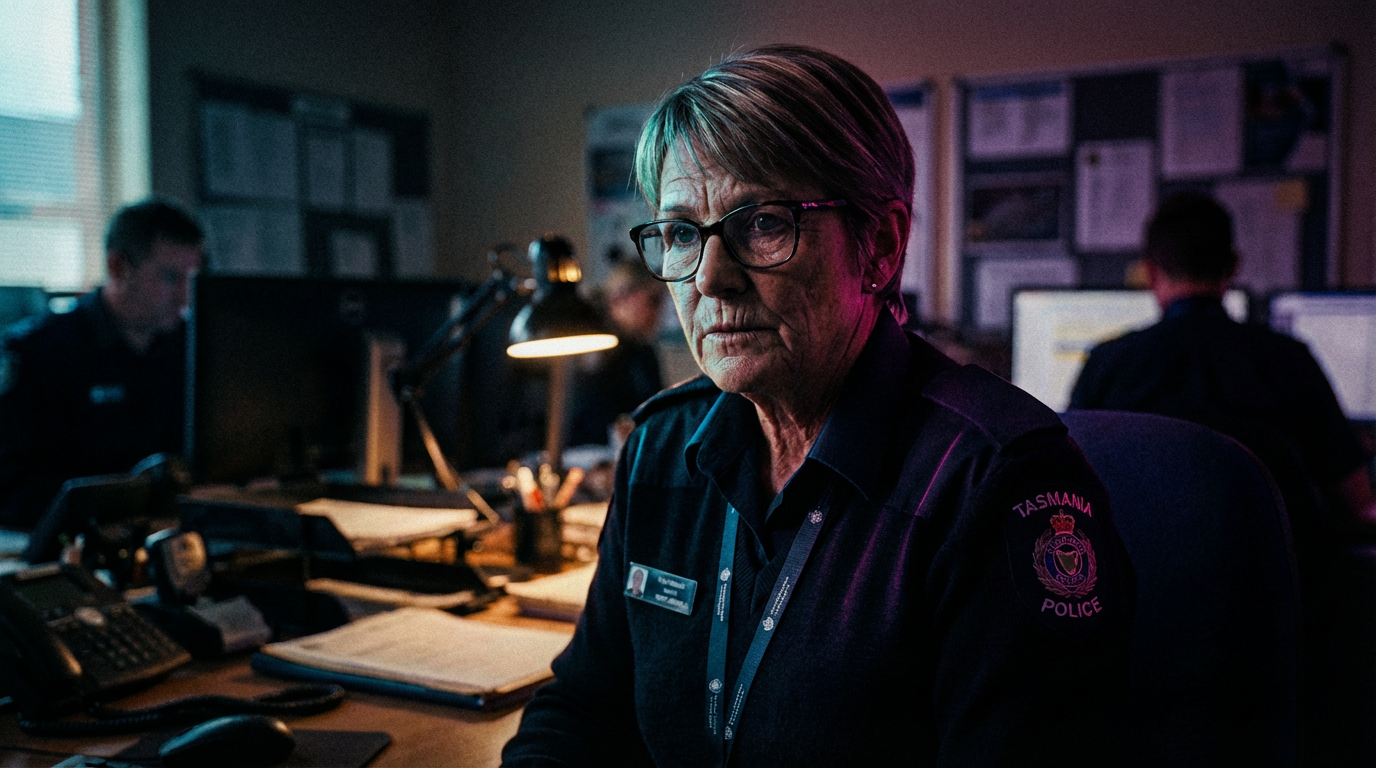
Ellen Margaret Lowe, born in Hobart in 1963, has dedicated over three decades to supporting Tasmania Police through meticulous administrative work. From her early days as an office assistant to her current role managing critical operations at Hobart Police Station, Ellen's career embodies quiet dedication and institutional memory. Her passion for genealogy and cultural heritage enriches a life marked by service, resilience, and an unwavering commitment to justice.
Born into Order and Service
Ellen Margaret Dawson entered the world on 17 March 1963 in Hobart, Tasmania, the middle child of John and Margaret Dawson. Her birth came at a time when Australia was emerging from the austerity of the post-war years into a period of relative prosperity and cultural transformation. The Hobart into which Ellen was born remained a city deeply connected to its colonial past, yet beginning to embrace the social changes that would define the latter half of the twentieth century.
John Dawson, a postmaster in Hobart's northern suburbs, embodied the quiet reliability that characterised public service in that era. His work at the post office required precision, trustworthiness, and an intimate understanding of the community he served. The position carried respect—postmasters were pillars of their communities, keepers of connections and facilitators of communication in an age before digital correspondence reduced letters to quaint anachronisms. John approached his responsibilities with methodical dedication, qualities he would pass to his middle daughter in ways neither could have predicted.
Margaret Dawson, née Patterson, worked as a librarian at the Hobart City Library, a role that positioned her at the intersection of knowledge preservation and community education. In the early 1960s, librarians occupied a unique cultural position—guardians of information in an age when books represented primary means of accessing knowledge beyond one's immediate experience. Margaret's love of learning, her organisational skills, and her passion for connecting people with information would profoundly shape Ellen's worldview.
The Dawson household was orderly, intellectually curious, and structured around principles of duty and service. Dinner conversations revolved around current events, local history, and the importance of contributing meaningfully to one's community. Books filled the modest home in New Town—not as decoration, but as tools actively used, their pages marked with notes and passages underlined for future reference.
Ellen was the middle child, positioned between her older brother Peter, born in 1960, and her younger sister Linda, who arrived in 1966. This birth order would fundamentally shape Ellen's temperament and approach to life. Middle children often develop as mediators, organisers, and stabilisers—roles Ellen would occupy throughout her life. Whilst Peter received the attention accorded to firstborns and Linda enjoyed the indulgences often granted to youngest children, Ellen learned early to find satisfaction in being capable, reliable, and self-sufficient.
Family Tree
Education and Early Influences
Ellen attended Hobart High School during the transformative years of the 1970s, a period when Australian society was undergoing significant social and cultural change. The school, located in the city's heart, exposed Ellen to a diverse cross-section of Hobart's youth—children of working-class families, professional households, and everything in between. This exposure to social diversity would later prove invaluable in her administrative work, where understanding people from varied backgrounds became essential.
Academically, Ellen excelled particularly in English and history. Her English teachers recognised in her writing a clarity of expression and attention to detail that suggested potential for legal or administrative work. Her history essays demonstrated not just memorisation of dates and events, but genuine interest in understanding how the past shaped the present—a fascination that would later manifest in her genealogical pursuits.
Beyond academics, Ellen actively participated in student council, where she discovered both an aptitude for organisation and satisfaction in making systems work more efficiently. When the school library club needed restructuring, Ellen volunteered, implementing cataloguing improvements and new borrowing procedures that substantially improved functionality. These might seem like minor achievements, but they revealed Ellen's core nature—she found genuine fulfilment in making processes smoother, more logical, more efficient. Where others sought glory or recognition, Ellen derived satisfaction from invisible infrastructure working properly.
The social landscape of Ellen's high school years was complex. The early 1970s brought questioning of traditional authority, experimentation with alternative lifestyles, and growing awareness of social justice issues. Yet Ellen's upbringing in a household that valued duty, service, and traditional civic responsibility created in her a temperament that, whilst not reactionary, leaned toward preservation of functional structures rather than revolutionary change. She wasn't opposed to progress—she simply believed that sustainable change came through careful modification of existing systems rather than their wholesale dismantling.
Ellen graduated from Hobart High School in 1981, a young woman possessed of solid academic credentials, practical skills, and a clear sense that her future lay in administrative work that supported larger institutional purposes. She had no grand ambitions for fame or transformative achievement. What she wanted—what she'd always wanted—was to be useful, competent, essential to functioning systems that served the broader good.
Professional Foundation
Following her secondary education, Ellen pursued a Secretarial Studies Certificate at TAFE Tasmania, completing the one-year programme in 1982-1983. The coursework focused on office administration, typing, shorthand, and basic bookkeeping—practical skills that represented the foundation of administrative professionalism in the pre-digital era. Ellen approached the training with characteristic thoroughness, mastering not just the mechanical skills of typing and filing, but developing the deeper understanding of office systems that would distinguish competent administrators from exceptional ones.
Upon graduating in 1983, Ellen secured a position as an administrative assistant with Hobart City Council in the public services department. The role, whilst junior, placed her within the machinery of local government administration at a time when councils were expanding their service provision and professionalising their operations. Her duties included filing, managing correspondence, and assisting with community events—tasks that might seem mundane but which provided invaluable exposure to how government bureaucracy actually functioned at the operational level.
Ellen proved exceptionally capable. Colleagues quickly learned that documents given to Ellen would be filed correctly, correspondence she managed would be answered promptly, and information she provided could be trusted absolutely. These might seem like minimal expectations, yet in the often-chaotic reality of public sector administration, reliability of this calibre made Ellen indispensable. Within two years, she'd become the person everyone turned to when something urgent needed doing correctly.
In 1985, Ellen made a significant career move, accepting a position as office administrator with Hobart Legal Services. The transition from local government to the legal profession represented a step up in complexity and responsibility. Legal practice demanded absolute precision—misfiled documents could compromise cases, missed deadlines could result in professional sanctions, breaches of confidentiality could have serious consequences. Ellen adapted quickly, her natural attention to detail proving perfectly suited to an environment where accuracy wasn't just valued but legally required.
During her five years at Hobart Legal Services, Ellen gained invaluable experience managing confidential information and supporting legal professionals whose work directly impacted people's lives. She learned to work under pressure, to prioritise competing demands, to maintain calm professionalism even when the lawyers she supported were frantic with approaching deadlines or difficult clients. Perhaps most importantly, she developed a deep appreciation for how administrative competence directly supported justice—when she filed documents correctly, when she scheduled matters efficiently, when she managed client communications effectively, she was facilitating the legal system's functioning. This understanding—that administrative work wasn't separate from the pursuit of justice but essential to it—would shape her approach to her future career in law enforcement.
Geographic Mobility and Broadening Experience
In 1990, Ellen made a decision that surprised those who knew her as someone deeply rooted in Hobart. She accepted a position as senior administrative officer at Launceston General Hospital, relocating to Tasmania's second city. The move represented both professional advancement and personal challenge—Ellen would be leaving behind her family, her established social networks, and the city where she'd spent her entire life.
The Launceston General Hospital position substantially increased both Ellen's responsibilities and her exposure to healthcare administration. She oversaw administrative functions in the outpatient department, coordinating schedules, managing patient records, and supervising junior staff. Healthcare administration in the early 1990s was undergoing significant transformation—computerisation was beginning to replace paper-based systems, patient rights were receiving increased emphasis, and hospitals faced growing pressure to improve efficiency whilst maintaining quality of care.
Ellen thrived in this environment. Her organisational skills proved particularly valuable in managing the complex scheduling required to coordinate doctors, nurses, specialists, and patients across multiple treatment pathways. She implemented new filing systems that substantially improved record retrieval times, developed protocols that reduced administrative errors, and established relationships with medical staff that improved communication between clinical and administrative functions.
The Launceston experience, whilst professionally rewarding, confirmed for Ellen something she'd suspected but hadn't fully acknowledged—her heart remained in Hobart. The professional opportunities in Launceston were excellent, but she missed the particular quality of life that Hobart offered, its cultural heritage, its connection to history and landscape. When the opportunity arose in 1995 to return south, accepting a position as administrative manager at Burnie Community Health Centre, Ellen took it, viewing the role as a stepping stone toward eventual return to her home city.
The Burnie position, whilst technically a lateral move, provided Ellen with leadership experience she'd lacked in previous roles. As administrative manager, she led an administrative team, implemented new office systems, improved patient intake processes, and ensured compliance with health regulations whilst managing budgets. The role required not just administrative competence but genuine management skill—the ability to motivate staff, resolve conflicts, balance competing priorities, and maintain morale during periods of organisational stress.
Ellen's five years in Burnie marked her maturation as an administrative professional. She left Burnie in 2000 not just as a competent administrator but as someone capable of transforming administrative dysfunction into operational efficiency, someone whose quiet leadership improved entire departments' functioning.
Devonport and the Path to Police Work
Ellen's next move would prove pivotal. She returned to northern Tasmania in 2000, accepting a position as office manager at Devonport Police Station. The transition from healthcare to law enforcement represented a significant shift, yet Ellen's core skills—organisation, confidentiality, attention to detail, calm under pressure—translated seamlessly.
Devonport Police Station in 2000 was undergoing substantial modernisation. The station was implementing new computer systems, adapting to evolving policing methodologies, and adjusting to increased community expectations for both service and accountability. Ellen arrived during this transitional period, tasked with managing the administrative functions that supported operational policing.
The role exposed Ellen to law enforcement culture in ways her previous positions hadn't. She worked alongside uniform officers, detectives, and senior command staff, observing how policing actually functioned beyond public perception. She managed sensitive case files, coordinated communication between departments, and maintained systems that enabled officers to focus on operational duties rather than administrative logistics.
Ellen's five years at Devonport were formative. She developed deep respect for the dedication of police officers, understanding that the public face of policing—officers on patrol, detectives solving cases—depended entirely on administrative infrastructure functioning invisibly but flawlessly in the background. When investigators needed phone records accessed, when patrol needed alerts distributed, when command needed briefing materials prepared—Ellen ensured these needs were met with efficiency and discretion.
During this period, Ellen also confronted the darker realities of law enforcement work. She encountered domestic violence cases, child abuse investigations, tragic accidents, and violent crimes. Whilst she wasn't operationally involved, the administrative aspects of supporting these investigations required emotional resilience. Ellen developed the professional detachment necessary to work with disturbing material without becoming overwhelmed, whilst maintaining the human empathy that prevented her from becoming hardened or cynical.
Her competence and dedication caught the attention of senior Tasmania Police leadership. In 2005, Ellen received an offer she hadn't anticipated—a position as executive assistant to the Commissioner at Tasmania Police Headquarters in Hobart. The role represented the pinnacle of administrative police work, a return to her beloved Hobart, and recognition of her exceptional capabilities.
Executive Assistant to the Commissioner
Ellen's tenure as executive assistant to the Tasmania Police Commissioner from 2005 to 2010 positioned her at the nerve centre of state policing. The role required managing the Commissioner's complex schedule, coordinating departmental communications, preparing briefing materials for command meetings, and serving as the primary administrative interface between the Commissioner and the rest of the organisation.
The position demanded absolute discretion. Ellen managed information about sensitive investigations, personnel matters, budget allocations, and political considerations that couldn't be widely shared. She became privy to the strategic thinking that guided Tasmania Police, understanding how operational policing connected to broader governmental priorities and community expectations.
During these years, Ellen witnessed leadership transitions, organisational restructuring, and significant cases that tested Tasmania Police's capabilities. She worked under pressure that would have broken less resilient individuals—the Commissioner's office operated at a pace and intensity that required not just competence but exceptional stamina and composure. Ellen managed it all with characteristic professionalism, becoming so integral to the office's functioning that multiple Commissioners came to rely on her institutional memory and administrative judgment.
Yet by 2010, Ellen had begun to recognise something about herself. Whilst the Commissioner's office represented career achievement, she missed operational proximity—the sense of directly supporting active investigations rather than being several layers removed at command level. When the opportunity arose to move to an administrative officer position at Hobart Police Station, Ellen made the surprising decision to accept what appeared externally as a step down but which she understood as a return to work that felt more immediately meaningful.
Hobart Police Station and Investigative Support
Ellen's move to Hobart Police Station in 2010 marked the beginning of what would become her longest and perhaps most satisfying professional chapter. As an administrative officer at the operational heart of Tasmania's largest police division, Ellen found herself once again directly supporting active policing—detectives pursuing investigations, uniform officers managing incidents, specialist units conducting operations.
Her role encompassed managing critical operational tasks, coordinating internal and external communications, and providing the administrative infrastructure that enabled detectives to focus on investigation rather than paperwork. Ellen became known throughout the station as the person who could get things done—phone records accessed, alerts distributed, information retrieved, requests processed. Her decades of experience meant she understood not just what needed to be done but how to navigate bureaucratic processes efficiently.
Detectives particularly valued Ellen's support. When Detective Sarah Lahey needed urgent information from airports and ferry services during the Jamie Greyson investigation in July 2018, Ellen's established relationships and procedural knowledge proved invaluable. When Detective Karl Jenkins required vehicle alerts distributed across Tasmania, Ellen ensured patrol units received immediate notification. Her contributions weren't dramatic—no arrests, no courtroom testimony, no public recognition—yet investigations progressed more smoothly because Ellen ensured administrative foundations remained solid.
Ellen's workspace became an institution within the station. Her desk, perpetually covered with handwritten notes and precisely organised files, represented a kind of analog efficiency that persisted even as digital systems increasingly dominated police work. Officers would find Ellen's desk abandoned whilst she took her frequent cigarette breaks in the courtyard, yet somehow everything always got done. The seeming chaos of her workspace belied the methodical precision with which she actually managed information and requests.
Her personality within the station environment was distinctive. Ellen cultivated a deliberately gruff, no-nonsense demeanour—she was cranky, blunt, occasionally dismissive of requests she deemed insufficiently urgent. Yet those who worked closely with her understood this presentation masked genuine dedication and even affection for colleagues. Her raspy voice, rough from decades of smoking, barking through corridors became a familiar sound. Ellen would complain loudly about being overworked, then stay late ensuring a detective had the information needed for a morning briefing.
The 2018 investigations that consumed Hobart Police Station—Jamie Greyson's disappearance, Karl Jenkins's vanishing, the tragic death of Detective Sarah Lahey—placed extraordinary demands on everyone, including Ellen. She worked longer hours, processed more requests, managed more sensitive information than ever before. The complexity and tragedy of these interconnected cases tested the station's resources and resilience. Ellen maintained her characteristic professionalism throughout, providing the administrative continuity that enabled investigations to continue even as the emotional toll mounted.
Personal Life and Private Passions
Beyond her professional dedication, Ellen maintained a rich personal life centred on intellectual pursuits and cultural engagement. Her weekends often found her wandering through Hobart's museums and art galleries, exploring Tasmania's history and artistic heritage with the same careful attention she brought to her work. She was a regular visitor to the Tasmanian Museum and Art Gallery, the Museum of Old and New Art when it opened, and smaller galleries showcasing local artists.
These cultural explorations weren't casual leisure but genuine intellectual engagement. Ellen would spend hours examining historical exhibits, reading every placard, considering how Tasmania's colonial past connected to its present character. Her interest wasn't nostalgic or uncritical—she understood the darkness in Tasmanian history, the violence of colonisation, the ongoing impacts of past injustices. Yet she also appreciated how understanding the past illuminated the present, how historical consciousness enriched contemporary life.
Ellen's passion for genealogy represented perhaps her deepest personal interest. She spent countless hours researching her family history, tracing the Dawson and Patterson lines back through generations of Tasmanian settlers and, ultimately, to British origins. This wasn't simply about identifying names and dates but about understanding the stories of ordinary people whose lives, accumulated across generations, had eventually produced her own existence.
Through genealogical research, Ellen discovered ancestors who'd been convicts transported to Van Diemen's Land, free settlers seeking opportunity, soldiers, farmers, shopkeepers—the forgotten people whose individual stories rarely made historical records but whose collective experiences shaped Tasmania's character. She contributed to local historical societies, sharing research and collaborating with others similarly committed to preserving family and community histories.
Her home in Hobart reflected her interests and temperament. It was modest, orderly, filled with books on Tasmanian history, genealogical records, and photograph albums documenting family connections across generations. The small garden Ellen maintained provided a peaceful retreat—she found solace in nurturing plants, watching the quiet rhythms of growth and bloom. Gardening required patience, attention, and acceptance of natural processes beyond human control—qualities Ellen both possessed and valued.
Ellen's two cats, Max and Mittens, provided companionship without the demanding emotional labour that human relationships often required. Their presence brought lightness and humour to her domestic life, their antics offering relief from the darkness she encountered in police work.
Health, Habits, and Personal Challenges
Ellen's relationship with smoking represented perhaps her most significant personal struggle. She'd begun smoking in her twenties, a habit that had started socially but which gradually became dependency. By her fifties, Ellen was a committed smoker, her raspy voice and frequent cigarette breaks marking her as someone for whom nicotine had become integral to daily functioning.
She wasn't oblivious to the health implications. Ellen understood intellectually that smoking was damaging her lungs, compromising her cardiovascular health, and likely shortening her life. Yet knowledge didn't translate to cessation. She'd attempted to quit multiple times over the years, each effort failing after periods ranging from days to months. The habit was bound up with stress management, with breaks providing both physical addiction satisfaction and psychological escape from work pressures.
By 2018, Ellen had reached a point of acknowledgement if not resolution. She recognised she was unlikely to quit entirely but committed to reducing consumption and managing the health impacts. She'd begun working with a doctor to monitor lung function, understanding that whilst she mightn't be able to stop smoking, she could at least be medically vigilant about its effects.
Ellen's personal life was notably absent of romantic partnership or children. Whether this represented conscious choice, circumstance, or orientation remained private. She maintained close relationships with her siblings—Peter had become a teacher, Linda worked as a nurse—and their families provided the extended family connections Ellen valued without requiring the constant emotional engagement that nuclear family might have demanded.
