4338.204 · July 23, 2018 AD
Echoes on the Wire
Luke reaches for Paul through the fragile lifeline of a phone call. What begins as a simple request becomes a tense dance of humour, desperation, and unspoken need, as both men test how far their bond can stretch across the distance.
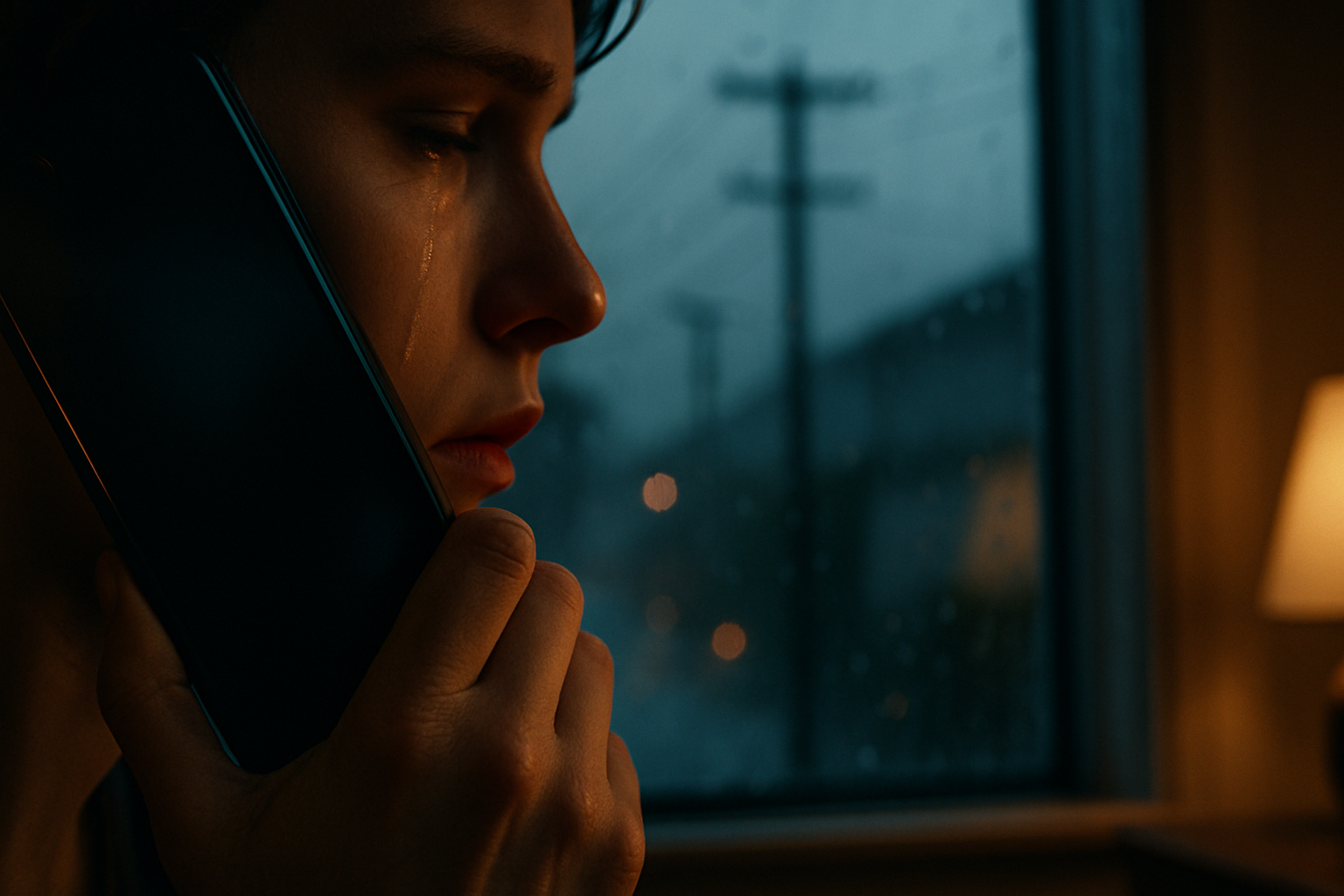
“Every call carries more than a voice. It carries the silence between us, the truths we can’t quite say aloud, and the hope that someone will still answer.”
The phone sat in my hand like a grenade with its pin half-pulled.
I'd been staring at Paul's contact entry for what felt like hours, though the clock insisted it had been only minutes. The screen's glow cast pale light across my fingers—the same fingers that had bled on an alien device, that had touched the surface of another world, that still carried grit from a desert that existed in a place no map could show. Such ordinary fingers for such extraordinary transgressions.
Duke and Henri had settled into their respective positions on the floor behind me, their presence a warm anchor against the cold unreality of what I was about to do. I'd risen from their comfort with the resolve I'd spoken aloud—come on, boys—but the resolve had curdled into something more complicated now that I faced the actual execution. Calling Paul. Asking for help. Admitting, even through the necessary filter of half-truths, that I needed someone.
INFJs don't ask for help easily. We process alone, in the cathedral spaces of our own minds, building elaborate architectures of meaning from experiences too strange to share. We convince ourselves that burdening others with our interior complexity would be unkind, that isolation is a gift we give to those we love. And perhaps that's true, sometimes. But it can also be cowardice dressed in consideration's clothing.
I pressed the call button before I could talk myself out of it.
The phone's smooth surface pressed cold against my palm, and I was suddenly, viscerally aware of it as a tether—a fragile technological thread connecting me to the world I was desperate to reclaim. The world of schedules and grocery lists and disagreements about whose turn it was to take out the bins. The world where portals didn't exist and voices from other dimensions didn't speak your name with the casual intimacy of old friendship. The world where Paul lived, in Broken Hill, with Claire and Mack and Rose, building a life that looked nothing like mine but at least made sense by the rules everyone agreed to play by.
The dial tone began, each ring a measured blow against my already-frayed composure. The sound stretched the silences between into something vast and accusatory, each pause another opportunity for doubt to whisper that I was being ridiculous, dramatic, that I should hang up and deal with this alone the way I'd dealt with everything else alone for thirty-four years.
By the third ring, my heart had migrated somewhere north of where hearts were supposed to live, hammering against my throat with the insistence of a tenant demanding attention. I counted the pulses between tones. Five. Six. Seven. Eight—
Click.
"Hey, stranger."
The words tumbled out before I could shape them into anything more considered—instinct taking over where intention faltered. I'd meant to sound casual, unbothered, the way brothers were supposed to sound when they called each other on ordinary afternoons. Instead, my voice carried the tremor of everything I couldn't say, a quaver that undercut the lightness I was attempting.
"Hey, you."
Two syllables. That's all it took.
Paul's voice landed in my ear with the solidity of a rope thrown to a drowning man, and for a moment I couldn't breathe around the relief of it. That familiar timbre—steady, grounded, carrying the particular resonance of someone who'd known me since before I had language to know myself. We'd shared a bedroom in Adelaide, then Broken Hill. We'd whispered secrets in the dark when Mum and Dad were fighting, constructed private languages to navigate the chaos of a household that kept pretending everything was fine whilst everything crumbled. Paul had been the responsible one, the careful one, the one who learned early that causing problems only made problems worse. And I had been... whatever I was. The sensitive one. The weird one. The one who saw things in dreams that made therapists exchange concerned glances.
Hearing his voice now, after everything—after the nightmare and the device and the desert and the voice that had spoken directly into the chambers of my soul—felt like finding a landmark after wandering lost in fog.
But relief, like everything else today, was temporary.
I laid out my proposition—the request that he fly to Hobart, that he be here with me, that he cross the thousand-plus kilometres between his life and mine because I needed him in ways I couldn't explain. The words came out rehearsed but ragged, a script I'd been writing in my head whilst Duke licked my face and Henri whined from the floor.
Paul's response arrived wrapped in the armour of practicality. Work obligations he couldn't abandon. Money he didn't have to spare. Leave time that didn't exist in his current circumstances. Each reason was logical, defensible, exactly the kind of reasonable objection I should have anticipated from a brother who'd spent his whole life being reasonable.
And yet.
To me, in this moment, his reasons fell like doors slamming shut one after another, each rational syllable another bar in the cage of impossibility he was constructing between us. I understood the logic. Part of me even respected it—Paul had Claire and the kids to think about, responsibilities that didn't evaporate just because his brother had crossed into another dimension and couldn't tell anyone about it. He was being practical. He was being adult. He was being everything I'd never quite managed to be.
But understanding didn't stop the desperation from sharpening into something more dangerous.
I shook my head—a useless gesture across the thousand kilometres between Tasmania and New South Wales, a reflex of frustration that had nowhere to go. His refusal was too clean, too tidy, whilst my need was a storm system that had long since blown past the possibility of tidiness. The mismatch tore at me, and something shifted in my chest. Strategy replacing pleading. Calculation displacing honesty.
My mind, treacherously loyal to its own desperate cause, summoned an image I'd kept buried for years: Bobby Cat.
She'd been a ginger, small and fierce and utterly devoted to six-year-old me in the way only cats can be devoted—on her own terms, at her own convenience, but with a totality that made the terms and convenience irrelevant. I'd found her as a kitten, half-starved behind Dad's garage, and I'd loved her with the uncomplicated intensity children bring to things that love them back without conditions. When she died—cancer, the vet had said, his voice careful and kind in that way veterinarians learn—I'd understood for the first time that loving something meant eventually losing it. That attachment came with an invoice, and the invoice was grief.
To invoke her now was a low blow. I knew it even as the memory surfaced, even as I felt my eyes begin to sting with moisture that was half genuine and half tactical. Bobby Cat had been real grief, real loss, the first wound that left scars in places I still carried. Using her as leverage against my brother's reasonable objections felt like betraying something sacred.
But desperation, I was learning, had no honour. And mine cared nothing for fairness.
The weight of that old loss pressed down, and for once the tear that escaped wasn't entirely artifice. It was real grief, yes—but grief borrowed and repurposed, weaponised against the brother I was supposed to love without agenda.
"Paul," I began, and my voice caught on his name, the sound fraying at its edges with sorrow that was half genuine ache and half manipulation. "I need you... I'm having a few... a few issues."
The words hung between us, suspended in the electronic void of the phone connection. Not simply a request but a hook, baited with childhood pain and cast into the stillness with trembling hope.
The pause that followed stretched into something that felt like geography—a vast empty space where his answer should have been but wasn't yet. My heartbeat filled the silence, frantic and uneven, each pulse a countdown I couldn't stop. I didn't dare breathe, didn't dare speak, didn't dare fill the void with anything that might tip the careful balance I'd constructed.
And then, cutting through the tension like a knife through fog, came the last sound I'd expected.
Laughter.
Paul's laughter erupted through the phone—rich, uncontained, crackling with the particular quality of genuine amusement that couldn't be faked. It was the laugh I remembered from childhood, from moments when I'd said something unintentionally absurd and he'd found it funnier than I'd meant it to be. It was the laugh of a brother who knew me too well to be entirely fooled.
My carefully constructed emotional architecture wobbled. The gravity I'd tried to summon, the wounded vulnerability I'd performed—all of it swept aside by the ridiculous spectacle of my own melodrama reflected back through Paul's amusement. I was less a man in crisis and more an actor who'd forgotten his lines, stumbling through a scene I'd written badly and performed worse.
"Oh, shut up!"
The words came sharp but dissolved almost immediately into something lighter. The irritation couldn't hold against the reluctant smile tugging at my own mouth, against the absurd relief of being seen through so thoroughly. Paul had always had this gift—the ability to puncture solemnity with irreverence, to find the comedy in situations that seemed to demand tragedy. Under other circumstances, I might have appreciated it.
Under these circumstances, it was both infuriating and oddly comforting.
His chuckles continued spilling through the connection, struggling to die down, and I found myself leaning back in the desk chair, exhaling slowly. The approach had been reckless—an impulsive lunge at sympathy that had backfired spectacularly. Paul had always been able to do this to me, to drag humour into even the gravest moments, to refuse the weight of seriousness I tried to impose.
But the laughter was also another wall between me and what I needed him to understand. Each chuckle, however genuine, was a reminder that convincing Paul would require something truer than tears. Something harder.
When he finally managed to choke out a question about the issues I was supposedly facing—only to collapse into fresh laughter—my patience snapped.
"I've already bought you plane tickets," I said, and there was no waver in my voice now. The edge was deliberate, a signal that the line between humour and seriousness had been crossed, and I couldn't follow him back to the side where any of this was funny.
Paul's laughter lingered but muffled now, uncertain. He couldn't conceive that behind the theatrics there might be something real, something desperate enough to justify the manipulation. To him, this was still a performance, still a game.
"Paul, I'm serious," I pressed, and the urgency stripped my voice of everything except raw need. This wasn't a role. This wasn't strategy. This was the truth bleeding through in tone if not in words.
His reply needled me—playful, teasing, the old rhythm of sibling rivalry asserting itself. Normally I would have parried back, would have met him where he was and danced the familiar dance. But not this time. My restraint, already frayed past breaking, finally snapped.
"For fuck's sake, Paul, would you just focus, please!"
The words left me sharper than I'd intended, their bite cutting through whatever fragile calm I usually maintained. I rarely swore at Paul. Rarely raised my voice with him. The rarity itself was a message—proof that whatever was happening had pushed past the boundaries of our normal interactions into territory neither of us knew how to navigate.
The silence that followed was immediate and complete.
"Okay, okay."
Paul's voice had changed. Quieter now, carrying weight it hadn't held moments before. Subdued, cautious, the laughter replaced by something approaching genuine attention. My words had finally landed. The veil of our banter had been torn, and through the gap he could finally glimpse that something real was waiting on the other side.
"I've sent the e-tickets to your phone," I said, forcing steadiness into my voice though my chest felt tight as a fist. The act of sending them felt strangely momentous—more than a digital transaction, more than a booking confirmation. It was a tangible expression of how serious I was, how desperate, how willing to spend money I probably shouldn't spend on the chance that Paul might actually come.
As I waited for him to check, my fingers betrayed me, drumming a restless rhythm against the desk. The soft tap-tap-tap filled the silence, echoing the heartbeat I couldn't quiet.
"Yeah. Got it."
A new note in his voice now. The laughter was gone entirely, replaced with something approaching sobriety. It wasn't agreement—not yet—but it was acknowledgement, and that alone soothed some of the rawness scraping at my nerves.
"What's going on?"
The question hung between us, simple in wording but weighted with everything unsaid. It was an opening, a bridge from jest to seriousness, and I seized it with both hands.
"It's serious, Paul. Jamie and I are having some major issues and I really need a bit of support right now. You know I don't really have anyone else here."
The lie tasted bitter on my tongue—not because it was entirely untrue, but because the truth it concealed was so much stranger than the fiction I was offering. Jamie and I were having issues. That part was real enough. The distance that had been growing between us for months, the secrets I'd been keeping, the missed call I still hadn't returned—all of it genuine, all of it painful. But the reason I needed Paul had nothing to do with relationship troubles and everything to do with portals and voices and alien deserts that had nearly killed me.
I was lying to my brother by telling him a truth that concealed a larger truth. The calculus of deception was more complicated than I'd anticipated.
"I know you don't," Paul said at last, his voice softened by something that might have been regret. "But I really can't afford these tickets, or the break from work."
The words landed with a dull weight, practical and undeniable yet aching with the quiet sorrow of someone who wished things were otherwise. I heard in them not refusal but reluctance—the gap between wanting to help and being able to help, the constraints of a life built on careful management of limited resources.
I knew Paul's financial situation. Had known it for years, through the times when Jamie and I had sent money to help with unexpected expenses, through the conversations where his pride warred with his need. He'd built a good life in Broken Hill—Claire's dance school, his various business ventures, Mack and Rose growing up in the dust and heat of the outback—but "good" didn't mean "comfortable," and "comfortable" didn't mean he could drop everything and fly across the country on a moment's notice.
So when I made the offer, it wasn't about coaxing him. It was about removing the obstacle I knew would be his first defence.
"You don't need to worry about any of it. I'll cover your expenses. And you don't need to worry about paying me back."
Each word carried the certainty I needed him to hear. This wasn't charity. This wasn't Luke playing wealthy saviour to his struggling brother. This was need—my need, raw and undeniable, willing to pay whatever cost in dollars because the cost of him not coming was measured in something far more valuable.
I heard him hesitate on the other end, pride and practicality wrestling in the silence. Paul had never been comfortable accepting help, even from family. Perhaps especially from family. The dynamic of older-brother-who-should-be-competent ran deep in him, and taking money from his younger brother scraped against something fundamental in his self-image.
"Are you sure we can't just talk about this over the phone?"
The question carried a faint edge of desperation—not the desperation of someone who wanted to avoid helping, but the desperation of someone seeking an easier path, a solution that wouldn't require disruption or travel or the uncomfortable acknowledgement that some problems couldn't be solved from a distance.
"I'm sure," I said, cutting through before doubt could take root again. The words came out measured but edged with the kind of insistence that left no space for negotiation. "It'll only be a couple of days, I promise."
The silence that followed stretched long and heavy, taut as a held breath. I sat rigid, phone pressed close, listening not to words but to the rhythm of Paul's breathing—that steady rise and fall I'd heard a thousand times through childhood bedroom walls, through phone calls during my mission, through the occasional visits that reminded us both how much distance had grown between our lives.
Everything seemed suspended in that pause. My need. His reluctance. The impossible truth I couldn't tell him and the plausible fiction I'd offered instead. The thousand kilometres between Tasmania and New South Wales. The infinite distance between who I'd been before today and who I was becoming.
Then, at last, his voice came through.
"Fine." The single syllable carried both resignation and resolve, the sound of a decision being made against better judgement but being made nonetheless. "I'll leave Broken Hill in an hour or so and drive to Adelaide."
The relief that surged through me was immediate and overwhelming. It crashed over my chest in a wave that made breathing temporarily impossible, a rush of gratitude so intense it bordered on painful. He was coming. Despite the laughter and the scepticism and the practical objections, Paul was coming. I wouldn't have to face whatever came next entirely alone.
"Thank you so much," I breathed, forcing every ounce of sincerity I possessed into the words. They felt inadequate—nothing I could say would properly convey what his agreement meant to me—but they were all I had to offer. "I'll see you tomorrow then."
The words tumbled out quickly, eager, intent on fastening the decision into place before hesitation could resurface and unravel everything I'd just accomplished. Tomorrow. He would be here tomorrow. Less than twenty-four hours between now and the moment I'd have to figure out what to tell him, how much to reveal, whether the truth was something that could be spoken aloud or whether I'd need to show him.
When I finally hung up, the click of the connection ending carried its own strange weight. It was more than ending a conversation—it felt like sealing a pact, closing a door firmly on doubt and ensuring the promise couldn't be undone.
I sat in the desk chair for a long moment after, phone still warm in my hand, staring at the wall where the portal had appeared just hours ago. The surface looked ordinary now—cream paint, a faint crack near the ceiling that Jamie had been meaning to patch for months, the edge of a bookshelf casting familiar shadows. No evidence that it had ever been anything other than a wall. No proof that I hadn't imagined the whole thing.
Except the device sat heavy in my pocket. Except the blood on my finger had dried to a dark line I could still trace. Except somewhere behind that ordinary surface, another world waited—vast and alien and utterly real.
Paul was coming. I had asked for help and received it, had manipulated and pleaded and finally broken through. But as the relief settled into something more complicated, I found myself wondering what exactly I'd done.
I'd lied to my brother. Not entirely—the kernel of truth about Jamie had been real enough—but the lie of omission was vast, and the lie of implication was worse. I'd let him believe this was about relationship troubles, about needing emotional support for a domestic crisis. I'd let him believe the problem was something he could understand, something within the bounds of normal human experience.
When he arrived tomorrow, expecting to comfort a brother whose partnership was struggling, what would he find instead?
The thought sent a chill through me that had nothing to do with Tasmania's winter. Paul dealt in the practical, the logical, the things that could be fixed with effort and planning. How would he react to portals? To voices? To the revelation that his younger brother had stumbled into something that defied every law of reality they'd both been taught to trust?
I didn't know. I couldn't know. But I'd set events in motion that couldn't be undone, and whatever happened next, I would face it with my brother at my side.
For the first time in hours—perhaps the first time since I'd woken from the nightmare that had started everything—I felt something other than afraid.
I felt ready.
Or at least, I felt less alone in my unreadiness.
