4338.205 · July 24, 2018 AD
Disconnected
Luke gathers supplies and steels himself before returning to Clivilius, where Paul and Jamie labour at the tent. A simple phone call confirms what he already suspected: they are cut off from their old lives, leaving only dust, silence, and fragile bonds to test whether they can survive together.
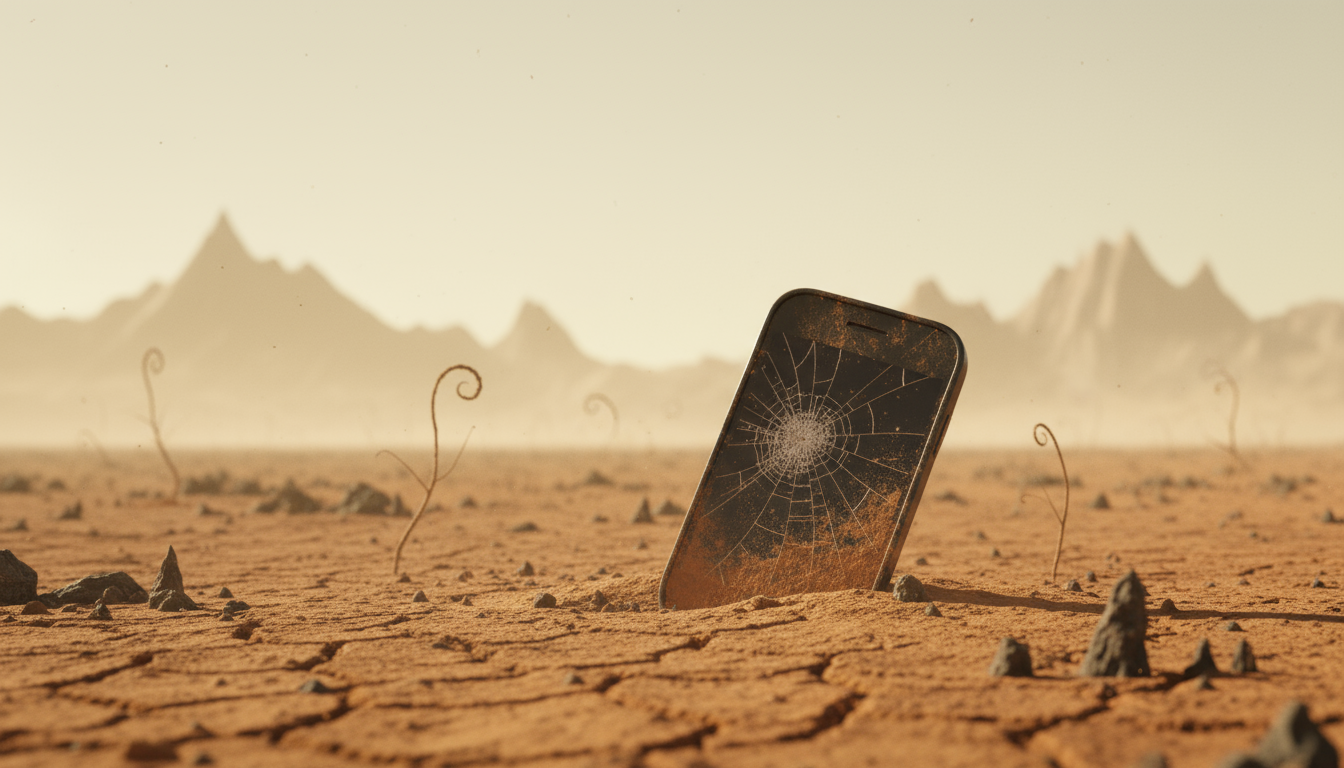
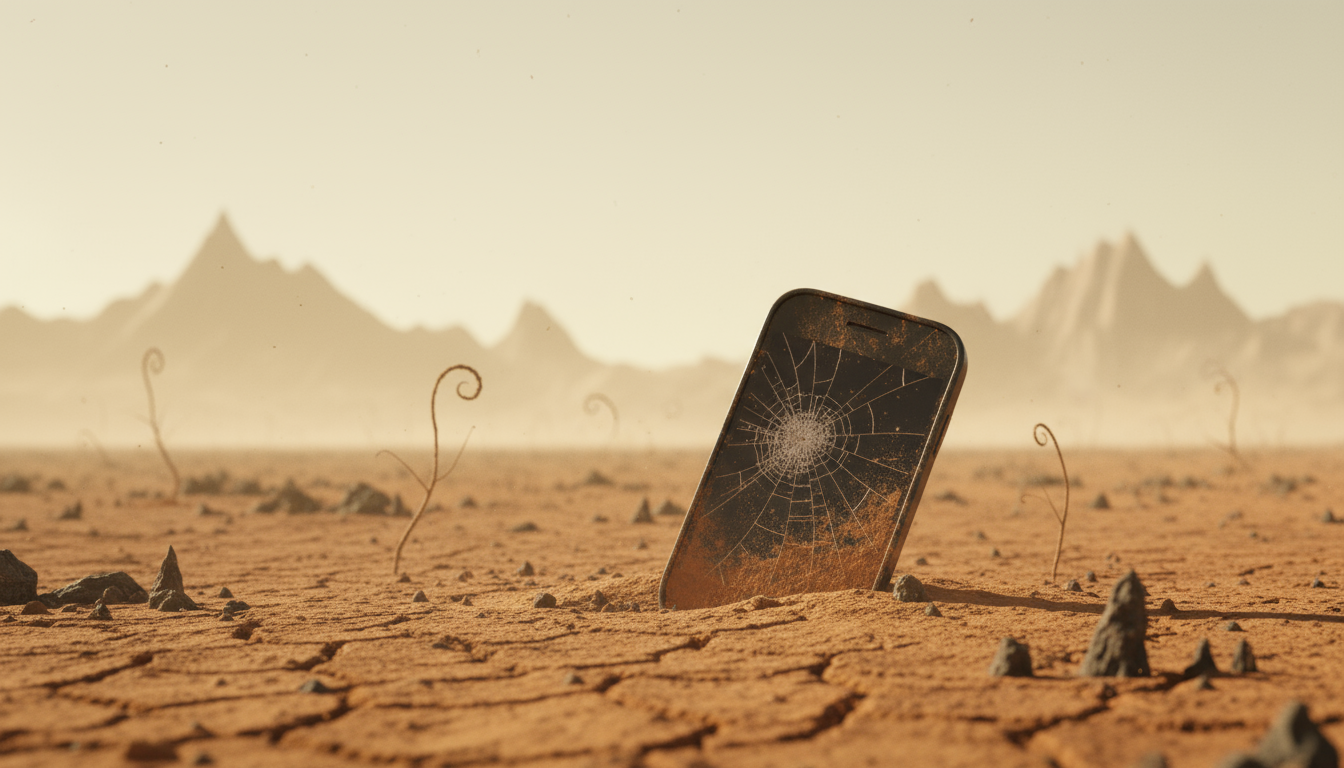
“The first thing Clivilius takes from you isn’t food, or shelter, or even hope—it’s connection. One moment you’re tethered to a world, the next you’re shouting into silence.”
Stepping back into the familiar confines of the study, I was struck by the jarring contrast between the storm I had left behind and the serenity that awaited me here.
Moments ago, I had been surrounded by dust, rage, and the brittle silence of broken trust. Now I was greeted by the comforting clutter of books, the soft hum of the house, and the scent of familiarity that seemed to cling to every surface.
And then there was Duke.
With his ever-wagging tail and a well-chewed toy dangling lazily from his mouth, he bounded towards me with the kind of enthusiasm that made it impossible not to smile. In his world, there were no rifts between brothers, no questions of destiny or exile, no alien dust stretching to infinity. There was only the joy of seeing me again, the promise of play, and the assurance of love unconditional and uncomplicated.
His sloppy kiss trailed across my cheek, wet and unrefined, yet it carried more comfort than a thousand soothing words could have. I let out a laugh—short, cracked, but genuine—and scratched behind his ears, marvelling at how his presence alone could disarm the storm still raging in my chest. For a fleeting moment, the shadows of Clivilius seemed to loosen their grip, the heaviness of guilt and conflict dissolving in the face of something as simple as his unbridled happiness.
What amused me most, though, was his complete indifference to the extraordinary nature of my arrival.
I had just stepped through a wall of swirling, kaleidoscopic light—an act that would shatter the foundations of belief for most—and yet Duke barely blinked. To him, it was no more remarkable than if I'd walked through the front door. That quiet absurdity made me chuckle, grounding me in the present, reminding me that even when worlds collided and destinies tangled, life—in its simplest, truest forms—went on.
Compelled by a surge of determination—part guilt, part pragmatism—I resolved to act swiftly on at least one of the practical issues gnawing at me.
Jamie and Paul could not be expected to share a single shelter. The simmering tension between them was volatile enough without forcing such proximity. If we were to stand any chance of survival—or even just coexistence—separation was not a luxury but a necessity.
I dropped into the chair at my desk, the creak of its familiar frame grounding me. My fingers moved with surprising speed across the keyboard, muscle memory taking over as I navigated to an online retailer.
It felt faintly absurd, the juxtaposition of worlds: one moment contending with dust and volatile emotions, the next scrolling through product descriptions and customer reviews. Yet here I was, scouring listings for canvas tents, my heart set on finding something both sturdy and expansive enough to suit the uncharted demands of Clivilius.
The choice of three additional large canvas tents was deliberate—reckless, perhaps, given the staggering cost—but I convinced myself it was necessary. Each tent was not just fabric and poles; it was a step towards peace, a barrier against conflict, a chance to restore some semblance of dignity in a situation that had stripped us all bare.
The price tag glared at me from the screen, a heavy figure that would have made me hesitate under normal circumstances. But what did financial prudence matter when weighed against survival in another world?
I smirked to myself at the thought. Was there even a credit collection agency capable of pursuing me through dimensions? The image of debt collectors storming Clivilius with clipboards and calculators almost made me laugh—a brief absurdity that lightened the weight pressing on my chest.
When the confirmation email appeared, its sterile subject line—Your order has been placed—felt almost profound. Here, in the quiet hum of my study, I had taken one small but concrete step towards shaping our fragile settlement into something sustainable.
The thought that soon Jamie and Paul would each have their own space, along with additional shelters for supplies, stirred a fragile sense of accomplishment within me. It wasn't much—not compared to the monumental task of civilisation-building that lay ahead—but it was something. A foothold in the chaos. A glimmer of cautious optimism began to take root, whispering that perhaps, just perhaps, we could make this work.
Buoyed by the small but significant victory of securing the tents, I channelled that flicker of momentum into the next task.
My study, once merely a sanctuary for books and idle musings, had become the nerve centre of an inter-dimensional outpost. The sheer absurdity of it might have overwhelmed me had I allowed myself to dwell on it, but instead I leaned into the rhythm of preparation, letting practicality drive me forward.
I moved through the house with renewed purpose, no longer distracted by guilt or hesitation. The details of survival—the small, mundane things I had once taken for granted—suddenly demanded careful attention.
I counted out bottles of spring water one by one, lining them up on the bench as though they were precious artefacts. Their reassuring solidity and the cool weight in my hands carried with them the reminder that, in Clivilius, there would be no taps to twist, no supermarkets to dash into when supplies ran low. Each bottle was not just hydration but lifeblood, a buffer between us and the unknown harshness of that alien environment.
From there, I turned to writing supplies, gathering notebooks, pens, and markers.
It struck me how vital documentation would become—not just for practical records of rations, tools, and shelter assembly, but for history itself. If Clivilius truly was to be the cradle of a new civilisation, then someone needed to record its first faltering steps. I imagined future generations, leafing through these humble notebooks, seeing in my scrawled handwriting the origins of their world.
The thought gave the act of stuffing stationery into a bag an unexpected gravity, transforming a mundane chore into something historic.
The growing weight of the supplies pressed against my arms as I loaded the bags, bottles clinking softly against one another. Yet the physical burden seemed to embolden me rather than slow me down. Each item I collected was a promise, a thread in the fragile web of survival I was weaving for myself, for Paul, and for Jamie.
My heart quickened with anticipation. Prepared as I could be for this moment, I stood ready to return to Clivilius, to shoulder the responsibilities that awaited me beyond the shimmering veil of the Portal.
Opening the Portal again, I stepped forward with the bags tugging at my arms, their uneven weight forcing me to adjust my stance as I crossed the shimmering threshold.
The swirl of colours gave way to the familiar ochre dust and vast horizon of Clivilius, and with it came that same mix of trepidation and resolve. Each crossing carried the reminder that this was no casual journey but a deliberate choice—one that demanded balance. Between Earth and here. Between duty and survival. Between my own conviction and the strained patience of those who had followed me unwillingly.
Carrying supplies through felt symbolic, as if every bottle of water and every notebook was a stitch binding our fragile hopes to the reality of this place.
The air greeted me with its dry stillness as I turned south, eyes scanning for the river.
There, beside the pale shimmer of water, I caught sight of Paul and Jamie. To my surprise, they had made remarkable progress. The skeletal frame of the great canvas tent was already rising against the barren backdrop, its bulk a reassuring presence.
For all the venom and despair that had coloured our earlier exchanges, their hands had not been idle.
Watching them work together stirred a quiet admiration in me—perhaps even relief. In such a short time, they had conjured order from nothingness, building the beginnings of a home where only dust had stretched before. Whatever anger still simmered between them, they had found a way to channel it into something constructive. Or perhaps they had simply needed something to do with their hands while their minds grappled with the impossible.
As I trudged closer, I withdrew my phone from my pocket almost unconsciously.
The device felt strange here, incongruous—a lifeline to a world now impossibly distant.
On impulse, I tapped Paul's name and raised the phone to my ear, half-knowing what the outcome would be.
The hollow tone of a disconnected signal echoed faintly before dissolving into silence. No network. No tether to Earth. Not a failure, I realised, but a confirmation. The line was cut, severed cleanly and absolutely.
Oddly, the sound didn't ignite frustration. Instead, it brought a cold clarity. That silence was a truth in itself—a reminder that the old world had slipped from our grasp, and only Clivilius remained.
Paul's voice cut clean through my reflections, grounding me back to the dust and canvas and strained faces of our new reality.
"What are you doing?" His tone was curious, though tinged with the suspicion that had become almost second nature between us now.
I held up my phone, still faintly glowing in my palm. "Did your phone ring?" The question slipped out as half a test, half a confirmation of what I already knew.
He frowned, pulling his own device from his pocket with the reluctance of someone who already anticipated the outcome. A few swipes, a pause, then his quiet, "No. Should it have?"
"Well, I just tried calling it," I said, the words heavier than they should have been. "I needed to be sure, but it seems like our mobile phones are useless here. You may as well hand it over to me—they'll help me sort stuff out on the other side."
For a moment, Paul's eyes narrowed as though he might argue.
But instead, he set about testing my claim, swiping through his contacts, firing off futile attempts, lifting the phone to his ear as though sheer willpower might coax a signal into existence. Nothing. Each attempt ended the same: silence.
When at last he gave up, the way he tossed the phone at my feet carried an air of resignation—a gesture of defeat that seemed to say far more than words could manage.
I stooped to retrieve it, brushing off a thin layer of dust that had clung to the casing. My gaze met his. "You'd better write your passcode down for me."
His eyebrows shot up, the disbelief plain on his face. That small rectangle of metal and glass had been his personal world; to hand over its key was to hand over trust, even control. For a moment, I wondered if he would refuse.
But then his lips twisted into something halfway between irritation and reluctant compliance.
"Sure. Just let me find a pen," he said, patting his pockets in a deliberately exaggerated pantomime, the gesture teetering on the line between humour and bitterness.
I was ready. Reaching into the bag of supplies I'd carried across, I produced a bundle of pens and a small notepad. "Don't worry," I said, my tone softer, a careful mix of reassurance and practicality. "I'm way ahead of you."
The sight of those simple objects—ink pens and lined paper—felt almost sacred in this alien world. Tools of the mundane had become instruments of survival, anchors to who we had been and perhaps to who we might still become.
"So, you knew?" Paul's words lingered in the air, sharp with accusation, laden with betrayal. It wasn't simply curiosity—it was the plea of someone who had hoped, however faintly, that I had not knowingly dragged him into this place of no return.
I raised my hands instinctively, palms open, as though trying to calm a wild animal. My voice stumbled in its haste.
"I didn't know," I insisted, every syllable straining to soften the blow. "I only suspected they wouldn't. It made sense—there's nothing to connect to here, and signals clearly can't come through the Portal."
Paul's frown deepened, the grooves on his forehead cutting sharper under the strain. His eyes burned with frustration, but behind the fire I caught a flicker of fear.
"You know what you're asking, don't you?" His tone hardened, the words landing like a challenge. "You want us to give up. To allow ourselves to be completely cut off from the life we know."
I hesitated, then held up the dead phone between us like evidence of something neither of us could change.
"Did your phone ring?"
The silence that followed was louder than any denial. He shifted, uncomfortable, his mouth parting as though to cling to one last argument.
"No, but—" The protest faltered, unravelled by the absence of a signal, of proof, of hope.
"So, what difference does it make, then?" My reply came quietly, not cruel, but resolute—a truth neither of us could evade.
I watched the tension drain from him, leaving behind only weariness.
His shoulders sagged, his defiance ebbing away like water into dry sand. When he finally reached for the bag, his movements were slow, heavy, as though weighed down by the enormity of surrender. He took the pen, poised for a moment as though the simple act of writing might sever the last fragile tether to his old life.
Then, with a deep, rattling sigh, he scrawled his passcode on the paper.
The sound of that sigh said more than words ever could. It was the sound of a man yielding not to me, but to inevitability itself—the acknowledgement of a future he had never chosen, but one he could no longer deny.
"Your turn, Jamie," Paul said, his voice quieter now, stripped of its earlier bite. The attempt to draw Jamie into the fragile accord between us landed with a hollow thud, met only by silence.
It wasn't the silence of thought or consideration but something colder, heavier—unyielding as stone.
"Jamie!" My shout cracked through the air, raw and edged with desperation, an attempt to break through the barricade he'd built around himself.
His answer came at once, sharp as a whip. "You're not having my fucking phone, Luke."
Each word was carved with finality, spat out with a venom that made the dust at our feet seem suddenly hostile. His defiance wasn't just about the phone—it was about control, about clinging to the last scrap of autonomy in a world that had ripped every other certainty from beneath his feet.
The line he drew was absolute, a trench dug deep in the Clivilian dust, and his voice carried the weight of someone daring me to try crossing it.
I swallowed back the instinct to push further, the retort that hovered on my tongue.
His shoulders had already turned away, his movements clipped and deliberate as he returned to the work of the tent. The air around him seemed charged, brittle with anger, and I knew pressing harder would only snap the fragile tether still holding us together.
Paul's voice slipped in under the tension, low, barely audible, as though even he feared to disturb the fragile balance.
"Why him?"
The two words brushed against me like a mirror, reflecting the very question I hadn't allowed myself to ask aloud.
I shrugged, though the weight of his gaze burned into me, heavy with unspoken accusations. His expectation that I should have the answers gnawed at me, but I had none to give. It wasn't my fault they couldn't stand each other, nor that our phones—once lifelines to an entire world—were now nothing more than cold, unresponsive rectangles in our pockets.
True, I had brought us here. But Clivilius played by rules not of my making.
And yet... not useless.
The thought crept in, quiet, persistent, like a candle refusing to be extinguished by the wind. The devices were worthless here, yes, but on Earth they might still matter. They had to. Jamie and Paul couldn't simply vanish without trace; someone would notice, someone would ask. Phones held histories, connections, data. In the right hands, they could become anchors back to the world we had left—evidence of lives now suspended between two realities.
That flicker of possibility clung to me, stubborn, even as the gulf between us widened.
Holding up the phone felt like holding up a banner of false authority, flimsy though it was.
Still, I straightened my shoulders and tried to sound as though I had a plan, as though I knew precisely what I was doing.
"I'll keep this safe," I told Paul, giving the device a small shake as if to underline its new purpose. My eyes drifted, inevitably, to Jamie, and I let them linger—long enough for the weight of expectation to settle between us.
"In the meantime, you should both consider what your immediate needs are," I continued, forcing a steadiness into my tone that belied the churn of irritation and fatigue inside me. "Write them down, and I'll get busy keeping you both alive, ok?"
"Sure," Paul replied, his voice muted but not unkind. The single syllable carried a thread of something fragile—hope, perhaps, or maybe just resignation dressed up as agreement.
"Good." I seized on it, eager to frame it as progress, however meagre. "So, Paul wants to stay alive. Jamie?"
My attempt at levity was thin, already bracing me for the inevitable sting.
"Fuck off."
The two words landed like stones hurled against glass. Predictable, sharp, and unrelenting.
I rolled my eyes—more reflex than choice, the kind of gesture that had become second nature whenever Jamie's caustic tongue lashed out. There was a perverse consistency to it, a strange sort of stamina in his ability to keep the negativity burning like a furnace that never cooled.
In another world—back in Berriedale, in the small irritations of domestic life—I might even have found it impressive, a testament to his ironclad refusal to yield. But here, in the fragile beginnings of a world that demanded cooperation, it wasn't impressive at all. It was a thorn lodged deep, a reminder that even in the face of survival, Jamie's anger remained inexhaustible.
An endurance test of the spirit that I was already losing.
"I have a few things to take care of back on Earth. I'll come back soon for your list," I told them, my words carrying a deliberate calm as I turned to leave.
But Jamie's voice, sharp and laced with disdain, hooked into me before I could take more than a few steps.
"What things have you got to take care of?" he sneered, each syllable dripping with mockery, as though survival itself were a petty excuse.
I spun the sarcasm back at him, unable to stop myself. "Oh, you know. Just things that will keep you alive. I can not bother if you'd prefer…?"
The retort tasted bitter the moment it left my mouth, a reflexive jab born of weariness. He had a way of dragging me down to his level, pulling out the petulant in me I so desperately wanted to bury.
"Just fuck off already, Luke," Jamie snapped, his voice slicing through the charged air. It was the finality in his tone—the unrelenting wall of rejection—that struck hardest.
"Fine."
The single word fell heavy from my lips, laden with disappointment.
I had hoped, however foolishly, for a flicker of cooperation. For even the smallest gesture of shared resolve. But Jamie's bitterness was inexhaustible, a wellspring of venom that seemed to deepen with every passing moment.
Why couldn't he, just once, be more like Paul—pragmatic, willing to bend rather than break?
With a shrug that carried all the weight of surrender, I turned to my brother, catching his gaze for a fleeting second. It was an unspoken acknowledgement, a silent pact that we would endure Jamie's tempests together.
Then I walked on, each step dragging me closer to the Portal, the luminous veil that waited like a silent witness to our fracturing bonds.
The world of Clivilius stretched endlessly around me, vast and unknowable. Its challenges were immense, yes, but none seemed so daunting as the task of stitching together the unravelled threads of the people I had brought with me.
"And put some bloody clothes on while you're there," Jamie's voice carried over the crest of a dune.
It echoed, lingering long after his figure had faded from sight—a reminder that even the smallest victories here would be hard won.
