4338.211 · July 30, 2018 AD
Defying Claiborne
When Claiborne denies Karl's request to stake out Gladys's house, Karl storms out and heads straight for his car to pursue the lead anyway—career suicide in uniform. Sarah watches him about to throw everything away and makes a split-second decision to jump in the passenger seat, enabling his reckless defiance despite knowing exactly how badly this will end.
"There's a special kind of stupid that makes you jump into a car with someone who's about to destroy their career. I've apparently got it in spades."
The Sergeant's words hit me like a gust of cold wind as I stumbled through the doorway of his office, immediately on Karl's heels, my boots leaving muddy tracks that some unfortunate constable would have to clean later.
"Well, don't you two look like shit," Sergeant Claiborne remarked, his tone carrying that particular blend of sarcasm and mild concern that suggested he'd seen worse but wasn't entirely sure when.
His eyes briefly scanned us, taking in our drenched clothes that clung to our bodies with uncomfortable persistence, the mud splattered across our trousers and jackets like abstract art rendered in earth tones, and our dishevelled appearances that probably violated several sections of the dress code. We must have looked like two characters straight out of a noir film — except there was nothing remotely glamorous about our current state. We were soaked to the bone, mud-splattered from tramping through wilderness, and emotionally spent from a day that had started badly and proceeded to get progressively worse with each passing hour.
The transition from the forest's oppressive wilderness to the station's fluorescent-lit normality felt jarringly abrupt. Out there, with rain hammering down and trees pressing in and Karl's arms around me, the world had narrowed to immediate sensation and raw emotion. In here, with bright overhead lights and the familiar smells of coffee and floor cleaner and that particular institutional odour all police stations seemed to share, everything suddenly felt too sharp, too bright, too mundane to contain what had just transpired between us.
My clothes dripped steadily onto the floor, creating small puddles that expanded with each passing second. Water ran down my face — rain mixed with sweat mixed with the lingering traces of tears I'd tried to wipe away but hadn't quite managed. My hair hung in wet ropes around my face, plastered against my skin in ways that were probably deeply unflattering but which I lacked the energy to address.
Every part of me was cold except for the places Karl had touched — those spots still carried phantom warmth, like his hands had left imprints that the rain couldn't quite wash away.
"Sergeant," Karl began, his voice steady despite our rough exterior, projecting the kind of professional competence that suggested none of the past hour's emotional chaos had affected him in the slightest. He took a step forward, assuming the lead in our impromptu debriefing. "I'd like to request an unmarked car to stake out Gladys Cramer's house. Just in case she goes home tonight."
His request was direct, his tone professional, yet there was an underlying urgency beneath the measured words that suggested this was more than just routine operational planning. This mattered to him — finding Gladys, tracking her down, pursuing this lead even though we'd lost her in the forest and logic suggested she was long gone. There was something almost obsessive about his focus, a single-minded determination that had been building all day and now demanded an outlet.
I watched the Sergeant's face for a reaction. Right now, his expression suggested Karl's request was landing somewhere between "questionable judgement" and "absolutely not going to happen."
Part of me wanted to chime in, to add weight to Karl's request with my own voice, to present a united front that might tip the scales in our favour. We'd found Gladys's car. We'd found her bracelet. We had fresh tracks leading into the forest. The woman was clearly involved in something, and surveillance on her residence made tactical sense even if we couldn't pursue her on foot through the wilderness in these conditions.
But my voice seemed to have deserted me entirely. The words that should have come — professional, articulate, persuasive — remained stubbornly locked somewhere between my brain and my mouth, trapped behind exhaustion and emotional overload and the lingering disorientation of transitioning between the forest's raw intimacy and the station's harsh fluorescence.
"No," the Sergeant replied curtly, his eyes not leaving the stack of papers in front of him, his attention apparently more occupied with whatever administrative task he'd been tackling before we'd dripped our way into his office.
"No?" Karl's voice echoed through the room, the word carrying a note of disbelief that rippled beneath the surface professionalism he'd been maintaining.
"That's right. No," the Sergeant repeated, his attention still firmly anchored to his paperwork, his indifference to our drenched and dishevelled state — to our urgency, to Karl's barely-contained desperation — feeling like a silent rebuke.
"But why the hell not?" Karl's voice rose, the volume amplifying his frustration and disbelief, professional composure beginning to crack under the strain of accumulated stress and denial.
I could feel the tension radiating off him in waves. Every muscle in his body had gone taut, his hands clenched at his sides, his jaw tight enough that I could see the muscle jumping beneath the skin.
"Karl," Sergeant Claiborne finally looked up, his gaze meeting Karl's with steady, measured authority. The moment felt charged, a palpable tension hanging in the air between superior and subordinate, between experience and desperation. "We already have other patrols scheduled to pass by her house regularly. If she returns home, we'll catch her and bring her in for questioning."
The Sergeant's words were meant to be reassuring, a logical explanation in a day that had been anything but logical. He was trying to de-escalate, to explain that the operational need was already covered, that Karl's request — whilst understandable — was redundant given existing arrangements.
Yet the words landed like a stone dropped into still water, sending ripples that went beyond simple operational planning. The subtext was clear as crystal: our personal involvement in this part of the investigation was over. We'd done our bit. We'd pursued the vehicles, found Gladys's car, attempted to track her on foot. Now it was time to step back and let standard procedures take over.
Other units would handle surveillance. Other detectives would conduct the eventual interview. Karl and I were being politely but firmly removed from active pursuit of this particular lead, probably because Claiborne could see exactly how invested we'd become, how the professional was bleeding into something more personal, how neither of us was displaying the kind of balanced judgement required for continued operational involvement.
It was the right call. Objectively, professionally, it was absolutely the right call.
But watching Karl's face as the implications sank in, I knew he wasn't going to accept it.
"For fuck's sake!" The words burst from Karl like steam from a pressure valve.
He stormed out of the Sergeant's office without another word, without waiting for dismissal. The door slammed shut behind him with a finality, reverberating off walls and filing cabinets and making me flinch with its violence.
I stood there, momentarily frozen in the aftermath of Karl's explosive exit. The quiet that followed felt almost oppressive, broken only by the soft drip of water from my clothes onto Claiborne's carpet and the rustle of papers as the Sergeant returned his attention to his desk as though nothing remarkable had just occurred.
The façade of respectful control Karl had maintained all day — through impossible circumstances, through bizarre discoveries, through mounting frustration — had finally fallen away completely, leaving behind nothing but raw, unfiltered emotion that scorched everything in its path like wildfire through dry brush.
I felt a pang of empathy for him despite everything, despite the grab earlier, despite yesterday's outburst. I understood all too well the frustration of being sidelined when every instinct screamed to stay involved, to keep pursuing, to see the investigation through to its conclusion rather than being benched at the crucial moment.
We'd invested so much in this case — not just hours but ourselves, our judgement, our professional reputations. To be told to step back now, when we were finally making progress, when Gladys was within reach... I understood why Karl had reacted with such visceral fury even if I couldn't quite condone the loss of control.
Sergeant Claiborne didn't look up, didn't acknowledge Karl's departure or my continued presence, simply kept working through his papers as though temperamental detectives storming out of his office was too common an occurrence to merit comment.
Maybe it was. Maybe Karl did this regularly and I'd just never witnessed it. That thought was somehow more disturbing than anything else — the possibility that this explosive rage was a pattern rather than anomaly, that I'd just never been present for previous episodes.
I should probably say something. Apologise for Karl's behaviour, maybe. Offer assurances that we'd comply with Claiborne's decision. Something professional and appropriate that might salvage this situation.
But I didn't. Instead, I turned and hurried after Karl, my footsteps echoing on the hard concrete of the car park as I pushed through the door into the late afternoon air. The cool air nipped at my skin — still wet, still cold, the brief respite of the heated office not nearly enough to dry out or warm up.
"Karl. Wait! Where are you going?" I tried to catch up to him before he could disappear into his car and leave me standing there in the car park like an idiot.
He was moving with purpose towards his vehicle, his stride long and determined. His keys were already in his hand, already aimed at the door lock, already seconds away from leaving without me.
Karl paused momentarily, his back still turned to me, shoulders rigid with tension. He didn't turn around, didn't look at me, just stood there with his hand on the car door handle whilst he delivered his answer to the empty air ahead of him.
"To find Gladys," he said, his voice blunt, carrying a determination that bordered on recklessness — or perhaps had crossed that border entirely and was now firmly planted in territory marked "terrible decisions."
He wasn't going to let this go. Wasn't going to follow Claiborne's directive. Wasn't going to wait for other patrols to handle surveillance. He was going to pursue this lead on his own, off the books, outside proper channels, in direct defiance of a superior officer's explicit instructions.
It was career suicide. It was insubordination. It was exactly the kind of thing that got detectives suspended or fired or at minimum subjected to formal disciplinary proceedings that left permanent marks on personnel files.
And he was going to do it anyway, consequences be damned.
"Karl, don't," I warned him, finally reaching his side, close enough now that I could see the muscle jumping in his jaw. "The Sergeant denied the request. You can't."
My words were a plea wrapped in pragmatism, an attempt to tether him back to reason, to remind him of the protocols and procedures we were bound to follow regardless of how frustrating they felt. We were police officers. We followed orders. We worked within systems even when those systems felt constraining. That was the job. That was the deal we'd signed up for.
"I don't really care what the Sergeant said," Karl snapped, finally turning to face me. The sharpness in his voice was like a slap, his expression taut with frustration that had found its target and was now zeroing in with laser focus.
His eyes met mine with a heat that should have been alarming, that probably was alarming if I'd had enough emotional energy left to properly process it. This wasn't reasonable disagreement with a superior's decision. This was something deeper, more fundamental — a complete rejection of institutional authority in favour of personal compulsion.
It was clear that the denial from the Sergeant had only fuelled his resolve rather than dampening it, pushing him further towards a path I feared would lead to consequences neither of us was prepared to handle. The rational Karl I thought I knew — methodical, by-the-book, respectful of hierarchy and procedure — seemed to have been completely replaced by someone I barely recognised.
Without another word, Karl got into his car, the movement brisk and final. He slammed the door shut with enough force to rock the entire vehicle on its suspension.
I stood there watching him, feeling a mixture of worry and frustration churning in my gut. His action, so decisive and unyielding, left me feeling helpless — a bystander in a narrative that was unravelling with gathering momentum, watching someone I cared about make catastrophically bad decisions in real-time whilst being utterly unable to stop him.
The engine started. He was actually doing this. Actually going to drive off and pursue an unauthorised investigation in direct defiance of orders, probably destroying his career in the process.
Which meant I had approximately three seconds to make a decision about what I was going to do next.
Before Karl could pull away — before I'd fully processed what I was doing or why — acting purely on impulse that bypassed rational thought entirely, my feet carried me swiftly to the passenger side of his car. Without hesitation, without pausing to consider consequences or implications or any of the thousand reasons this was a terrible idea, I opened the door and jumped into the seat, a sense of urgency propelling my movements that I couldn't fully articulate even to myself.
"I'm coming with you," I declared, my voice firm despite the uncertainty churning beneath the surface, challenging him to argue, daring him to try sending me away.
The words hung in the air between us, a commitment made before I'd fully understood what I was committing to. But once spoken, they felt inevitable — as though there had never really been any other choice, as though the moment Karl had decided to pursue this lead off the books, my decision to follow him had already been made by whatever forces bound us together.
As I settled into the seat, pulling the door shut and reaching automatically for the seatbelt, I couldn't help but acknowledge the complex emotions colliding within me. Despite Karl's recent behaviour — the aggression, the violence, the controlling tendencies that should have sent me running in the opposite direction — I knew the truth that lay in my heart with uncomfortable certainty.
I had fallen in love with him.
It was a realisation that came with its own particular kind of pain, especially in moments like these when I watched him make choices that were so clearly self-destructive, when I saw him willing to throw away everything he'd worked for in service of a need I didn't fully understand. Seeing Karl so tormented, so willing to break the rules he'd always sworn to uphold, was like watching the man I knew and loved morph into someone unrecognisable — a stranger wearing Karl's face and body but driven by demons I couldn't see and couldn't fight.
The Karl I loved — the one I had come to know so well over months of partnership — was methodical, precise, respectful of the law and the systems designed to uphold it. He would never willingly step outside the boundaries of protocol. Never compromise an investigation through unauthorised action. Never let personal investment override professional judgement.
Never.
Yet here he was, doing exactly that, and here I was, enabling him by refusing to let him do it alone.
What did that make me? Loyal partner? Enabler of destructive behaviour? Accomplice to career suicide? All of the above?
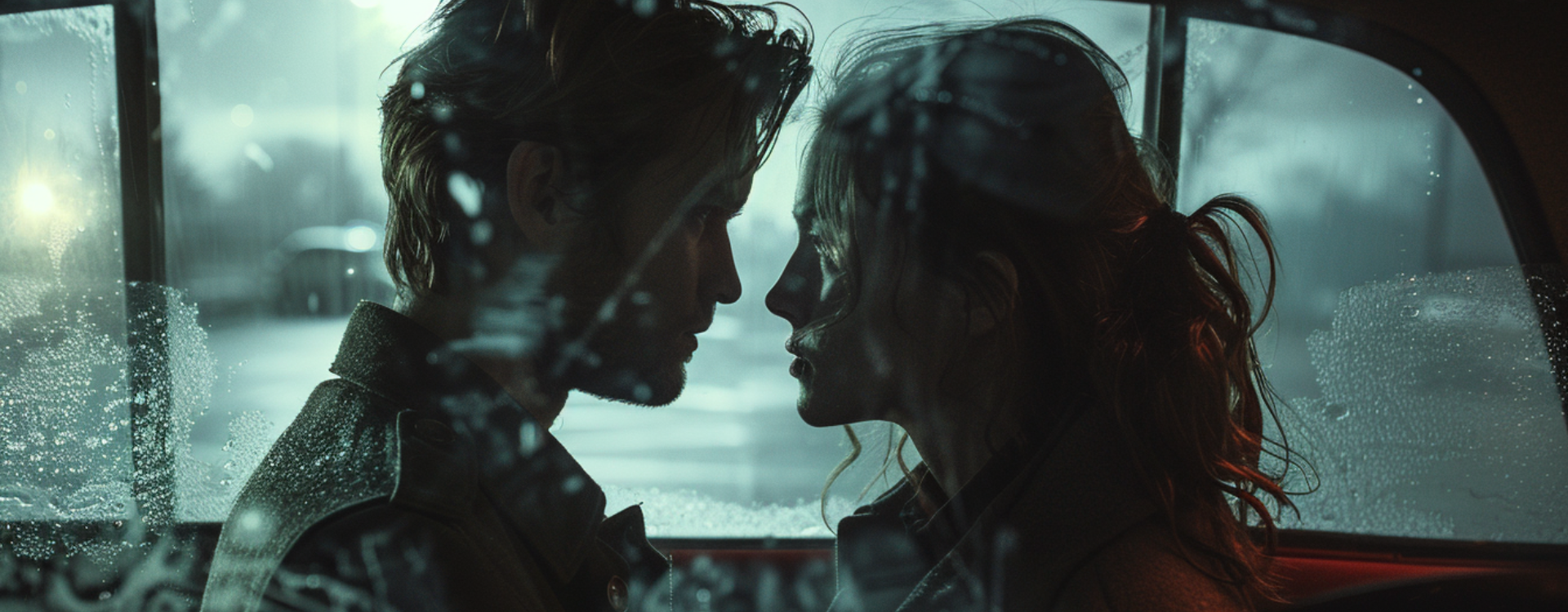
But then, unexpectedly — so suddenly I didn't have time to brace for it — Karl's demeanour shifted completely. He leaned over quickly, crossing the distance between his seat and mine in one fluid motion, and kissed me.
His lips were firm against mine, insistent, demanding response rather than requesting it. It was a sudden, intense moment of connection that caught me completely off guard, bypassing every rational thought and defensive barrier I might have erected if I'd seen it coming.
I responded instinctively, muscle memory and desire overriding the part of my brain screaming that this was complicated and messy and probably a terrible idea. I kissed him back with a passion that surprised even me, matching his urgency with my own, my hand coming up to touch his face almost without conscious decision.
There was a desperation in that kiss — on both sides, I think, though perhaps for different reasons. A fervent desire to hold onto the moment, to prolong the sensation of his lips on mine, to capture and preserve something that felt perpetually on the verge of slipping away entirely. For those few seconds, nothing else mattered — not the case, not Claiborne's orders, not the rules we were about to break, not the impending storm of consequences that would inevitably follow.
Just this. Just now. Just Karl's mouth on mine and the taste of rain still on his lips and the heat of him close enough to touch.
As quickly as it had begun, the kiss ended. Karl pulled away, breaking the connection with the same abruptness he'd initiated it, and without uttering a single word — without explanation or apology or acknowledgment of what had just transpired — he started the ignition.
The moment had passed, but it left a lingering warmth in my chest, a silent acknowledgment of something deeper between us that words couldn't capture and probably would only diminish if we tried to articulate it.
I turned to face the window as Karl put the car in gear, my gaze fixed on the outside world that was beginning to blur into motion as we pulled out of the car park. A slight smile crossed my face despite everything — despite the terrible decisions we were making, despite the uncertainty of what came next, despite knowing this was going to end badly because everything with Karl seemed destined to end badly.
It was a private, treasured reaction to the unexpected kiss, a small moment of joy stolen from the wreckage of an impossible day. In that fleeting moment of intimacy, a thought fluttered through my mind like a bird trying to find purchase on a windowsill.
Maybe he does really love me back.
It was a thought both frightening and exhilarating, terrifying in its implications but intoxicating in its possibility. Maybe beneath all the complications there was something real, something genuine, something worth holding onto.
Maybe.
The word was simultaneously hopeful and cautionary, a hedge against certainty, a recognition that I was reading signals that might mean something entirely different than what I wanted them to mean.
But Karl had kissed me. And in that moment, in the warmth still lingering on my lips and the small smile I couldn't quite suppress, that felt like it mattered more than anything else.
Even if it probably shouldn't.
