David James Moreland
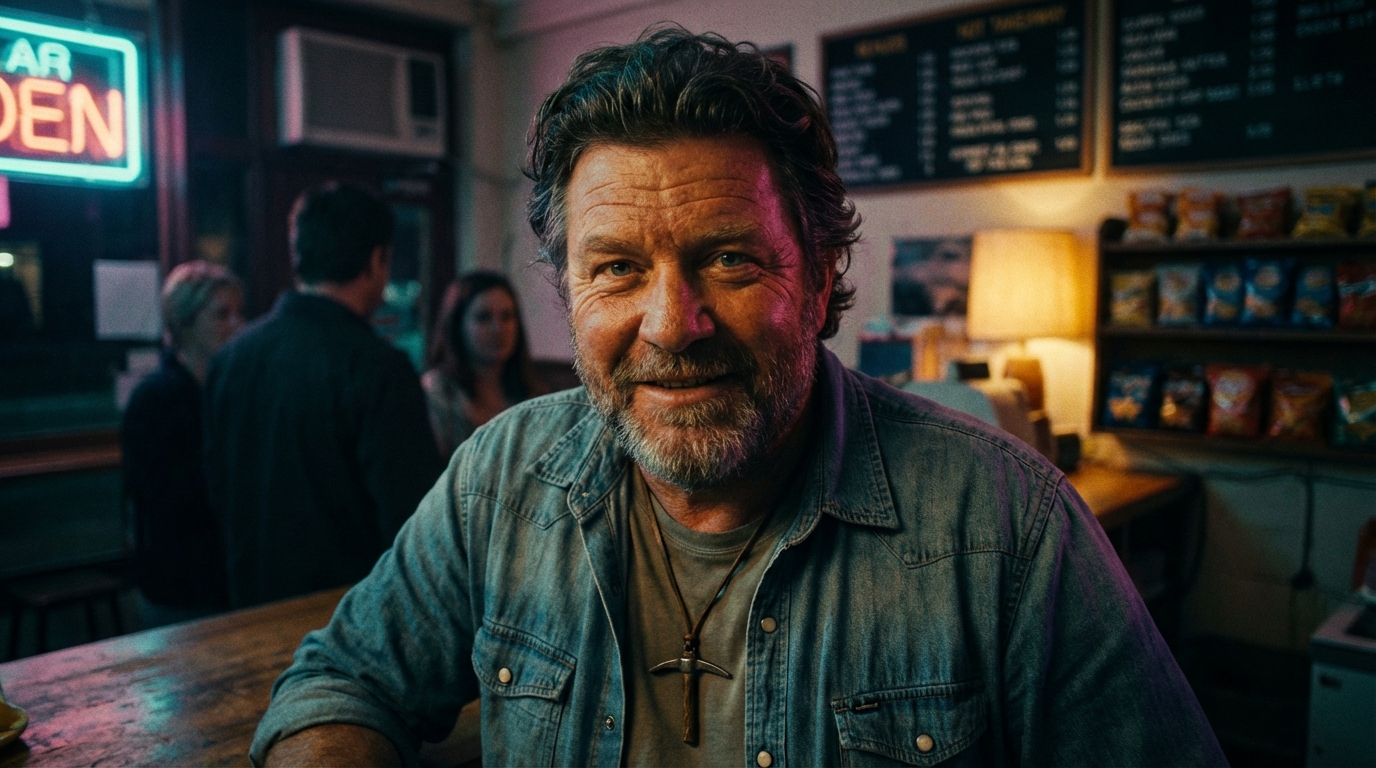
David James "Cheesy" Moreland, born 3 April 1959 in Broken Hill, New South Wales, is the beloved owner of Raglan's Takeaway. After twenty-five years in mining, a workplace injury prompted his transition to hospitality in 2007. His signature crinkle-cut chips and legendary cheeseslaw transformed the modest takeaway into a community institution. Known for his unhurried manner and storytelling gift, David embodies Broken Hill's spirit of resilience and connection.
Birth and Family Origins
David James Moreland entered the world on 3 April 1959 in Broken Hill, the remote mining town in far western New South Wales that would shape every aspect of his character and destiny. His arrival came during an era when the town's prosperity depended entirely upon the extraction of silver, lead, and zinc from the ancient geological formations beneath the red earth. The hospital where he drew his first breath served a community whose rhythms were dictated by shift changes, ore prices, and the relentless physical demands of underground labour.
His father, William Moreland, worked as a mechanic for one of the smaller mining operations scattered around Broken Hill. William's days were spent maintaining the machinery that kept extraction operations running, his hands perpetually stained with grease, his knowledge of engines and equipment accumulated through years of practical problem-solving rather than formal training. The quiet strength and unfaltering work ethic that defined William's approach to labour would prove the most significant inheritance he passed to his son.
David's mother, Margaret Moreland, managed the household whilst supplementing the family income through cleaning work at the mining company offices. Her role demanded the practical resourcefulness that outback life required of women—stretching limited budgets, maintaining domestic order amidst the dust that infiltrated everything, and providing the emotional foundation upon which her family could depend. Together, William and Margaret taught their son the values that would come to define his life: hard work undertaken without complaint, loyalty to community and family, and the understanding that character mattered more than status.
The Moreland household operated according to principles common among Broken Hill's working-class families. Money was always limited but never discussed with self-pity. Work came before leisure, and obligations to others preceded personal desires. The family's circumstances were modest but stable, their expectations realistic but not without hope. David absorbed these values through observation rather than instruction, learning from what his parents did rather than what they said.
Childhood in Broken Hill
Growing up in Broken Hill during the 1960s meant inhabiting a world where the mining industry touched everything. The mullock heaps that dotted the landscape, the distant rumble of underground operations, the shift whistles that marked the town's daily rhythm—all formed the backdrop against which David's childhood unfolded. The red earth that characterised the region found its way into every crevice of daily life, colouring clothes, coating surfaces, and providing the distinctive visual signature that Broken Hill natives carried in their memories wherever life might later take them.
As a child, David displayed the curiosity and physical energy typical of boys in outback communities where formal entertainment remained scarce. He roamed the rugged hills surrounding the town with friends, hunting for interesting rocks or discarded bits of mining equipment that imagination could transform into tools and treasures. These expeditions through the harsh landscape developed the physical resilience and practical orientation that would serve him throughout his working life. The outback taught lessons that classrooms could not—how to read weather, how to navigate terrain, how to find interest in environments that urban visitors might dismiss as barren.
School proved less engaging than the world beyond its walls. David attended Broken Hill High School, where his interests in history and storytelling never quite translated into academic achievement. He was comfortable working with his hands, solving practical problems, and engaging with the physical world in ways that traditional education failed to assess or reward. His teachers recognised a capable student whose talents lay outside the curriculum's narrow definitions of intelligence. David himself understood that the mining industry awaited most Broken Hill boys regardless of examination results, and this understanding shaped his approach to formal education with pragmatic acceptance rather than resentment.
The friendships formed during these years would prove enduring. In communities as tight-knit as Broken Hill, childhood companions often remained connected throughout adult life, their relationships strengthened by shared experience of the town's particular challenges and rewards. David's social instincts, the easy warmth that would later define his hospitality career, developed through these early associations. He learned to listen as well as speak, to value connection over competition, to find satisfaction in belonging rather than standing apart.
Mining Career
Like many of his generation in Broken Hill, David entered the mining workforce straight after leaving school at seventeen in 1976. The decision required no deliberation; the industry that had employed his father offered the most obvious path to adult responsibility and income. His early roles involved machinery maintenance and repair, work that drew upon the mechanical aptitude he had developed through childhood tinkering and observation of his father's labour.
The mining environment demanded physical endurance and mental alertness in equal measure. Underground work occurred in conditions that tested every aspect of human resilience—the darkness interrupted only by headlamps, the dust that infiltrated lungs despite protective measures, the constant awareness of geological forces that could shift without warning. David learned to function within this demanding environment, his body adapting to the physical requirements whilst his mind absorbed the institutional knowledge that experienced miners passed to newcomers.
Over the following years, David progressed through various positions within the industry. He worked in the pits, performed labour that left muscles aching and joints protesting, and gradually accumulated the expertise that comes only through sustained engagement with challenging work. By his mid-thirties, the accumulated wear on his body prompted transition to safety monitoring roles, where his experience could be applied to ensuring others avoided the injuries that physical labour inevitably risked.
The safety work suited his temperament in ways that earlier positions had not. David's patient attention to detail, his ability to communicate clearly with workers at all levels, and his genuine concern for the wellbeing of colleagues made him effective in roles that required trust rather than authority. He oversaw site inspections, conducted equipment checks, and ensured compliance with the regulations that protected workers from the industry's inherent dangers. His reputation as a careful, reliable presence grew throughout these years.
Twenty-five years in the mining industry left marks both visible and invisible. David's body carried the evidence of physical labour—the wear on joints, the accumulated minor injuries, the posture shaped by years of demanding work. His mind held memories of underground darkness, of mates lost to accidents, of the particular camaraderie that develops among men who face shared dangers. These experiences would inform everything that followed, providing the foundation of authenticity that would later make his hospitality work so effective.
The Injury and Transition
The pivotal change in David's life arrived in his early forties when a workplace injury kept him off his feet for months. The specific nature of the injury mattered less than its consequences—enforced rest that provided unwanted opportunity for reflection on a career whose physical demands he could no longer indefinitely sustain. Lying in recovery, David confronted questions he had previously avoided about what the remainder of his working life might look like.
The injury period, spanning roughly from 2001 to 2006, became a time of uncertainty and gradual reorientation. David watched friends and colleagues continue in work he could no longer perform, his identity as a miner challenged by a body that refused to cooperate with the demands such identity required. The experience proved humbling in ways that his previous life had not prepared him for. A man defined by physical capability had to discover what else might define him.
During this extended recovery, David learned that Raglan's Takeaway was available for purchase. The modest establishment on Oxide Street had served Broken Hill since the late 1980s, selling chips, burgers, and basic groceries to locals and passing travellers. The business represented a fresh start—work that would engage his social instincts rather than his physical strength, that would keep him connected to his community through different means than underground labour had provided.
The decision to purchase Raglan's required courage that David's modest manner might have obscured. He was trading the familiar for the unknown, abandoning the mining identity that had defined his adult life for an enterprise about which he knew little. Yet something in the prospect appealed to instincts he had perhaps not fully recognised—the desire to serve his community, to create spaces where people felt welcome, to build something that reflected his own values rather than merely executing tasks others had designed.
Taking Over Raglan's
David assumed ownership of Raglan's Takeaway in 2007, bringing to the enterprise the same practical competence and genuine warmth that had characterised his approach to mining safety work. The establishment he acquired was functional but unremarkable, a roadside stop that served its purpose without inspiring particular affection or loyalty. What emerged over the following years would transform both the business and its proprietor.
His approach to running Raglan's combined the work ethic his parents had instilled with an instinct for hospitality that his previous career had never required but that proved natural when circumstances demanded it. Within months of taking over, David had introduced changes that would define the establishment's modern character. The signature crinkle-cut chips, dusted generously with chicken salt and prepared with attention that elevated humble ingredients, quickly became the menu's centrepiece.
More distinctive still was the cheeseslaw. This creation—a mixture of shredded cheese, grated carrot, and mayonnaise—emerged from David's own preferences, developed during his mining years when substantial food that travelled well held practical appeal. The combination sounded improbable to customers encountering it for the first time, yet something about the proportions David had developed produced a side dish that converted sceptics into advocates. The cheeseslaw became simultaneously the menu's most unusual offering and its most discussed.
The nickname that would become inseparable from David's identity emerged directly from his devotion to this creation. "Cheesy" Moreland embraced the moniker with the good humour that characterised his entire approach to life, eventually adding the nickname to the menu with evident pride. Where another man might have resisted being defined by something as humble as a side dish, David understood that the nickname captured something essential about his values—the lack of pretension, the willingness to find identity in service rather than status.
The Everyday Icon
David's transformation of Raglan's from ordinary takeaway into community institution occurred gradually, emerging from countless small interactions rather than deliberate strategy. His willingness to listen, his unhurried manner that suggested unlimited time for whoever stood before him, his repertoire of stories drawn from decades of mining and community observation—all contributed to an atmosphere where customers felt valued beyond their commercial significance.
The storytelling deserves particular attention. David accumulated tales across his lifetime that he shared naturally during service, offered without demand for attention but rewarding those who paused to listen. Stories of Broken Hill's grand mining strikes, the ghostly quiet of abandoned shafts, the hearty resilience of pioneers who had built the town—all emerged in his distinctive slow delivery, punctuated by the deep laugh that became as recognisable as his cheeseslaw. Younger customers heard history they might otherwise never encounter; older patrons found their memories validated and preserved.
His characteristic fumbles with the cash register and unhurried confusion over change calculations became endearing quirks rather than service failures. In an era when commercial transactions had become increasingly automated and impersonal, David's slight inefficiencies reminded customers that they were dealing with a human being rather than a system optimised for speed. The extra moments required to complete purchases became opportunities for conversation, transforming transactions into social exchanges.
This approach attracted the attention of Marcus Lowe, a struggling artist from nearby Silverton who had spent years seeking subjects worthy of his evolving vision. In January 2018, Marcus's van broke down near Raglan's, stranding him whilst awaiting roadside assistance. Observing David's interactions with customers, Marcus recognised something that his artistic education had prepared him to see—the profound significance hidden within ordinary moments, the dignity of service performed with authentic warmth.
The resulting painting, "Cheesy at the Pass," depicted David behind the counter with his trademark grin, apron dusted with flour and salt, chicken salt jar in hand. The work captured not merely likeness but emotional truth—the particular quality of welcome that David extended to all who entered Raglan's. This painting became the centrepiece of Marcus's "Everyday Icons of Broken Hill" series, bringing David and his takeaway to attention far beyond their previous reach.
Character and Temperament
Those who know David Moreland speak consistently of certain qualities that define his presence. His manner is unhurried in ways that might frustrate those accustomed to urban efficiency but that suit the rhythms of outback life perfectly. He never seems rushed, never appears to have somewhere more important to be, never communicates through body language or verbal shorthand that the person before him is consuming time that might be better spent elsewhere.
The slow humour that punctuates his conversation reflects a mind that finds amusement in life's ordinary absurdities rather than seeking entertainment through external stimulation. His jokes tend toward the gentle and self-deprecating, observations about his own foibles or the minor ironies of daily life rather than wit deployed at others' expense. This approach to humour creates an atmosphere where customers feel comfortable rather than evaluated, welcomed rather than judged.
His warmth appears genuine rather than performed—the natural expression of someone who finds satisfaction in human connection rather than a sales technique designed to encourage return business. Regular customers receive recognition that acknowledges their place in the establishment's ongoing story, whilst newcomers encounter welcome that makes first visits feel like returns. This democratic hospitality, extended equally regardless of apparent status or spending power, reflects values that David absorbed through his working-class upbringing.
The easy-going nature that defines David's public presence conceals depths that occasional conversations reveal. His years in the mines provided exposure to danger, loss, and the particular bonds that develop among men who face shared risks. These experiences inform a perspective on life that values connection over achievement, presence over ambition, the daily satisfactions of useful work over distant goals that may never arrive. David has made peace with a life that others might consider limited, finding within its apparent constraints a freedom that constant striving would preclude.
Notable Encounters
Raglan's position as community hub and waypoint for travellers has brought David into contact with individuals whose stories extend far beyond ordinary takeaway commerce. The establishment serves those crossing Australia's vast interior, many pausing in Broken Hill en route between distant destinations. These transient visitors experience Rags briefly but intensely, David's hospitality representing their primary encounter with outback welcome.
Among the more memorable visitors was a silver-haired woman whose guarded presence and watchful glances suggested someone carrying unseen burdens. David's miner's intuition, honed by decades of reading colleagues and situations underground, sensed the weight she bore as she observed shadows across the street. Their brief exchange—chips ordered, change fumbled—became one of countless intersections between his rooted certainty and the mysteries that passed through Broken Hill.
Such encounters remind observers that takeaway counters serve as crossroads where transient lives intersect with settled communities. David extends his hospitality to all equally, the warmth of Rags available to whoever seeks it regardless of the secrets they might carry. His gift lies not in perceiving the extraordinary within his visitors but in treating everyone with the same authentic welcome, creating space where even those burdened by unusual circumstances might find momentary comfort.
