4338.209 · July 28, 2018 AD
Cold Tiles and Missing Hours
Karl Jenkins surfaces from the wreckage of his own celebration to find his South Hobart flat transformed into a crime scene he cannot read. The promotion that was supposed to mark his ascent into Major Crimes has left him tangled in sweat-soaked sheets with a hangover that borders on poisoning, a K9 partner whose amber eyes carry the weight of silent witness, and a single piece of evidence on the bedroom floor that refuses to identify its accomplice.
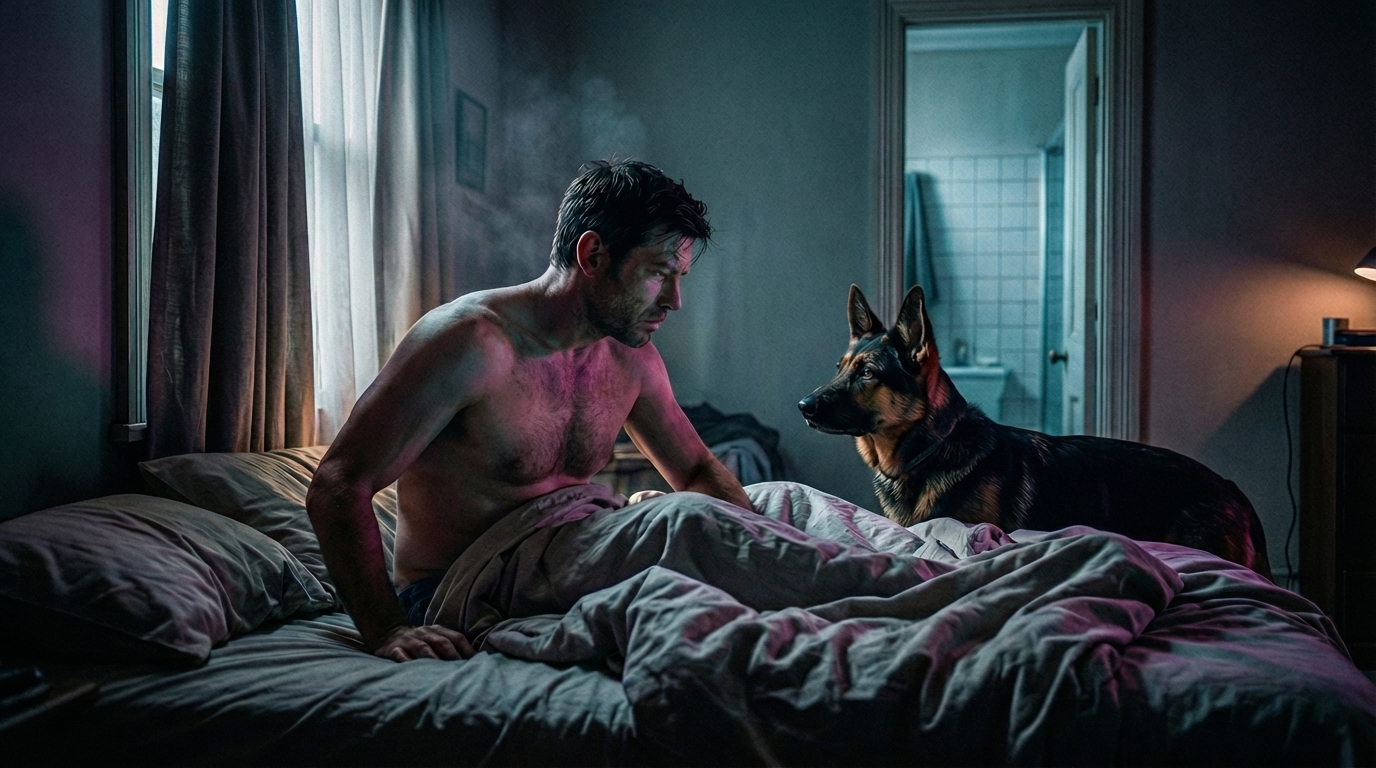
Not even the dog would look at him.
Jargus lay pressed against Karl Jenkins's ribs with the determined stillness of an animal that had decided, sometime during the small hours, that loyalty did not require enthusiasm. His amber eyes, ordinarily sharp enough to track movement across a crowded park, had retreated behind a dull glaze that spoke of long hours spent waiting beside a door that would not open, followed by longer hours spent beside a man who had finally stumbled through it reeking of spirits and regret. The German Shepherd's warmth was the only gentle thing in the room. Everything else — the light, the cold, the thudding pulse behind Karl's temples — had arrived with hostile intent.
July had settled over Hobart like a damp compress. The city's winter pressed itself against the windows of the South Hobart flat with a patience that suggested it had nowhere else to be, seeping through brick and plaster to pool in corners where heat could not reach. Outside, the mountain would be wearing its grey shawl of cloud, the streets below it quiet with the particular stillness of a Saturday morning that had not yet decided whether to commit to rain. Inside, the curtains held their line against the sun, but a single blade of light had found the gap between them and driven itself into the room like a blade between ribs.
Karl's mouth tasted of copper and ash. His tongue sat thick and immobile against his palate, furred with the residue of whatever sequence of drinks had carried him from the polished timber of the Salamanca bar to this horizontal wreckage. The celebration had begun as celebrations ought to — handshakes and backslaps, glasses raised to the man who had topped the senior detective examination, the man whose name would appear on the Major Crimes roster before the month was out. Colleagues whose respect he had spent years cultivating had offered it freely, and he had accepted it with the particular hunger of someone who understood exactly what the promotion meant. Not merely rank. Trajectory. The kind of upward arc that turned senior detective into sergeant, that turned sergeant into the sort of career his father's generation would have recognised as worthy.
Somewhere between the third round and the sixth — or the eighth, or wherever the count had dissolved into the general blur — the evening had slipped its leash. Karl could not identify the precise moment when controlled celebration became something darker. The transition existed in his memory as a smear rather than a line, a gradual loss of definition like a photograph left too long in developing solution. Faces he recognised gave way to faces he did not. The bar's warm lighting had been replaced, at some unmarked point, by something harsher — strobing, pulsing, the bass-heavy darkness of a venue whose name he could not retrieve. There had been heat. Bodies. The press of strangers in chemical proximity.
And then nothing. Hours of nothing, stretching from that last smeared impression to the moment consciousness had dragged him back to this bed, this pain, this dog who would not meet his eyes.
He attempted to rise. His body, which had served him reliably through two decades of police work — foot chases, long surveillances, the physical demands of a career that kept a man on his feet more often than behind a desk — responded with the coordinated grace of a marionette whose strings had been cut by a spiteful child. His legs tangled in sheets that clung to his skin with the intimacy of damp plaster. His arms, reaching for the bed frame, found nothing but air. Gravity, sensing opportunity, intervened with prejudice.
The carpet received him with indifference. He lay sprawled across it, breath coming in shallow bursts, one hand outstretched in a gesture that might have been supplication if anyone had been watching who cared. No one was. Jargus lifted his head from the mattress above, surveyed the fallen man with the unhurried assessment of a magistrate reviewing a sentencing brief, and let it drop again.
Karl's palm, still groping for purchase against the floor, found something that was neither carpet nor timber. The texture registered before thought could intervene — slick, cooling, yielding in a way that sent his fingers recoiling with an instinct older than reason. He brought his hand into view and saw it dangling there: latex, spent, its contents settling with the obscene patience of evidence that understood its own significance.
The flat went very quiet.
He stared at the thing as though it might offer testimony. It did not. It hung from his fingers with the passive indifference of all physical evidence — present, undeniable, and utterly silent on the question of who. His mind reached for Sarah Lahey, reached for the possibility that whatever had happened in the missing hours had happened with the woman whose trust he had been trying, with genuine if imperfect effort, to deserve. But the reaching found nothing to grip. No memory of her voice, her skin, her presence in this room. Only the gap where memory should have been, and this grotesque artefact occupying the space where explanation ought to stand.
The nausea that had been circling since consciousness returned chose this moment to make its approach. It came not as a wave but as a siege — methodical, patient, tightening around his stomach with the slow certainty of a hand closing into a fist. Karl made the bathroom on instinct rather than coordination, his body navigating the short hallway with the desperate momentum of a man who understood that stopping meant surrendering to gravity a second time. The toilet received what his stomach could no longer contain: bile and acid and the chemical remnants of a night that had consumed him as thoroughly as he had consumed it.
Afterwards, he reached the shower. He did not choose a temperature. He did not undress with any attention to sequence or dignity. He simply placed himself beneath the water and let it fall, his spine pressed flat against tiles whose cold bit through his skin like a reprimand delivered without words. The water was too hot or too cold — he could not tell which, and the distinction had ceased to matter. What mattered was the contact: the relentless percussion of droplets against flesh, each one a small erasure, washing away sweat and shame in equal measure while leaving the deeper stain untouched.
His thoughts would not organise. They arrived in fragments — a woman's hand against his chest, fingernails tracing a line whose destination he could not recall; the bass thud of music felt more than heard; laughter that might have been his own — and each fragment dissolved before it could connect to the next. The detective in him understood what this meant. He had worked cases where victims and suspects alike presented with exactly this pattern: the shattered chronology of a mind that had been chemically separated from its own experience. He had sat across interview tables from people who could not account for their own hours, and he had regarded their confusion with the professional scepticism of a man who believed that memory, like evidence, existed to be recovered if one only knew where to look.
Now that man sat on the floor of his own shower, water beating against his skull, and could not find what he was looking for.
Jargus appeared in the bathroom doorway. The German Shepherd stood on the threshold with the particular stillness he adopted when assessing whether a situation required his involvement — ears forward, weight balanced, those amber eyes tracking Karl through the shower glass with an expression that defied easy categorisation. Loyalty, certainly. Patience, without question. But threaded through both, something that looked uncomfortably like the steady gaze of a witness who had seen everything and would say nothing.
