Cinerei Antri
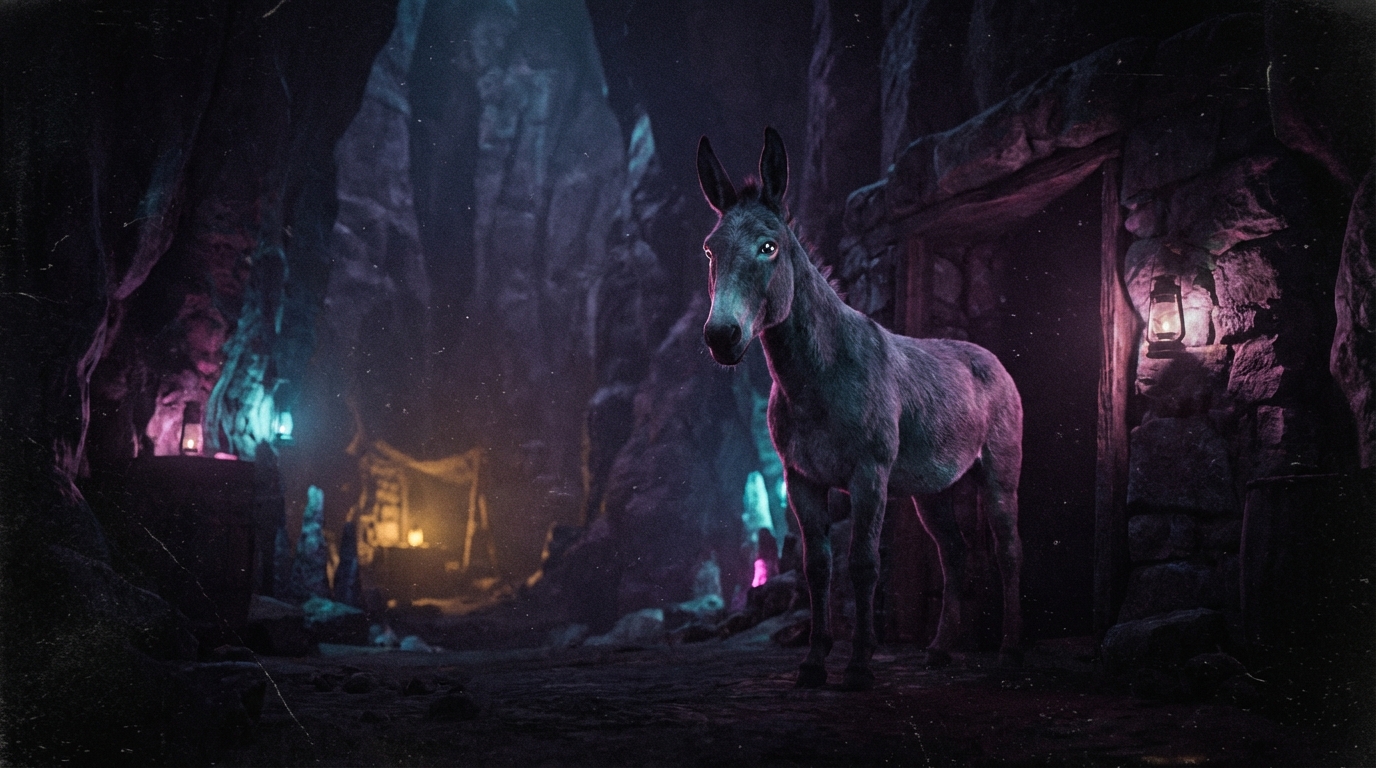
The Cinerei Antri—the Ash-greys of the Cave—are the pale-coated mules bred for over two thousand years in the sheltered canyon of L'Establum. Descended from Andalusian donkeys and Iberian horses brought through the Portals by Los Antiguos settlers in 86 BCE, they have been shaped by generations of careful selection for the demands of cave and mountain terrain. Their soft grey coats blend with stone; their enlarged dark eyes navigate near-darkness; their patient temperament suits the silence required for Éclaireur patrols. They are as much a product of this region as the Lumineux themselves.
Origins
The first equines arrived in the Los Antiguos region on September 14, 86 BCE, three years after the settlement's founding.
Other settlements elsewhere in Clivilius had almost certainly brought livestock through their own Portals over the millennia, but for the isolated cave system that would one day become Xylora, this was the beginning.
Marcus Equitius Cursor was a horse trader from Hispalis in the Roman province of Hispania Ulterior, a practical man who had joined the Los Antiguos settlers seeking opportunity rather than refuge. Within months of arrival, he had identified the settlement's most pressing logistical problem: the terrain between the caves and the surface was brutal, and human backs could not sustain the burden of supply transport indefinitely. Mules—the sterile hybrid offspring of donkeys and horses—had served Roman military campaigns across mountain ranges for generations. They could serve here as well.
He brought his proposal to Lucius Valerius Cordubensis, one of the five Guardians of Los Antiguos. Lucius was a merchant from Corduba whose trading networks had once spanned the western Mediterranean; he understood the value of pack animals and the logistics of mountain transport. After weeks of negotiation—debating costs, risks, and the practical challenges of bringing livestock through a Portal into absolute darkness—Lucius agreed to facilitate the crossing.
On September 14, 86 BCE, Lucius led nine animals through his Portal: four donkey jennies named Umbra, Petra, Noctis, and Silva; two donkey jacks named Ferox and Canus; and three Iberian mares named Castella, Hispalis, and Rubra. The Portal itself posed no danger—stepping through was no different from stepping through a doorway, one moment in the sunlit hills of Hispania, the next in the cool stillness of a Clivilius cave.
The danger came after.
The animals emerged into near-total darkness, their instincts rebelling against an environment that offered nothing familiar. Handlers carrying Lumineux vessels provided what light they could, but the journey from Portal to surface was three hours through passages that humans found challenging and animals found terrifying.
Silva, the youngest jenny, broke her leg on an unseen drop barely an hour into the journey. The handlers had no choice but to put her down where she fell—her screams echoing through the caves until Marcus's knife silenced them. Rubra, the red-coated mare, panicked two hours later when the passage narrowed and the ceiling dropped. She reared, struck her head against the stone with force enough to split bone, and died within minutes.
Seven animals reached the surface on September 17, 86 BCE: three jennies, two jacks, and two mares. They stood blinking in the grey light of an overcast afternoon, the first equines to set hoof in this region—traumatised, exhausted, but alive.
Marcus wept when he counted them. Then he began planning how to get more.
Building the Herd
Lucius made a second crossing to Earth in the spring of 85 BCE.
He brought back five additional animals: two jennies to replace the losses, one more jack, and two mares selected specifically for their calm temperament. The journey through the caves claimed no lives this time; handlers had learned from the first crossing, widening dangerous passages with picks and hammers, stationing Lumineux bearers at regular intervals, moving more slowly and with greater care.
By 83 BCE, the Los Antiguos herd numbered fourteen donkeys and six horses—enough to begin systematic mule breeding.
The first mule born in the region arrived on August 7, 82 BCE, foaled by the mare Castella and sired by the jack Ferox. Marcus named him Primus. The animal was unremarkable by Earth standards—brown-coated, sturdy, possessed of the patient stubbornness common to his kind. But he represented proof that the breeding programme could succeed. Primus lived for twenty-eight years, siring no offspring of his own but working the mountain trails until his joints gave out in his final summer.
By 75 BCE, mules outnumbered their parent stock. The breeding programme had found its rhythm.
L'Establum
By 71 BCE, the livestock operation had outgrown the main settlement.
The animals needed grazing space and fresh air that Los Antiguos could not provide. Marcus had identified a solution years earlier: a sheltered canyon accessible both from the surface and through a secondary passage in the cave system, oriented north-south so that its steep walls blocked direct sunlight for most of the day. A spring fed the canyon floor, providing year-round water. The terrain offered grazing, defensible positions, and enough space for a breeding herd to grow.
On March 3, 71 BCE, Marcus Equitius Cursor formally established this site as a permanent breeding station. He called it Stabulum—the Latin word for stable. The name would evolve over two millennia: Stabulum became Establum under medieval French influence, and finally L'Establum in modern usage.
Eight families formed the founding population. Marcus led them, but he was joined by seven others whose descendants would maintain the operation for generations beyond counting. Lucius Pastorius Capra brought expertise in goat and sheep husbandry. Gaius Camparius Frumentus understood fodder cultivation and grazing rotation. Quintus Ferrarius Faber was a farrier whose knowledge of hoof care proved indispensable. Titus Custorius Vigil organised the station's security. Publius Aquarius Fonteius managed the spring and irrigation. Sextus Selarius Corianus worked leather into harnesses and equipment. Aulus Mercatorius Venator handled trade relations with Los Antiguos and, eventually, with external settlements.
These eight surnames persist at L'Establum to this day. Two thousand years of intermarriage have blurred the boundaries between them, but the founding families remember their origins, and the old names still carry weight.
The Breeding Programme
The transformation from ordinary Iberian stock to the distinctive Cinerei Antri took centuries of deliberate selection.
The earliest breeders selected primarily for temperament. Animals that spooked at shadows, balked at unfamiliar sounds, or fought handlers in confined spaces were not bred. The mules that passed on their traits were the calm ones—creatures that would stand motionless for hours if required and walk forward into darkness without hesitation.
Physical changes followed more gradually. The pale coats emerged first, lighter animals preferred over darker ones until the soft ash-grey that now defines the breed became dominant by approximately 50 CE. Grey animals were easier to locate in low light, their pale forms visible against dark stone when handlers needed to find them quickly. The darker coats of their Iberian ancestors served no purpose in a world where direct sunlight was rarely encountered.
The eyes changed over longer timescales. Mules born to parents with larger pupils and darker irises were favoured, generation after generation, the cumulative effect producing animals whose eyes seemed to drink in whatever light was available. By the Lumivaux era, the enlarged dark eyes had become the breed's most distinctive feature—giving them an expression that newcomers invariably found unsettling.
The hooves required active management rather than passive selection. L'Establum farriers developed trimming techniques specific to cave and mountain terrain, shaping hooves for grip on wet stone rather than dry earth. The animals adapted their gait over generations as well, each foot placed with a deliberation their Earth ancestors had never possessed.
By the time Thomas Whitaker's settlers arrived in 1683 CE and formalised relations with L'Establum, the Cinerei Antri had been a distinct breed for over a thousand years.
Survival Through Collapse
The Cinerei Antri have survived three settlement collapses.
When Los Antiguos fell in 187 CE—its population scattered by disease and internal conflict, its Guardian lines extinguished within a single devastating decade—L'Establum endured. The breeding station had always been semi-independent, its families accustomed to periods of limited contact with the main settlement. When contact ceased entirely, they adapted. Trade relationships with external surface settlements, established generations earlier by the Mercatorius family, provided goods that Los Antiguos had once supplied.
Not all the animals remained under human control. During the chaos of the collapse, a significant portion of the breeding stock escaped or was released by handlers fleeing the region. These animals formed the foundation of the feral Cinerei population that persists to this day—grey shapes glimpsed in the canyons and mountain passes, descendants of domesticated stock that returned to wildness eighteen centuries ago.
When Lumivaux was founded in 923 CE, the new settlers discovered L'Establum still operational. The relationship was formalised anew: Lumineux access and protection in exchange for livestock and surface-grown goods. The arrangement persisted for nearly five centuries, until Lumivaux's collapse in 1412 CE.
Again, L'Establum survived. Again, the feral population swelled as escaped animals joined their wild cousins. And again, when Xylora was founded in 1683 CE, the breeding station remained—its families weathered but unbroken, its mules the living legacy of a programme begun seventeen centuries earlier.
Physical Characteristics
A mature Cinerei Antri stands between fourteen and fifteen hands at the shoulder—slightly smaller than the Iberian stock from which they descended, a size better suited to low-ceilinged passages and tight mountain switchbacks.
Their coats range from pale silver to soft ash-grey, occasionally dappled with lighter patches across the hindquarters. The hair is finer than that of Earth mules, lacking the coarse outer layer that protects against sun and weather. This adaptation renders them poorly suited for extended surface exposure—a Cinerei Antri left in direct sunlight for more than three hours will develop skin irritation and visible distress—but ideally suited for the cool, consistent temperatures of cave systems.
The eyes are the breed's most recognisable feature. Proportionally larger than those of Earth mules, with irises so dark they appear almost black, they allow navigation in light conditions that would leave Earth horses effectively blind. A Cinerei Antri can walk confidently through passages lit only by a single Lumineux vessel, finding footing that human eyes cannot perceive.
Their ears are proportionally larger as well, rotating independently to track sounds from multiple directions. In the echoing acoustics of cave systems, this auditory sensitivity serves them well. Experienced handlers learn to watch their mules' ears: both ears forward indicates curiosity, both ears back signals irritation, one ear swivelling independently means the animal has detected something the handler has not.
Temperament
The Cinerei Antri are patient to a degree that borders on immobility.
Two thousand years of breeding have selected for animals that will not panic in darkness, will not bolt at sudden sounds, will not fight handlers on narrow paths where a single misstep means death. The result is a breed that moves with careful deliberation, considering each step before committing, refusing to be rushed regardless of circumstances.
This temperament makes them ideal for Éclaireur patrols, which may require hours of motionless observation on exposed ridgelines. A Cinerei Antri will stand without complaint, ears tracking ambient sounds, content to wait as long as waiting is required.
The same temperament frustrates anyone accustomed to more responsive animals. Cinerei Antri cannot be forced. They respond to patience, to calm handling, to the particular tone of voice that experienced handlers develop through years of practice. Attempts to hurry them produce the opposite of the desired effect. A Cinerei Antri that feels threatened will simply stop, planting its hooves and refusing to move until the threat passes.
The Xyloran saying têtu comme un gris—stubborn as a grey—carries no negative connotation. In a world where a single wrong step can mean death, stubbornness is survival.
The Feral Population
Not all Cinerei Antri answer to human handlers.
The feral population traces its origins to the collapse of Los Antiguos in 187 CE. Subsequent settlement collapses added to their numbers. Today, the wild Cinerei Antri constitute a population estimated between three hundred and five hundred animals, scattered across a range extending roughly forty leagues from L'Establum.
They retain the physical characteristics of their domesticated cousins but generations without human contact have reshaped their behaviour. Feral Cinerei Antri are wary, quick to flee at human approach, capable of navigating terrain that domesticated animals would refuse. They travel in small bands of eight to fifteen individuals, led by dominant jennies whose authority is maintained through biting and kicking.
The feral population presents both nuisance and genuine threat. They compete with domesticated herds for grazing. Feral jacks occasionally disrupt breeding programmes by attempting to mate with domesticated jennies. More seriously, feral bands have been known to spook or scatter domesticated herds during Éclaireur patrols, creating chaos at moments when discipline is essential.
L'Establum handlers conduct periodic culls, targeting aggressive individuals and bands that venture too close to the breeding station. But complete eradication has never been attempted. The feral Cinerei Antri represent a genetic reserve—a population that could theoretically be recaptured and redomesticated if catastrophe struck L'Establum itself.
Roles and Uses
The Cinerei Antri serve three primary functions in modern Xyloran society: patrol, cargo, and transport.
The Éclaireurs rely on them for reconnaissance work, spending days in the foothills covering terrain too rough for vehicles and too extensive for foot travel. The mules carry supplies, equipment, and wounded personnel. They serve as elevated observation platforms and provide mobility in combat situations.
Cargo transport remains the most common use. Everything that enters or leaves Xylora by land travels on mule-back: supplies, trade goods, equipment, correspondence. A mature Cinerei Antri can carry up to one hundred fifty kilograms across terrain that would defeat any wheeled conveyance.
Prisoner and casualty transport is where the breed's temperament proves most valuable. Those being brought to Xylora against their will are typically bound and placed on mule-back for the descent. The Cinerei Antri's calm allows handlers to focus on their charges rather than their mounts.
Naming
The name "Cinerei Antri" dates to the Los Antiguos era, first recorded in Marcus Equitius Cursor's breeding logs around 68 BCE.
L'Establum handlers pronounce it sin-ER-ee-eye AN-tree, close to the classical Latin, while Xylorans soften it to sin-air-ee AN-tree under French influence. Colloquial usage varies: L'Establum residents often shorten it to "Cinerei" or "les Gris," Éclaireurs typically say "the greys," and external settlements have developed their own variants.
The formal name persists in official contexts. But in daily speech, the animals answer to whatever their handlers call them. After two thousand years, they have learned not to be particular about names.
