4338.204 · July 23, 2018 AD
Choose Wisely
Escaping the desolation of Clivilius’s desert, Luke stumbles back into the seeming safety of his study. But as a voice of impossible scale speaks directly into his soul, Luke begins to understand that his place in this story carries consequences far beyond himself.
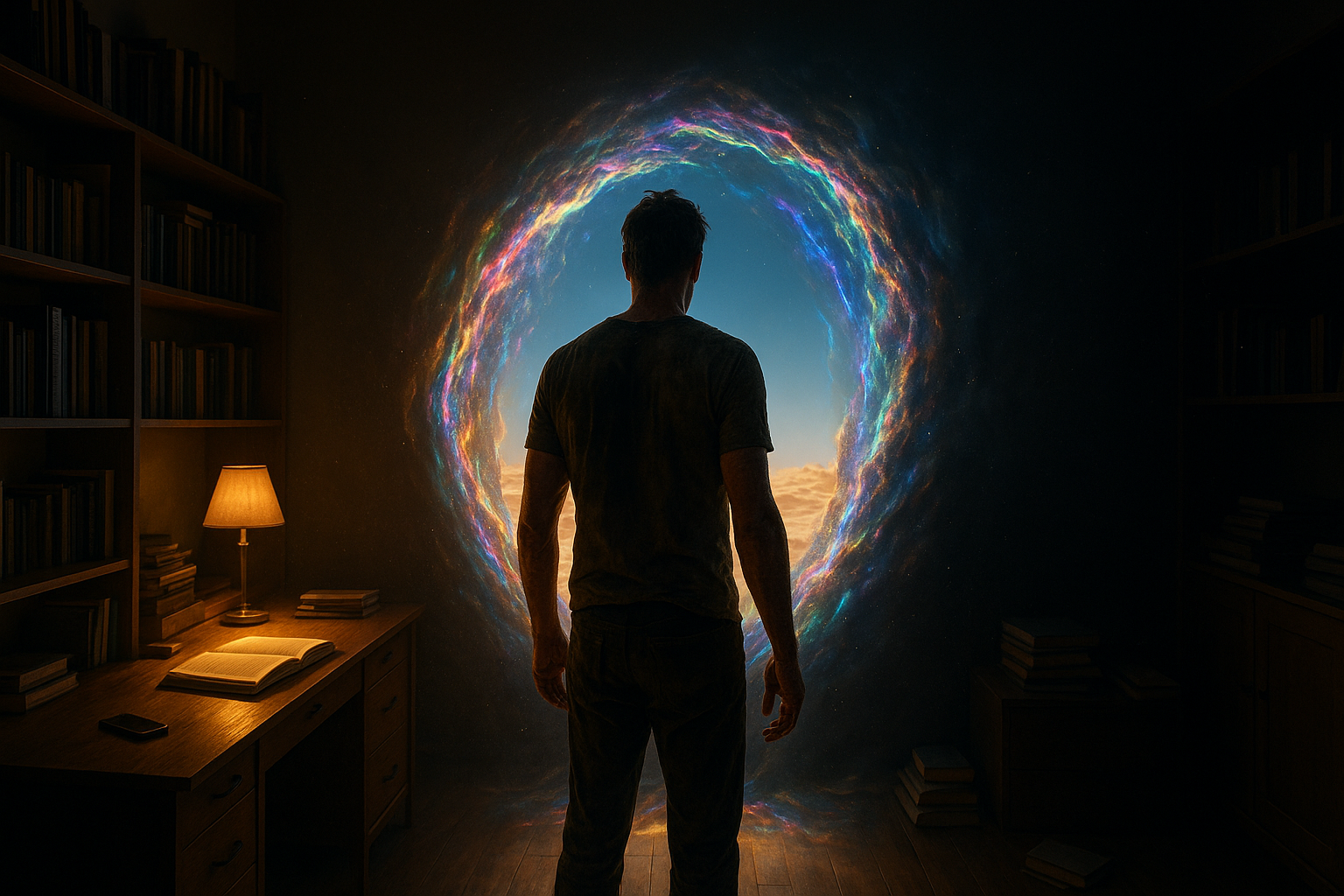
“Some choices feel small—until you realise the universe has been waiting for them.”
Consciousness returned like a fist through glass—sudden, violent, leaving shattered edges everywhere it touched.
My eyes snapped open. For a disorienting instant, I had no idea where I was, who I was, what had happened to deliver me to this place of blinding light and alien sky. Then memory crashed back in fragments: the portal, the desert, the endless brown expanse, my legs buckling, the ground rising to catch me as everything went dark.
The sky above me burned with a blue so pure it seemed to hum with its own frequency—a colour that existed nowhere in Tasmania's muted palette of cloud and eucalyptus grey. It stretched from horizon to horizon without interruption, without mercy, filling my vision with such aggressive brightness that my eyes watered even as they struggled to adjust. For a moment—just a moment—the sheer beauty of it overwhelmed everything else. I lay there staring upward at an alien heaven, and something in my chest loosened. Serenity. The fragile, illusory peace of a man who doesn't yet remember why he should be afraid.
Then my body reminded me.
The serenity lasted perhaps three heartbeats before reality came surging back with the subtlety of a flood. My chest convulsed, muscles locking in rebellion against an air that had been cooking my lungs whilst I lay unconscious. I tried to breathe and found the act had become a negotiation—each gasp dragging the desert's furnace breath deep into spaces that wanted nothing to do with it.
The heat was wrong. Not the gentle warmth of a Tasmanian afternoon but something hostile, something that seemed to reach down my throat and scrape moisture from tissue that desperately needed it. My tongue felt like sandpaper. My lips had cracked somewhere during my collapse, and when I tried to wet them, I found nothing to give. Only dryness upon dryness, my body a house with all its taps run dry.
I had been holding my breath, I realised. Unconscious but refusing to draw air, as though some deep animal part of my brain had tried to close off the world rather than admit what had happened. Now that defence had failed, and everything came rushing in at once.
The first cough tore itself from my chest with a violence that shocked me. It felt like something being ripped loose—not air expelled but damage done, a wet and brutal spasm that left my ribs aching. Then another followed, and another, each one building on the last until my whole body had become a machine for producing agony. Dust rose around me in clouds as I curled inward, the fine powder clinging to sweat I hadn't realised I'd produced, coating my arms and face and the exposed skin of my neck in a film of grit that turned immediately to mud where moisture met it.
I thought of my mother—Heather—though I rarely thought of her these days. Thought of the stories Dad had told us about her dark periods, the days she couldn't get out of bed, the nights she'd wander the house like a ghost searching for something she'd lost. I wondered if this was what it felt like for her. This sense of being too far gone to return. This body that had become a prison rather than a vehicle.
Each convulsion was a fresh reminder of how fragile I was here. How utterly unprepared. I had stepped through a portal into another world carrying nothing but curiosity and a cheap plastic pen, and the world had responded by nearly killing me in what felt like minutes. The desert didn't care about my dreams or my destiny or the voice that had been whispering to me since childhood. The desert simply existed, vast and indifferent, and I was an insect that had wandered into its domain without permission.
The peace I'd woken to seemed like mockery now. A cruel joke—offering serenity at the precise moment when panic would have been more useful. Wake up calm, it seemed to say, so you can appreciate exactly how fucked you are.
I forced myself to think. Forced the coughing to subside through sheer will, pressing my lips together until the spasms passed, breathing shallowly through my nose to avoid triggering another fit. The voice—Clivilius—had welcomed me. Had spoken my name. That meant something. That had to mean something beyond simply dying alone in an alien desert with no one to find my body, no one to tell Jamie what had happened, no marker to show where the curious fool had finally met the end of his curiosity.
Get up, I told myself. Get up or die here.
Driven by nothing more sophisticated than the raw instinct to survive, I forced myself upright.
My legs trembled beneath me—uncertain, unreliable, threatening to fold with every shift of weight. The muscles had gone strange during my collapse, stiffening in positions they weren't meant to hold, and now they protested every demand I made of them. But I willed them forward anyway, because the alternative was staying here, and staying here meant dying, and dying meant—
What? What would dying mean? Would Jamie find out eventually? Would Paul? Would anyone ever know what had happened to Luke Smith, the dreamer who finally found the world he'd been dreaming about and discovered it didn't want him there?
The horizon offered nothing but more of the same desolation I'd collapsed into. Brown and orange and the merciless glare of that alien sun, stretching in every direction like an accusation. But there—cutting through the emptiness like a wound in the fabric of the world—was the swirling vortex of colour.
It churned and pulsed against the monotony of the desert, alive with impossible hues that seemed to vibrate at frequencies my eyes hadn't been designed to register. Kaleidoscopic. Beautiful. The only thing in this entire wasteland that didn't want to kill me—or at least, the only thing that offered an alternative to dying slowly of heat and thirst.
My gaze fixed on it with the desperation of a drowning man spotting a rope. The colours shifted and danced, beckoning me, promising something I needed more than I'd ever needed anything: escape. The familiar. Home—whatever that word meant anymore.
I thought of my study. The half-filled bookshelves with their spines of poetry and fantasy and the occasional theological text I'd kept from my mission days. The scatter of notebooks containing thoughts I'd never shared with anyone. The dust motes drifting through afternoon light. The particular smell of that room—paper and ink and the faint mustiness of old carpet.
I thought of Jamie's voice on the phone. Of Henri and Duke waiting at home, probably confused by now, probably pacing. Of the life I'd been living just moments ago—complicated, imperfect, strained by distances I'd never figured out how to close, but mine. A life with oxygen that didn't burn going down and ground that didn't try to cook me through the soles of my shoes.
Home, I thought. Please.
I would give anything.
With what strength remained in legs that had no right to still be functioning, I staggered toward the portal. Each step was a small battle won against a body that wanted to quit. The desert's grip seemed to tighten with every pace I took away from it, the heat pressing down harder, the dust rising in clouds around my feet as though trying to hold me in place.
I refused to stop.
The colours grew brighter as I approached—emerald and sapphire and crimson swirling together in patterns that seemed almost intentional, almost welcoming. Their light played across my skin, painting my arms and hands in shifting hues that looked strange and wrong and beautiful all at once.
Ten metres. Five. Three.
The portal loomed before me, a tear in reality that shouldn't exist but absolutely did, promising deliverance from this world that had tried so hard to kill me.
I didn't hesitate. I didn't stop to think about what might be waiting on the other side. I didn't consider the possibility that the portal might have closed, or changed, or led somewhere other than where I needed to go.
I simply hurled myself forward with a final, desperate lunge.
The crossing was instantaneous—a blink, a heartbeat, a single breath begun on one side of existence and completed on another. There was no tunnel. No sensation of movement. No dramatic passage between worlds that might have given me time to prepare for what came next.
One moment I was surrounded by the desert's killing heat and the portal's cascading light.
The next I was somewhere else entirely.
It was as though reality itself had blinked, and I had been carried along with its closing lid.
My foot came down on carpet.
The texture registered before anything else—the familiar give of fibres beneath my shoe, the soft resistance of something designed for human comfort rather than human destruction. It felt impossibly good. Impossibly right. After the hard-packed grit of the desert floor, this simple surface seemed like a gift beyond measure.
Then the smell hit me. Paper. Wood. The faint mustiness of a room that had been closed up on a winter afternoon. The particular combination of scents that meant my study, that meant my house, that meant I am alive and I am home.
For a heartbeat—perhaps two—I almost wept.
The relief was so total, so overwhelming, that my legs nearly buckled all over again. But this time not from exhaustion. From gratitude. From the simple, primal joy of a creature that had come close to dying and found itself, against all odds, delivered back to safety.
I was home. Or at least, I told myself I was.
But before I could fully claim the sanctuary of the familiar, before I could let myself collapse into the desk chair or reach for my phone or do any of the small mundane things that would confirm my return to the world I knew—it returned.
The voice.
It didn't arrive through the air. Didn't travel the way sound was supposed to travel, vibrating through atmosphere and eardrum and cochlea. Instead, it simply was—present in the core of me, blooming in spaces I hadn't known existed, a whisper and a command intertwined into something that defied every category I possessed for understanding communication.
Alien, yes. Utterly inhuman in the way it bypassed all the machinery I'd been taught to use for receiving language. But also strangely intimate. As though it knew me—had always known me—had been waiting somewhere beyond the walls of the ordinary world for exactly this moment when I would finally be ready to hear what it had to say.
Remember.
The single word reverberated through me with a force that seemed disproportionate to its simplicity. One word. Eight letters. A command so basic that children learned to understand it before they could properly speak. And yet it carried within itself entire oceans of implication—promise and warning and burden all folded together, all pressing against my consciousness at once.
My steps faltered. The urgency that had driven me through the portal softened into something else—a stillness that didn't feel like my own choice, as though the word itself had reached into my nervous system and adjusted the settings.
I turned.
The compulsion was irresistible. Not violent—the voice didn't force me—but the pull was so strong that refusing felt unthinkable. Like refusing to breathe. Like refusing to acknowledge the existence of the sun.
Behind me, the portal still shimmered against the study wall. The colours had dimmed from their earlier intensity, settling into something that looked almost tired, almost spent. They rippled faintly against the plaster and the bookshelf edge they'd swallowed, like the last embers of a fire that had burned too hot and was now banking itself into coals.
In that glow—in the fading kaleidoscope of what had nearly been my death—I saw something beyond the immediate. Saw, or perhaps felt, the enormity of what that swirling light represented. Not just a passage between my study and a desert. Not just a doorway between Tasmania and Clivilius. But a threshold between everything I had been and everything I might become. A hinge point. A fulcrum.
The choices that had led me here—the curiosity that had made me throw the pen, the recklessness that had made me step through, the stubbornness that had driven me back—all of them suddenly felt like they mattered in ways I couldn't fully comprehend. As though each small decision had been a thread woven into a tapestry so vast I couldn't see its edges.
My throat tightened. The words came before I could stop them, escaping in a whisper so fragile it barely reached my own ears.
"Remember what?"
The question hung in the air of my study—that ordinary space filled with ordinary things, suddenly rendered extraordinary by the impossible light still rippling against its far wall. I heard my own voice as though from a distance, heard the bewilderment in it, the desperation for something to hold onto in this flood of mystery and implication.
What was I supposed to remember? The nightmare that had started this? The eyes beneath Paul's bed, the shadow man emerging from childhood darkness? The voice itself, whispering to me since I was eight years old, guiding me toward... what? This moment? This choice?
I stood there, waiting, raw and exposed and utterly out of my depth.
The voice's reply did not come gently.
It struck with the force of revelation—not words so much as understanding, cascading through me like a river that had burst its banks and was now flooding every low-lying space in my consciousness. I felt myself stagger under the weight of it, felt my knees threaten to buckle for the third time since I'd woken in the desert.
Billions of decisions from thousands of years are converging. You cannot begin to understand the scale of what it is you are involved in. Every action has an impact. Every decision has consequences. You are a part of this, Luke Smith. Choose wisely.
The phrases didn't so much enter my mind as settle into it—each one finding its place like sediment drifting to the bottom of a stirred glass, arranging itself into patterns that felt permanent. These weren't words I would forget. They had been carved into something deeper than memory, inscribed on surfaces I didn't have names for.
Billions of decisions.
I tried to comprehend it. Tried to wrap my understanding around the scale being described—not hundreds, not thousands, not millions, but billions. Every choice made by every creature capable of choosing, stretching back through millennia I couldn't count, all of it somehow relevant to this moment. To me. To a thirty-four-year-old man standing in his study in Berriedale, Tasmania, with desert dust still coating his arms and the taste of alien air still burning in his throat.
Thousands of years.
The voice—Clivilius—had been watching for that long. Had been waiting. Had seen civilisations rise and fall, had observed humanity crawling out of caves and building cities and inventing gods to explain what they couldn't understand. And through all of it, somehow, threads had been woven that led here. To this house. To this day. To me.
The arrogance of imagining myself important enough to matter to something so vast warred with the terror of discovering that I did, in fact, matter. That my choices—my small, personal, often poorly-considered choices—carried weight in some calculation I would never be able to see or verify.
Every action has an impact.
I thought of the decisions I'd made just today. Waking from the nightmare. Reaching for the strange device. Pricking my finger on its hidden needle. Throwing the pen. Stepping through. Collapsing. Rising. Returning. Each one a choice, each one a fork in a path that apparently mattered to the universe itself.
What about the choices I'd made before today? The decision to move to Tasmania. To stay with Jamie despite the growing distance between us. To ignore Paul's occasional phone calls because I didn't know how to explain what was happening in my dreams. To keep secrets from everyone who might have helped me understand what was stirring inside me.
Had all of that mattered too? Had every moment of evasion and denial been weighed somewhere, measured by forces I couldn't perceive, added to some cosmic ledger whose totals I would never be allowed to see?
Every decision has consequences.
The weight of it pressed down on me—not physically, but with a gravity that had nothing to do with mass and everything to do with significance. I felt small. Impossibly, terrifyingly small. A single point of consciousness in a network of decision-makers spanning continents and centuries, all of us unknowingly participating in something none of us could comprehend.
And yet, somehow, I mattered. Somehow, of all the billions of decision-makers across all the thousands of years, the voice had chosen to speak to me. Had chosen to welcome me by name. Had chosen to warn me—to guide me—to place upon my shoulders a burden I had never asked to carry but apparently couldn't refuse.
You are a part of this, Luke Smith.
My name, spoken by something older than human memory. Spoken with a certainty that suggested it had known I would arrive here long before I'd known it myself. Perhaps before I was born. Perhaps before my parents met, or their parents, or any of the endless chain of ancestors whose choices had eventually produced the specific combination of genes and circumstances that became me.
Choose wisely.
The admonition settled over me like a garment I hadn't asked to wear but couldn't remove. It was burden, yes—the weight of knowing that my decisions mattered beyond my ability to calculate their impact. But it was also something else. Something that felt almost like invitation. Almost like honour.
I had been chosen. Whether I wanted it or not, whether I understood it or not, something vast and ancient had looked across the span of existence and decided that Luke Smith—dreamer, son of a broken home, partner in a failing relationship, keeper of secrets he couldn't explain—was worthy of this message. Worthy of this warning. Worthy of participation in whatever vast unfolding the voice was trying to describe.
As the final syllables faded from wherever syllables went when they were finished resonating through the architecture of a human soul, my study was consumed by darkness.
It happened without transition—one moment the familiar shapes of books and desk and chair were visible in the afternoon light, the next they had been swallowed by an absence so complete it felt almost solid. The portal's glow vanished. The windows ceased to exist. Even the faint hum of the refrigerator from the kitchen—a sound so constant I'd stopped noticing it years ago—fell silent.
This was not the darkness of night or the darkness of closed eyes. This was something thicker, denser, more present than mere absence of light had any right to be. It pressed against my skin. It filled my lungs with each breath. It wrapped around me until I could feel it pulsing, as though the darkness itself was alive and observing.
I should have been terrified. Some part of me understood that—understood that this was the moment when panic would have been reasonable, when screaming or running or curling into a ball would have been perfectly justified responses to finding oneself suddenly blind in a room that had been visible moments before.
But terror didn't come.
Instead, what rose in me was something closer to recognition. As though this darkness was not a threat but a symbol—a visual representation of everything I had just been told. Within that void loomed the enormity of what I faced: the unknown paths branching before me in every direction, the impossible choices waiting at every junction, each one carrying weight far beyond my own small life.
This was what it meant to be part of something vast. This was what it felt like to stand at the intersection of billions of decisions spanning thousands of years. The darkness wasn't punishment or warning. It was truth—the honest acknowledgment that I could not see where any of my choices would lead, could not calculate the consequences of actions whose ripples would spread through webs of causation too complex for any human mind to trace.
I stood in that darkness and felt the admonition coil around me.
Choose wisely.
It was a burden. It was a challenge. It was perhaps—if I was brave enough to accept it—a calling.
I thought of my father, Noah, who had made choices that fractured our family but also rebuilt it. Thought of Greta, who had chosen to love children who weren't hers with a generosity I still didn't fully understand. Thought of Paul, who had chosen duty and family and the careful construction of a life that looked nothing like mine but was no less valid for its differences.
Thought of Jamie, who had chosen me despite all the ways I'd failed to be fully present. Who kept choosing me, even now, even through the growing distance I didn't know how to bridge.
Thought of myself, standing at this pivot point, this fulcrum on which realities I couldn't perceive might tilt one way or another based on what I did next.
The darkness was Clivilius. The darkness was the universe. The darkness was every consequence I would never see, every ripple I would never trace, every life my choices would touch without my knowledge or permission.
And I, impossibly, was now woven into its endless story.
I didn't know what came next. Didn't know what choices would be required of me, or when, or how I would recognise the moments that mattered from the moments that didn't. Perhaps they all mattered. Perhaps that was the point—that there were no insignificant decisions, no safe choices, no actions too small to count.
But standing there in darkness that felt less like blindness and more like truth, I made a choice.
I chose to stay.
I chose to learn.
I chose to become whatever this vast, ancient, impossible presence needed me to become—not because I understood what that meant, but because understanding had never been the prerequisite for courage. Because sometimes you simply had to step forward into the unknown and trust that the path would reveal itself as you walked it.
Choose wisely.
I would try.
God help me, I would try.
