
Callum Edward Bray
Callum Edward Bray (2 November 1991 – ) stands as the methodical heartbeat of emergency communications at Hobart Police Command, where his unshakeable composure and technical precision transform chaos into coordinated response. Born into a Launceston family that valued education and public service, Callum evolved from the quiet child who dismantled radios and mapped bushland tracks into the Senior Communications Officer whose voice guides detectives through Tasmania's darkest investigations. His career, marked by the pivotal Luke Smith case and countless crisis interventions, reflects a deeper pattern—a man who finds order in complexity, who bridges human emergency with systematic efficiency, yet remains enigmatic to colleagues who respect his competence whilst never quite penetrating his carefully maintained reserve.
The Architecture of Observation
Callum Edward Bray entered the world at Launceston General Hospital on 2 November 1991, the second child of Edward Jonathan Bray and Amelia Margaret Bray née Donoghue. His arrival in the hospital where his mother worked—and would continue working for decades in Paediatrics and Emergency—created an immediate connection between birthplace and lifelong purpose. The attending staff noted his "serious eyes" and unusually long fingers, details that would prove prophetic for a child destined to see patterns others missed and manipulate complex systems with delicate precision.
The Bray household on High Street, East Launceston, embodied structured respectability. Edward, teaching mathematics at Launceston College, brought home the discipline of equations and proofs. Amelia, navigating between paediatric wards and emergency trauma, understood how order could anchor chaos. Between them, they created an environment where achievement was expected but not demanded, where Catholic faith provided moral framework without suffocating dogma, where three children could develop distinct identities whilst sharing fundamental values.
From earliest memory, Callum exhibited what his mother called being "born looking for the pattern in things." While his elder sister Victoria commanded attention through articulate expression and his younger brother James would later charm through social ease, Callum observed. His bedroom became a workshop of salvaged electronics—old radios, discarded keyboards, obsolete remote controls—each methodically disassembled, catalogued in labelled boxes, studied for the logic of their construction. This wasn't destruction but archaeology, seeking to understand how disparate components created functional wholes.
The Solitary Explorer
Callum's childhood territory extended beyond the house to Punchbowl Reserve, where bushland offered different puzzles. He would disappear for hours, returning mud-kneed but clear-eyed, carrying moss samples or bark patterns he intended to examine under the household magnifying glass. These solo expeditions weren't escapes from family but explorations of a world that operated by discoverable rules—water always flowed downhill, certain birds appeared at specific times, tracks in mud told stories of nocturnal passages.
East Launceston Primary School, beginning 7 February 1996, provided Callum's first encounter with institutional structure. Teachers quickly recognised his unusual capabilities—visual-spatial reasoning advanced beyond his years, ability to solve logic puzzles meant for much older children, intuitive grasp of number patterns and base conversions. Yet they also noted concerning traits: resistance to group activities, challenges to adult reasoning when it contradicted his internal logic, preference for solitary pursuits over peer interaction.
The incident that would define his primary school reputation occurred in Year 4 when Callum repaired a malfunctioning class projector during lunch break. Ms. Clare Burney found him surrounded by components, the device not just functional but improved. Her response—simultaneous praise and warning about "unauthorised tampering"—encapsulated the challenge Callum would face throughout education and career: exceptional capability coupled with problematic independence.
Chess provided crucial outlet for his strategic thinking. Under the guidance of Mr. Dominic Fields at the Launceston Mechanics' Institute Library, Callum discovered a world where patterns had names, where defensive patience could defeat aggressive assault, where thinking multiple moves ahead was virtue rather than overthinking. His style—methodical, defensive, grinding opponents down through positional advantage rather than dramatic attacks—would later manifest in his professional approach to crisis management.
The Technical Awakening
Launceston College, beginning 5 February 2003, marked Callum's intellectual flowering. The institution's embrace of digital technology perfectly timed with his evolving interests. Mr. Peter Halvorsen, teaching Computer Science, recognised in Callum something beyond typical teenage programming enthusiasm. Here was someone who understood code not just as instruction but as language, who saw in recursive algorithms the same patterns he'd observed in bushland water flow.
Callum's technical projects during these years revealed sophisticated understanding. The binary visualiser he created became a teaching tool. His Morse code communicator, built from salvaged rotary phone parts, demonstrated both historical appreciation and innovative application. When he participated in the Australian Informatics Olympiad, advancing to state finals in 2008, it validated what teachers already knew—this quiet, contrary student possessed exceptional analytical capability.
Yet social integration remained challenging. The Year 10 altercation with the Deputy Principal over mobile device policy—Callum had created an encryption app for SMS messaging—revealed his ongoing struggle with authority. His defence, a five-page document outlining the security potential of encrypted communication, demonstrated both his intellectual capability and his inability to navigate institutional politics. The IT coordinator's quiet praise couldn't offset the formal warning for "wilful insubordination."
The Criminology Connection
The University of Tasmania's Bachelor of Criminology programme (2010–2013) provided unexpected synthesis of Callum's interests. Forensic psychology offered patterns in human behaviour. Communication systems revealed how information flowed through crisis. The intersection of technology and law enforcement suggested career possibilities he hadn't previously considered.
His 2012 summer internship with the Tasmanian Department of Police, Fire and Emergency Management proved transformative. Dispatch operations combined everything that engaged him—complex systems requiring constant monitoring, patterns that predicted problems, technology serving crucial purpose. Unlike university's theoretical discussions, here consequences were immediate and real. A delayed dispatch could mean death. A misrouted communication could doom an operation. Precision wasn't preference but necessity.
The internship also introduced Callum to professional hierarchy's realities. Unlike university where intelligence could challenge convention, emergency services demanded protocol adherence. Yet within these constraints, he discovered unexpected freedom. Once procedures were mastered, innovation became possible. Efficiency improvements were welcomed. His suggestions for streamlining multi-agency incident handling were not just heard but implemented.
The Professional Foundation
Joining Hobart Police Command as Junior Communications Officer in 2013 required geographic and psychological transition. Moving from Launceston to Hobart meant leaving familiar territory, though he maintained strong family connections through regular visits. More challenging was entering an established team with entrenched dynamics, where his youth and technical expertise marked him as outsider.
Early years tested Callum's resilience. Colleagues initially perceived him as aloof, his quietness mistaken for arrogance, his precision interpreted as criticism of existing methods. The breakthrough came during a multi-vehicle accident on the Southern Outlet requiring coordination between police, fire, ambulance, and rescue services. Callum's calm management of overwhelming information flows, his ability to maintain clarity as situations deteriorated, earned grudging respect that gradually evolved into genuine appreciation.
The Luke Smith case (2019–2020) elevated Callum from competent officer to invaluable asset. The disappearances that gripped Hobart required unprecedented coordination between investigation and ground teams. Callum's ability to track multiple moving pieces, to maintain communication clarity despite mounting pressure, to remain unshakeable as the case grew increasingly complex and strange, proved decisive. His voice became the anchor for detectives like Sarah Lahey and Karl Jenkins venturing into situations that challenged comprehension.
The Weight of Coordination
Promotion to Senior Communications Officer in 2018 had preceded the Luke Smith case, positioning Callum perfectly for the challenge it presented. The role expanded his responsibilities from operational to strategic, from managing incidents to developing protocols. He implemented technical improvements that reduced response times, created redundancy systems preventing communication failures, established frameworks for inter-agency cooperation that became state-wide models.
Yet the position also intensified his isolation. Leadership meant maintaining professional distance. His natural reserve, once personal quirk, became professional necessity. Younger officers found him intimidating despite his willingness to mentor. His dry humour, appreciated by those who recognised it, was often missed by those expecting more conventional workplace banter. The engagement to Sophia Reid (2014–2016), a university classmate who initially seemed to understand his nature, ended when she realised his emotional availability would always be limited by professional demands and personal temperament.
The Family Constellation
Throughout professional evolution, family remained Callum's anchor. Edward, watching his son apply mathematical precision to emergency response, recognised his own systematic thinking transformed into life-saving application. Amelia, understanding crisis from her hospital experience, provided emotional support without demanding explanations Callum couldn't articulate. Their High Street home remained sanctuary where achievement was acknowledged without interrogation, where Catholic grace before meals provided continuity amidst change.
Victoria's role as confidante proved invaluable. Despite her Sydney location, she remained Callum's primary emotional outlet, the one person who could navigate his reserve without triggering retreat. Their conversations—during her Launceston visits or through carefully scheduled calls—allowed Callum to process experiences he couldn't share with colleagues or parents. Her legal training helped him understand institutional dynamics. Her emotional intelligence translated social situations that bewildered him.
James represented different connection—the extroverted younger brother whose ease in social situations Callum envied whilst knowing he could never replicate. James's marine research at IMAS created unexpected professional overlap, both brothers serving Tasmania through different applications of systematic observation. James's ability to bridge their reserved siblings provided family cohesion that might otherwise have fractured through geographic and temperamental distance.
The Patterns of Solitude
Callum's personal life reflects careful balance between engagement and isolation. The Hobart Chess Club provides intellectual stimulation without emotional demand. His defensive style—patient, positional, grinding—mirrors his professional approach. Opponents respect his technical skill whilst finding him difficult to read, never certain whether quietness masks deep calculation or simple introversion.
Bushwalking continues the childhood pattern of solitary exploration. Tasmania's national parks offer what Punchbowl Reserve once provided—space where patterns exist without human complication, where problems have solutions found through observation rather than negotiation. These solo expeditions, which worried Sophia during their engagement, remain essential to Callum's psychological equilibrium.
His journal, maintained with the same meticulous attention he applies to dispatch logs, serves as repository for thoughts too complex for verbal expression. Here, the man who coordinates others' emergencies processes his own internal complexity. Observations about human behaviour patterns, technical insights about communication systems, philosophical reflections on order and chaos—all find expression in careful handwriting that would surprise colleagues accustomed to his digital precision.
The Luke Smith Shadow
The Luke Smith case left marks beyond professional recognition. Coordinating the response to disappearances that ultimately defied explanation, managing communications as reality seemed to fracture around Jeffries Manor, maintaining operational stability whilst detectives reported impossible observations—these experiences challenged Callum's foundational belief in discoverable patterns.
His role in dispatching Lahey and Jenkins to what became their final conventional investigation weighs on him. The calm voice that guided them toward Jeffries Manor became the last official contact before everything changed. Karl Jenkins's disappearance, Sarah Lahey's death, the sealed files and unanswered questions—all filtered through Callum's position as communications nexus. He knows more than most about what happened, yet understands less than anyone about what it means.
The Technical Evolution
Callum's ongoing engagement with technology extends beyond professional requirements. He monitors developments in communication systems, cyber-security, and emergency response protocols with the same intensity he once applied to dismantling radios. His home office resembles his childhood bedroom—organised chaos of technical manuals, coding projects, experimental communication devices.
The integration of artificial intelligence into dispatch systems particularly engages him. Unlike colleagues who fear technological replacement, Callum sees opportunity for enhancement. His proposals for AI-assisted pattern recognition in emergency response, initially met with scepticism, gradually gain traction as their potential becomes apparent. He understands that technology doesn't replace human judgment but amplifies it, that algorithms can identify patterns humans miss whilst requiring human wisdom to interpret significance.
The Professional Present
At thirty-three, Callum Edward Bray has become indispensable to Hobart Police Command's operations. His voice—calm, precise, unshakeable—guides officers through crises daily. His protocols structure responses to chaos. His improvements save lives through efficiency gains measured in seconds. Yet he remains enigmatic to most colleagues, respected rather than liked, essential rather than integrated.
The speculation about his future reflects uncertainty about his ambitions. Some expect him to pursue command positions, leveraging technical expertise into institutional leadership. Others believe he'll specialise further, perhaps focusing on cyber-crime where his technical skills and analytical nature would find perfect application. Victoria suggests something different—that Callum has found his optimal position, where he can serve without exposure, contribute without politics, maintain order without bearing ultimate responsibility for outcomes.
The Continuing Calibration
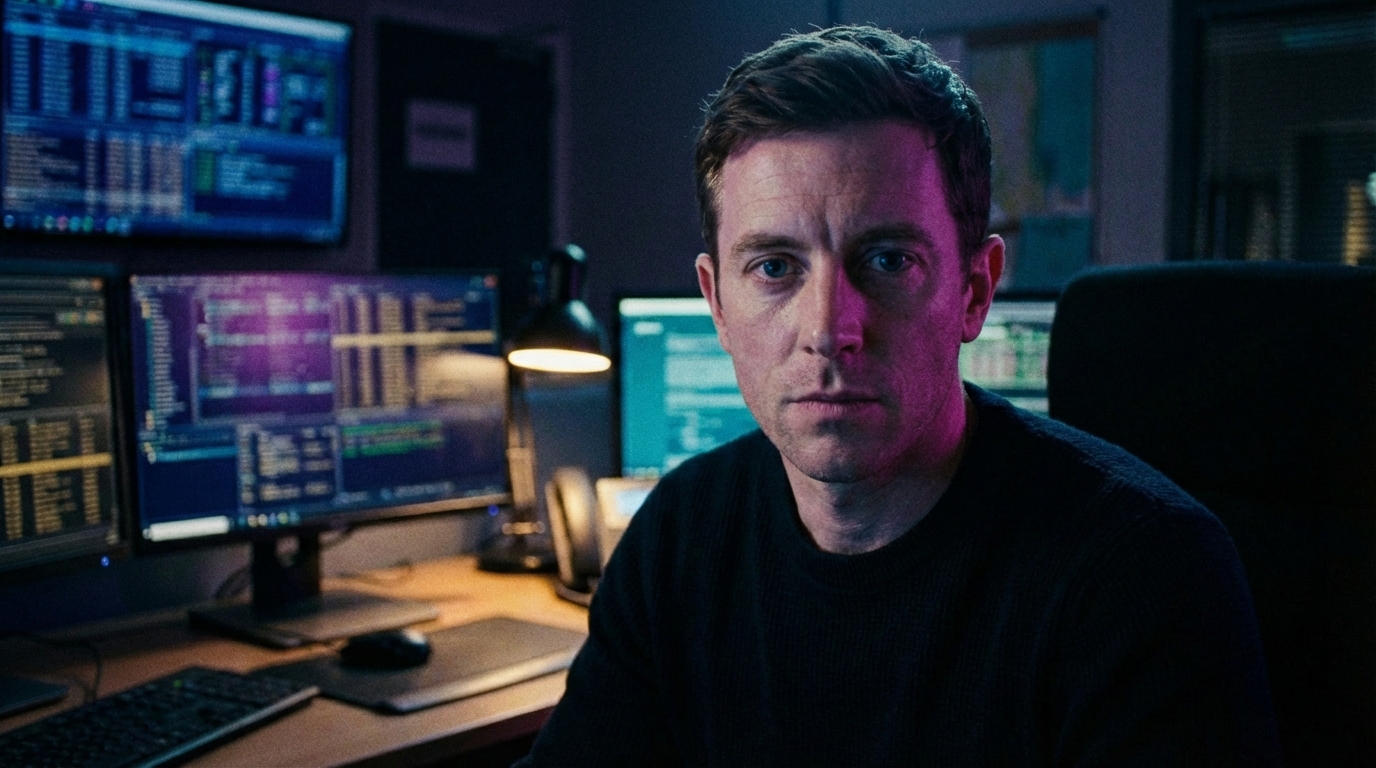
Callum's story continues daily in the fluorescent-lit dispatch centre where screens display Hobart's emergencies in real-time. Each shift brings new crises requiring coordination, new patterns suggesting problems, new challenges to protocols he's carefully constructed. The boy who dismantled radios to understand their function now orchestrates communication systems that hold society's fabric together when tears appear.
His relationships with the detectives and officers he coordinates remain professionally distant but functionally intimate. He knows their voices under stress, their patterns of request and response, their breaking points and recovery methods. They rely on his consistency without knowing the man behind the microphone. This arrangement suits Callum—connection without exposure, importance without scrutiny.
The impact of coordinating responses to cases like Luke Smith's disappearances, Karl Jenkins's vanishing, and whatever strange forces seem to bleed through Tasmania's familiar landscape, accumulates in ways Callum processes privately. His journal entries from these periods, should anyone ever read them, would reveal a mind struggling to maintain rationality whilst acknowledging experiences that defy rational explanation.
The Essential Voice
Callum Edward Bray embodies a particular kind of heroism—the steady presence that anchors others through crisis, the voice that maintains calm when reality fractures, the systematic mind that finds patterns in chaos. Born into a family that valued service, educated in institutions that nurtured analysis, shaped by experiences that demanded precision, he has become exactly what Tasmania's emergency response system requires.
His story lacks dramatic peaks that define conventional narratives. No single moment of breakthrough or breakdown marks his trajectory. Instead, his significance accumulates through thousands of successfully coordinated responses, through crises managed so efficiently they never become disasters, through the space his competence creates for others to perform their more visible roles.
In Callum, the traditional masculine virtues of stoicism and competence find modern expression. He doesn't rescue people directly but enables rescue through coordination. He doesn't investigate crimes but ensures investigators can communicate. He doesn't make command decisions but provides information that makes good decisions possible. This indirect importance suits his nature—essential but not exposed, central but not scrutinised.
As technology evolves and Tasmania faces new challenges—climate change intensifying natural disasters, social changes creating new crime patterns, unknown forces that the Luke Smith case suggests exist beyond conventional understanding—Callum's role becomes more crucial. The patterns he perceives, the connections he facilitates, the calm he maintains all serve as foundation for emergency response that keeps society functional when forces threaten to tear it apart.

