Brett Wayne Cramer
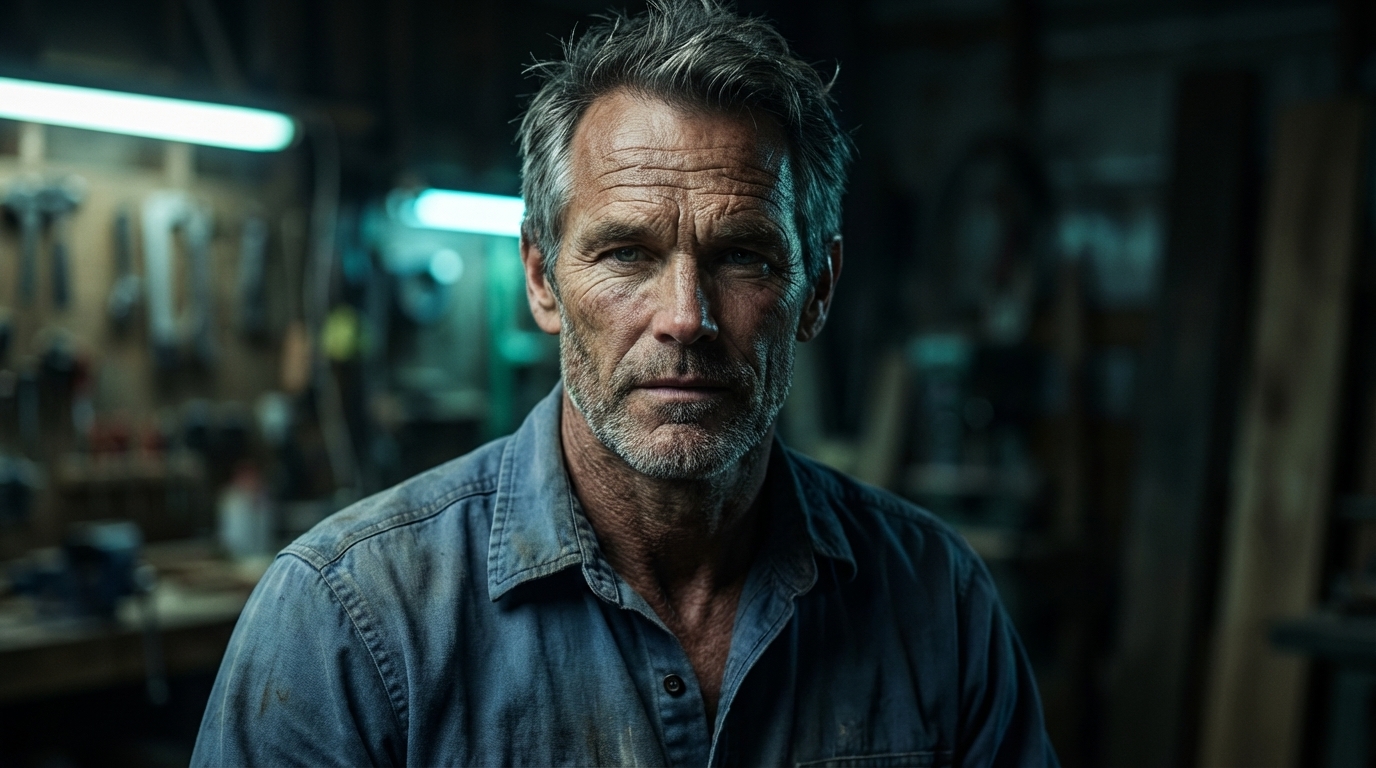
Brett Wayne Cramer, born 3rd April 1957 in Hobart, transformed quiet craftsmanship into forty-year legacy of sustainable building excellence. From Harold's toolshed lessons to Premier Construction Group's senior consultant, he championed principles that quality work justifies itself and homes shelter more than bodies—they anchor souls. His methodical hands built the Lesdelle Street sanctuary, crafted display cabinets for Beatrix's curiosities, and posted $50,000 bail for Gladys's freedom. In retirement, he remains the fixer, tending workshop and weathering impossible revelations with characteristic steadiness.
Early Life and Family Background
Brett Wayne Cramer entered the world at 5:42 AM on 3rd April 1957 at St John's Hospital in Hobart, Tasmania, weighing precisely 3.6 kilograms and measuring 51 centimetres—figures that would prove prophetic for a man who would spend his life measuring, calculating, and building with exacting precision. Born to Harold James Cramer, a civil engineer with the Tasmanian Department of Public Works, and Edith May Cramer (née Langford), a homemaker renowned for her rose garden and championship scones, Brett arrived as the third of four children into a household where quiet competence was valued above boastful ambition.
The weatherboard bungalow on Waimea Avenue in Sandy Bay, within comfortable walking distance of Long Beach, reflected Harold's engineering sensibility and Edith's domestic grace. Harold had spent his professional life building bridges and roads across southern Tasmania during the post-war expansion, bringing home the same philosophy of functional longevity that characterised his public works—structures designed to endure rather than impress. Edith, originally from Deloraine, transformed this practical framework into home through patient cultivation: the legendary rose garden that became neighbourhood landmark, the preserved fruits from backyard trees, and the constant small attentions that maintained domestic order through sustained effort rather than dramatic intervention.
Harold's toolshed at the rear of the property served as more than storage—it functioned as classroom where each Cramer child received education in measurement, tool maintenance, and construction principles. Within this timber-framed sanctuary, Harold taught not through formal instruction but through patient demonstration, his running commentary explaining reasoning: "Measure twice, cut once, saves timber and time." "Tool's only as good as its maintenance." "Respect the grain, work with the wood rather than against it." Brett absorbed these lessons through observation and incremental participation, eventually earning the family nickname "the fixer" for his methodical approach to problems that others either ignored or attacked with insufficient planning.
Siblings and Formative Relationships
Brett occupied the third position amongst four children, each contributing distinct elements to family dynamics. Margaret Elaine, born 1951, established the academic standard through fierce determination that led to nursing and eventual position as head nurse at Launceston General Hospital. Six years Brett's senior, her sharp intelligence and sharper tongue created household where achievement was expected and effort mattered more than natural talent.
Raymond Harold, born 1953 and known as Ray, represented the family's rebellious streak. Four years older than Brett, Ray possessed intuitive mechanical genius that bypassed theoretical understanding in favour of empirical tinkering. The brothers formed alliance in backyard cubby houses and contraptions, Ray attacking projects with enthusiastic chaos whilst Brett followed with measuring tape and level, quietly correcting structural deficiencies. Ray's death in a Queenstown workplace accident on 17th June 1984 devastated Brett profoundly. In 1985, he named a workshop project after his late brother—the "Ray Cramer Cabinet," constructed from reclaimed Huon pine, demonstrating techniques the brothers had discussed but never executed together.
Christine May, born 1961, completed the family four years after Brett. She inherited Edith's garden passion and Harold's structural planning, eventually becoming landscape designer specialising in native plantings and heritage restoration. The four-year gap between them created relationship less fraught with competition, leading to decades of professional collaboration—Christine designing landscaping schemes for Brett's residential builds, their partnership embodying the principle that buildings needed gardens and gardens needed thoughtful structure.
Education and Professional Training
Brett attended Lansdowne Crescent Primary School from 1963 to 1970, where teachers noted his unusual patience and manual dexterity. His Year 3 teacher, Mrs Lorraine Kessell, observed in 1966 that Brett "demonstrates an engineer's mind—always asking how and why, and often correcting my use of a ruler!" By Year 5, he consistently performed above expectations in numeracy, particularly in spatial reasoning and geometry. He earned second place in the 1969 Regional Primary Schools Problem Solving Competition, competed in the annual Maths Challenge, and participated in the school's gardening club whilst building birdhouses during lunch breaks.
Secondary education at Hobart High School (1971-1975) revealed his affinity for technical subjects. Mr Charles "Charlie" Denholm, his Year 9 mathematics teacher, introduced logarithmic tables and geometric design principles, later describing Brett as "quiet, deliberate, and persistent… a student who rarely draws attention to himself but is invariably the first to solve the problem." Brett excelled in the woodworking and industrial arts programme under Mr Vincent Larkham, learning foundational joinery, cabinetmaking, and blueprint reading. His 1974 submission to the school's Applied Technology Exhibition—a model energy-efficient timber dwelling using recycled materials—won merit award for innovative design.
Though maintaining solid marks in English and History, Brett's writing style was noted as "concise to a fault," favouring bulleted analyses and technical diagrams over flowing prose. He avoided debating and theatrical pursuits, preferring behind-the-scenes contributions in group settings. He graduated in December 1975 with clear vocational trajectory, enrolling directly into Certificate III in Carpentry at TAFE Tasmania rather than pursuing university entrance.
From 1975 to 1977, Brett completed his carpentry certificate at TAFE Tasmania's Hobart campus, combining classroom instruction with on-site apprenticeship placement. He was apprenticed to Robert "Rob" Chisholm of Chisholm & Sons Construction in Moonah, working on weatherboard renovations in Bellerive and new builds in Mount Nelson's foothills. Rob later described Brett as "the most dependable apprentice I ever had—quiet, precise, and always ten minutes early."
Brett consistently ranked among the top students in workshop assessments, particularly excelling in timber framing, roofing systems, and cabinetry joinery. His distinctive style favoured simplicity and functional elegance, influenced by mid-century Tasmanian domestic architecture. In 1977, he was awarded the Tasmanian Master Builders' Apprenticeship Distinction Prize, an annual recognition for exemplary practical and theoretical performance. His final year project—a full-scale timber staircase from reclaimed Huon pine—was displayed in the campus foyer until 1983.
Eager to build upon his vocational foundation, Brett enrolled in the Advanced Diploma in Building and Construction at the University of Tasmania's School of Architecture and Design in February 1977, joining a small intake of eighteen students from trade backgrounds. The two-year diploma blended architectural principles with project management, materials science, and construction law. He gravitated towards modules in scheduling logistics, site safety, and environmental systems, developing growing interest in passive design and thermal efficiency—concepts still considered niche in mainstream Australian construction.
Dr Helen Maudsley, a visiting lecturer from Melbourne who had worked on public housing retrofits in Victoria, became his mentor. She guided his independent research culminating in his final thesis: "Domestic Sustainability in Tasmanian Climates: A Design Model for Energy-Efficient Dwellings in Temperate Zones." Submitted in late 1979, the thesis combined statistical energy modelling with architectural case studies and detailed construction diagrams. It was awarded top honours in the cohort and later cited by the Tasmanian Housing Trust in internal briefings on cost-efficient retrofitting.
Alongside his studies, Brett worked part-time for Anderson Design & Drafting, a small architectural practice in North Hobart, assisting in drawing conversion work and liaising with builders on minor residential alterations. The exposure broadened his understanding of collaboration between trades and architects—relationships he would navigate skilfully throughout his career. He graduated in December 1979 with high distinction and clear professional goal: to combine traditional building craftsmanship with modern project planning and emerging environmental sensibilities.
Marriage and Family Life
Brett married Wendy Elizabeth Cradock on 12th November 1980 at St David's Anglican Church, Hobart. The modest ceremony, attended by close family and colleagues from Premier Construction Group and Wendy's teaching position at Claremont Primary School, was followed by a reception in the garden of Wendy's parents' home in New Town. Rain briefly threatened the afternoon but passed quickly—something Brett often referenced as metaphor for enduring love through temporary storms.
Wendy, born 8th March 1958 in Bicheno, was daughter of Kenneth Alan Cradock, a local fisherman, and Irene Lillian Cradock (née Storey), a seamstress and church organist. She had moved to Hobart in 1976 to attend the Tasmanian College of Advanced Education, earning her teaching qualification in Early Childhood Education. At the time of their marriage, she was teaching Year 2 at Claremont Primary School, already gaining reputation for calm presence, dedication to students, and tireless involvement in the Parents and Friends Committee.
Their relationship, kindled through shared love of storytelling and community building, represented complementary partnership—she the educator nurturing young minds, he the craftsman shaping spaces. Where Brett provided structure and stability through quiet presence and tangible contributions, Wendy generated warmth that drew people inward. Their marriage would weather four decades, from rental accommodation in Claremont through home ownership on Branscombe Road, eventually to the purpose-designed sanctuary at 8 Lesdelle Street that Brett would build in 1994.
Their first daughter, Gladys May Cramer, arrived during a storm on 17th August 1981 at Royal Hobart Hospital. The twenty-four-year-old Brett, already established as junior carpenter at Premier Construction Group, found himself transformed from builder of houses to builder of family. Gladys inherited his carpenter's precision and quiet problem-solving instincts, evident from childhood organisation charts to her later energy sector career at Aurora Energy.
Their second daughter, Beatrix Evelyn Cramer, was born 12th February 1985 at Calvary Hospital in Lenah Valley. Where Brett built display cabinets to contain Beatrix's strange treasures, she learned that love could hold chaos without crushing it. Born into his world of measured precision, Beatrix became his antithesis—impulsive where he was methodical, drawn to secrets where he favoured transparency. Yet his patient craftsmanship taught her that boundaries need not be barriers, that even wayward things need careful hands to help them find their place.
Professional Career and Philosophy
Brett began his professional career at Premier Construction Group in 1979 as junior carpenter, working on residential projects and learning the intricacies of framing, roofing, and finishing work. His commitment to quality and ability to adapt to challenges quickly earned respect among senior tradesmen. Within two years, he was promoted to senior carpenter in 1981, leading small teams and setting high standards for workmanship and safety on-site.
In 1985, Brett transitioned to site supervisor, managing larger and more complex projects. Known for meticulous planning, coordination with subcontractors, and ability to keep projects within budget and on schedule, he demonstrated that sustainable construction methods could be both economically viable and environmentally responsible. His advocacy for sustainable building materials and practices began during this period, informed by his 1979 thesis and growing awareness of ecological challenges.
From 1990 to 2015, Brett served as project manager, playing pivotal role in shaping Hobart's residential and commercial architecture over twenty-five years. He led the team behind the Aurora Business Centre, a major development in the city's central business district, and championed early adoption of sustainable building materials within Premier Construction Group. His work was regularly cited at industry conferences and in publications promoting green architecture, earning him reputation as forward-thinking professional who balanced tradition with innovation.
In 2015, Brett moved into senior consultant role, mentoring younger staff and advising on complex projects whilst continuing to advocate for environmentally responsible construction. His decades of experience made him invaluable resource for special projects requiring both technical expertise and diplomatic handling of challenging circumstances.
Brett officially retired in 2018 but remained active as freelance consultant, selectively taking advisory roles for special projects. This shift allowed him to spend more time with family, indulge in personal hobbies such as gardening and woodworking, and explore Tasmania's natural landscapes. His workshop in the purpose-built garage at 8 Lesdelle Street continued producing furniture for family, toys for grandchildren, and the custom pieces that demonstrated techniques refined across forty years.
The Home He Built
The residence at 8 Lesdelle Street, Claremont, constructed in 1994, represents Brett's most personally significant creation. Unlike commercial projects where client requirements and budget constraints created inevitable compromises, this home allowed him to implement techniques and materials he'd long advocated but rarely deployed at scale. He acquired the vacant land in early 1993, selecting the site for optimal passive solar design, established neighbourhood connections, and proximity to both Claremont Primary School and his workshop sites across Hobart.
He served as his own project manager, with Premier Construction Group colleagues contributing specialised labour as favours to respected peer. The design incorporated principles that would only become mainstream in Tasmanian residential construction a decade later: enhanced insulation exceeding code requirements, strategic window placement maximising natural light whilst minimising heat loss, rainwater harvesting systems, and timber sourced exclusively from certified sustainable forestry operations.
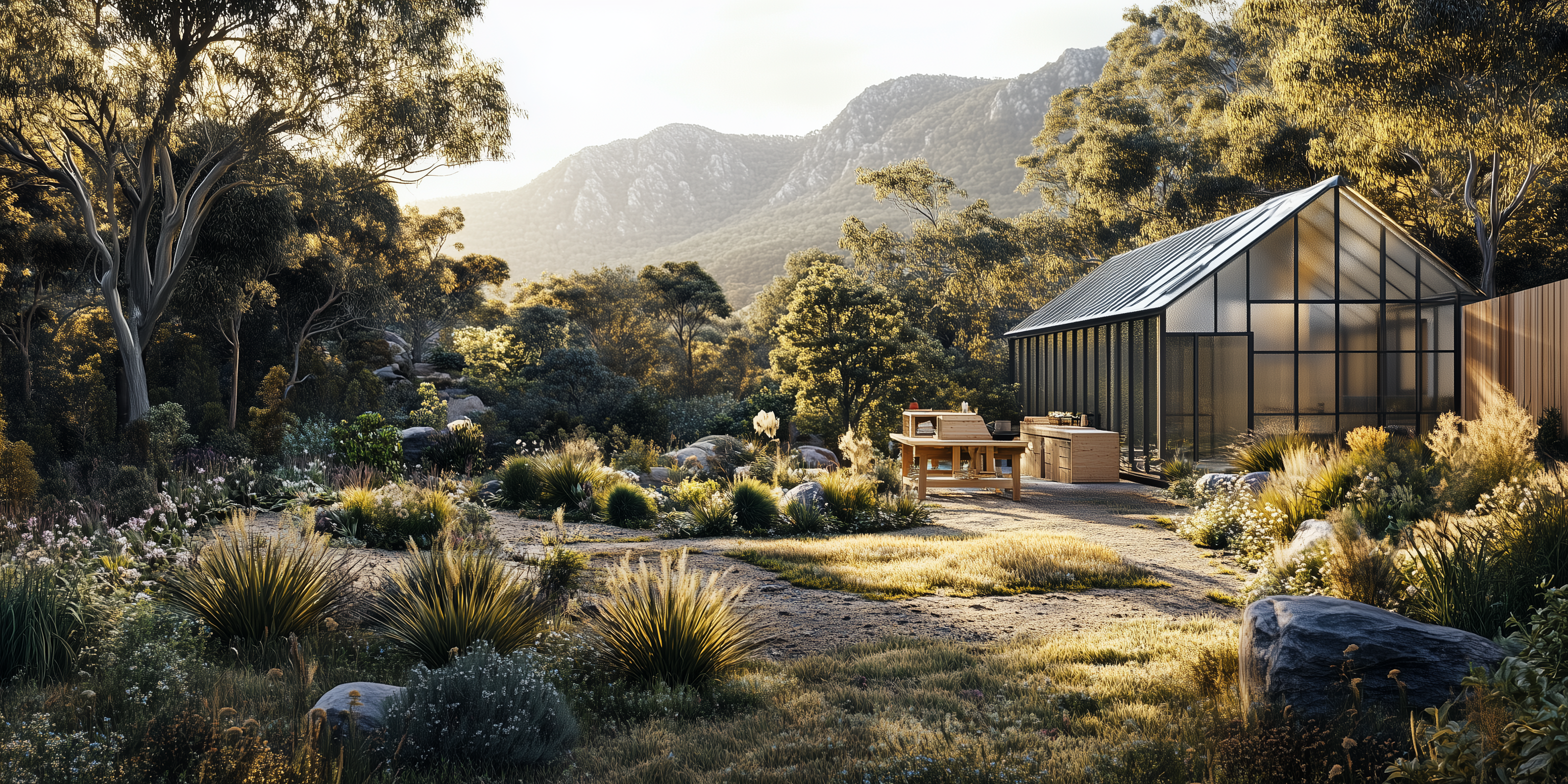
The covered deck along the rear elevation became signature feature, demonstrating his philosophy about blurring boundaries between interior and exterior space. The structure combined practical functionality with aesthetic consideration that exceeded conventional residential work—posts and beams sized for structural integrity but also proportioned for visual harmony, roofing providing weather protection whilst maintaining connection to Tasmanian sky and landscape.
The garage included dedicated workshop space from initial design, featuring electrical systems supporting professional-grade tools, dust extraction infrastructure, and storage configured for extensive equipment. This purpose-built workspace represented his claim to territory that would remain distinctively his—space where sawdust accumulated as evidence of ongoing creation, where tools hung in organised arrays reflecting both professional discipline and personal satisfaction.
The family moved into 8 Lesdelle Street in late 1994, with Gladys aged thirteen and Beatrix aged nine. For Brett, the residence embodied his conviction that homes meant to shelter families deserved respect proportional to their sacred function—every joint fitted with precision, every surface finished as though posterity rather than family would evaluate the work, every system installed with redundancy and maintainability prioritised over initial cost savings.
Fatherhood and the Weight of Impossible Truths
Brett's approach to fatherhood mirrored his craftsmanship—quiet devotion expressed through tangible action rather than verbal declaration. For Gladys, he provided steady foundation of reliability, his methodical presence teaching her that problems yielded to patient analysis and systematic effort. For Beatrix, he built display cabinets to contain her strange collections without judgement, demonstrating that love could hold chaos without crushing it, that boundaries could protect without imprisoning.
The death of Brody Taylor in August 2014 brought Brett his first confrontation with grief he couldn't repair through carpentry. Watching Beatrix's devastation, witnessing Gladys's slow unravelling as she bore secret knowledge of what she'd found in that Moonah storage unit, Brett faced the limitations of paternal protection. His workshop hummed with patient rhythm of creation, but no amount of careful joinery could rebuild what trauma had shattered.
The events of July 2018 tested every principle Brett had built his life upon. When Gladys disappeared into circumstances he couldn't comprehend, when Beatrix returned home carrying secrets about dimensional portals and Guardian politics, when Detective Karl Jenkins arrived at his doorstep seeking information about daughters who'd become entangled in phenomena defying rational explanation—Brett's methodical mind confronted mysteries that measurement couldn't solve.
On 13th August 2018, Brett posted $50,000 bail for Gladys's release from custody following her arrest. The man who once earned the nickname "the fixer" confronted his most profound challenge—not timber or steel to be measured and joined, but a daughter's freedom requiring cash counted with the same precision he'd applied to forty years of carpentry. Each banknote represented patient accumulation through decades of quiet integrity, now transformed into hope for Gladys's redemption.
The day Gladys was released, Brett stood beside her as afternoon sunlight replaced fluorescent glare, his weathered carpenter's hands—which once crafted a workshop project honouring his late brother Ray—now guiding his eldest child through freedom's fragile threshold. His steady presence embodied forty years of principle tested by unimaginable circumstances, proving that some foundations transcend even the heaviest burdens.
