4338.204 · July 23, 2018 AD
Between Pawprints and Portals
Exhausted but unable to find rest, Luke wrestles with visions of impossible cities and the lingering reality of his journey. As Duke and Henri ground him in the ordinary, Luke realises the strange device in his hand is no longer just an object—it is the embodiment of choice, and his next step cannot be taken lightly.
“Sometimes the smallest things don’t just change your life—they tilt the whole world.”
The weight of exhaustion hung on me like waterlogged clothing, dragging at every limb as I made my way from the study. My body had become a negotiation—each step requiring conscious effort, each muscle filing formal complaints about the demands being placed upon it. The hallway stretched before me in that peculiar way spaces stretch when you're running on fumes, the fifteen steps to the bedroom multiplying into something that felt like pilgrimage.
I kept one hand against the wall as I walked, not trusting my legs to remember their job without supervision. My palm left faint smudges on the paint—dirt from Clivilius, I realised. Evidence. I was tracking another world through my house like mud from a garden I'd never planted.
The afternoon light filtering through the hall window seemed wrong somehow. Too ordinary. Too yellow. After the brutal brilliance of that alien sun, after the colours of the portal and the absolute darkness that had followed the voice's warning, Tasmania's winter light felt like something from a photograph rather than something I was actually standing inside. The disconnect made my head swim, made the walls seem paper-thin, as though they might tear if I leaned against them too hard.
At last, I reached the bedroom.
The sight of the bed—our bed, the one Jamie and I had shared for three years, with its familiar duvet and the pillows we'd bought together from that shop in Hobart whose name I could never remember—struck me with a force that had nothing to do with physical impact. It was recognition. Homecoming. The visual equivalent of a held breath finally releasing.
I didn't so much lie down as surrender to gravity. My body folded onto the mattress with the gracelessness of something that had stopped caring about appearances several hours and one dimension ago. The duvet received me without judgement, and for a moment I simply lay there, feeling the bed absorb my weight, letting the familiar softness of home hold me in ways I hadn't realised I needed to be held.
I pressed my face into the pillow and breathed.
The scent that rose up was complicated—layers of laundry detergent Jamie preferred, the floral one that cost more than I thought laundry detergent should cost, underlaid by something warmer and harder to name. The accumulated presence of nights spent here. The smell of sleep and safety and the particular domestic intimacy of sharing a bed with someone for years. It was the smell of the life I'd been living before everything changed. Before I discovered that reality had a back door and I apparently had the key.
For the first time since my return, I allowed myself to believe—really believe, in my body rather than just my mind—that I was actually home.
"Shit!"
The word escaped me in a whisper so soft it barely disturbed the air. It wasn't a curse, not really. More an exhalation given form—a single syllable to contain the fear and the awe and the confusion and the bone-deep exhaustion that had accumulated over the past hour like sediment settling after a flood. I didn't have the energy for more eloquent expression. Shit would have to suffice.
I closed my eyes, hoping for the darkness of ordinary rest. Hoping my mind might cooperate and let me drift into something like sleep, even for a few minutes.
My mind had other plans.
Behind my closed lids, the darkness came alive.
Images flickered there—fragments bright and sharp-edged, impossible to hold onto but impossible to ignore. Cities rose from nowhere, their architecture laughing at every principle of engineering I'd ever been taught to trust. Towers spiralled upward in configurations that should have collapsed under their own weight, defying gravity with the casual confidence of things that had never learned to fear falling. Spires twisted like frozen flames. Bridges arced between structures too far apart to be bridged, yet there they were, delicate and certain.
Were these visions of Clivilius? Of places the portal might take me? Or were they something else entirely—dreams bleeding through from whatever source had been feeding them to me since I was eight years old?
Faces appeared next, drifting through the impossible cityscapes like leaves on an unseen current. Some were blurred, their features smeared as though someone had dragged a thumb across wet paint. Others emerged with startling clarity—a woman with silver hair and eyes that held storms, a child laughing at something I couldn't see, an old man whose face seemed to shift between races and ages like a deck of cards being shuffled. I was certain I had never met any of them. And yet something in me recognised them anyway, the way you might recognise a song you've never heard because it's built from notes you've always known.
The visions tumbled over one another, refusing sequence or sense.
I knew, with the resigned certainty of long experience, that sleep would not come easily. It never did, after the dreams. And this was so much more than dream.
My hand found the dream journal without conscious decision. The leather-bound notebook lived on my bedside table the way rosary beads might live on a Catholic's nightstand—tools of a faith I couldn't quite name but couldn't abandon either. I'd kept dream journals since I was twelve, since Dad had suggested it as a way to process the nightmares that plagued me, since the therapist Greta had sent me to after the divorce had said it might help me feel more in control of what was happening in my sleep.
Twenty-two years of journals now, stored in boxes in the spare room closet. Twenty-two years of trying to pin the ineffable to paper, of translating experiences that existed outside language into words that never quite captured them. The ritual had become essential—a tether, a discipline, the difference between being swept away by the visions and maintaining some tenuous grip on who I was when I wasn't dreaming.
The journal's cover felt cool and reassuring against my palms. Worn leather, softened by handling, edges slightly frayed from years of being opened and closed and opened again. This particular volume was only three months old, but it already looked ancient. I treated my dream journals hard.
I cracked it open to the waiting page—cream-coloured paper, faintly lined, ready to receive whatever inadequate words I could offer. The visions still flickered at the edge of thought, fading now but not yet gone, and I knew that if I didn't capture something of them soon, they would dissolve entirely into that frustrating fog of almost-remembering that always followed the more intense experiences.
I reached for a pen.
My fingers found nothing.
I rifled through the bedside table drawer, increasingly irritated. Pens bred in this drawer like rabbits—I was certain I'd had half a dozen in here last week—but now the space yielded only old receipts, a broken phone charger, and a tube of lip balm whose cap had come off and smeared everything with waxy residue. I checked the table's surface, the floor beside the bed, the pocket of the trousers I'd been wearing. Empty. Empty. Empty.
The timing felt almost malicious, as though the universe was testing whether I could maintain my composure in the face of minor inconveniences after having demonstrated I could survive major impossible ones.
In frustration, I ran my hand across the open page of the journal—a gesture of exasperation, nothing more, the physical equivalent of sighing heavily.
When I pulled my hand away, my breath caught.
There it was.
My own bloody fingerprint, stark and unmistakable against the clean whiteness of the paper. The crimson mark sat where my finger had touched, vivid and accusatory, a guest that had not been invited to this particular page. The blood from my pricked finger—the finger the Portal Key had bitten in my study, what felt like a lifetime ago but had probably been less than one hour—had dried to something darker than fresh red but not yet brown. It looked almost like a signature. Almost like a seal.
For a long moment, I simply stared at it.
The dream journal was meant for recording the intangible. For capturing visions that lived in the spaces between sleeping and waking, experiences that couldn't be verified or proven, images that might be prophecy or might be nothing more than neurons firing in patterns that meant less than they seemed. That was the whole point. The journal was a place for things that might not be real.
But this—this fingerprint of actual blood, left by an actual wound, caused by an actual device that had opened an actual portal to an actual other world—this wasn't supposed to be here. The journal couldn't contain it. The journal wasn't designed for evidence this concrete.
The crimson mark grounded me, but not in the way I'd been longing for. It didn't make me feel safer or more certain. Instead, it unsettled me more than all the fantastical visions combined. Because the visions could be dismissed—had been dismissed, by therapists and family members and even by myself on my more skeptical days. The visions were dreams. The visions were imagination. The visions were the product of an overactive mind seeking meaning in the chaos of sleep.
But the blood was real.
The desert had been real. The voice had been real. The portal had teeth, and it had bitten me, and here was the proof staring up from a page that was supposed to hold only speculation and wonder.
I was still processing this when the silence fractured.
The sound was small—a soft scrabble of nails against carpet, approaching from the hallway—but it might as well have been a symphony for the way it pulled me back into the present. I knew that sound. Knew it the way I knew my own heartbeat.
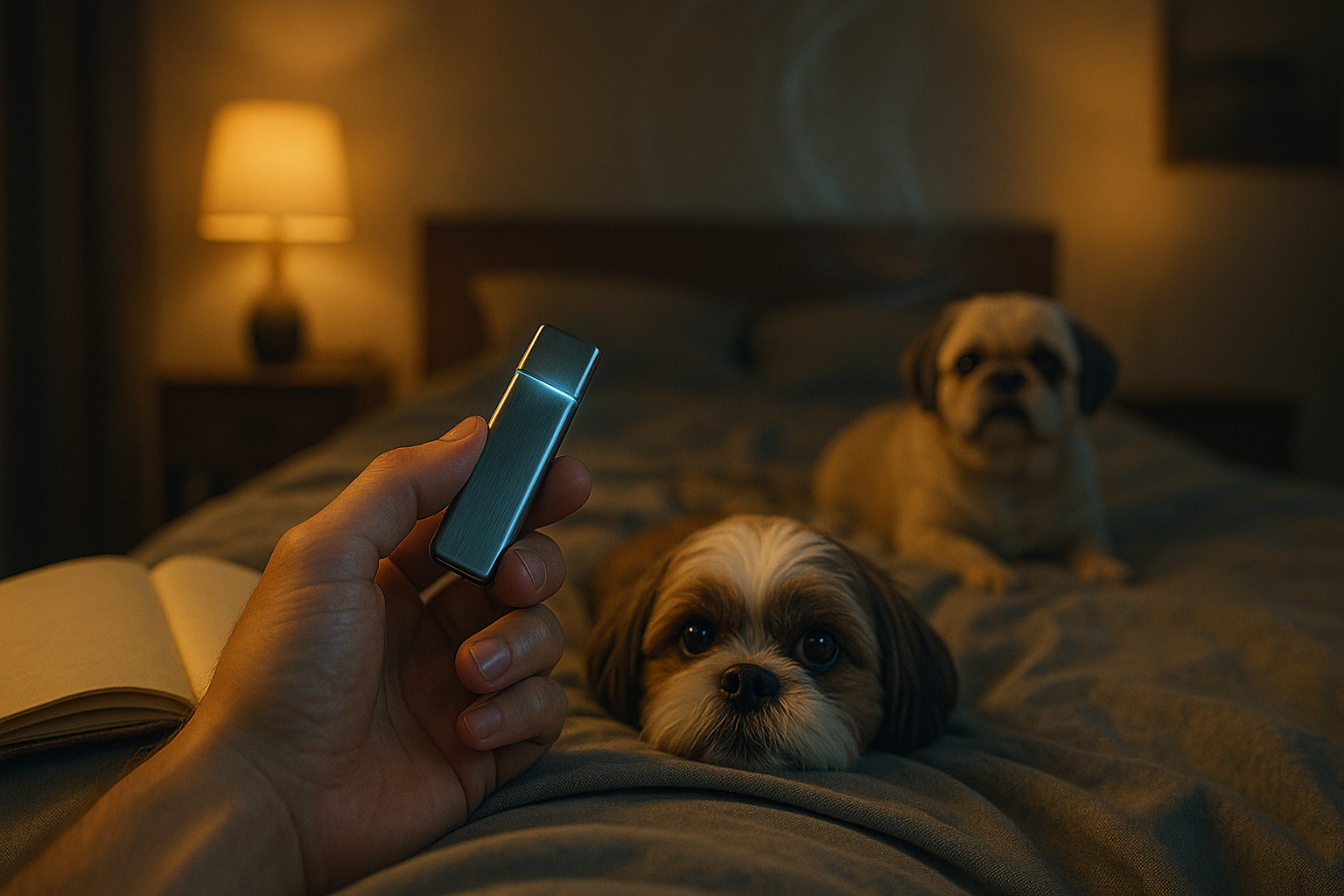
Duke appeared at the side of the bed, his patchwork coat of warm browns and soft whites slightly dishevelled, his eyes bright with the particular intelligence that had always made him seem more aware than a dog had any right to be. His tail was already wagging before he'd fully entered the room, that enthusiastic metronome that accompanied everything he did, and when he saw me looking at him, the wagging intensified until his entire rear end was involved in the motion.
He had sensed something. He always did. Duke was attuned to emotional atmospheres the way some people were attuned to changes in barometric pressure—he could tell when Jamie was about to come home from a shift, could tell when I was having a particularly vivid dream night, could tell when the house held tension even if neither of us had spoken a word. The fact that he'd sought me out now, in the immediate aftermath of everything that had happened, felt less like coincidence and more like confirmation of abilities I'd never been able to explain.
He launched himself toward the bed with characteristic determination. The first attempt failed—his front paws made it onto the mattress, but his back legs couldn't find purchase, and he slid back down with a grunt of frustration. The second attempt was no more successful, his claws scrabbling against the duvet's fabric like a climber failing to find handholds on a cliff face.
A faint smile tugged at the corner of my mouth despite everything. Duke's persistence in the face of physical limitations had always charmed me. He was not built for jumping—Shih Tzus rarely were—but he refused to accept this fact, approaching each attempt with the conviction that this time would be different.
At last, with a final scramble that involved more determination than grace, he succeeded. He hauled his small body onto the mattress and collapsed beside me in the particular way of dogs who have achieved something exhausting, panting lightly, his eyes shining with quiet satisfaction at having overcome the obstacle of the bed's height.
Then, without warning, his tongue found my cheek.
The sensation was wet and enthusiastic and utterly impossible to maintain dignity in the face of. Duke's greeting licks were not delicate affairs—they were whole-hearted expressions of canine affection, thorough and insistent, leaving no part of the accessible cheek unkissed. I turned my face away reflexively, but he followed, determined to complete his welcome.
A laugh escaped me—nervous, half-choked, uneven, but genuine. The sound surprised me. I hadn't known I was still capable of laughing, not after everything.
I reached out and ruffled his fur, my fingers sinking into the softness at his neck where the coat was thickest. He leaned into the touch with the unselfconscious pleasure of a creature who had never learned to be embarrassed by wanting affection.
The absurdity of the moment was not lost on me. Here I was—a man who had just returned from another dimension, who had heard a voice older than human civilisation speak his name, who had stared down the infinite and narrowly avoided dying in an alien desert—and I was being undone by the affectionate persistence of a Shih Tzu. The cosmic and the mundane, colliding in my bedroom on a Monday afternoon.
The visions that had seemed so urgent moments before—the towers defying gravity, the faces hovering at the edge of recognition—retreated into the background. They didn't disappear entirely, but they dimmed, pushed aside by the insistent reality of Duke's weight against my side, the rhythm of his breathing, the warmth of his presence.
What remained was simpler. Smaller. Duke pressed against me, demanding nothing except proximity. The familiar smell of dog and the house we shared. A lingering sense of wonder I couldn't quite dismiss, even as exhaustion continued its patient work of dismantling my capacity for coherent thought.
The visions were ephemeral. They came and went, sliding through consciousness like water through fingers. But this—this room, this bed, this warm and ridiculous dog—this was solid. This was real. This would still be here when the visions faded completely, when the portal closed, when I had to face whatever came next.
Then came Henri.
His whines preceded him, plaintive and insistent, the particular frequency that meant I require assistance and I require it immediately. I turned my head to find him stationed at the bedside like a small furry monument to thwarted ambition. His body was rounder than Duke's, his coat the colour of cookies and cream, his expression one of profound injustice at the height of the mattress relative to his stature.
His short legs pawed the air with determination wholly unsuited to the physical realities of his situation. Where Duke had eventually succeeded through persistence and luck, Henri faced a mathematical impossibility. His centre of gravity was simply too low, his legs too stubby, his body too optimised for lounging rather than leaping. Physics itself stood between him and his goal.
"Oh, Henri, you fat little pup, you," I murmured, chuckling softly despite the heaviness still sitting behind my ribs.
I leaned down and gathered him into my arms, and the weight of him—substantial, warm, somehow both dense and soft at the same time—pressed against my chest with a solidity that banished the last tremors of unreality clinging to my thoughts. Henri was not an ethereal creature. Henri was not a vision or a voice or a mystery. Henri was approximately six kilograms of contentment-seeking fur who viewed the universe primarily in terms of how it might produce his next meal.
His presence was proof of something, though I couldn't have articulated what. Proof that the ordinary world continued to exist, perhaps. Proof that not everything had to be cosmic and significant. Proof that even in the immediate aftermath of discovering that reality contained hidden dimensions and ancient voices, there were still dogs who needed to be lifted onto beds because their legs were too short to manage the jump themselves.
I set him on the mattress.
Henri wasted no time with ceremony or gratitude. He shuffled toward the foot of the bed with the purposeful waddle that characterised his movement, circled once with the theatrical precision that preceded all his resting—a ritual as fixed and predictable as the orbit of planets—and flopped down into a loaf-like mound of unquestionable contentment.
That was Henri's declaration, as clear as any words: he was positioned exactly where he intended to be, and whatever else might be happening in the house or the world or the universe beyond, it could proceed without his further involvement. He was a dog who had found his spot. The cosmos could sort itself out.
Duke, by contrast, remained close. He shifted until his head rested gently upon my stomach, the weight of his skull slight but somehow grounding in a way that Henri's dramatic flop at the foot of the bed couldn't quite match. His eyes stayed open, watching me with that particular alertness that had always made me feel both comforted and slightly exposed.
He was a sentinel. A guardian in miniature. And though he was blissfully ignorant of portals and voices and the cosmic stage upon which I now apparently stood, his presence reminded me of something I needed to remember: that no matter what worlds I had crossed or might yet cross, here and now I was not alone.
For a long moment, I simply lay there.
The bedroom was quiet except for the sounds of dogs settling—Henri's small snores already beginning at the foot of the bed, Duke's steady breathing against my stomach. Through the window, the pale light of a Tasmanian winter afternoon filtered in, painting the room in shades of grey and muted gold. Somewhere in the house, the refrigerator hummed. Somewhere outside, a car passed on the street.
Ordinary sounds. Ordinary light. Ordinary afternoon.
Except.
My fingers found the device without my conscious direction. It had been in my pocket this whole time—the Portal Key, though I didn't yet know it was called that. The strange object that had started everything, that had pricked my finger and bled light and torn a hole in the wall of my study.
It sat cool and unassuming in my palm, its edges catching faint glimmers from the window. I turned it over slowly, almost reverently, my thumb tracing its contours as though sufficient touch might unlock whatever secrets it held. The surface was textured in a way that felt older than the plastic and metal it appeared to be made of. The small recessed button where I'd been pricked gleamed dully, innocent-looking now, offering no hint of what it could do.
It was impossible to reconcile the enormity of what this object represented with the banality of its appearance. Here was a thing that could tear open the seams of reality, that could fling me into worlds vast and empty and strange. Here was a thing that had nearly killed me, that had connected me to a voice that measured time in millennia, that had apparently been waiting—perhaps for years, perhaps for centuries—for exactly this moment when I would find it.
And yet. Cradled in my palm, it looked like nothing. A mislaid USB stick. A forgotten gadget. Something that might roll behind a desk and not be missed for months.
I rolled it between my fingers, again and again, each rotation carrying the weight of everything I didn't understand. The device was more than metal and circuitry—I understood that now. It had become a symbol. A hinge upon which my life now turned. Its simplicity mocked me, concealed complexities I couldn't begin to unravel.
Choose wisely.
The voice's words returned, less heard than remembered, settling back into the spaces where they'd first taken root.
Every possible path seemed to emanate from this small frame. I could see them—not literally, but with the peculiar vision of someone who has learned to attend to patterns others miss. Threads of fate unspooling into distances I couldn't measure, converging and diverging and looping back upon themselves in configurations too complex for any human mind to trace.
If I put this device in a drawer and never touched it again, one set of futures would unfold. If I returned to the portal, stepped through again, explored whatever waited in that vast alien desert—different futures. Different consequences. Different versions of myself branching outward from this single point, this single choice.
Billions of decisions from thousands of years are converging.
I hadn't understood what that meant when the voice first spoke it. I still didn't, not fully. But lying here in my bedroom with two dogs anchoring me to the mundane, holding an object that defied every law I'd ever been taught to trust, I was beginning to glimpse the edges of it.
I was a part of something vast. Something old. Something that extended far beyond my individual existence, my small concerns, my complicated relationship with Jamie, my fractured family, my dreams and fears and hopes. Whatever happened next—whatever I decided—would matter in ways I couldn't calculate.
The weight of decision pressed thick in the air around me. Not just the question of whether to use the device again, though that was part of it. The deeper truth it carried—that nothing from here on could ever be simple again. The device was no longer an object. It was a choice made manifest.
And choices, I now understood, carried worlds within them.
I lay there for what might have been minutes or might have been an hour, Duke's weight on my stomach, Henri's snores providing bass notes to the silence, the device growing warm in my hand from the heat of my palm. I thought about Jamie, about when he might come home, about what I could possibly say to explain any of this. I thought about Paul, about whether I should call him, about what words existed in any language to describe what I'd experienced. I thought about the voice, about the desert, about the darkness that had swallowed my study and the admonition that still echoed somewhere in the chambers of my chest.
I thought about the visions of cities I'd never seen—and whether I might see them yet.
"Come on, boys," I finally said.
My voice came out low but edged with something that hadn't been there before. Something that might have been resolve. Something that might have been the beginning of acceptance.
Duke gave a soft huff of protest as I gently shifted him from his place on my stomach, his head lifting reluctantly, his eyes communicating the particular betrayal of a dog who had been comfortable and was now being disturbed. At the foot of the bed, Henri blinked up from his loaf-like sprawl, ears twitching with mild curiosity at the disruption of what had been, from his perspective, an entirely satisfactory afternoon.
I pushed myself upright.
The hesitation, the circling thoughts, the battle between fear and wonder that had occupied me since I'd first collapsed onto this bed—all of it gave way to something quieter. Steadier. A determination that didn't announce itself with trumpets but simply arrived and took up residence.
The moment had come. Not the moment for answers—those were still far off, if they existed at all. But the moment for choosing. A threshold stood before me, invisible yet undeniable, and beyond it lay paths no one I knew had ever walked. Realities I couldn't imagine until I entered them. Futures that wouldn't exist unless I helped create them.
The words I'd spoken—come on, boys—had been meant for Duke and Henri. But they had also been for myself. A summons. An invocation. A declaration that whatever came next, I was going to face it rather than flee from it.
This was no idle curiosity, no passing whim that would fade when the novelty wore off. The voice had called me by name. The portal had opened in my study. The device had found its way to my hand through means I couldn't explain and didn't understand. Whatever force had orchestrated this—whatever vast intelligence had been preparing for this moment across what it claimed was thousands of years—it had chosen me.
I could refuse. I could put the device in a drawer, board up the wall where the portal had appeared, pretend none of this had happened, return to the life I'd been living before this afternoon tore it apart. I could choose the safety of ignorance, the comfort of the familiar, the path of least resistance.
But I wouldn't.
I knew that now, with a certainty that surprised me. Somewhere between the desert's killing heat and Duke's wet tongue on my cheek, somewhere between the voice's warning and Henri's theatrical napping ritual, I had made a decision without realising I was making it.
I was going back. Not today, perhaps. Not until I'd prepared, thought through what I might need, figured out how to survive more than a few minutes in that alien landscape. But I was going back.
Choose wisely.
I would try.
With Duke still watching me with his unsettlingly perceptive eyes and Henri already settling back into sleep at the foot of the bed, I rose to meet whatever came next. The device sat warm in my palm, no longer a mystery to be feared but a key waiting to be used.
And though the scale of it threatened to overwhelm me—billions of decisions, thousands of years, consequences I couldn't begin to calculate—I was not alone. I had two dogs who would be confused and loyal through whatever strange turns my life was about to take. I had a brother who might listen, if I could find the words. I had a partner who deserved explanations I wasn't yet ready to give.
I had myself. Thirty-four years of surviving things I couldn't explain, thirty-four years of carrying dreams that didn't fit in the ordinary world, thirty-four years of waiting for something I couldn't name.
The waiting was over.
