Benny Michael Salter
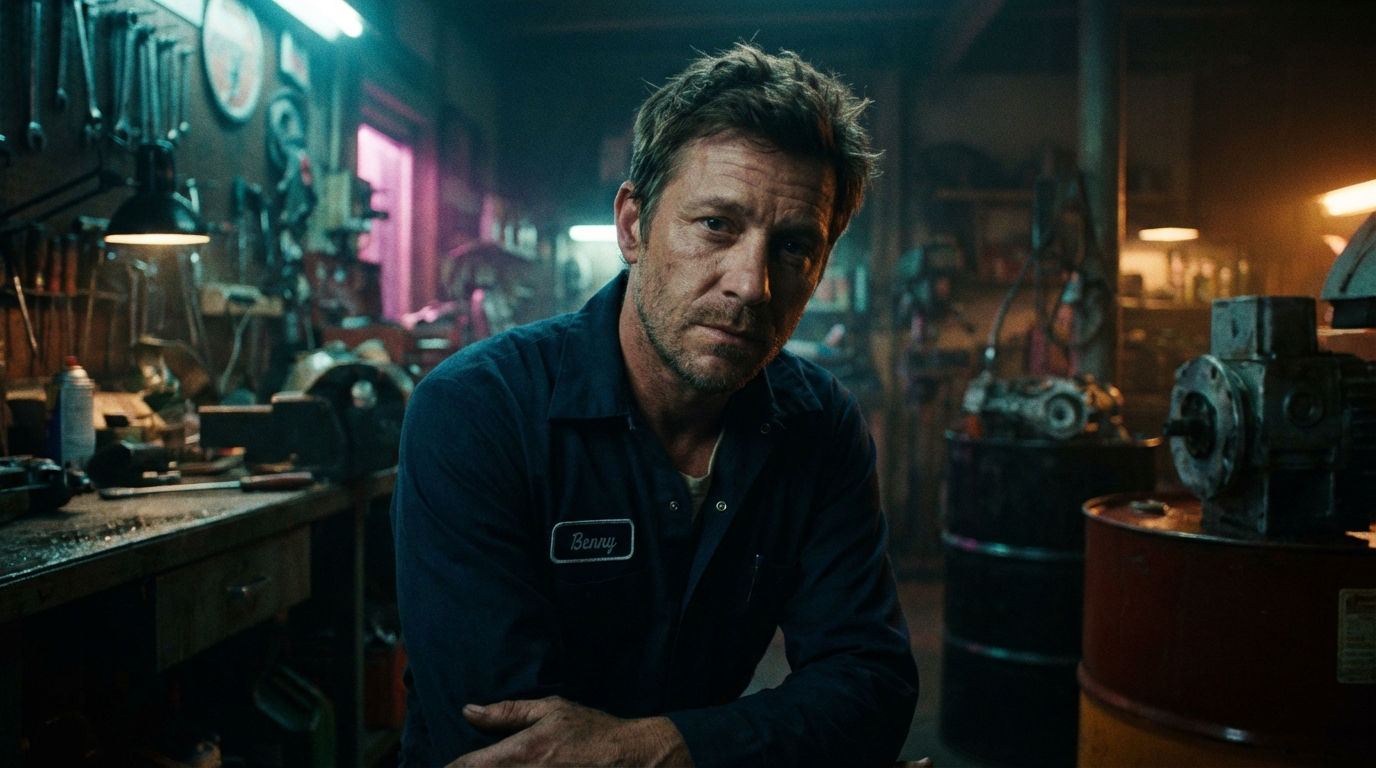
Benny Michael Salter, born 5 March 1982 in Hobart, Tasmania, is a reserved mechanic whose quiet Glenorchy life has been punctuated by unwanted entanglements with danger. The youngest of three children, he inherited five generations of Tasmanian working-class resilience alongside his father's mechanical aptitude. His friendship with Detective Sarah Lahey drew him into the shadows of her investigations, culminating in August 2018 when a simple favour led to near-fatal injuries.
Birth and Family Origins
On 5 March 1982, Benny Michael Salter was born in Hobart, Tasmania, to Robert "Bob" Salter and Edith Mae Salter née Langford. His arrival completed a family already including two daughters, making Benny the youngest of three children and the only son. The Salter household occupied a modest home in Glenorchy, a working-class suburb nestled between the Derwent River and the foothills of kunanyi/Mount Wellington, where Benny would spend the entirety of his life.
Bob Salter had served as a navy officer before transitioning to civilian life as a ferry captain, spending long stretches away at sea whilst maintaining the steady, no-nonsense principles that naval service had instilled. He was a man of few words but strong convictions, his presence in the household intermittent but influential. When home, Bob imparted to his son the mechanical understanding that would shape Benny's future—the patient logic of engines, the satisfaction of diagnosing problems and implementing solutions, the quiet pride of work competently performed.
Edith Salter brought different qualities to her children's upbringing. A primary school teacher by profession, she possessed the patience and practicality that both classroom management and raising three children demanded. Her steady presence provided the domestic continuity that Bob's seafaring absences might otherwise have disrupted, her calm demeanour establishing the emotional foundation upon which the family operated.
The Salter lineage stretched back five generations through Tasmanian soil, encompassing the island's intimate history in microcosm. Convict ancestors had arrived in chains only to find redemption as skilled shipwrights in Battery Point's bustling dockyards. Subsequent generations had breathed copper dust in Queenstown's tunnels, organised railway unions in locomotive yards, and built communities through depression and war. This heritage of ordinary people forging extraordinary resilience from Tasmania's unforgiving landscape flowed through Benny's veins, shaping his character in ways he rarely articulated but consistently demonstrated.
Childhood in Glenorchy
Benny's childhood unfolded with the modest predictability that characterised working-class Tasmanian families of that era. Glenorchy provided a stable if unremarkable setting—neither affluent nor impoverished, the suburb offered the security of community without the pretensions of wealth. The Salter children attended local schools, played in neighbourhood streets, and absorbed the values their parents modelled: hard work, self-reliance, and the understanding that one earned one's place through effort rather than expectation.
His two older sisters, Rachel and Katherine, had arrived in 1978 and 1980 respectively, establishing the family dynamic before Benny's birth altered it. As the youngest and only male child, he occupied a particular position—somewhat indulged by his mother, somewhat overshadowed by sisters who had already claimed their territories within the household hierarchy. Both girls were sociable and academically capable, their futures seemingly mapped toward professional careers that would eventually draw them to the mainland.
Benny, by contrast, displayed different inclinations from his earliest years. Where his sisters thrived on social interaction and classroom achievement, he gravitated toward solitary pursuits that engaged his hands rather than his tongue. Even as a small child, he demonstrated the knack for taking things apart and putting them back together that would define his adult life—old bicycles, broken toys, the family's battered Holden all became subjects for his mechanical investigations. His parents recognised the aptitude and encouraged it, Bob particularly pleased to see his son share his understanding of how machines functioned.
By adolescence, Benny's natural talents had blossomed into genuine capability. Weekends and after-school hours found him working on cars and motorbikes with a small circle of similarly inclined friends, the practical education of the garage complementing whatever the classroom offered. These friendships, based on shared interests rather than social obligation, established the pattern that would characterise his adult relationships: few but genuine, built on mutual respect and common purpose rather than superficial connection.
Education and Early Career
Benny attended Glenorchy High School, where he compiled an academic record that was neither distinguished nor concerning. Quiet and introspective, he avoided the attention that troublemakers attracted whilst also declining the spotlight that academic excellence might have provided. His teachers would likely have struggled to recall him specifically—a student who completed his work adequately, caused no difficulties, and preferred the company of a small circle of friends to broader social engagement.
He left school at sixteen, the minimum legal age, his decision reflecting both self-knowledge and practical calculation. University held no appeal for someone whose talents lay in hands-on work rather than abstract study, and the pathway to mechanical expertise ran through apprenticeships rather than lecture halls. His parents, though perhaps wishing he had pursued further education, understood their son well enough to accept his choice without significant resistance.
The years following school departure saw Benny accumulate the experience and credentials his chosen field required. He undertook apprenticeships at various auto repair shops around Hobart, learning the trade from mechanics whose expertise had been similarly acquired through practical application. Later, he worked for a small engine mechanic, expanding his capabilities beyond automotive work into the broader realm of mechanical repair. Each position added to his repertoire, building the comprehensive skill set that would eventually enable independent operation.
During this period, Benny began working out of his parents' shed, gradually establishing a small clientele among local friends and acquaintances who trusted his abilities and appreciated his reasonable rates. This informal arrangement suited his temperament perfectly—work arrived through word of mouth rather than advertising, customers were people he knew rather than strangers, and the scale remained manageable for someone who valued quality over quantity.
Salter's Garage
The establishment of Salter's Garage around 2010 marked a significant transition in Benny's life, though one that evolved organically rather than through deliberate planning. The workshop occupied space behind his house in Glenorchy, transforming from informal side project into the central focus of his working life. The timing coincided with his father's death from cancer that same year, lending the enterprise an element of memorial—continuing the mechanical tradition Bob had passed to his son, maintaining the family's connection to practical craftsmanship.
The garage never became a formal business in the conventional sense. Benny operated without significant advertising, relying instead on reputation and referral to bring work to his door. This approach reflected both his temperament and his priorities: he preferred steady, manageable workload to the pressures of expansion, valued relationships with regular customers over the anonymity of commercial transaction, and found satisfaction in the work itself rather than the financial rewards it might generate.
Motorbikes became his particular speciality, though he could competently address most mechanical challenges that arrived in his workshop. The steady rhythm of restoration and repair provided the structure his days required—problems to diagnose, solutions to implement, the tangible satisfaction of machines returned to proper function. For someone who found human interaction challenging, the workshop offered sanctuary: a space where his skills were valued, where communication could be practical rather than social, where he could make himself useful without the demands of deeper engagement.
The garage accumulated the detritus of years—tools acquired and organised according to personal logic, spare parts salvaged against future need, the ongoing projects that filled whatever hours remained after paid work was completed. His cherished '78 Yamaha occupied pride of place among these projects, a restoration that had extended over years and might never truly conclude, each component receiving the patient attention that Benny's perfectionism demanded.
The Friendship with Sarah Lahey
Benny's friendship with Sarah Jane Lahey defied the social isolation that otherwise characterised his life. They had known each other since their early twenties, their connection establishing itself through circumstances that neither would later articulate clearly. Sarah, seven years his junior, had grown up in Tasmania's highlands before joining the police force and eventually rising to detective within the Criminal Investigation Branch. Her personality could hardly have contrasted more sharply with Benny's—driven where he was content, reckless where he was cautious, socially capable where he preferred solitude.
Yet their friendship endured, built on foundations of trust and mutual respect that transcended superficial compatibility. Sarah recognised in Benny someone who could be relied upon absolutely, whose word once given would be kept regardless of personal cost. Benny recognised in Sarah someone who valued him genuinely, who sought his company and assistance not from obligation but from authentic connection. The relationship operated according to unspoken rules both understood: Sarah would occasionally request favours that pushed beyond Benny's comfort zone, and Benny would provide them without demanding explanations he knew she couldn't give.
The nature of these favours reflected Sarah's complicated relationship with professional boundaries. As a detective, she pursued cases with intensity that sometimes outpaced official sanction, her investigative instincts leading her into territories where proper procedure became inconvenient. When such situations required assistance she couldn't officially request, she turned to Benny—the reliable friend who asked no questions, performed the tasks requested, and maintained the discretion that her position demanded.
This dynamic placed Benny in an uncomfortable position he nevertheless accepted. His loyalty to Sarah outweighed his preference for uninvolvement, his willingness to help overriding his instinct for self-preservation. Each favour represented a debt acknowledged and discharged, a transaction within a relationship that both valued even as it occasionally endangered Benny's quiet existence.
Family Losses
The decade preceding the events of 2018 brought significant losses to Benny's family. His father Bob succumbed to cancer in 2010, the former navy officer and ferry captain declining with the same stoic acceptance he had brought to life's other challenges. The loss affected Benny deeply, removing the parent who had most shaped his identity and understood his temperament. The establishment of Salter's Garage that same year represented, in part, a response to grief—channelling the mechanical knowledge Bob had imparted into a lasting enterprise.
His mother Edith continued living in the family home following Bob's death, her presence providing continuity even as the household's composition changed. Benny remained nearby, his attachment to Glenorchy strengthened rather than weakened by his father's passing. The sisters visited occasionally from their mainland lives—Rachel having become a nurse in Melbourne, Katherine a social worker in Sydney—but Benny preferred the familiar rhythms of home to the upheaval that relocation would require.
Edith's death in 2017 completed Benny's transition to orphanhood, though at thirty-five the term seemed almost inappropriate. He remained in the family home, now truly his own, the house accumulating the bachelor's mixture of comfort and neglect that characterised properties occupied by men who valued function over appearance. His sisters' visits grew more infrequent, their connections maintained through occasional calls and letters rather than physical presence—an arrangement that suited Benny's preference for emotional distance even from those he genuinely loved.
The Events of August 2018
The sequence of events that would transform Benny's quiet existence began on 1 August 2018, when Sarah Lahey called requesting a favour. The task seemed straightforward: repair a broken window at a house connected to one of her investigations. Benny agreed as he always did, the debt between them operating according to familiar patterns. He would fix the window, remove the glass, ask no questions about why a detective needed such work performed unofficially.
What Benny didn't know—couldn't have known—was that the house at 2 Wallcrest Road in Berriedale contained horrors that defied rational explanation. The property belonged to Luke Smith, and its basement harboured something that official reports would later describe inadequately as an "escaped exotic pet." Sarah's request to repair the window stemmed from her own off-the-books investigation, her determination to uncover truth leading her to blur the lines between professional duty and personal obsession.
On 2 August, Benny arrived at the Berriedale house to complete the repair. What he encountered there would leave him hospitalised with severe lacerations and forever changed his understanding of what the world contained. In the darkness, something attacked—a creature with completely black eyes, moving in ways that seemed physically wrong, recoiling from light as though it caused genuine pain. The attack would have proven fatal had Kate Gibbons, another person drawn to the house by her own desperate search, not hit the light switch and driven the creature back.
Kate Gibbons was later shot and killed by police responding to the incident. An unidentified male body was also discovered, deceased for several days. The creature itself was destroyed by officers, its remains examined by wildlife authorities who returned only two words: "species unidentified." Benny survived, his injuries severe but not mortal, owing his life to a woman he had never met who died moments after saving him.
Investigation and Aftermath
The weeks following the Berriedale incident subjected Benny to the official attention he had always avoided. Detective Constable Angus Whitehall conducted multiple interviews, seeking to understand Benny's presence at the scene and his connection to the unfolding investigation. On 8 August, still recovering from his wounds, Benny provided a guarded account that corroborated certain details whilst remaining evasive about others. He confirmed the presence of two unknown women—later identified as Jenny Triffett and Sharon Pafistis—who had arrived before Kate Gibbons and the tragedy that followed.
A second interview on 13 August extracted the revelation that would cast Sarah Lahey's involvement in troubling light: Benny admitted that Sarah herself had requested his assistance with the window repair. This disclosure illuminated connections between the detective and the events surrounding Cody Jennings's death, painting a picture of a woman whose professional duties had become entangled with personal struggles and questionable decisions.
Sarah Lahey died later that month during a covert operation in Myrtle Forest, her pursuit of truth leading to a fatal conclusion that left more questions than answers. For Benny, her death represented the loss of his closest friend and the severing of a connection that had anchored his social existence. The secrets she had kept, the consequences of their shared history, the questions about what she had truly been investigating—all remained unanswered, leaving Benny to grapple with uncertainty alongside grief.
Breaking Silence
Five weeks after the Berriedale tragedy, on 5 September 2018, Benny broke his public silence in an interview with the Tassie Independent. His account contradicted official explanations that had characterised the creature as an escaped exotic pet. No such animal had been reported missing in Tasmania. The Department of Primary Industries possessed no import records matching the description. Wildlife authorities examining the remains had been unable to identify the species.
Benny's description of the creature carried the weight of traumatic memory: eyes that were completely black, "like looking into nothing"; movement that was fundamentally wrong, defying the normal mechanics of animal locomotion; an aversion to light so pronounced that illumination seemed to cause physical pain. He credited Kate Gibbons with saving his life, acknowledging the debt he owed to a woman whose own desperate search had led her into the same nightmare.
He declined to explain why he had been in the house, the loyalties and complications of his friendship with Sarah Lahey remaining private even as he placed his extraordinary account on public record. His purpose, he stated, was simply to ensure that his experience was documented—whatever had occupied that basement wasn't any escaped pet, and the official explanations failed to account for what he had witnessed and survived.
Character and Temperament
Those who know Benny describe a man whose qualities reveal themselves gradually, requiring patience and time to appreciate fully. His reserve is not hostility but rather the natural inclination of someone who finds social interaction effortful and prefers the company of machines to the complications of human relationship. He speaks when speech is necessary, maintains silence when it serves better, and values actions over words in assessing both himself and others.
His mechanical aptitude reflects deeper characteristics: the patience required for diagnosis, the precision demanded by repair, the satisfaction found in tangible results. Where human problems resist solution and social situations defy prediction, machines operate according to comprehensible principles. They can be understood, fixed, restored to proper function—a reliability that Benny finds reassuring in a world otherwise characterised by uncertainty.
Loyalty defines his relationships with those few who have earned his trust. Sarah Lahey received that loyalty absolutely, her requests honoured regardless of personal cost or risk. Such devotion, once granted, does not waver—a quality that makes Benny valuable as a friend but vulnerable to exploitation by those who would abuse his commitment.
His interests beyond work are few but genuine. Vintage motorbikes occupy whatever leisure his schedule permits, the restoration of old machines providing both creative outlet and meditative practice. Weekend rides into the Tasmanian countryside offer solitude and natural beauty, the open road providing the freedom that his otherwise circumscribed existence lacks. Good music, a cold beer, and the satisfaction of work well done complete his modest requirements for contentment.

