4338.210 · July 29, 2018 AD
A Curtain Too Quiet
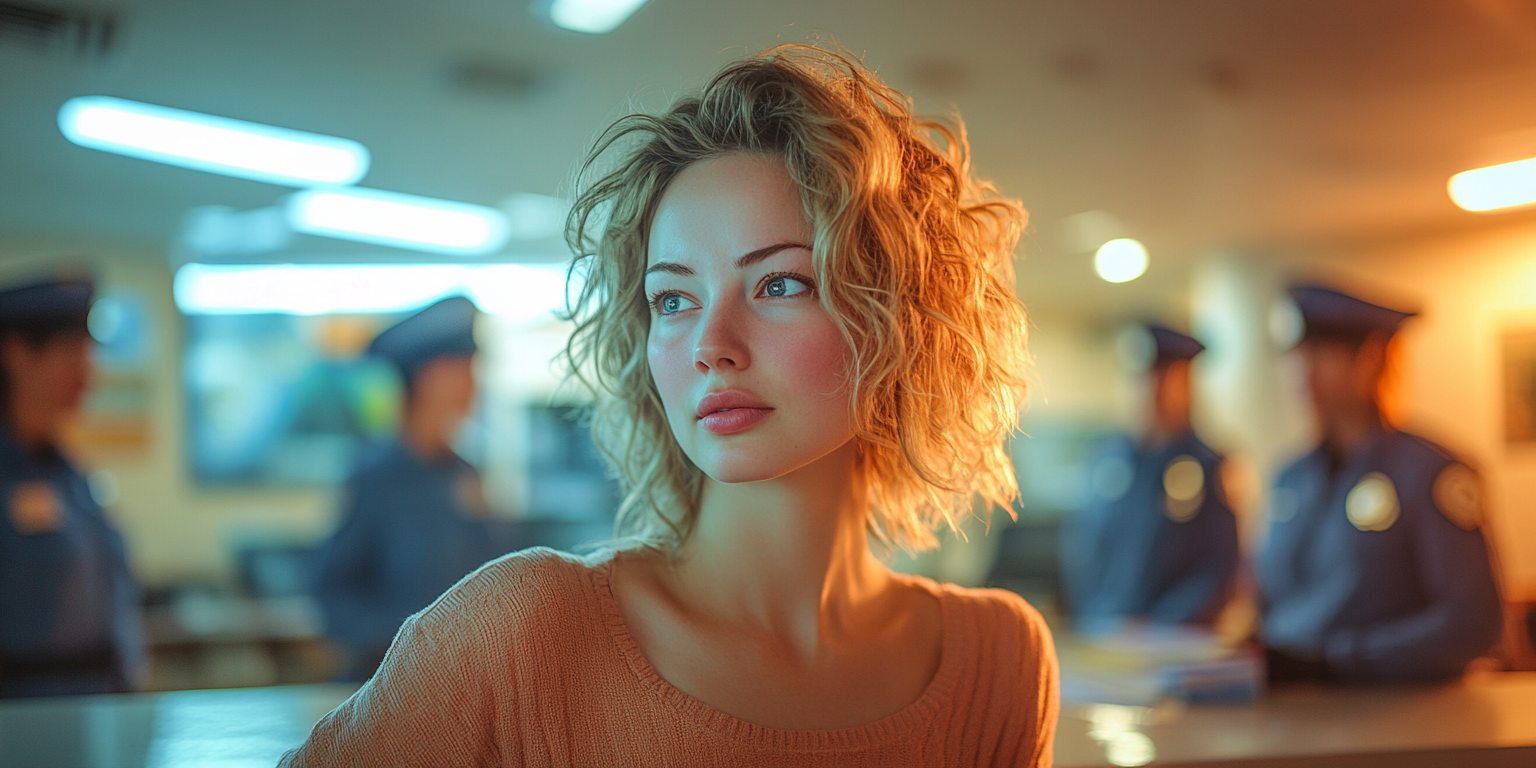
It is a kilometre and a half from her mother's gate to the police station, and Jenny sits in the car park unable to get out of the car. She rings her husband and mouths his voicemail along with him, word for word. Then she puts her body back together at the tinted glass, piece by piece, the way she has done it for four hundred girls in the wings — and the doors open before she is ready.
"I sat in that car park rehearsing how to tell them. Not one word of it survived the doors."
It was a kilometre and a half from my mother's gate to the police station in Liverpool Street, and I had never in my life wanted a longer drive.
Up Hampden Road and along Sandy Bay Road with the river going past on my right, flat and grey as an old knife. Through a city that had not bothered to get up. A man in a fluorescent vest hosing down the front of a café. Two women in running gear coming back up the hill with their breath going. The whole of Hobart drowsing under a lid of cloud with the mountain gone entirely and nothing left in the sky at all — and every last one of those people was going somewhere ordinary, and I sat at the lights at the bottom of Davey Street and hated them so much that it frightened me.
Because not one of them was driving to a police station to say it out loud.
My husband is missing.
I had said it to my mother down a telephone line and I had said it to my mother's face on her own verandah, and both times I had been given a chance to arrange it first. This was going to be different. There would be a counter, and there would be a form, and somebody would type it into a machine — and a number would come out, and my husband would go into a database in a room somewhere and become an entry, and there would be no getting him back out of it again.
I turned into Liverpool Street and the building came up on my left, and I slowed right down without meaning to and had to make myself put my foot back on.
It squatted there in the middle of all that lovely colonial sandstone like something that had come off the back of a truck. Grey concrete, tinted glass, four storeys of it, a set of automatic doors and a wheelchair ramp, and not one single thing about it built to make a human being feel welcome. I had driven past that building I do not know how many times in my life — coming out of a matinee, going down to the market, taking Sammy to the museum — and I had never once looked at it properly.
I pulled into the car park and put the car under a eucalypt in the far corner, as far away from those doors as it was possible to get without leaving.
And then I sat in it.
The engine ticked as it cooled. Leaves came down onto the windscreen, one and then another and then two more together, and I watched them land and did not put the wipers on.
My phone was on the passenger seat where I had dropped it, lying on that flat empty seat still pushed all the way back to the stop.
I picked it up and rang him.
And it did not ring. It had not rung once since Saturday afternoon and it did not ring then — no pause, no click, no line opening up somewhere out in the world — and after a second and a half he was in my ear.
"Hi. This is Nial Triffett. I'm busy at the moment, but if you—"
And I mouthed it along with him.
I did not decide to. I sat in a police station car park with my eyes shut and my lips moving and said my husband's voicemail message along with my husband, word for word and breath for breath, hitting every beat of it — because I had heard it fourteen times since the morning before and I knew it now the way I knew the opening of a second act, and I could have done the whole of it with the sound off.
Hi. This is Nial Triffett.
Two thousand and thirteen. Out on the deck of that dreadful flat in West Hobart with a beer in his hand and four takes and the giggles. And he never changed it. Five years, and he never changed it — and I had spent two days listening to a man giggling in 2013.
The beep went.
And I had it all ready. It had been sitting in my chest since the small hours and it was fully formed and it was enormous, and it went something like this. Where are you. Where are you. Why are you doing this to us. Sammy is not eating and he asked for you twice last night and I did the bear voice wrong. Buffy is gone and he says a man took her and I do not know what that means and nobody will help me. There are bruises coming up on our son's arms in shapes, and you have not asked. I am frightened, Nial. I have never been this frightened in my life and I need you to come home right now, this minute, and I will not ask you a single question, I swear before God I will not ask you one single question, just come home.
And what came out of me was nothing at all.
I sat in that car with the phone against my ear and the line running and I did not make a sound. I had left him eleven messages. Every one of them had been worse than the one before it, and every one of them was sitting inside a phone in a pocket somewhere, and I had come to the end of the things a woman can say into a machine.
The silence ran on, eating up the tape, and then I ended the call.
And then I threw the phone.
I put my whole arm into it. It went off the seat and off the door and came down somewhere in the footwell, and the noise of it in that small cold car was appalling — and I sat there with my hand still out and my chest going, and I had not known that I was going to do it until it was already done, and it was the only violent thing I had ever done in my life.
I put my head down on the wheel.
The leather was cold against my forehead and the whole car smelled of my husband, and above me, turning round and round on its little string, was a cardboard pine tree.
He bought that at a service station outside Sorell in about March. He held it up to me across the counter and told me, entirely seriously, that it smelled like being fourteen — like the tent that leaked, and his father's terrible coffee, and the trip they took every January until his father stopped — and he was so pleased with himself that I laughed at him and let him have it, and it had been hanging off that mirror ever since, going round and round in front of me every time I braked.
The booster seat in the back with the dinosaurs on it.
The registration sticker on the windscreen, stuck on crooked because Sammy had been helping.
The mark on the console where I put a coffee down badly, laughing, at something he had said that was not even funny.
The whole of my life was in that car, every last piece of it, and I sat with my head on the wheel in a police station car park and could not make myself get out.
When I lifted my head I caught myself in the mirror.
And the woman looking back at me was somebody I would have sent home. Her hair was everywhere. The shadows under her eyes had gone the colour of a bruise turning yellow. And there was something in her face — loose, and wide, and unmoored — that I had seen perhaps three times in my life, on seventeen-year-old girls doing Blanche in a school hall, going too far, going somewhere I could not get them back from.
This is not a performance.
I said it to myself, hard, in my own car, and I made myself sit up.
Except that it had begun to feel exactly like one, and I could not make it stop, and I could never afterwards make anybody understand that. Standing on my own verandah. Sitting in my own living room. Kneeling in my own sandpit. Some part of me kept waiting for somebody to call and hold it there — kept waiting for the lights to come up and Nial to walk out of the wings grinning, delighted with himself, delighted with every last one of us for having been taken in.
I have spent my whole working life teaching people how to make an audience forget that it is watching a play.
Nobody ever taught me what to do when it happened to me.
Through the windscreen I watched a young couple come out of those doors. She was crying. He had his arm right round her shoulders and they came down that ramp about an inch at a time, and they got into a car two rows over and sat in it and did not start it.
Everybody inside that building was carrying something. That was what I had not understood until I was sitting in the car park looking at it. It was a place people came to on a wet grey morning to hand over the worst thing that had ever happened to them — and there was a queue for it.
And I was about to go and join the queue.
I got my handbag up onto my knees and went through it.
Licence. Medicare card. The photograph of Nial from the barbecue in January, the most recent good one I had, in which he was laughing at somebody out of frame with a pair of tongs in his hand. The text message, still sitting at the bottom of the thread.
Evidence. Although of what, I could not have told anybody. Proof that we had been real, perhaps. Proof that there had been four of us in a house on the side of a mountain until Saturday morning, and that something had gone very badly wrong, and that I had not made a single part of it up.
And then it arrived.
It came into that car the way the cold came in, from underneath, all at once, and it got hold of me and would not let go, and I sat in a police station car park with my hands in my own handbag and could not breathe.
Langley wrote it down.
She had sat in my living room with her pen and I had told her that my husband and I had made love that morning, and she had written it down. And it had gone into a computer somewhere, and it was in there now — it was in there while I sat in that car — and it had my name on it, and I had put it there myself.
And I could not build on it and I could not take it back.
Because if I walked in through those doors and told the truth — that the marriage had been coming apart for a month, that he had been weighing every sentence he gave me since June, that I had lain awake at four o'clock in the morning listening to him agree to something in the dark — then I was a woman who had lied to the police about her own marriage on the very first night. And nothing I said afterwards would be worth the paper it went onto.
And if I did not tell them, then my husband had no reason on this earth to walk out. And a man with no reason to walk out does not walk out. And a man who does not walk out is a man who has left of his own accord for reasons his wife will not disclose — and they were straight back where they started, and I was straight back to being a woman with a text message from a husband who was coming home late.
I had done it to myself.
I had sat on the edge of my own armchair and given a girl of twenty-six exactly what she needed to close the file, and I had done it beautifully, and I had done it to protect him — and it had cost me the only thing I actually had, which was the truth.
Two days. I had been lying for two days, to everybody, without once deciding to.
And now I was going to have to walk in there and ask them to believe me.
My hand went to the door and stopped.
Because underneath all of it, running along beneath the fear of it like a wire, was the thing I could hardly bear to look at directly.
Hope.
Because they would help me. Surely to God they would help me. They had databases and phone records and cars and men who could walk a paddock in the dark, and I had a shopping pad with four names crossed off it. They would find him. Whatever it was that I had failed to see in that bathroom on the Saturday morning with my hand flat on his shoulder, they would see it. It was their job to see it.
And I thought about his face in that mirror, for what must have been the hundredth time. And I thought: if I had known, I would have held on. I would have put both arms round him and hung on and not let him go anywhere at all. I would have sat him down on the edge of the bath and made him tell me.
In a crisis, darling, we must act, not agonise.
My mother, in her own kitchen, with her coat already on and her keys in her hand and a car waiting outside in the rain.
I got out of the car.
The cold went straight through me. The eucalypt came down on my head in a shower of leaves and I brushed them out of my hair without looking at them, and I locked the car, and the horn gave a little chirp behind me that sounded obscenely cheerful.
Every step across that car park was longer than the one before it.
And at the doors I stopped.
The glass was tinted almost black and it gave me back to myself full length, and I stood in front of it in the cold with my handbag held in both hands and looked at what I had brought with me.
Small. That was what came back at me out of that glass. Small, and grey, and the wrong shape, and standing badly.
So I fixed it.
I did it the way I had done it four hundred times in the wings of a draughty hall in front of a shaking sixteen-year-old, and the way I had been doing it to myself since I was nineteen years old. Weight down through both feet. Shoulders back, and down, not up. Ribs lifted. Jaw off the chest. Breathe the whole way to the bottom of it and let it go slowly, and find the woman who could walk into a room full of strangers and make every last one of them look at her.
And she came. She always came.
I stood outside a police station in Liverpool Street putting my own body back together a piece at a time, and I got about three-quarters of the way through it, and my chin was coming up and the breath was going down, and I had almost — very nearly — got hold of the first sentence.
And then a man came out.
The sensors went. The doors opened for him and the warm air came out over me smelling of floor cleaner and photocopier and other people's fear, and he went past me with his phone up at his ear, saying something about a caravan.
And the doors stood open.
Not for me. They had not opened for me and they were not waiting for me. They were simply open, and there was a counter in there, and a queue, and a light going somewhere at the back of it.
I was not ready. I had another four bars.
I went in anyway.
